
Enclosure Movement In England beginning in 15 th16

Enclosure Movement • In England, beginning in 15 th-16 th centuries, landlords began reorganizing common lands – Changed the whole structure of farming village – Wealthy landlords fenced in common fields, claimed them as private property • Wool had become profitable industry, landlords converted common fields into sheep-raising fields – Increased wealth of landlords but further impoverished peasant communities – 1516 Thomas More wrote Utopia as a response to the landlords’ greed
On page 21 • How are the Agricultural Revolution, Scientific Revolution and the Catholic Church affected by each other?
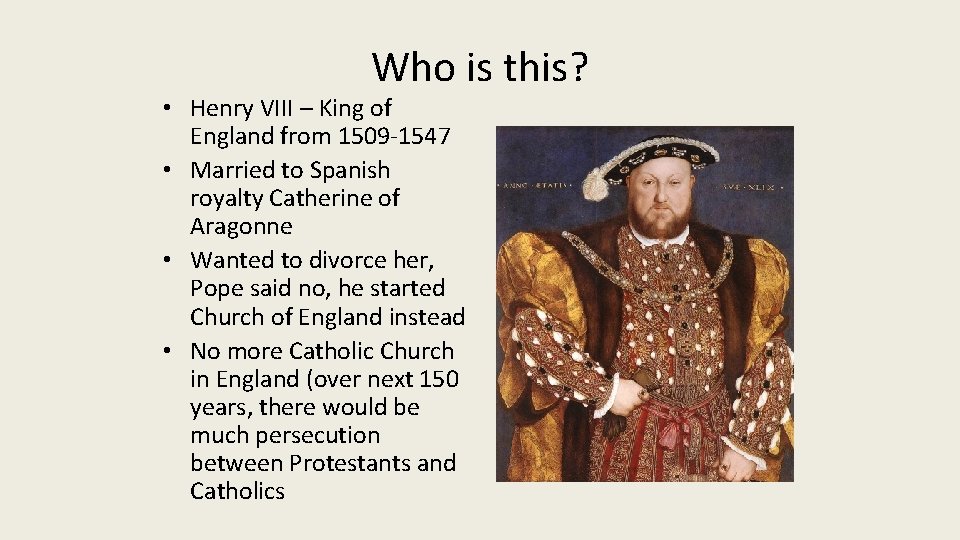
Who is this? • Henry VIII – King of England from 1509 -1547 • Married to Spanish royalty Catherine of Aragonne • Wanted to divorce her, Pope said no, he started Church of England instead • No more Catholic Church in England (over next 150 years, there would be much persecution between Protestants and Catholics
Now that the Church was out of England…. • What do we know was happening in Europe during the 1500’s? • Whom did you say was the most significant contributor to the Scientific Revolution? • Where was Isaac Newton born? ? – ENGLAND!! • What do we know was happening to the scientists in continental Europe (think: Galileo) • What conclusion can you come to based on this information?
Crop Rotation • Enclosure created “scientific farming” • Landlords now had unified control over the fields – Experiment new techniques to increase productivity • Farmers realized that by planting different types of crops, they didn’t need to leave land fallow • New crops = clover, alfalfa, pod-bearing plants (peas) and turnips – These crops didn’t deplete the soil the way grains did – New plants improved soil by giving off nitrogen and making soil more porous (water flowed through the soil, thus providing deeper watering for plants) – Improved soil = increased fertility of the fields
Other Discoveries • Jethro Tull, an English farmer, invented the seed drill – Implanted seeds into soil at constant intervals – Effect = amount of seed needed to sow a field was reduced by 80%, from 10 pounds an acre to 2 pounds an acre • New crops from the New World – Maize (corn) – yielded 20 x more seeds than avg grain – Potato – could grow anywhere, even poor soil • Planting clover, etc created healthier animals ⁼ ⁼ ⁼ more manure more fertilizer higher crop yields more food for livestock repeat • After centuries of high death rates from disease and starvation during famine, Europe’s population began to increase
Effects of Agricultural Revolution • Shifted balance of power – After EM, peasants and poor farmers lost their • Voice (in decision making) • Livelihood (had to become poor wage laborers) • Lived in shoddy structures, had too little to eat, drank too much and were susceptible to diseases (small pox) – Wealthy landlords gained: • • Sole control of the land Reaped huge profits from improved techniques Moved into cities, built factories, Built tremendous wealth and developed trade with mainland Europe and the colonies in America
• Ag rev occurred in England because enclosure movement was strong there – Idea of property rights and wage labor more wide spread than in France – By time of enclosure movement, England did not have land-bound peasantry because the feudal, manoral system evolved into land ownership and wage labor
Summary – Improved farming techniques increased the food supply and provided a safety net during famine – Under these prosperous conditions, England gained enough $$ to finance the Industrial Revolution
• Create a cartoon showing the changes the Agricultural Revolution brought to landowners and the poor • www. toondoo. com
- Slides: 11