
Encapsulation Controlled Release Background Information Version 032517 Overview

Encapsulation & Controlled Release Background Information Version 032517

Overview What is encapsulation? What is self-assembly and what are the forces behind it? What is micro and nanoencapsulation? What types of capsules can be made? Why is encapsulation important? How are sodium-alginate macrocapsules formed?

What is encapsulation? • Encapsulation, the process of enclosing something in a capsule, occurs naturally Example: the formation of liposomes via the process of self-assembly • Liposomes Are small, spherical vesicles made up of at least one lipid bilayer Diameter range: a few tens of nanometers to a few tens of micrometers • The Core May be various substances dependent upon the surrounding environment, liposome size, and other natural processes (ex: diffusion/osmosis) • The Shell May be a hydrophilic or hydrophobic membrane surrounding the core depending on surroundings Shell Core
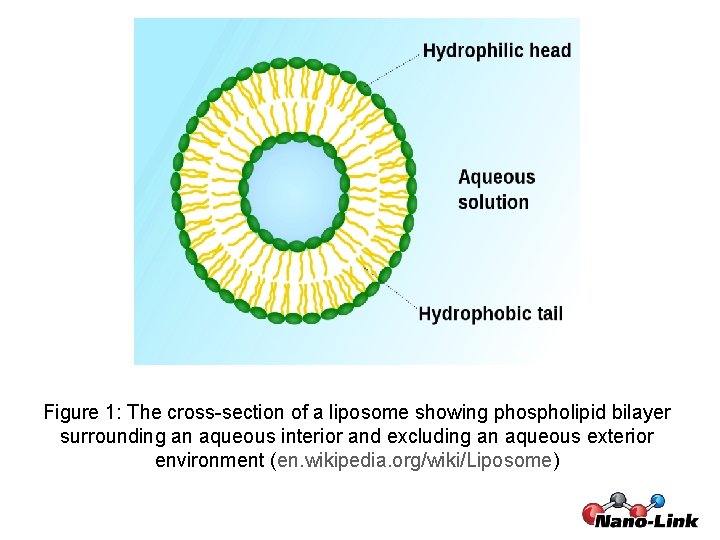
Figure 1: The cross-section of a liposome showing phospholipid bilayer surrounding an aqueous interior and excluding an aqueous exterior environment (en. wikipedia. org/wiki/Liposome)
What is self-assembly • Lipid bilayers are formed via self-assembly • Self-assembly • The formation of an organized structure within a disordered system due to various physical, chemical, electrical, and other environmental forces
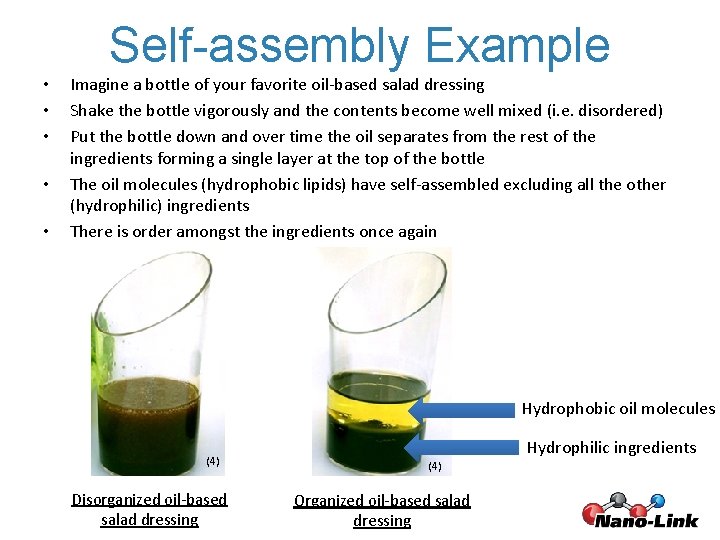
Self-assembly Example • • • Imagine a bottle of your favorite oil-based salad dressing Shake the bottle vigorously and the contents become well mixed (i. e. disordered) Put the bottle down and over time the oil separates from the rest of the ingredients forming a single layer at the top of the bottle The oil molecules (hydrophobic lipids) have self-assembled excluding all the other (hydrophilic) ingredients There is order amongst the ingredients once again Hydrophobic oil molecules (4) Disorganized oil-based salad dressing Hydrophilic ingredients (4) Organized oil-based salad dressing
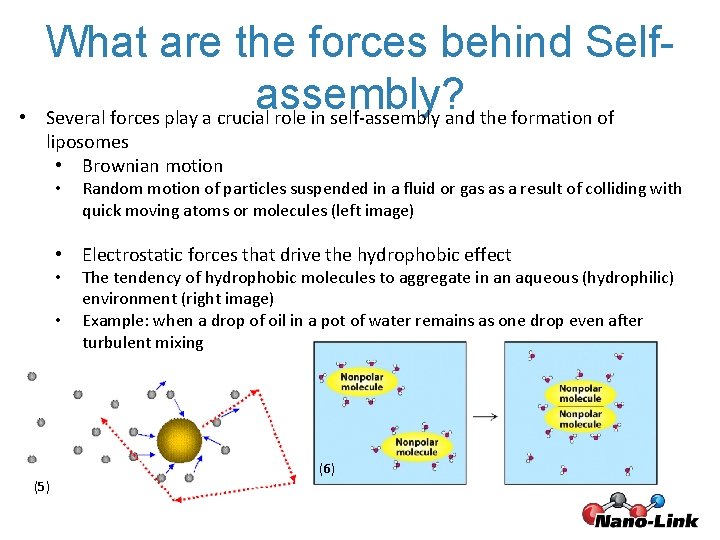
• What are the forces behind Selfassembly? Several forces play a crucial role in self-assembly and the formation of liposomes • Brownian motion • Random motion of particles suspended in a fluid or gas as a result of colliding with quick moving atoms or molecules (left image) • Electrostatic forces that drive the hydrophobic effect • • The tendency of hydrophobic molecules to aggregate in an aqueous (hydrophilic) environment (right image) Example: when a drop of oil in a pot of water remains as one drop even after turbulent mixing (6) (5)
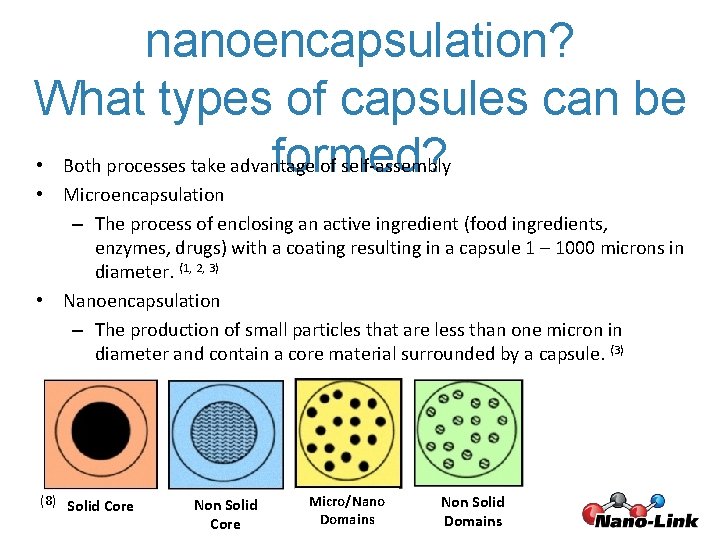
nanoencapsulation? What types of capsules can be • Both processes take advantage of self-assembly formed? • Microencapsulation – The process of enclosing an active ingredient (food ingredients, enzymes, drugs) with a coating resulting in a capsule 1 – 1000 microns in diameter. (1, 2, 3) • Nanoencapsulation – The production of small particles that are less than one micron in diameter and contain a core material surrounded by a capsule. (3) (8) Solid Core Non Solid Core Micro/Nano Domains Non Solid Domains

Why is encapsulation important? • Active ingredients are encapsulated for intended release • Encapsulation of a substance is important when it is necessary to – Entrap it within a shell (permanently or temporarily) – Extend its life and stability – Control its release under specific environmental conditions • p. H, salinity, temperature, etc. (7)
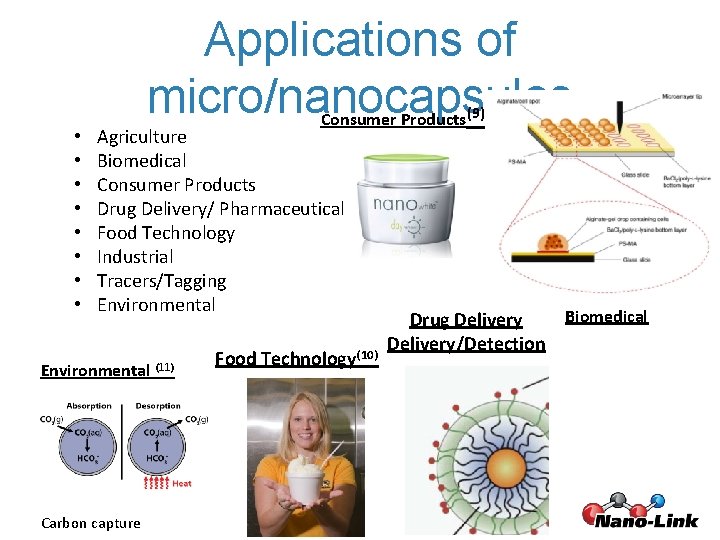
Applications of micro/nanocapsules • • Consumer Products(9) Agriculture Biomedical Consumer Products Drug Delivery/ Pharmaceutical Food Technology Industrial Tracers/Tagging Environmental Carbon capture (11) Food Technology(10) Biomedical Drug Delivery/Detection
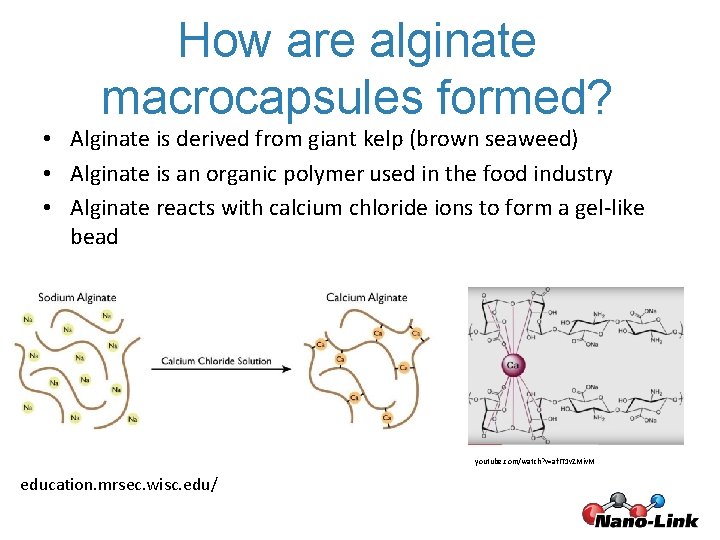
How are alginate macrocapsules formed? • Alginate is derived from giant kelp (brown seaweed) • Alginate is an organic polymer used in the food industry • Alginate reacts with calcium chloride ions to form a gel-like bead youtube. com/watch? v=af. IT 1 v. ZMiv. M education. mrsec. wisc. edu/
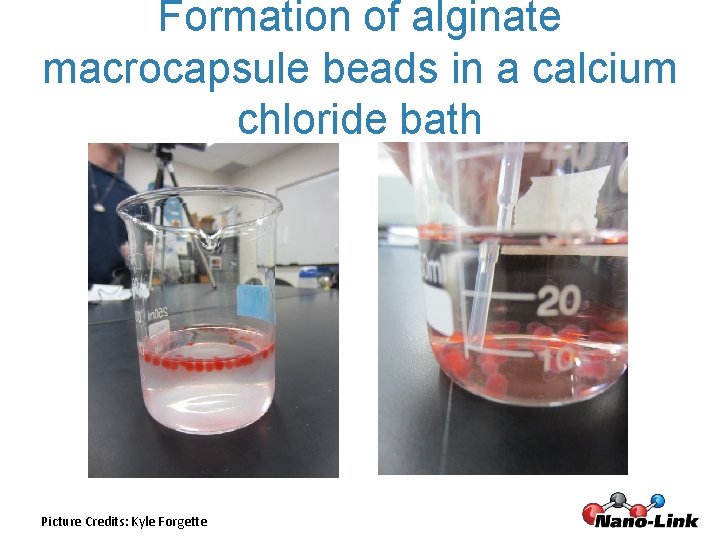
Formation of alginate macrocapsule beads in a calcium chloride bath Picture Credits: Kyle Forgette
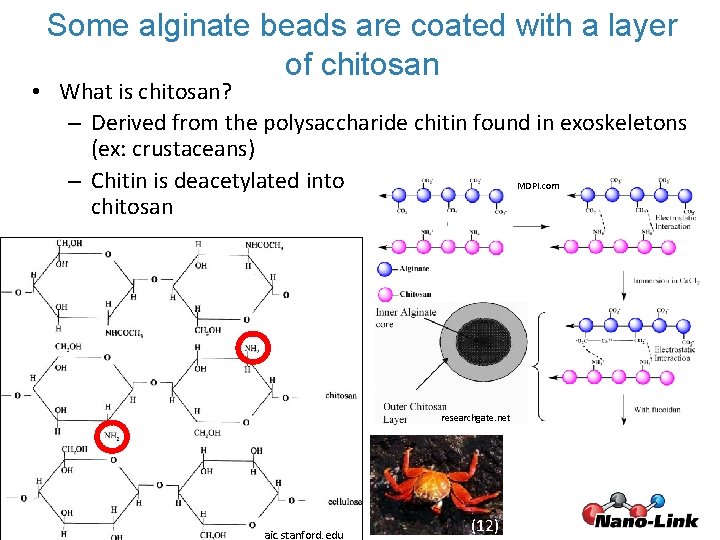
Some alginate beads are coated with a layer of chitosan • What is chitosan? – Derived from the polysaccharide chitin found in exoskeletons (ex: crustaceans) – Chitin is deacetylated into MDPI. com chitosan researchgate. net aic. stanford. edu (12)
References 1. 2. 3. 4. 5. 6. 7. 8. 9. 10. 11. 12. http: //www. academia. edu/16290403/A_SEMINAR_ON_MICROENCAPSULATION_FOR_CO RROSION_DETECTION_AND_CONTROL_WRITTEN_BY_ENWENYEOKWU_GENESIS_NNEJI file: ///C: /Users/jq 6246 vh/Downloads/50406777 -MIT. pdf http: //site. thebiotransportlab. com/what. Is. Microencapsulation. htm http: //www. sciencefriday. com/educational-resources/salad-dressing-science-emulsions/ http: //webspace. clarkson. edu/projects/crcd/me 537/notes/aerosols_page 19. ht ml http: //oregonstate. edu/instruct/bb 450/450 material/lecture/introductionoutline. html http: //pubs. rsc. org/-/content/articlelanding/2015/ra/c 5 ra 01629 k#!div. Abstract https: //www. slideshare. net/srinivasnaik 52643/controlled-release-formulations-as-asmart-delivery-system-for-eco-friendly-pesticides-ssnaik-tnau http: //www. nanowhite. com. my/index 2. html http: //munews. missouri. edu/news-releases/2011/0909 -the-next-generation-of-ice-creamone-bite-two-flavors/ http: //www. nature. com/articles/ncomms 7124 arthropods-grade 7. wikispaces. com/Crustaceans
- Slides: 14