
Enabling SOA Implementation with an Integrated Process Technology
Enabling SOA Implementation with an Integrated Process & Technology Framework George Brown, Program Manager IT Research, Intel Corporation Michael Goul, Professor Arizona State University Jason Nichols, Mark Keith, Haluk Demirkan Arizona State University Slide 1
Operational Definition of Value Chain = A network of highly structured organizational processes and partners to create, produce, and deliver a product or service satisfying customer and market demands. Companies are producing a constantly changing mix of increasingly complex products, while global competition demands ever shorter cycle times and shorter product life cycles. Market conditions and requirements change every day. This results in frequent new product introductions and constant adjustment of the value proposition of all products in the portfolio. Value Chain responsiveness becomes a primary differentiator. Slide 2
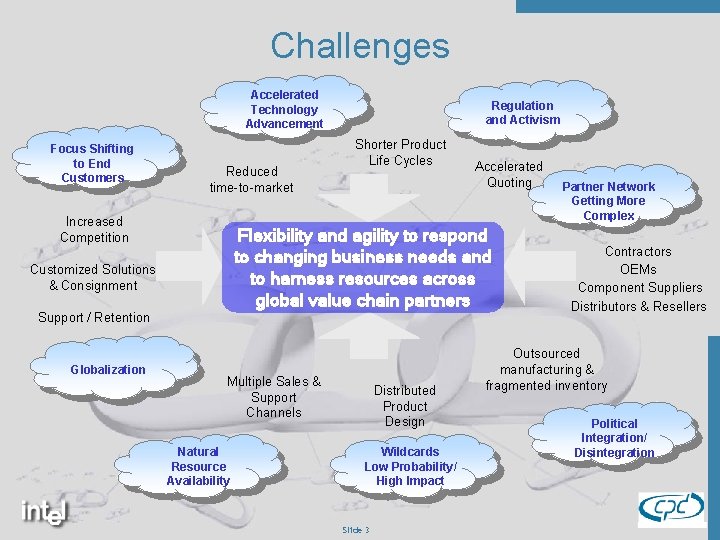
Challenges Accelerated Technology Advancement Focus Shifting to End Customers Reduced time-to-market Increased Competition Regulation and Activism Shorter Product Life Cycles Flexibility and agility to respond to changing business needs and to harness resources across global value chain partners Customized Solutions & Consignment Support / Retention Globalization Accelerated Quoting Multiple Sales & Support Channels Natural Resource Availability Distributed Product Design Wildcards Low Probability/ High Impact Slide 3 Partner Network Getting More Complex Contractors OEMs Component Suppliers Distributors & Resellers Outsourced manufacturing & fragmented inventory Political Integration/ Disintegration
The Pressing Need • Companies are producing a constantly changing mix of increasingly complex products, while global competition demands ever shorter cycle times and shorter product life cycles • Market conditions and requirements change every day. This results in constant adjustment of the value chains of all products in the portfolio Value chain responsiveness becomes a primary differentiator Slide 4
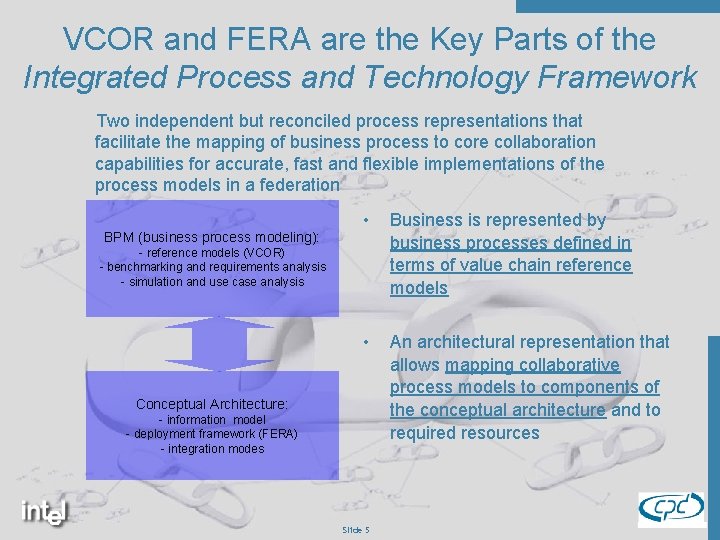
VCOR and FERA are the Key Parts of the Integrated Process and Technology Framework Two independent but reconciled process representations that facilitate the mapping of business process to core collaboration capabilities for accurate, fast and flexible implementations of the process models in a federation BPM (business process modeling): • Business is represented by business processes defined in terms of value chain reference models • An architectural representation that allows mapping collaborative process models to components of the conceptual architecture and to required resources - reference models (VCOR) - benchmarking and requirements analysis - simulation and use case analysis Conceptual Architecture: - information model - deployment framework (FERA) - integration modes Slide 5
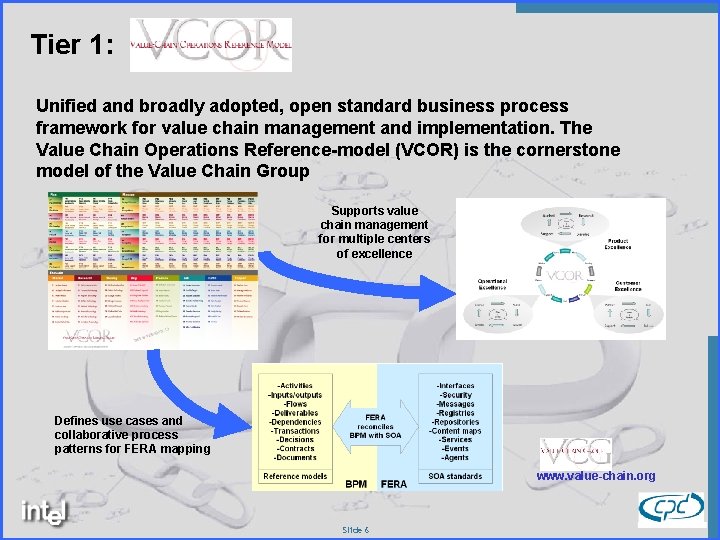
Tier 1: Unified and broadly adopted, open standard business process framework for value chain management and implementation. The Value Chain Operations Reference-model (VCOR) is the cornerstone model of the Value Chain Group Supports value chain management for multiple centers of excellence Defines use cases and collaborative process patterns for FERA mapping www. value-chain. org Slide 6
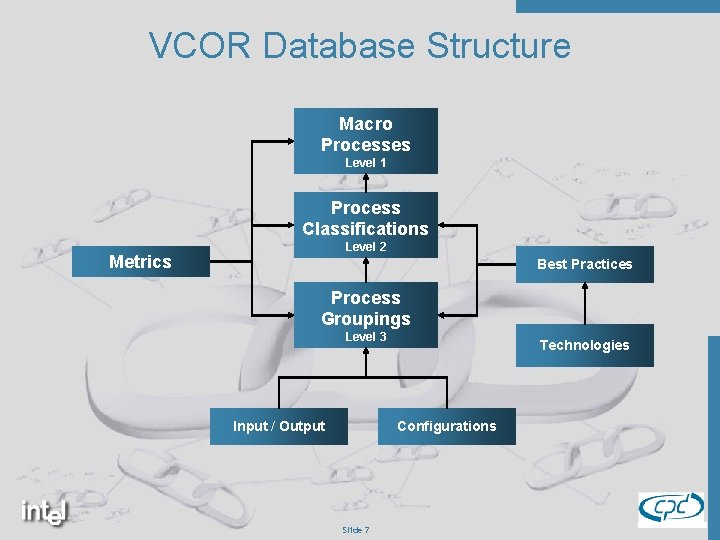
VCOR Database Structure Macro Processes Level 1 Process Classifications Level 2 Metrics Best Practices Process Groupings Level 3 Input / Output Technologies Configurations Slide 7
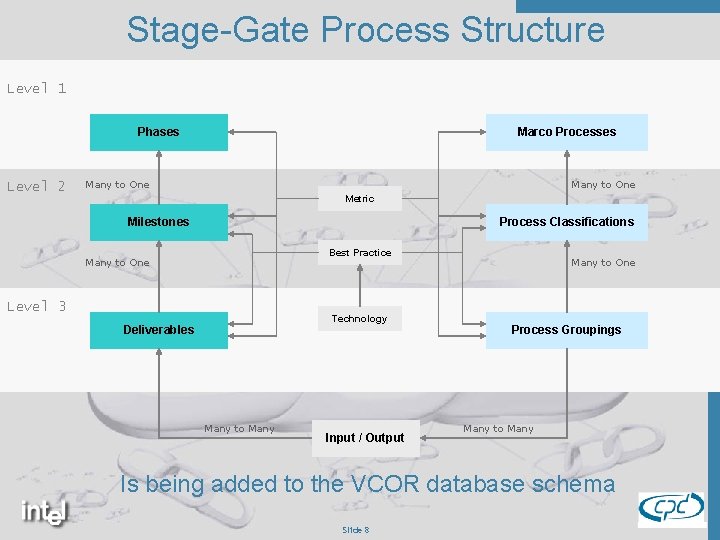
Stage-Gate Process Structure Level 1 Phases Level 2 Marco Processes Many to One Metric Milestones Process Classifications Best Practice Many to One Level 3 Technology Deliverables Many to Many Input / Output Many to One Process Groupings Many to Many Is being added to the VCOR database schema Slide 8
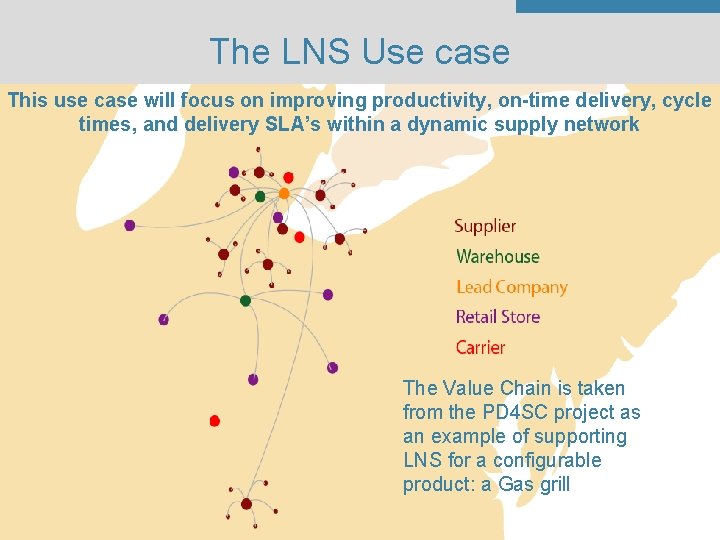
The LNS Use case This use case will focus on improving productivity, on-time delivery, cycle times, and delivery SLA’s within a dynamic supply network The Value Chain is taken from the PD 4 SC project as an example of supporting LNS for a configurable product: a Gas grill Slide 9
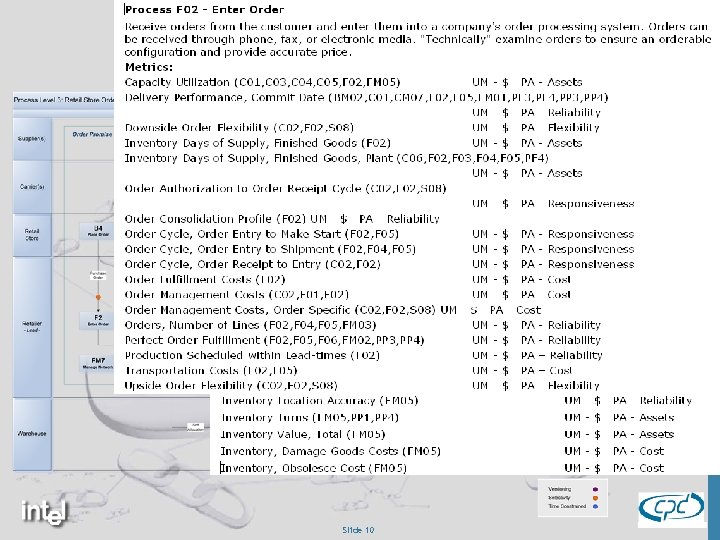
Level 3 Flow in VCOR Slide 10
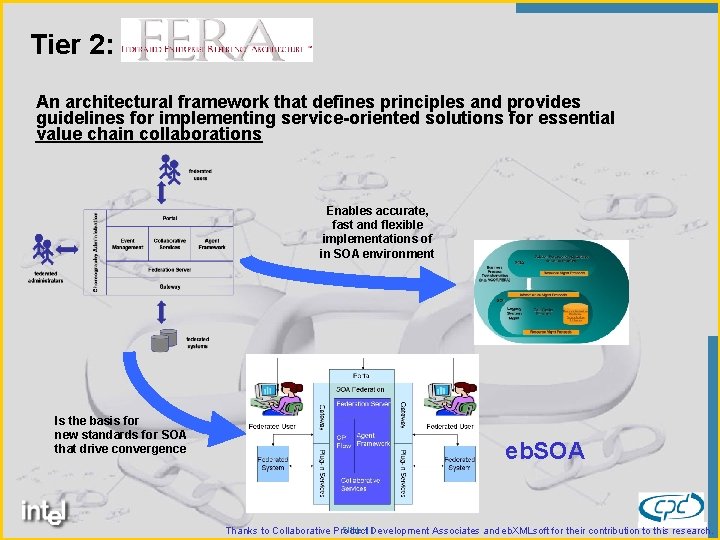
Tier 2: An architectural framework that defines principles and provides guidelines for implementing service-oriented solutions for essential value chain collaborations Enables accurate, fast and flexible implementations of in SOA environment Is the basis for new standards for SOA that drive convergence eb. SOA Slide 11 Thanks to Collaborative Product Development Associates and eb. XMLsoft for their contribution to this research.
Collaborative Semantics • Business semantics – Using terminology applicable to describing process flows in practice – Has to be widely applicable (sequential transactions as well as iterative decision based flows) • Technology semantics – Complete set of instructions for run-time execution – Component functions and interfaces definition • eb. SOA IM and eb. SOA semantics is a FERA based standard proposal to OASIS Slide 12
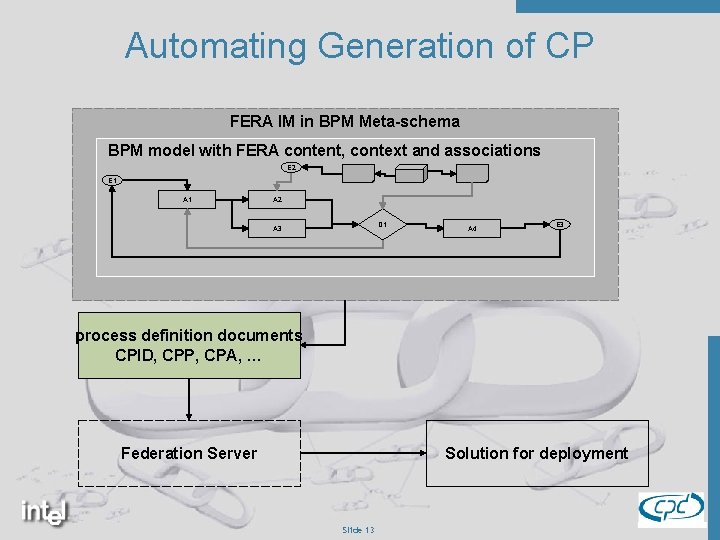
Automating Generation of CP FERA IM in BPM Meta-schema BPM model with FERA content, context and associations E 2 E 1 A 2 D 1 A 3 A 4 E 3 process definition documents CPID, CPP, CPA, … Federation Server Solution for deployment Slide 13
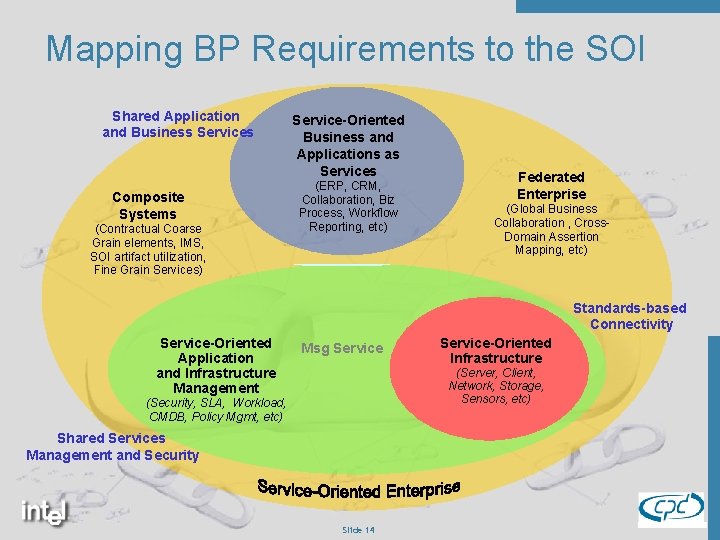
Mapping BP Requirements to the SOI Shared Application and Business Services Composite Systems (Contractual Coarse Grain elements, IMS, SOI artifact utilization, Fine Grain Services) Service-Oriented Business and Applications as Services (ERP, CRM, Collaboration, Biz Process, Workflow Reporting, etc) Federated Enterprise (Global Business Collaboration , Cross. Domain Assertion Mapping, etc) Standards-based Connectivity Service-Oriented Application and Infrastructure Management Msg Service-Oriented Infrastructure (Server, Client, Network, Storage, Sensors, etc) (Security, SLA, Workload, CMDB, Policy Mgmt, etc) Shared Services Management and Security Slide 14
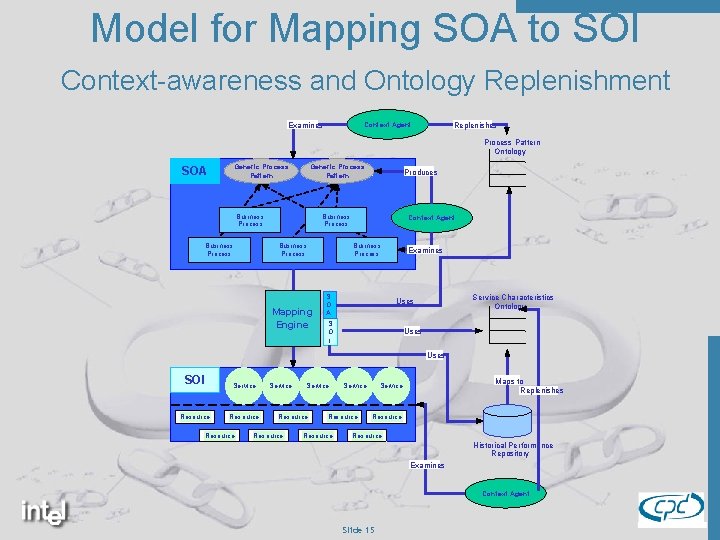
Model for Mapping SOA to SOI Context-awareness and Ontology Replenishment Context Agent Examines Replenishes Process Pattern Ontology Generic Process Pattern SOA Generic Process Pattern Business Process Produces Business Process Mapping Engine Context Agent Business Process S O A S O I Examines Service Characteristics Ontology Uses SOI Service Resource Service Resource Maps to Replenishes Service Resource Historical Performance Repository Examines Context Agent Slide 15
- Slides: 15