
Enabling High Performance Bulk Data Transfers With SSH
Enabling High Performance Bulk Data Transfers With SSH Chris Rapier Benjamin Bennett Pittsburgh Supercomputing Center TIP ‘ 08 Chris Rapier, Benjamin Bennett Pittsburgh Supercomputing Center HPN-SSH TIP’ 08
Moving Data • Still crazy after all these years – Multiple solutions exist • Protocols – UDT, SABUL, etc… • Implementations – Grid. FTP, k. FTP, bb. FTP, hand rolled and more… • Not to mention – Advanced congestion control, autotuning, jumbograms, etc… Chris Rapier, Benjamin Bennett Pittsburgh Supercomputing Center HPN-SSH TIP’ 08
Many Solutions No Answers • All developed as a solution to the same problem – Moving lots of a data very fast can be very difficult • Unfortunately, no single solution meets all needs. – Fast, easy to use, inexpensive to maintain, flexible, secure Chris Rapier, Benjamin Bennett Pittsburgh Supercomputing Center HPN-SSH TIP’ 08
What About SSH? • • • Easy to use. Cheap to maintain. Installed everywhere. Flexible. Strong cryptography. Chris Rapier, Benjamin Bennett Pittsburgh Supercomputing Center HPN-SSH TIP’ 08
Why not SSH? • It can be really slow. Chris Rapier, Benjamin Bennett Pittsburgh Supercomputing Center HPN-SSH TIP’ 08

How slow? Chris Rapier, Benjamin Bennett Pittsburgh Supercomputing Center HPN-SSH TIP’ 08

A little better Chris Rapier, Benjamin Bennett Pittsburgh Supercomputing Center HPN-SSH TIP’ 08
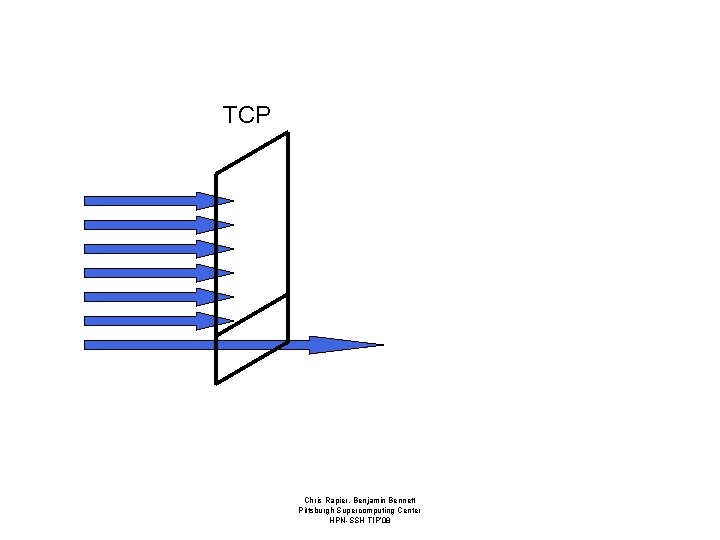
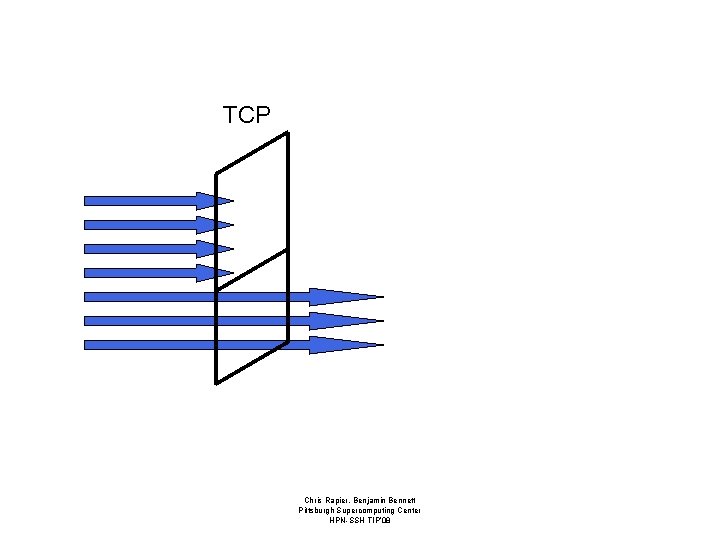
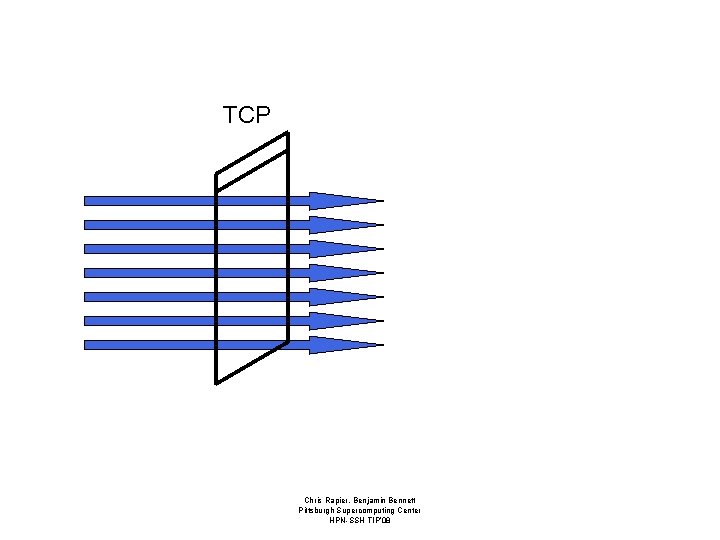
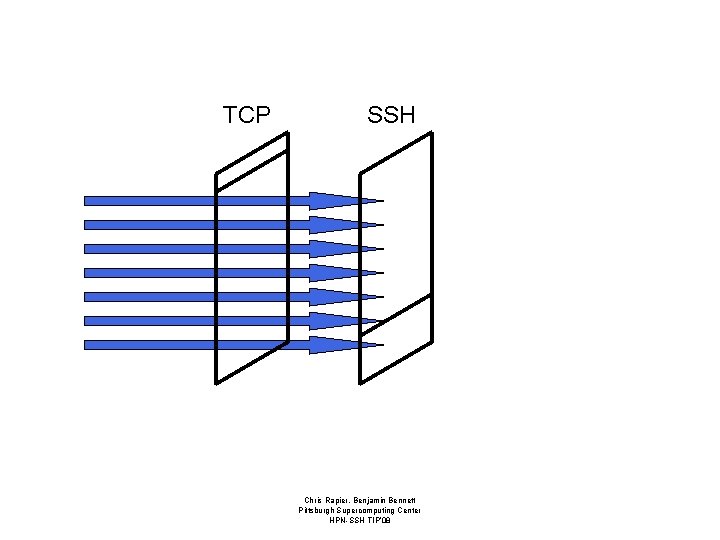
What changed? • Why the improvement in Open. SSH 4. 7? – SSH is a multiplexed application • Each channel requires its own flow control which is implemented as a receive window – In 4. 7 the maximum window size was increased to ~1 Mi. B up from 64 Ki. B Chris Rapier, Benjamin Bennett Pittsburgh Supercomputing Center HPN-SSH TIP’ 08
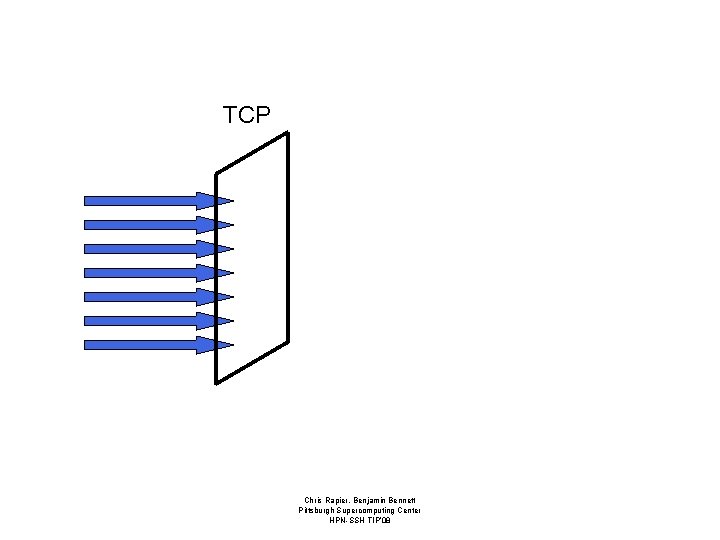
Windows • Receive windows advertise the amount of data a system or application is willing to accept per round trip time. • Effective window size is the minimum of all windows; protocol and application. • Each window must be tuned and in sync to maximize throughput. – If any one is out of tune the entire connection will suffer. Chris Rapier, Benjamin Bennett Pittsburgh Supercomputing Center HPN-SSH TIP’ 08
TCP Chris Rapier, Benjamin Bennett Pittsburgh Supercomputing Center HPN-SSH TIP’ 08
TCP Chris Rapier, Benjamin Bennett Pittsburgh Supercomputing Center HPN-SSH TIP’ 08
TCP Chris Rapier, Benjamin Bennett Pittsburgh Supercomputing Center HPN-SSH TIP’ 08
TCP Chris Rapier, Benjamin Bennett Pittsburgh Supercomputing Center HPN-SSH TIP’ 08
TCP SSH Chris Rapier, Benjamin Bennett Pittsburgh Supercomputing Center HPN-SSH TIP’ 08
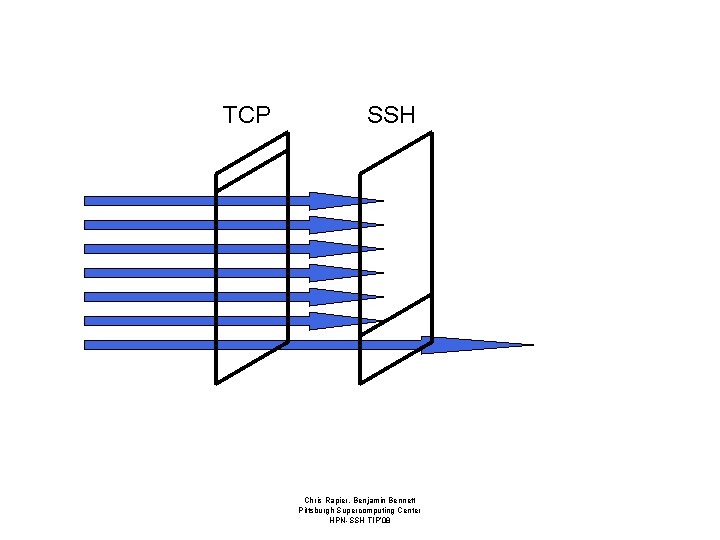
TCP SSH Chris Rapier, Benjamin Bennett Pittsburgh Supercomputing Center HPN-SSH TIP’ 08
Windows in HPN-SSH • Dynamically defined receive window size grows to match the TCP window. – Set to TCP RWIN on start. – Grows with RWIN if autotuning system. – Dynamic sizing reduces issues of overbuffering problems. Chris Rapier, Benjamin Bennett Pittsburgh Supercomputing Center HPN-SSH TIP’ 08
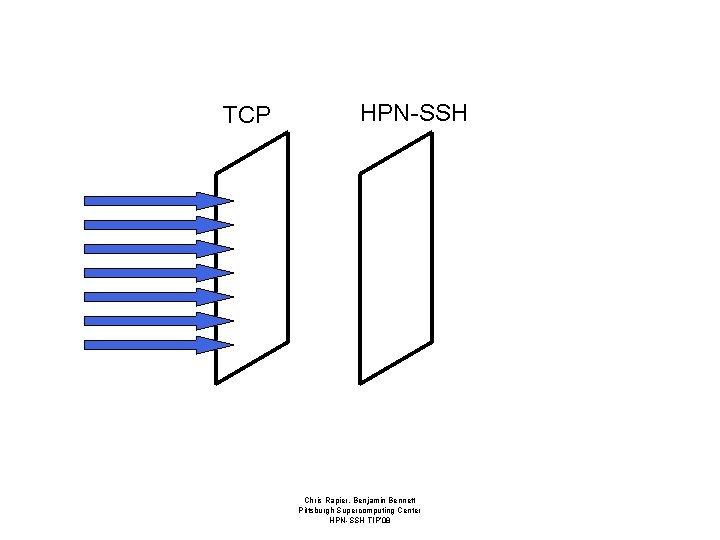
TCP HPN-SSH Chris Rapier, Benjamin Bennett Pittsburgh Supercomputing Center HPN-SSH TIP’ 08
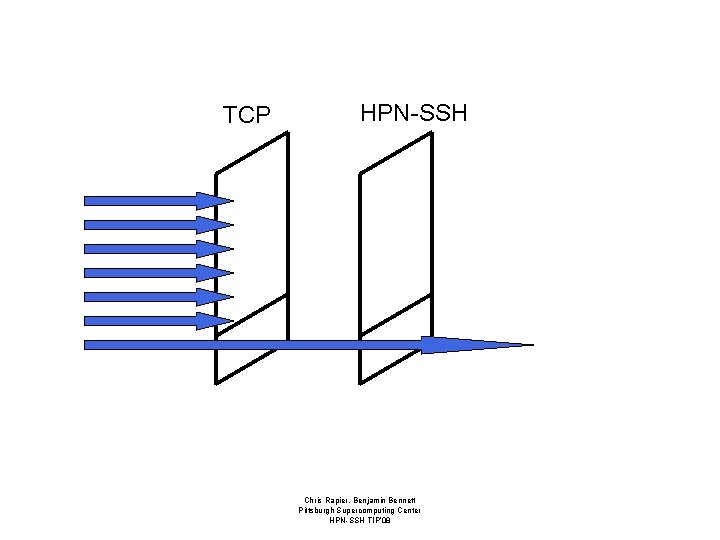
TCP HPN-SSH Chris Rapier, Benjamin Bennett Pittsburgh Supercomputing Center HPN-SSH TIP’ 08
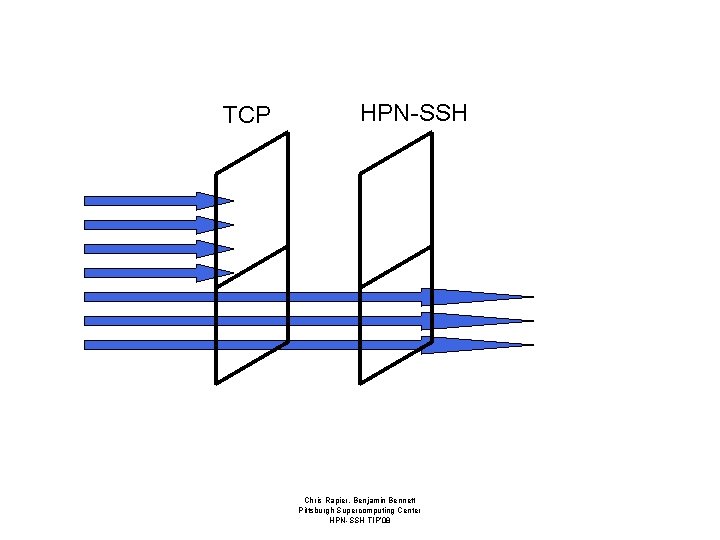
TCP HPN-SSH Chris Rapier, Benjamin Bennett Pittsburgh Supercomputing Center HPN-SSH TIP’ 08
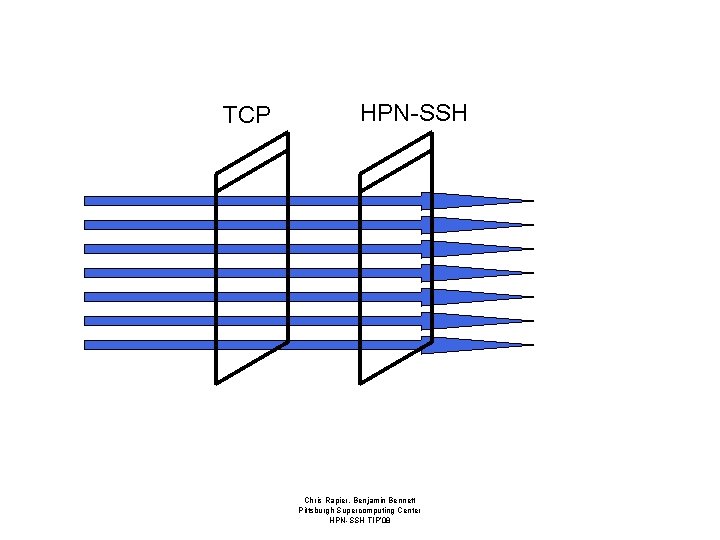
TCP HPN-SSH Chris Rapier, Benjamin Bennett Pittsburgh Supercomputing Center HPN-SSH TIP’ 08
SFTP is Special • SFTP adds *another* layer of flow control. – All SFTP packets are treated as requests – By default no more than 16 outstanding requests. – Results in a 512 Ki. B window – Increase using -R on command line Chris Rapier, Benjamin Bennett Pittsburgh Supercomputing Center HPN-SSH TIP’ 08
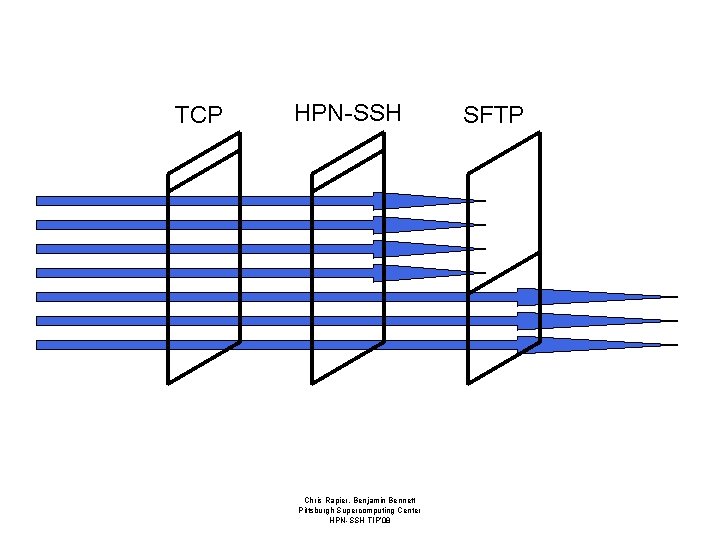
TCP HPN-SSH Chris Rapier, Benjamin Bennett Pittsburgh Supercomputing Center HPN-SSH TIP’ 08 SFTP

A lot better Chris Rapier, Benjamin Bennett Pittsburgh Supercomputing Center HPN-SSH TIP’ 08
But… • As the throughput increases crypto demands more of the processor. – The transfer is now processor bound Chris Rapier, Benjamin Bennett Pittsburgh Supercomputing Center HPN-SSH TIP’ 08
We Need More Power? • Two solutions to processor bound transfers – Throw more processing power at the problem – Do the work more efficiently • Define ‘work’ Chris Rapier, Benjamin Bennett Pittsburgh Supercomputing Center HPN-SSH TIP’ 08
The None Switch • Many people only need secure authentication. The data can pass in the clear. – HPN-SSH allows users to switch to a ‘None’ cipher after authentication. Chris Rapier, Benjamin Bennett Pittsburgh Supercomputing Center HPN-SSH TIP’ 08

Done! Chris Rapier, Benjamin Bennett Pittsburgh Supercomputing Center HPN-SSH TIP’ 08
As far as we can go? • Windows are already optimized. – No more real improvements available there • NONE cipher is limited to a subset of transfers. – Sometimes you absolutely need full encryption. • So what now? Chris Rapier, Benjamin Bennett Pittsburgh Supercomputing Center HPN-SSH TIP’ 08

More Power • Common assumption that current hardware is incapable of meeting crypto demand – Is it true? Chris Rapier, Benjamin Bennett Pittsburgh Supercomputing Center HPN-SSH TIP’ 08
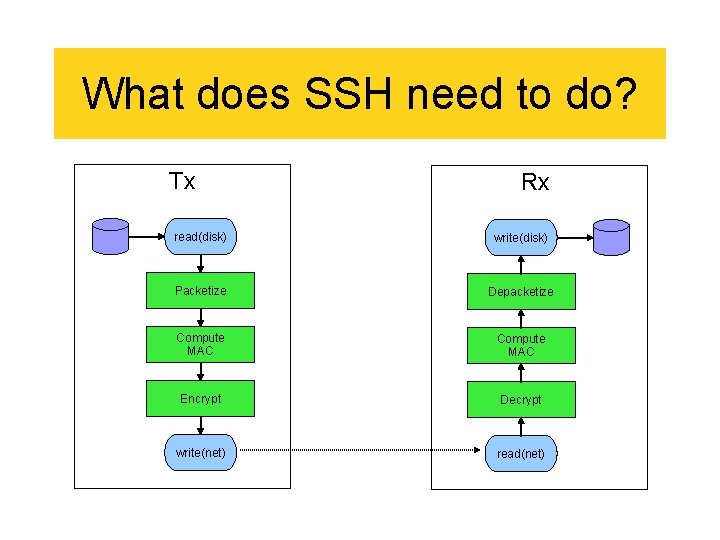
What does SSH need to do? Tx Rx read(disk) write(disk) Packetize Depacketize Compute MAC Encrypt Decrypt write(net) read(net)
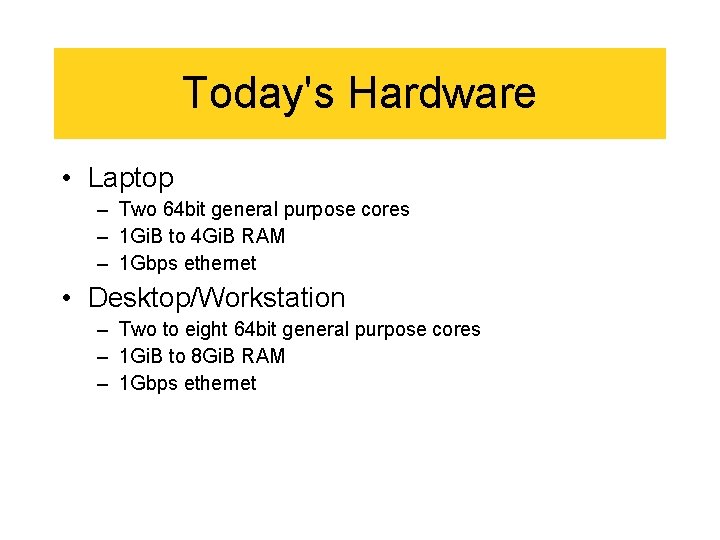
Today's Hardware • Laptop – Two 64 bit general purpose cores – 1 Gi. B to 4 Gi. B RAM – 1 Gbps ethernet • Desktop/Workstation – Two to eight 64 bit general purpose cores – 1 Gi. B to 8 Gi. B RAM – 1 Gbps ethernet
Open. SSL Benchmarks • Dual Intel Xeon 5345 Workstation – 4 cores per socket, 8 cores total @ 2. 33 Ghz – Fedora 7 stock Open. SSL build
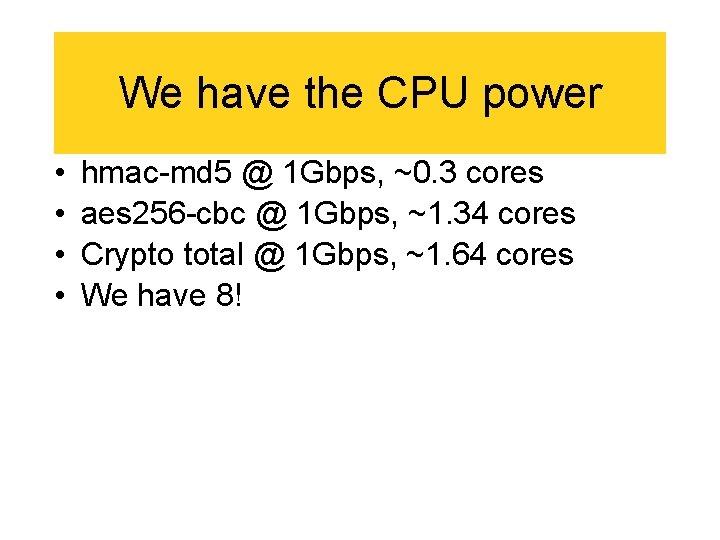
We have the CPU power • • hmac-md 5 @ 1 Gbps, ~0. 3 cores aes 256 -cbc @ 1 Gbps, ~1. 34 cores Crypto total @ 1 Gbps, ~1. 64 cores We have 8!
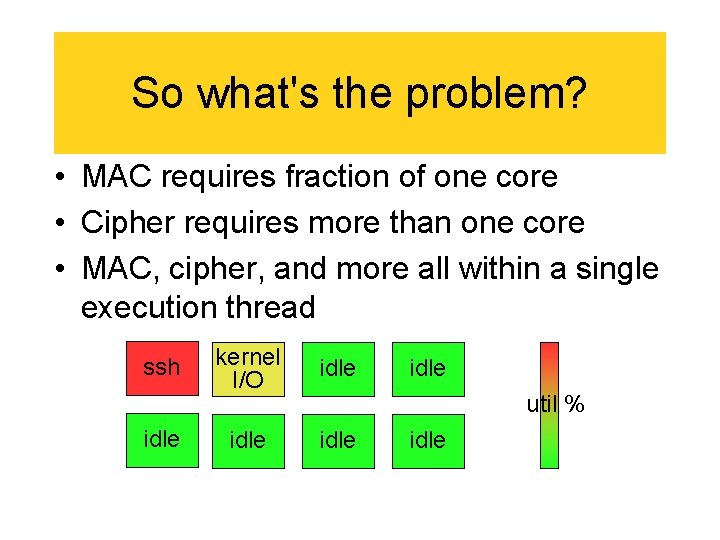
So what's the problem? • MAC requires fraction of one core • Cipher requires more than one core • MAC, cipher, and more all within a single execution thread ssh idle kernel I/O idle util % idle
How can we fix it? • Multi-threading on functional boundaries – Perform MAC and cipher on a packet concurrently • Possible on sender, not on receiver – Process multiple packets concurrently (pipeline) – Cipher still needs more than one core • Multi-threading within cipher – Can it be parallelized?
SSH Cipher Modes • CBC – Most common – RFC 4253 “The Secure Shell (SSH) Transport Layer Protocol” specifies only CBC mode ciphers, arcfour, and none. • CTR – Specified in RFC 4344 “SSH Transport Layer Encryption Modes” – More desirable security properties than CBC Chris Rapier, Benjamin Bennett Pittsburgh Supercomputing Center HPN-SSH TIP’ 08
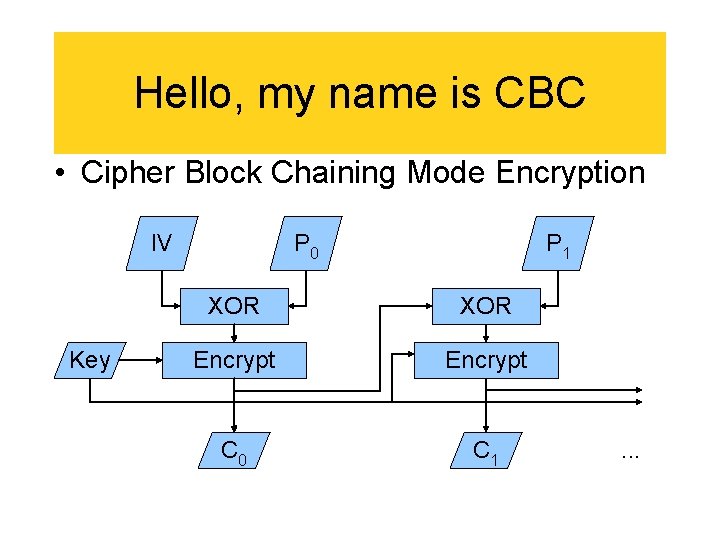
Hello, my name is CBC • Cipher Block Chaining Mode Encryption IV Key P 0 P 1 XOR Encrypt C 0 C 1 . . .
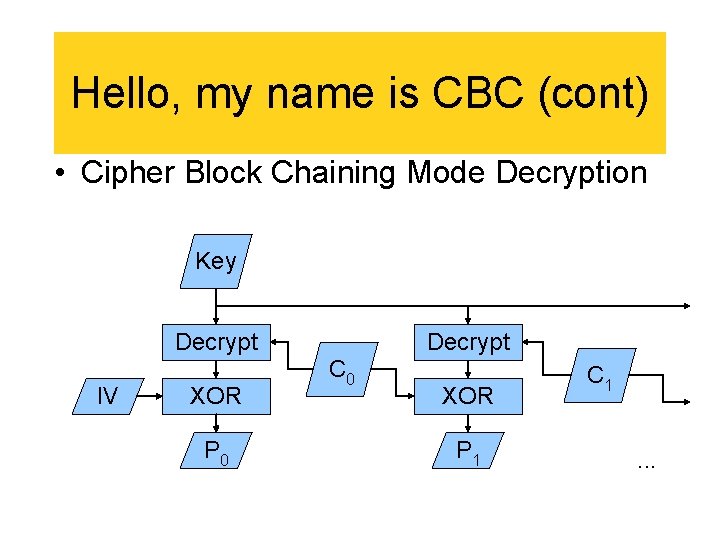
Hello, my name is CBC (cont) • Cipher Block Chaining Mode Decryption Key Decrypt IV XOR P 0 Decrypt C 0 XOR P 1 C 1. . .
CBC Summary • Encrypt must be serial • Decrypt may be parallel • That doesn't help so much : -(
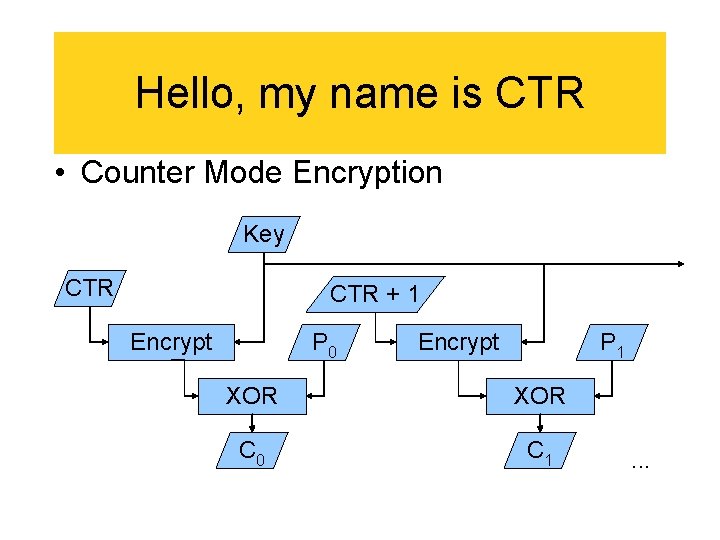
Hello, my name is CTR • Counter Mode Encryption Key CTR + 1 Encrypt P 0 Encrypt P 1 XOR C 0 C 1 . . .
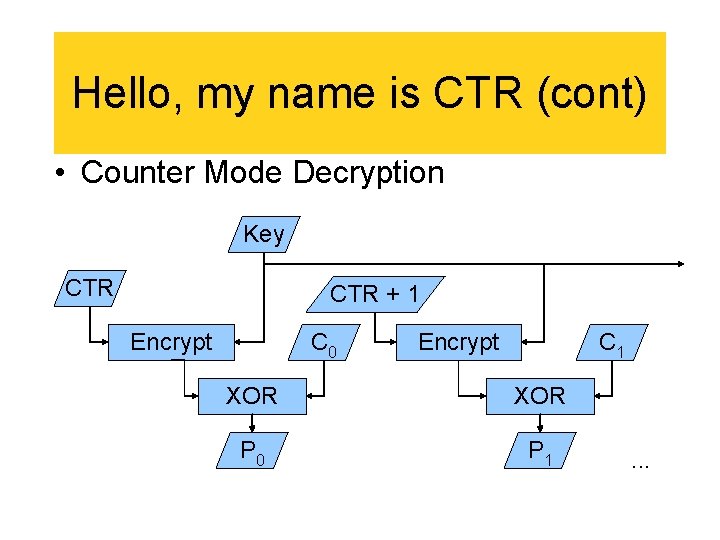
Hello, my name is CTR (cont) • Counter Mode Decryption Key CTR + 1 Encrypt C 0 Encrypt C 1 XOR P 0 P 1 . . .
CTR Summary • • Encrypt may be parallel Decrypt may be parallel Keystream can be pregenerated Let’s get to work…
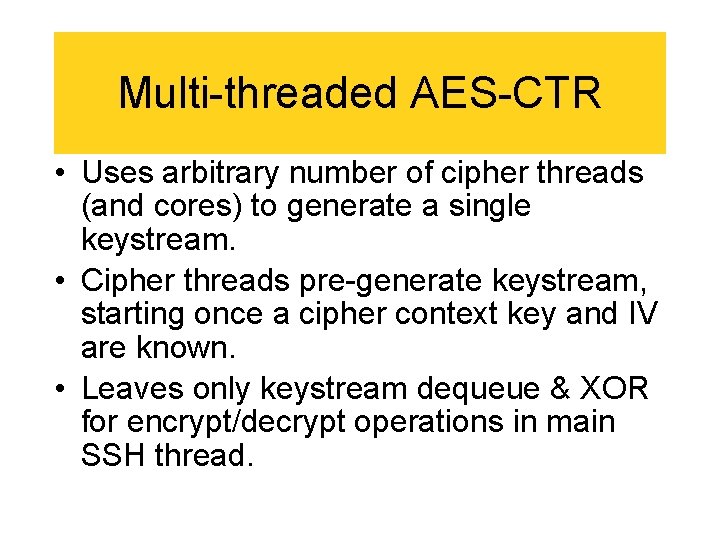
Multi-threaded AES-CTR • Uses arbitrary number of cipher threads (and cores) to generate a single keystream. • Cipher threads pre-generate keystream, starting once a cipher context key and IV are known. • Leaves only keystream dequeue & XOR for encrypt/decrypt operations in main SSH thread.
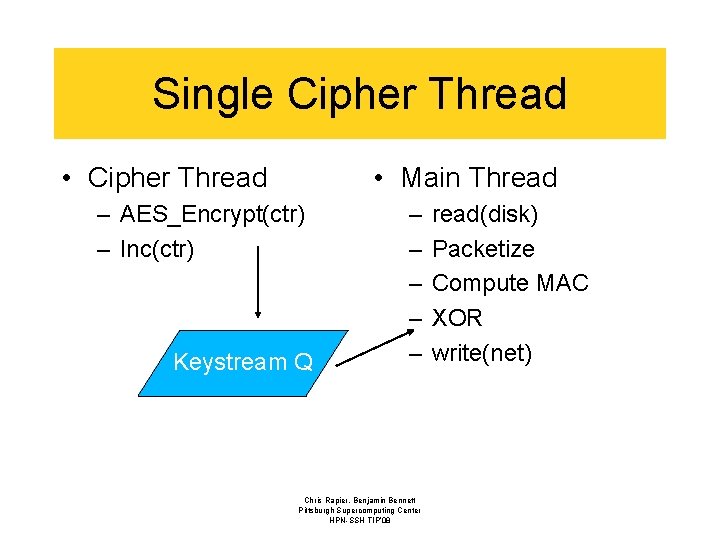
Single Cipher Thread • Cipher Thread • Main Thread – AES_Encrypt(ctr) – Inc(ctr) Keystream Q – – – Chris Rapier, Benjamin Bennett Pittsburgh Supercomputing Center HPN-SSH TIP’ 08 read(disk) Packetize Compute MAC XOR write(net)
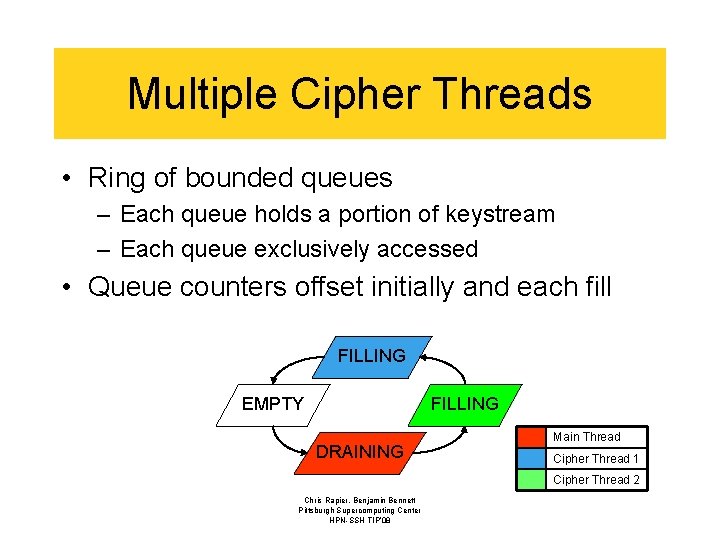
Multiple Cipher Threads • Ring of bounded queues – Each queue holds a portion of keystream – Each queue exclusively accessed • Queue counters offset initially and each fill FILLING EMPTY FILLING DRAINING Main Thread Cipher Thread 1 Cipher Thread 2 Chris Rapier, Benjamin Bennett Pittsburgh Supercomputing Center HPN-SSH TIP’ 08
M-T AES-CTR Results Chris Rapier, Benjamin Bennett Pittsburgh Supercomputing Center HPN-SSH TIP’ 08
Conclusion • SSH designed for security – HPN-SSH is performance enhancements to the most common SSH implementation, Open. SSH • High throughput with high latency – Kernel auto-tuning adjusts TCP flow contol – HPN-SSH Recv. Buffer. Polling adjusts SSH flow control • High throughput with any latency – HPN-SSH None cipher for non-private data – HPN-SSH Multi-threaded AES-CTR cipher Chris Rapier, Benjamin Bennett Pittsburgh Supercomputing Center HPN-SSH TIP’ 08
Future Work • Approaching 10 Gbps • Continued multi-threading – Concurrent packet processing/pipelining • Efficiency • Striped data transfers • Exotic architectures Chris Rapier, Benjamin Bennett Pittsburgh Supercomputing Center HPN-SSH TIP’ 08

Where to get it http: //www. psc. edu/networking/projects/hpn-ssh Email: hpnssh@psc. edu Chris Rapier, Benjamin Bennett Pittsburgh Supercomputing Center HPN-SSH TIP’ 08
- Slides: 49