
Enabling Grids for Escienc E Grid Interoperability and
Enabling Grids for E-scienc. E Grid Interoperability and Interoperation Laurence Field CERN-IT-GD JRA 1 -AH Oct. 2007 www. eu-egee. org EGEE-II INFSO-RI-031688 EGEE and g. Lite are registered trademarks
What does that mean? Enabling Grids for E-scienc. E • Interoperability: “The ability to exchange information and to use what has been exchanged” (software) • Interoperation “The use of interoperable systems“ (Infrastructures) EGEE-II INFSO-RI-031688 2
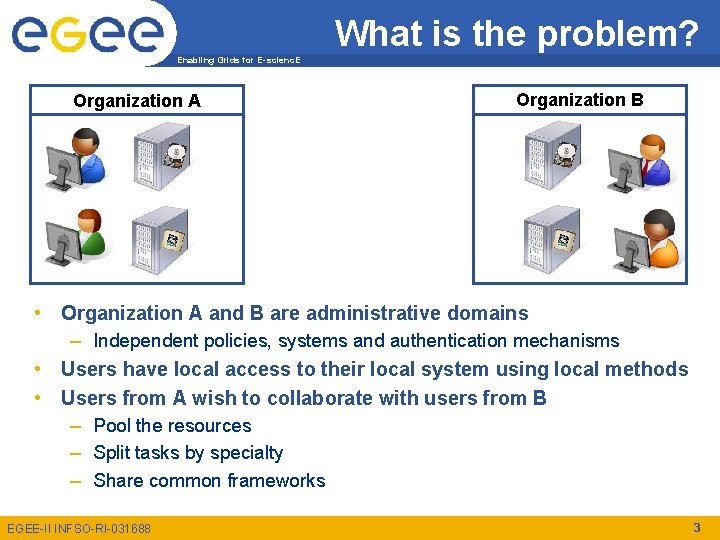
What is the problem? Enabling Grids for E-scienc. E Organization A Organization B • Organization A and B are administrative domains – Independent policies, systems and authentication mechanisms • Users have local access to their local system using local methods • Users from A wish to collaborate with users from B – Pool the resources – Split tasks by specialty – Share common frameworks EGEE-II INFSO-RI-031688 3
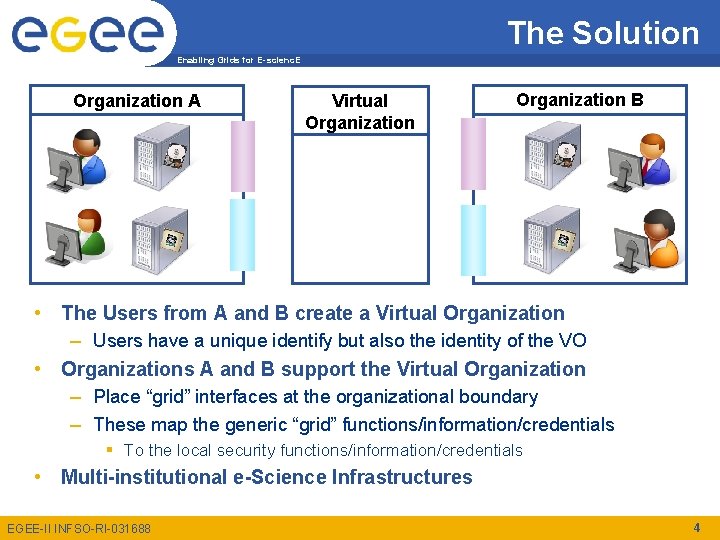
The Solution Enabling Grids for E-scienc. E Organization A Virtual Organization B • The Users from A and B create a Virtual Organization – Users have a unique identify but also the identity of the VO • Organizations A and B support the Virtual Organization – Place “grid” interfaces at the organizational boundary – These map the generic “grid” functions/information/credentials § To the local security functions/information/credentials • Multi-institutional e-Science Infrastructures EGEE-II INFSO-RI-031688 4
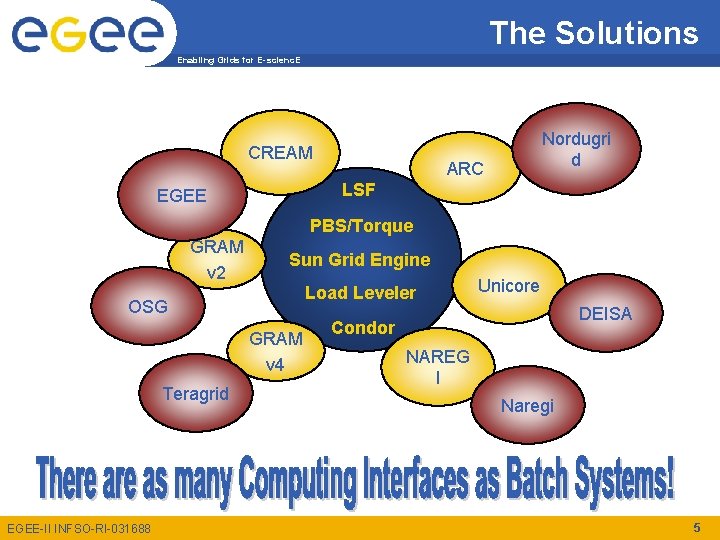
The Solutions Enabling Grids for E-scienc. E CREAM Nordugri d ARC LSF EGEE PBS/Torque GRAM v 2 Sun Grid Engine Load Leveler OSG GRAM v 4 Teragrid EGEE-II INFSO-RI-031688 Unicore DEISA Condor NAREG I Naregi 5
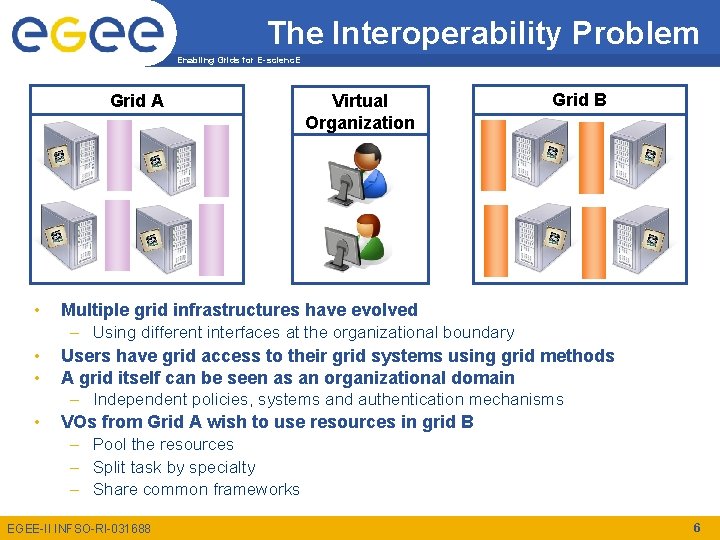
The Interoperability Problem Enabling Grids for E-scienc. E Grid A • • Virtual Organization Grid B Multiple grid infrastructures have evolved – Using different interfaces at the organizational boundary Users have grid access to their grid systems using grid methods A grid itself can be seen as an organizational domain – Independent policies, systems and authentication mechanisms VOs from Grid A wish to use resources in grid B – Pool the resources – Split task by specialty – Share common frameworks EGEE-II INFSO-RI-031688 6
Why? Enabling Grids for E-scienc. E • Required common interfaces – We now have multiple ”common” interfaces • Tried to solve one problem – But we created another • Reasons: – The infrastructures were developed independently – Initially there were no standards – Standards take time to mature § We need to build the infrastructures now! – Good standards require experience – Experimentation with different approaches EGEE-II INFSO-RI-031688 7
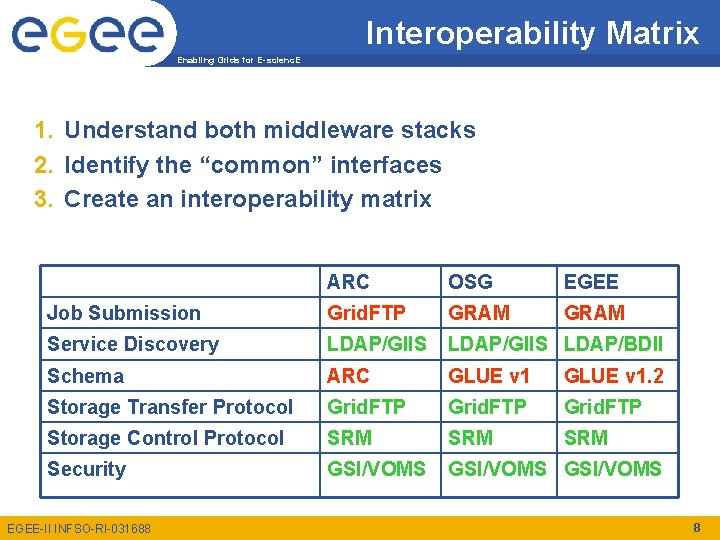
Interoperability Matrix Enabling Grids for E-scienc. E 1. Understand both middleware stacks 2. Identify the “common” interfaces 3. Create an interoperability matrix ARC OSG EGEE Job Submission Grid. FTP GRAM Service Discovery LDAP/GIIS LDAP/BDII Schema ARC GLUE v 1. 2 Storage Transfer Protocol Grid. FTP Storage Control Protocol SRM SRM Security GSI/VOMS EGEE-II INFSO-RI-031688 8
Select Strategy Enabling Grids for E-scienc. E • Long term solution – Common interfaces – Standards • Medium term solutions – Gateways – Adaptors and Translators • Short term solutions – Parallel Infrastructures § User driven § Site driven EGEE-II INFSO-RI-031688 9
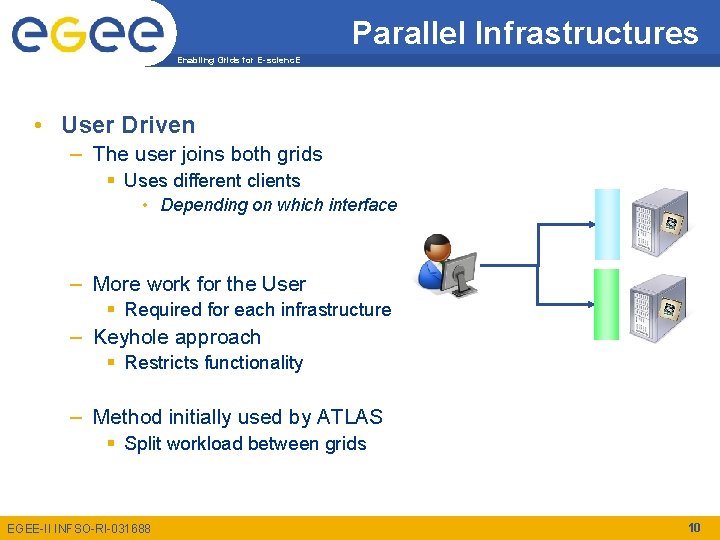
Parallel Infrastructures Enabling Grids for E-scienc. E • User Driven – The user joins both grids § Uses different clients • Depending on which interface – More work for the User § Required for each infrastructure – Keyhole approach § Restricts functionality – Method initially used by ATLAS § Split workload between grids EGEE-II INFSO-RI-031688 10
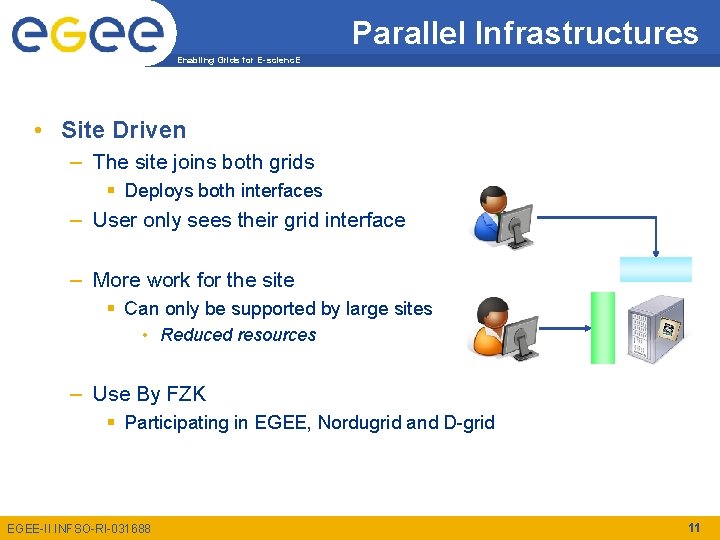
Parallel Infrastructures Enabling Grids for E-scienc. E • Site Driven – The site joins both grids § Deploys both interfaces – User only sees their grid interface – More work for the site § Can only be supported by large sites • Reduced resources – Use By FZK § Participating in EGEE, Nordugrid and D-grid EGEE-II INFSO-RI-031688 11
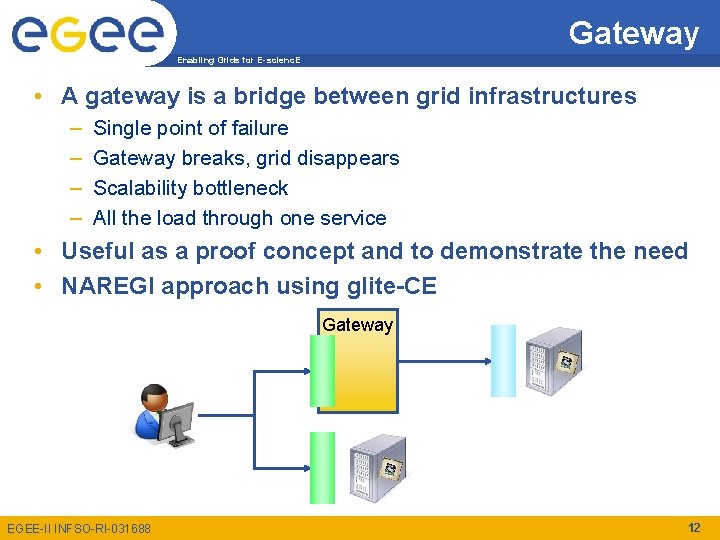
Gateway Enabling Grids for E-scienc. E • A gateway is a bridge between grid infrastructures – – Single point of failure Gateway breaks, grid disappears Scalability bottleneck All the load through one service • Useful as a proof concept and to demonstrate the need • NAREGI approach using glite-CE Gateway EGEE-II INFSO-RI-031688 12
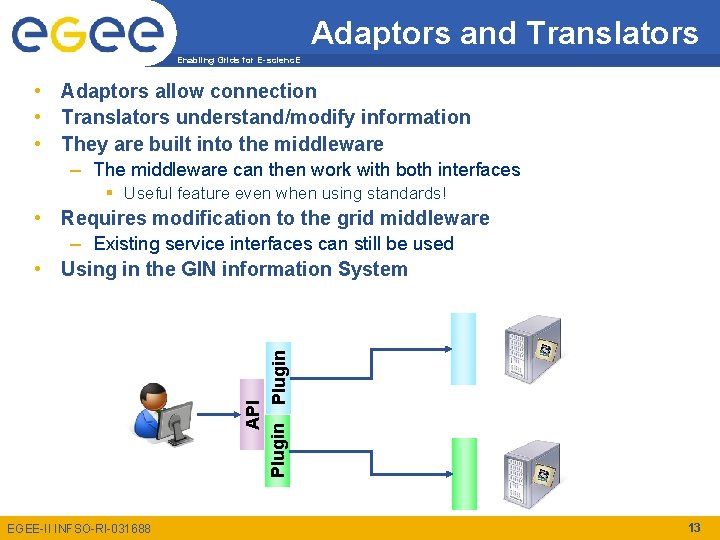
Adaptors and Translators Enabling Grids for E-scienc. E • Adaptors allow connection • Translators understand/modify information • They are built into the middleware – The middleware can then work with both interfaces § Useful feature even when using standards! API Plugin • Requires modification to the grid middleware – Existing service interfaces can still be used • Using in the GIN information System EGEE-II INFSO-RI-031688 13
OSG Activity Enabling Grids for E-scienc. E • November 2004 - Initial meeting with OSG – Only the information schema was different § Use a common schema, Glue v 1. 2 • January 2005 - Proof of concept was demonstrated § Small deployment differences found and overcome • Modifications to the software releases • August 2005 - Month of focussed activity – First OSG site available • November 2005 – First user jobs from GEANT 4 arrived on OSG sites • March 2006 - Operations Progress • Summer 2006 - CMS successfully taking advantage • Summer 2007 - Joining software certification Testbeds § To ensure interoperability is maintained EGEE-II INFSO-RI-031688 14
Nordugrid Activity Enabling Grids for E-scienc. E • August 2005 - Initial meeting with ARC – Different Schema and CE § Create Information System Gateway § Modify the WMS to use condor submitter • Feb 2006 – Information System Gateway ready – Condor testing underway • April 2006 official EGEE activity started – UKBH to test condor and adapt the WMS • May 2007 - Condor tested but WMS stalled – Building problems • Sept 2006 – Alternative approach – Investigating CE gateway approach – WMS developers adapting WMS § Very good progress • On going operations discussions – Nordugrid integrated into the operations process. EGEE-II INFSO-RI-031688 15
Unicore Enabling Grids for E-scienc. E • August 2006 – Initial Meeting – Official EGEE activity – Very different software stack (CE + UI + GUI) • Investigate Condor submission – Try WMS adaptation § Waiting on Nordugrid experience • May 2007 – Condor submission working – Reluctant to attempt WMS modification • Jun 2007 – Attempt CE gateway approach • Oct 2007 – Prototype demonstrated at EGEE 07 EGEE-II INFSO-RI-031688 16
Naregi Enabling Grids for E-scienc. E • March 2006 – Initial Meeting – Very different software stack § But similar components • EGEE acting in consultancy capacity • November 2006 – Prototypes demonstrated at SC 06 • July 2007 - Visit of the Japanese grid site managers – – Naregi software stack is still in the development phase Large scale production rollout envisaged end of 2008 Further work on interoperation will have to wait prototypes will remain untested in a production environment EGEE-II INFSO-RI-031688 17
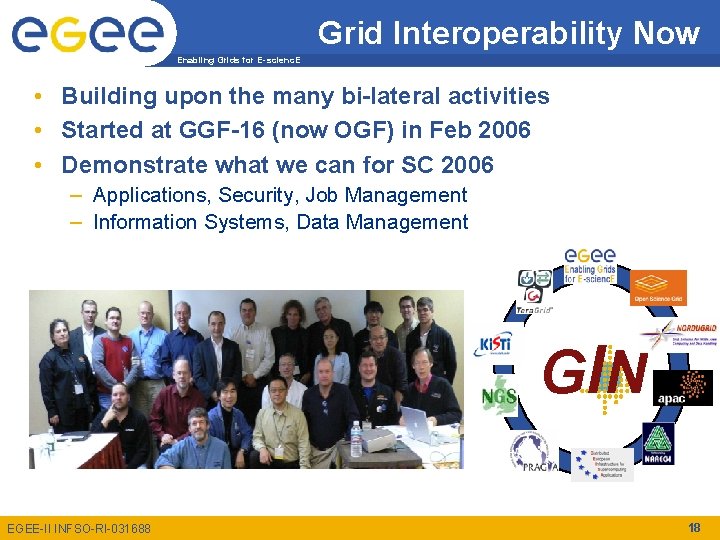
Grid Interoperability Now Enabling Grids for E-scienc. E • Building upon the many bi-lateral activities • Started at GGF-16 (now OGF) in Feb 2006 • Demonstrate what we can for SC 2006 – Applications, Security, Job Management – Information Systems, Data Management GIN EGEE-II INFSO-RI-031688 18
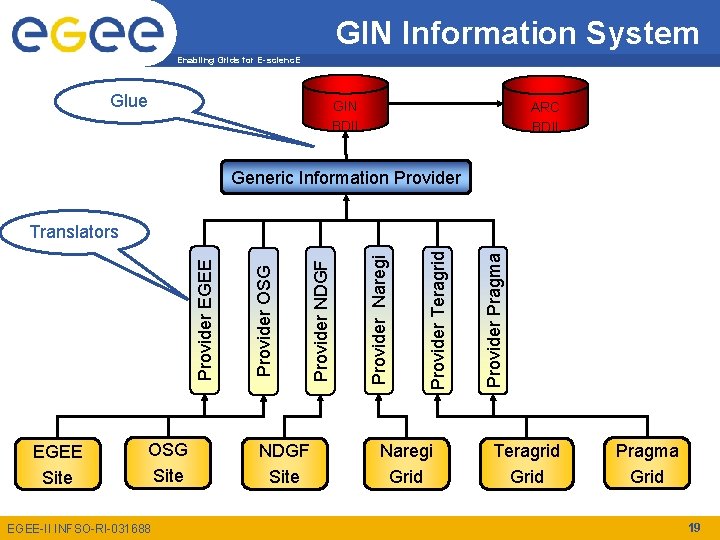
GIN Information System Enabling Grids for E-scienc. E Glue GIN BDII ARC BDII Generic Information Provider EGEE Site OSG Site EGEE-II INFSO-RI-031688 NDGF Site Naregi Grid Provider Pragma Provider Teragrid Provider Naregi Provider NDGF Provider OSG Provider EGEE Translators Teragrid Grid Pragma Grid 19
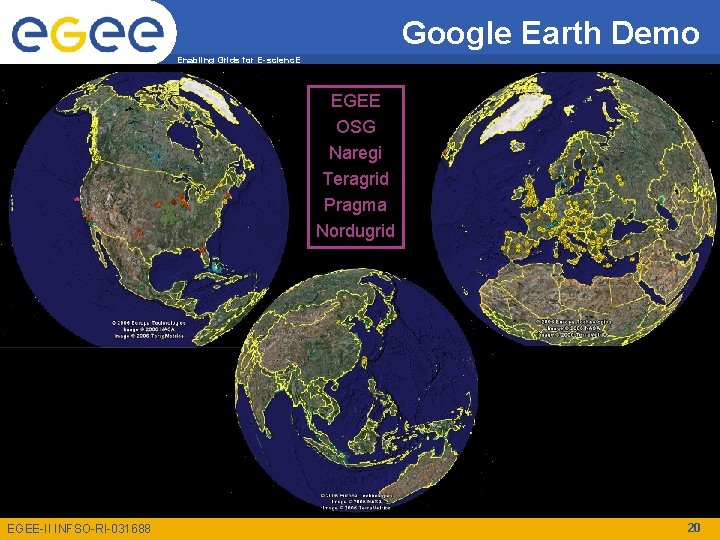
Google Earth Demo Enabling Grids for E-scienc. E EGEE OSG Naregi Teragrid Pragma Nordugrid EGEE-II INFSO-RI-031688 20
The Need For Standards Enabling Grids for E-scienc. E • Identified areas where standards are needed – From the various interoperation activities • Common interfaces – Critical interfaces at the organizational boundary § § Security Information Computing Storage • Standards are less important for higher level services – Problem constrained within the VO § Chose one solution and somewhere to host it. EGEE-II INFSO-RI-031688 21
Final Thoughts Interoperability Enabling Grids for E-scienc. E • The problem of grid interoperation – A second attempt at the original problem • The solution is common interfaces – Most crucially at the site boundary – The only way forward is real standards • The most important part is to agree – Production feedback will ensure it works! – The initial choice only select the starting point • Interoperability can be overcome short term – But only standards are sustainable in the long term EGEE-II INFSO-RI-031688 22
Final Thoughts Interoperation Enabling Grids for E-scienc. E • Needs clear drive and direction by a user community – Focus is maintained and the tasks are seen as critical – The main motivation is to gain access to additional resources – Need to identify a pilot VO • Interoperation affects all areas of the project – The activity needs to be pervasive – Work needs to be done by individuals who are the experts § A separated interoperation activity is not affective • Requires coordination of many different tasks – Vital to have a specific coordination role for interoperation – Interoperation is an activity between to grid infrastructures § A technical consultant who can liaise with other infrastructure EGEE-II INFSO-RI-031688 23
Summary Enabling Grids for E-scienc. E • Grid Interoperability is an avoidable problem – Grid Interoperation is not! • More focus is needed on the interfaces – Less focus required on specific implantations • Standards are critical for the future – It doesn’t matter what they are as long a we agree § Existing use cases will ensure the standards work • Interoperation requires coordination – Between different areas of the project – Between the different infrastructures EGEE-II INFSO-RI-031688 24
- Slides: 24