
Enabling Grids for Escienc E File Transfer Software
Enabling Grids for E-scienc. E File Transfer Software SC 3 Gavin Mc. Cance – JRA 1 Data Management Cluster LCG Storage Management Workshop April 6, 2005, CERN www. eu-egee. org INFSO-RI-508833
Outline Enabling Grids for E-scienc. E • Requirements and status • Design and components • How to plumb your existing frameworks onto it INFSO-RI-508833
Reliable File Transfer Requirements Enabling Grids for E-scienc. E • LCG created a set of requirements based on the Robust Data Transfer Service Challenge • LCG and g. Lite teams translated this into a detailed architecture and design document for the software and the service – A prototype (radiant) was created to test out the architecture and was used in SC 1 and SC 2 § Architecture and design have worked well for SC 2 – g. Lite FTS (“File Transfer Service”) is an instantiation of the same architecture and design, and is the candidate for use in SC 3 § Current version of FTS and SC 2 radiant software interoperable INFSO-RI-508833
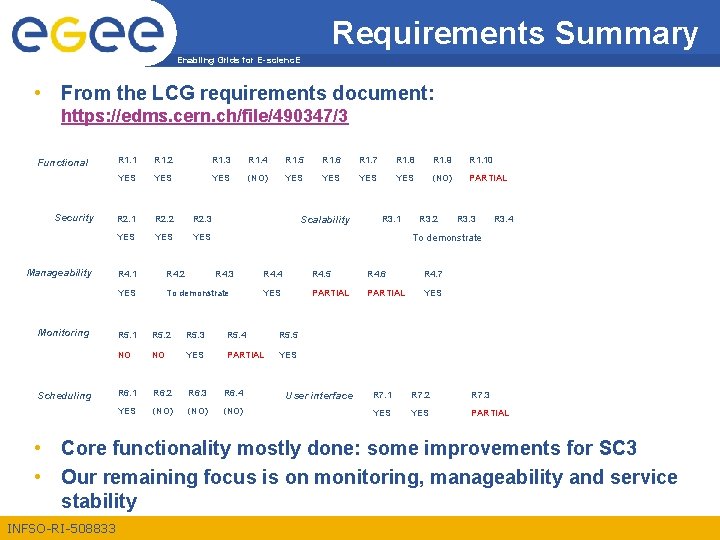
Requirements Summary Enabling Grids for E-scienc. E • From the LCG requirements document: https: //edms. cern. ch/file/490347/3 Functional Security Manageability Monitoring Scheduling R 1. 1 R 1. 2 R 1. 3 R 1. 4 R 1. 5 R 1. 6 R 1. 7 R 1. 8 R 1. 9 R 1. 10 YES YES (NO) PARTIAL R 2. 1 R 2. 2 R 2. 3 YES YES Scalability R 3. 1 R 3. 2 R 3. 3 R 3. 4 To demonstrate R 4. 1 R 4. 2 R 4. 3 YES To demonstrate R 4. 4 R 4. 5 R 4. 6 R 4. 7 YES PARTIAL YES R 5. 1 R 5. 2 R 5. 3 R 5. 4 R 5. 5 NO NO YES PARTIAL YES R 6. 1 R 6. 2 R 6. 3 R 6. 4 YES (NO) User interface R 7. 1 R 7. 2 R 7. 3 YES PARTIAL • Core functionality mostly done: some improvements for SC 3 • Our remaining focus is on monitoring, manageability and service stability INFSO-RI-508833
Notes on architecture Enabling Grids for E-scienc. E • The FTS is a service which provides point to point movement of SURLs – Aims to provide reliable file transfer, and that’s it! – Does not do ‘routing’ (e. g like Phedex) – Does not deal with GUID, LFN, Dataset, Collections • These are all higher level concepts and can be dealt with by higher level software • It does provides a pluggable agent-based architecture where some of this higher level work could be done, if required – VOs could provide their own agents to do VO specific things (e. g cataloging, different retry policies) – As an example of this, g. Lite will aim to provide basic agents that integrate the FTS with the rest of the g. Lite software stack (especially the catalogs) § this is what people mean when they talk about the g. Lite FPS “File Placement Service”. INFSO-RI-508833
To be clear… Enabling Grids for E-scienc. E • The substance of this presentation is about the FTS (i. e. the basic SURL->SURL transfer system) and how to plumb your own frameworks onto it • FTS code is now stabilised, we’re getting good experience running with it • The example extra agents that plumb the FTS into the rest of the g. Lite framework (the “FPS” agents) need some work and are not tested INFSO-RI-508833
Software components Enabling Grids for E-scienc. E • Decoupled stateless agents: – Allocator agents – Transfer agents – Retry agents to decide what to do with failed files (depending on the failure class). • Database: stores all the state – Currently runs on the CERN Oracle service • Web-service: – wrapper over database, secure job submissions and status querying via the interface, channel service management – decoupled from the agents that actually do the file movement • Command line: – command line clients (job management and service management) • GUI: – job monitoring GUI and service monitoring GUI running against webservice or DB directly INFSO-RI-508833
Service management Enabling Grids for E-scienc. E • “Channels” are dedicated network pipes for production use, e. g. CERN->RAL distribution – The service can be configured to assign work to and service work on a number of channels • Management functions to control the state of channels (without losing work assigned to that channel) – Change channel state (e. g. Active, Inactive, Drain) – Throttle network usage – Manual intervention functions to recover jobs that have been running on a problematic channel INFSO-RI-508833
Testing status Enabling Grids for E-scienc. E • Presented in more detail at the Lyon LCG service challenge meeting… • Validation tests have proved ~positive – Trying to run as close to SC 2 mode as possible to make sure that we catch issues early – 24/7 running on (small) subset of SC 2 setup, running in parallel. Best effort problem resolution. – We plan to continue this testing and increase the scale of it as we head to SC 3 – Issues already found and understood / fixed. – Maintaining a close interaction with LCG service challenge team to ensure the experience of SC 1 and SC 2 feed into the software INFSO-RI-508833
FTS Design concepts Enabling Grids for E-scienc. E • System is driven by state machine and a set of ‘agents’ working on their own part of the state machine – The state is kept in a database. – Agents should be decoupled – Agents should be as stateless as possible, and always able to recover the true state should they fail • Multiple file transfers grouped into a single job – Overall job state (“is it done yet? ”) is a function of the individual states of the job’s constituent files INFSO-RI-508833
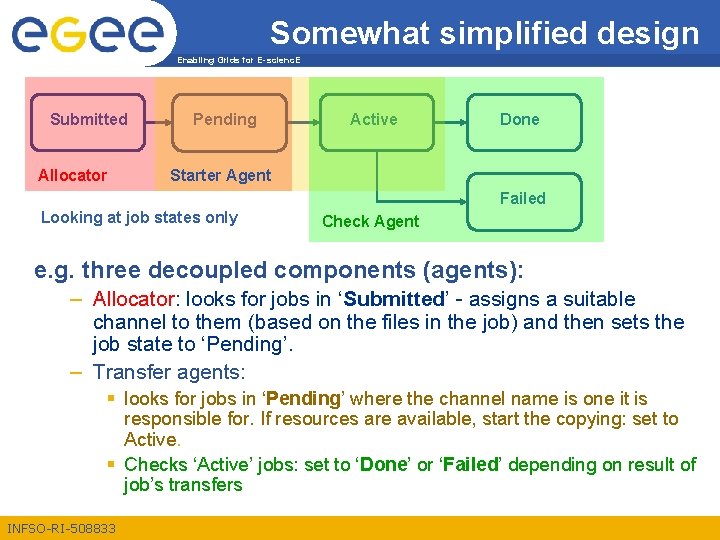
Somewhat simplified design Enabling Grids for E-scienc. E Submitted Allocator Pending Active Done Starter Agent Failed Looking at job states only Check Agent e. g. three decoupled components (agents): – Allocator: looks for jobs in ‘Submitted’ - assigns a suitable channel to them (based on the files in the job) and then sets the job state to ‘Pending’. – Transfer agents: § looks for jobs in ‘Pending’ where the channel name is one it is responsible for. If resources are available, start the copying: set to Active. § Checks ‘Active’ jobs: set to ‘Done’ or ‘Failed’ depending on result of job’s transfers INFSO-RI-508833
How to plug onto the FTS Enabling Grids for E-scienc. E • The FTS only moves SURLs – Someone has to work out which SURLs get copied – Someone has to update the appropriate catalogs, etc after they have been copied • We define two state transitions in the framework where these actions could occur – Resolution (or allocation): which SURLs and which channel? – Post-processing: do something after the copy – The details of the actions that happen are likely to be VO specific INFSO-RI-508833
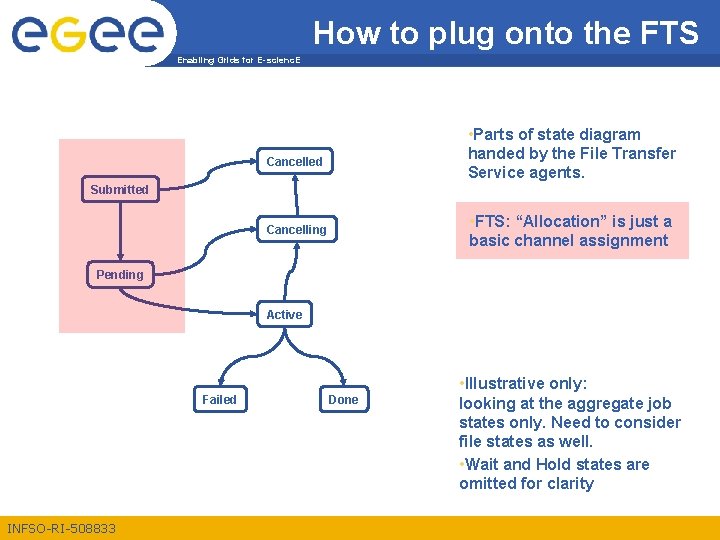
How to plug onto the FTS Enabling Grids for E-scienc. E • Parts of state diagram handed by the File Transfer Service agents. Cancelled Submitted • FTS: “Allocation” is just a basic channel assignment Cancelling Pending Active Failed INFSO-RI-508833 Done • Illustrative only: looking at the aggregate job states only. Need to consider file states as well. • Wait and Hold states are omitted for clarity
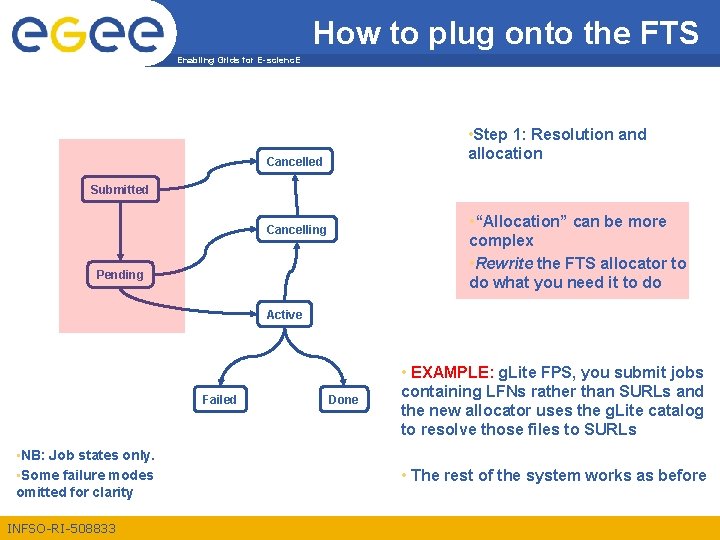
How to plug onto the FTS Enabling Grids for E-scienc. E • Step 1: Resolution and allocation Cancelled Submitted • “Allocation” can be more complex • Rewrite the FTS allocator to do what you need it to do Cancelling Pending Active Failed • NB: Job states only. • Some failure modes omitted for clarity INFSO-RI-508833 Done • EXAMPLE: g. Lite FPS, you submit jobs containing LFNs rather than SURLs and the new allocator uses the g. Lite catalog to resolve those files to SURLs • The rest of the system works as before
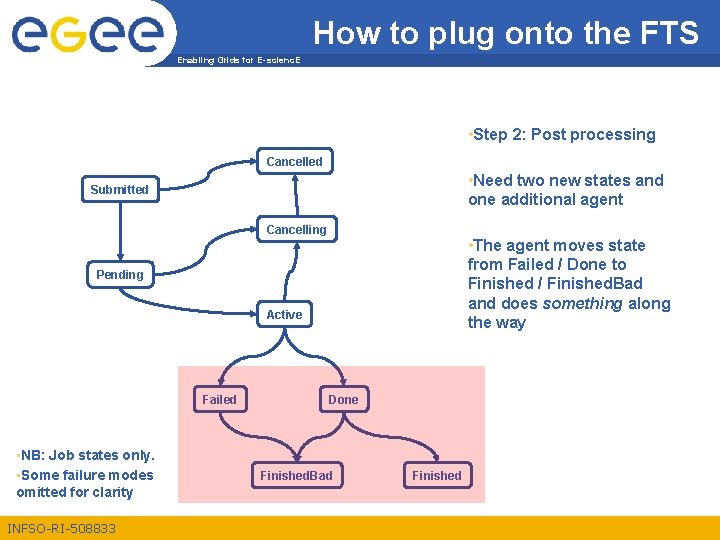
How to plug onto the FTS Enabling Grids for E-scienc. E • Step 2: Post processing Cancelled • Need two new states and one additional agent Submitted Cancelling • The agent moves state from Failed / Done to Finished / Finished. Bad and does something along the way Pending Active Failed • NB: Job states only. • Some failure modes omitted for clarity INFSO-RI-508833 Done Finished. Bad Finished
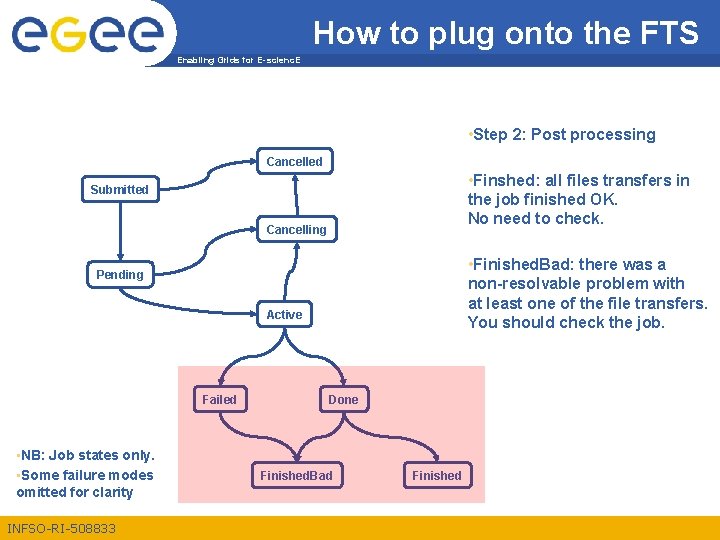
How to plug onto the FTS Enabling Grids for E-scienc. E • Step 2: Post processing Cancelled • Finshed: all files transfers in the job finished OK. No need to check. Submitted Cancelling • Finished. Bad: there was a non-resolvable problem with at least one of the file transfers. You should check the job. Pending Active Failed • NB: Job states only. • Some failure modes omitted for clarity INFSO-RI-508833 Done Finished. Bad Finished
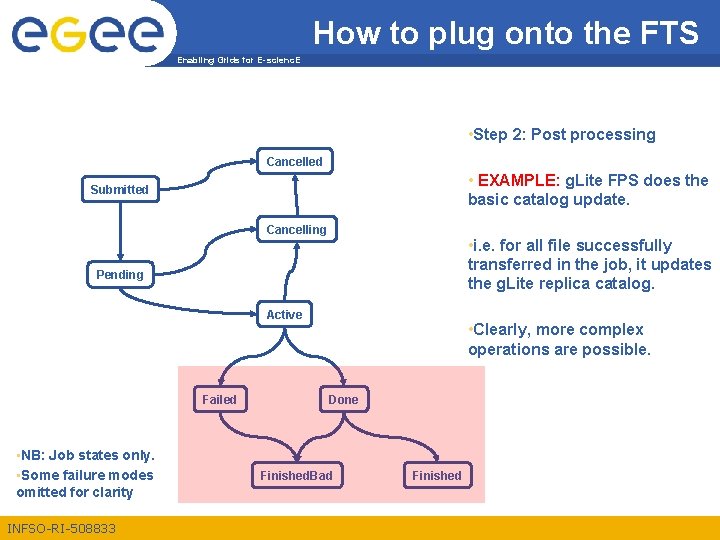
How to plug onto the FTS Enabling Grids for E-scienc. E • Step 2: Post processing Cancelled • EXAMPLE: g. Lite FPS does the basic catalog update. Submitted Cancelling • i. e. for all file successfully transferred in the job, it updates the g. Lite replica catalog. Pending Active Failed • NB: Job states only. • Some failure modes omitted for clarity INFSO-RI-508833 • Clearly, more complex operations are possible. Done Finished. Bad Finished
How to plug onto the FTS Enabling Grids for E-scienc. E • How to make your framework with the FTS • Three options: – Only use the FTS (i. e. just the file transfer) and do everything else in your existing frameworks – Use the agent framework we provide to do some of the operations – Write your own agent INFSO-RI-508833
Agent framework Enabling Grids for E-scienc. E • For both of the steps, we can provide a basic fill-in-theblanks agent – It will load a library that you write, that does whatever action you need • Suitable for simple catalog resolution and update – This approach is being used for the g. Lite “FPS”. • Pros: – It’s simple to write – No chance of interference with core transfer system • Cons: – Limits the information you can have to do your action. i. e. no arbitrary access to the underlying DB tables INFSO-RI-508833
DB access Enabling Grids for E-scienc. E • For both of the steps, you write your own agent – It talks to the DB and does what you need – But. . It should restrict itself to the allowed state transitions, so that it doesn’t interfere with the core FTS software • Pros – Much more flexible, you have all the information available – You can add your own DB tables if you need them • Cons – Chance of breaking the core transfer system if you mess up the states – Any future FTS schema changes may affect you INFSO-RI-508833
Summary Enabling Grids for E-scienc. E • Core FTS software is in good shape – On its way to becoming software that can provide a manageable, reliable service • Stress-testing underway – Gaining operational experience with it early – Increasing as we head to SC 3 • We are now understanding how the experiment frameworks can plug onto it – Interested to discuss further and work with experiments INFSO-RI-508833
Enabling Grids for E-scienc. E Backup slides www. eu-egee. org INFSO-RI-508833
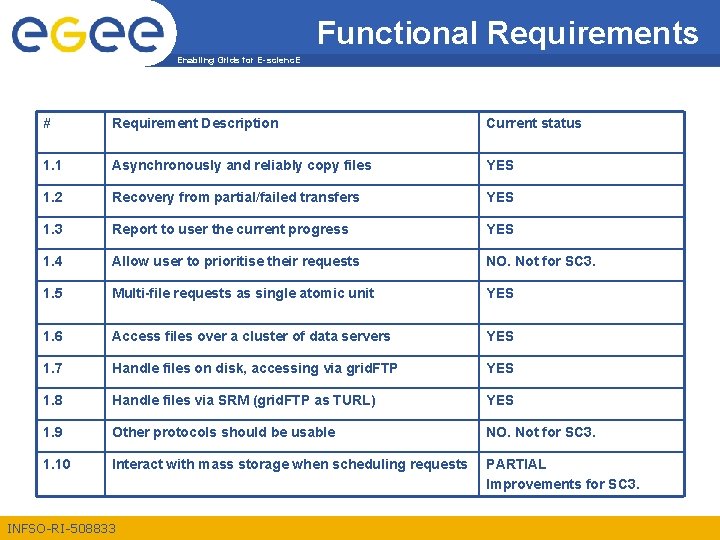
Functional Requirements Enabling Grids for E-scienc. E # Requirement Description Current status 1. 1 Asynchronously and reliably copy files YES 1. 2 Recovery from partial/failed transfers YES 1. 3 Report to user the current progress YES 1. 4 Allow user to prioritise their requests NO. Not for SC 3. 1. 5 Multi-file requests as single atomic unit YES 1. 6 Access files over a cluster of data servers YES 1. 7 Handle files on disk, accessing via grid. FTP YES 1. 8 Handle files via SRM (grid. FTP as TURL) YES 1. 9 Other protocols should be usable NO. Not for SC 3. 1. 10 Interact with mass storage when scheduling requests PARTIAL Improvements for SC 3. INFSO-RI-508833
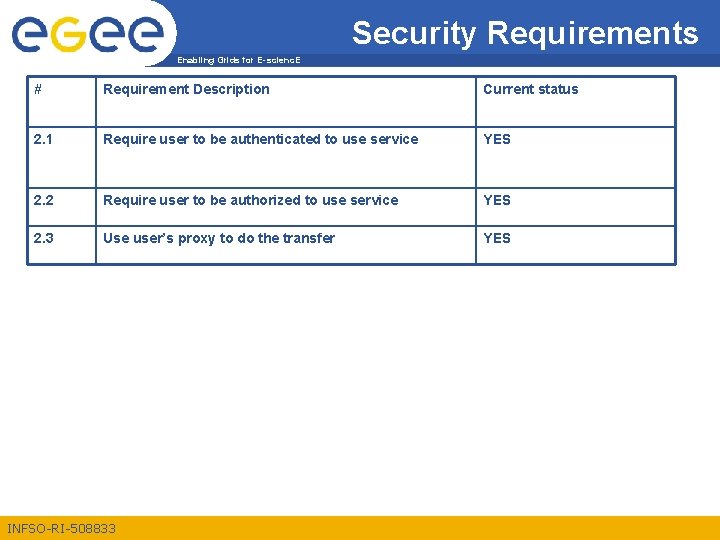
Security Requirements Enabling Grids for E-scienc. E # Requirement Description Current status 2. 1 Require user to be authenticated to use service YES 2. 2 Require user to be authorized to use service YES 2. 3 Use user’s proxy to do the transfer YES INFSO-RI-508833
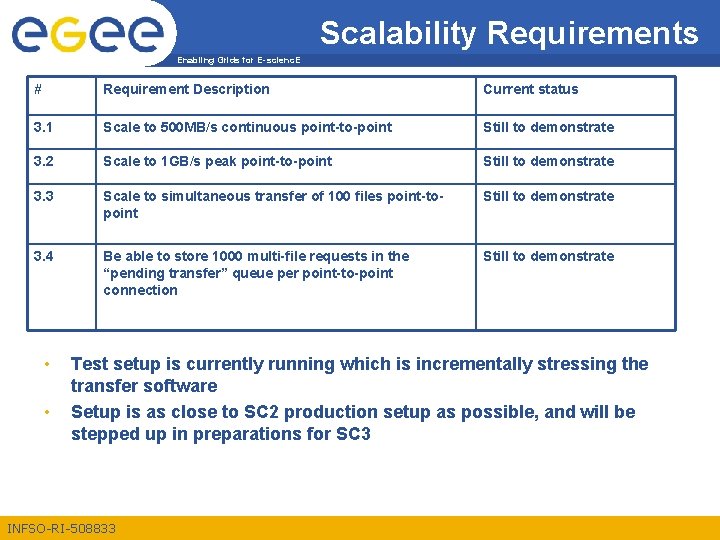
Scalability Requirements Enabling Grids for E-scienc. E # Requirement Description Current status 3. 1 Scale to 500 MB/s continuous point-to-point Still to demonstrate 3. 2 Scale to 1 GB/s peak point-to-point Still to demonstrate 3. 3 Scale to simultaneous transfer of 100 files point-topoint Still to demonstrate 3. 4 Be able to store 1000 multi-file requests in the “pending transfer” queue per point-to-point connection Still to demonstrate • • Test setup is currently running which is incrementally stressing the transfer software Setup is as close to SC 2 production setup as possible, and will be stepped up in preparations for SC 3 INFSO-RI-508833
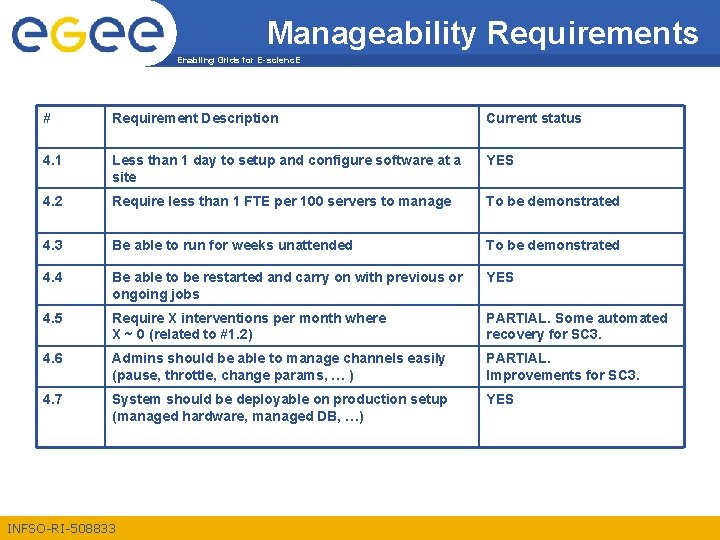
Manageability Requirements Enabling Grids for E-scienc. E # Requirement Description Current status 4. 1 Less than 1 day to setup and configure software at a site YES 4. 2 Require less than 1 FTE per 100 servers to manage To be demonstrated 4. 3 Be able to run for weeks unattended To be demonstrated 4. 4 Be able to be restarted and carry on with previous or ongoing jobs YES 4. 5 Require X interventions per month where X ~ 0 (related to #1. 2) PARTIAL. Some automated recovery for SC 3. 4. 6 Admins should be able to manage channels easily (pause, throttle, change params, … ) PARTIAL. Improvements for SC 3. 4. 7 System should be deployable on production setup (managed hardware, managed DB, …) YES INFSO-RI-508833
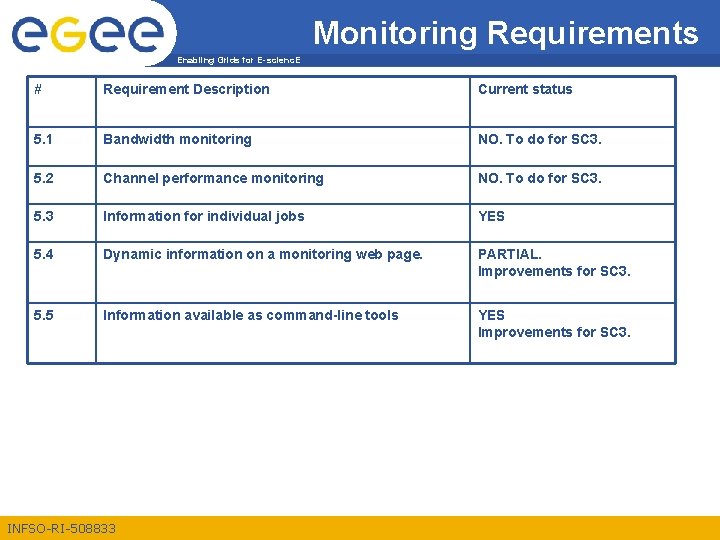
Monitoring Requirements Enabling Grids for E-scienc. E # Requirement Description Current status 5. 1 Bandwidth monitoring NO. To do for SC 3. 5. 2 Channel performance monitoring NO. To do for SC 3. 5. 3 Information for individual jobs YES 5. 4 Dynamic information on a monitoring web page. PARTIAL. Improvements for SC 3. 5. 5 Information available as command-line tools YES Improvements for SC 3. INFSO-RI-508833
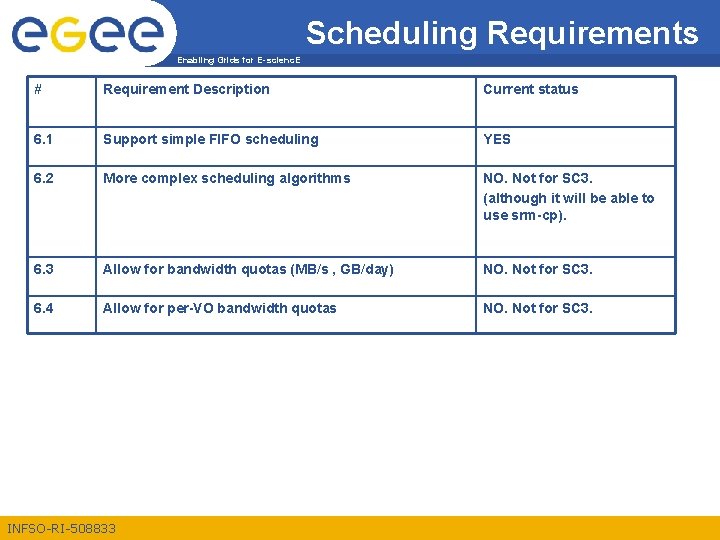
Scheduling Requirements Enabling Grids for E-scienc. E # Requirement Description Current status 6. 1 Support simple FIFO scheduling YES 6. 2 More complex scheduling algorithms NO. Not for SC 3. (although it will be able to use srm-cp). 6. 3 Allow for bandwidth quotas (MB/s , GB/day) NO. Not for SC 3. 6. 4 Allow for per-VO bandwidth quotas NO. Not for SC 3. INFSO-RI-508833
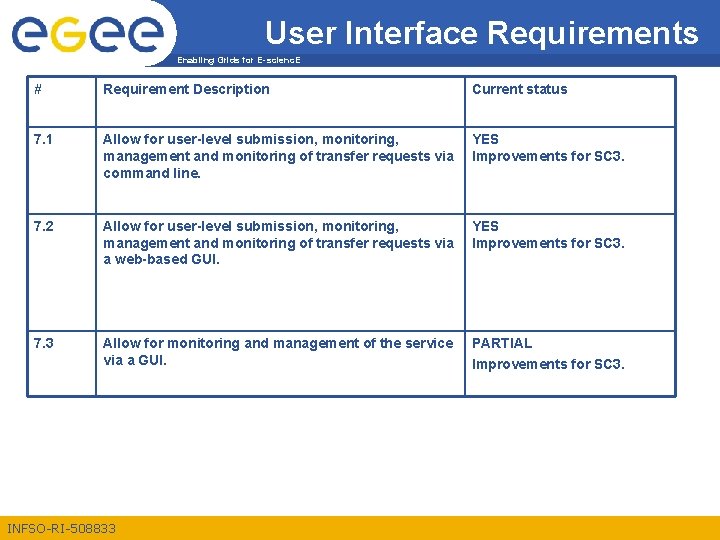
User Interface Requirements Enabling Grids for E-scienc. E # Requirement Description Current status 7. 1 Allow for user-level submission, monitoring, management and monitoring of transfer requests via command line. YES Improvements for SC 3. 7. 2 Allow for user-level submission, monitoring, management and monitoring of transfer requests via a web-based GUI. YES Improvements for SC 3. 7. 3 Allow for monitoring and management of the service via a GUI. PARTIAL Improvements for SC 3. INFSO-RI-508833
- Slides: 29