
Enabling Grids for Escienc E Digital repositories and
Enabling Grids for E-scienc. E Digital repositories and Grids Bob Jones EGEE-II Project Director CERN Bob. Jones@cern. ch 3 rd July 2006 Oxford www. eu-egee. org EGEE-II INFSO-RI-031688 EGEE and g. Lite are registered trademarks
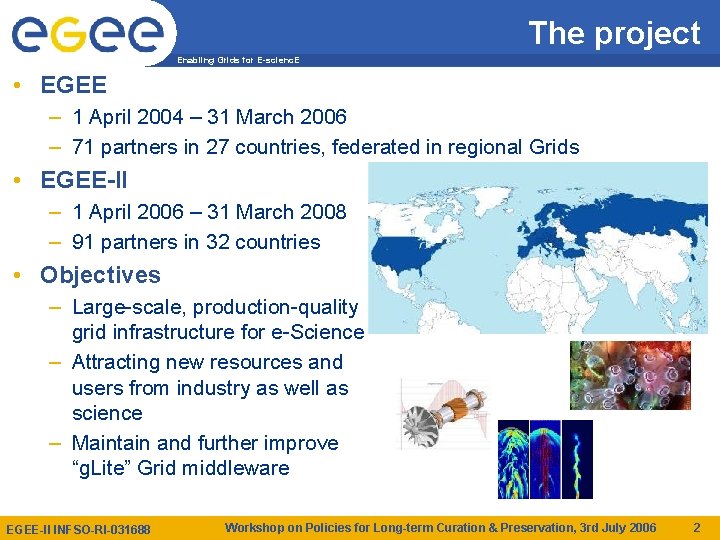
The project Enabling Grids for E-scienc. E • EGEE – 1 April 2004 – 31 March 2006 – 71 partners in 27 countries, federated in regional Grids • EGEE-II – 1 April 2006 – 31 March 2008 – 91 partners in 32 countries • Objectives – Large-scale, production-quality grid infrastructure for e-Science – Attracting new resources and users from industry as well as science – Maintain and further improve “g. Lite” Grid middleware EGEE-II INFSO-RI-031688 Workshop on Policies for Long-term Curation & Preservation, 3 rd July 2006 2
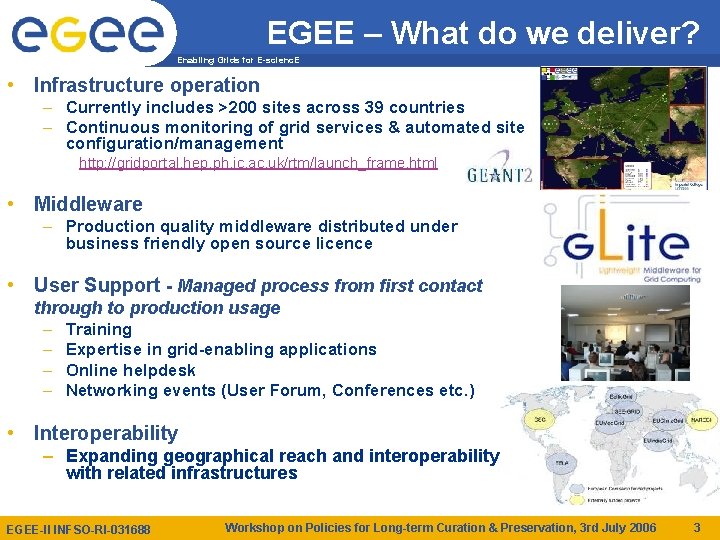
EGEE – What do we deliver? Enabling Grids for E-scienc. E • Infrastructure operation – Currently includes >200 sites across 39 countries – Continuous monitoring of grid services & automated site configuration/management http: //gridportal. hep. ph. ic. ac. uk/rtm/launch_frame. html • Middleware – Production quality middleware distributed under business friendly open source licence • User Support - Managed process from first contact through to production usage – Training – Expertise in grid-enabling applications – Online helpdesk – Networking events (User Forum, Conferences etc. ) • Interoperability – Expanding geographical reach and interoperability with related infrastructures EGEE-II INFSO-RI-031688 Workshop on Policies for Long-term Curation & Preservation, 3 rd July 2006 3
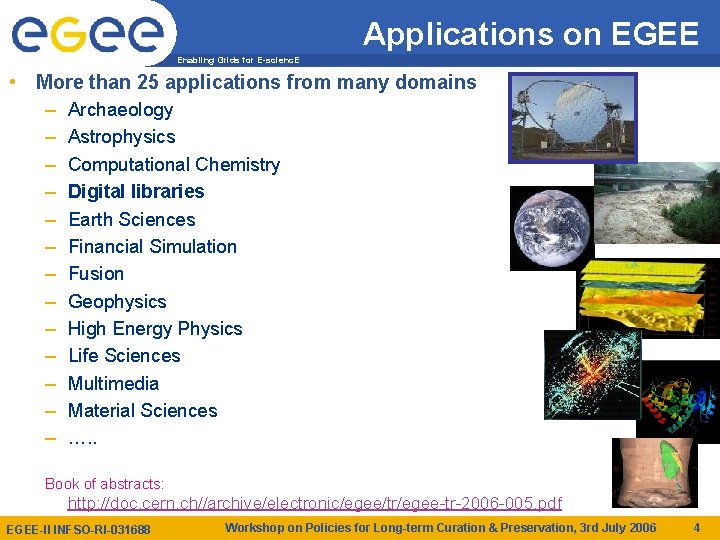
Applications on EGEE Enabling Grids for E-scienc. E • More than 25 applications from many domains – Archaeology – Astrophysics – Computational Chemistry – Digital libraries – Earth Sciences – Financial Simulation – Fusion – Geophysics – High Energy Physics – Life Sciences – Multimedia – Material Sciences – …. . Book of abstracts: http: //doc. cern. ch//archive/electronic/egee/tr/egee-tr-2006 -005. pdf EGEE-II INFSO-RI-031688 Workshop on Policies for Long-term Curation & Preservation, 3 rd July 2006 4
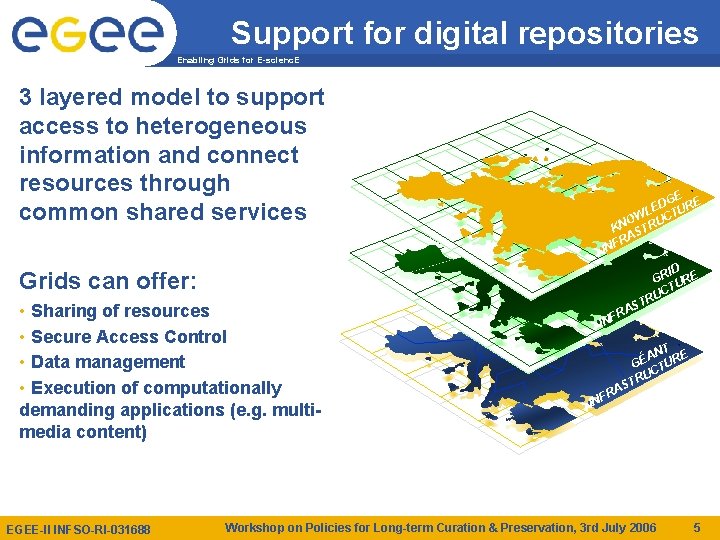
Support for digital repositories Enabling Grids for E-scienc. E 3 layered model to support access to heterogeneous information and connect resources through common shared services Grids can offer: • Sharing of resources • Secure Access Control • Data management • Execution of computationally demanding applications (e. g. multimedia content) EGEE-II INFSO-RI-031688 . E G ED URE L T OW RUC N K ST RA INF. ID E R G UR T UC R T AS R INF. T N E A GÉ TUR C U TR AS R INF Workshop on Policies for Long-term Curation & Preservation, 3 rd July 2006 5
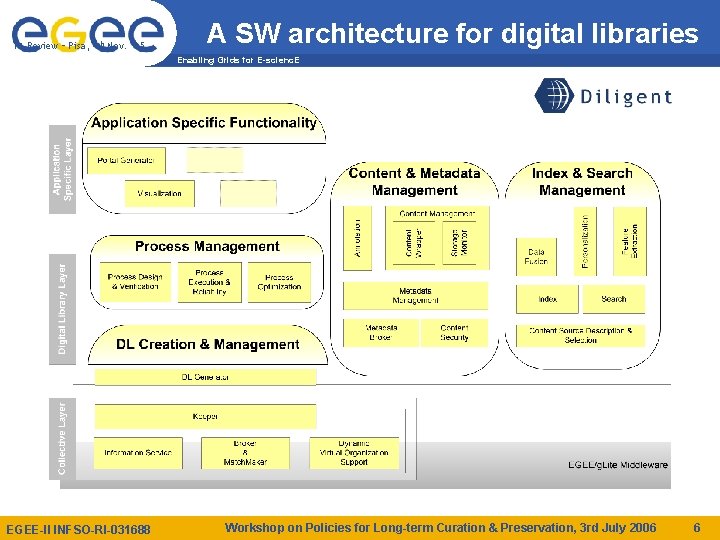
1 st Review – Pisa, 4 th Nov. ‘ 05 A SW architecture for digital libraries Enabling Grids for E-scienc. E EGEE-II INFSO-RI-031688 Workshop on Policies for Long-term Curation & Preservation, 3 rd July 2006 6
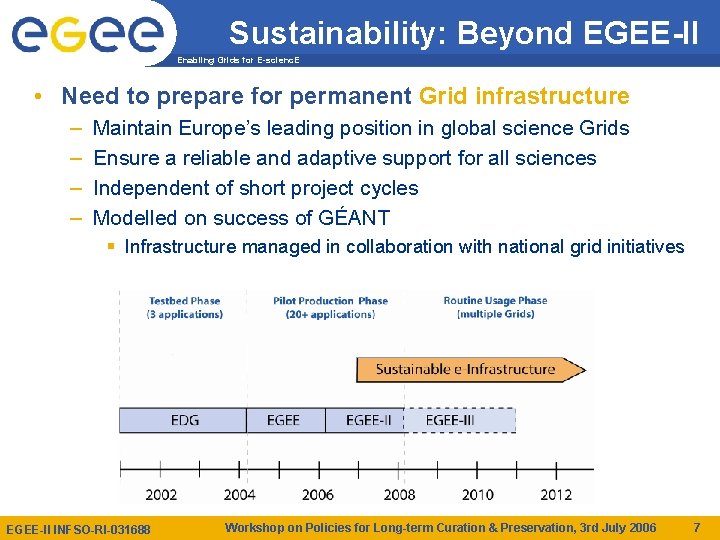
Sustainability: Beyond EGEE-II Enabling Grids for E-scienc. E • Need to prepare for permanent Grid infrastructure – – Maintain Europe’s leading position in global science Grids Ensure a reliable and adaptive support for all sciences Independent of short project cycles Modelled on success of GÉANT § Infrastructure managed in collaboration with national grid initiatives EGEE-II INFSO-RI-031688 Workshop on Policies for Long-term Curation & Preservation, 3 rd July 2006 7
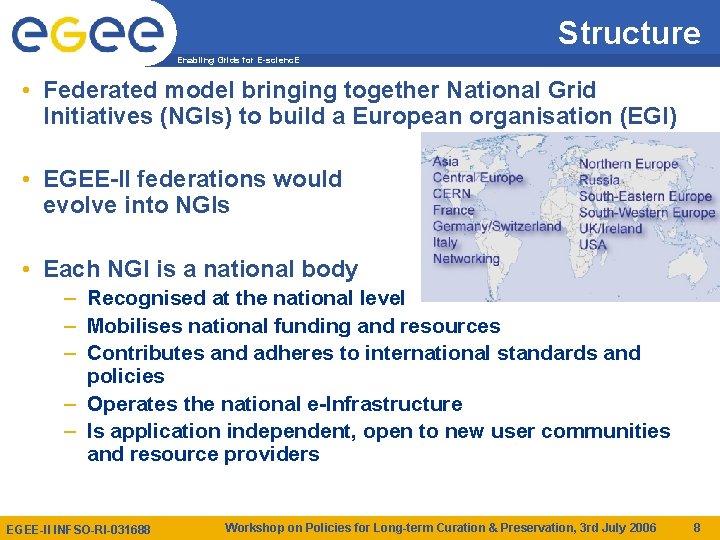
Structure Enabling Grids for E-scienc. E • Federated model bringing together National Grid Initiatives (NGIs) to build a European organisation (EGI) • EGEE-II federations would evolve into NGIs • Each NGI is a national body – Recognised at the national level – Mobilises national funding and resources – Contributes and adheres to international standards and policies – Operates the national e-Infrastructure – Is application independent, open to new user communities and resource providers EGEE-II INFSO-RI-031688 Workshop on Policies for Long-term Curation & Preservation, 3 rd July 2006 8
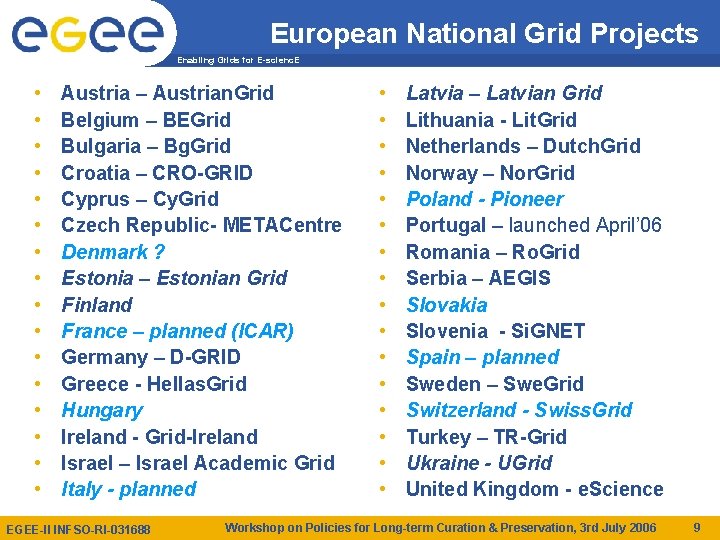
European National Grid Projects Enabling Grids for E-scienc. E • • • • Austria – Austrian. Grid Belgium – BEGrid Bulgaria – Bg. Grid Croatia – CRO-GRID Cyprus – Cy. Grid Czech Republic- METACentre Denmark ? Estonia – Estonian Grid Finland France – planned (ICAR) Germany – D-GRID Greece - Hellas. Grid Hungary Ireland - Grid-Ireland Israel – Israel Academic Grid Italy - planned EGEE-II INFSO-RI-031688 • • • • Latvia – Latvian Grid Lithuania - Lit. Grid Netherlands – Dutch. Grid Norway – Nor. Grid Poland - Pioneer Portugal – launched April’ 06 Romania – Ro. Grid Serbia – AEGIS Slovakia Slovenia - Si. GNET Spain – planned Sweden – Swe. Grid Switzerland - Swiss. Grid Turkey – TR-Grid Ukraine - UGrid United Kingdom - e. Science Workshop on Policies for Long-term Curation & Preservation, 3 rd July 2006 9
EGI/NGIs and Business Enabling Grids for E-scienc. E • Business model to commercially exploit the research infrastructure managed by EGI/NGIs is unclear – Should not use tax payers’ money to compete with commercial service providers – Infrastructure can be used by companies to do research at a precompetitive stage and encourage transfer of technology • Likely to see transfer of technology from research to industry by adoption/internalisation of EGI/NGI backed products and services (e. g. software, operations procedures/techniques) – e-Science leading to e-Business – For multi-site corporate usage or to offer a service to a set of SMEs • EGI/NGIs could subcontract infrastructure support to industry and make use of commercial software as standards evolve EGEE-II INFSO-RI-031688 Workshop on Policies for Long-term Curation & Preservation, 3 rd July 2006 10
Managed Resource Centres Enabling Grids for E-scienc. E • Given the existence of such an e-Infrastructure, managed resources centres can be established: – Create shared pool of resources (CPU, disk and data curation) independent of funding for specific user communities – Managed by the NGIs and coordinated by EGI – Joint capital funding from NGIs and EU – Pay-per-usage/storage business models to cover operational and depreciation costs • This would create a network of data-centre “hubs” that can ensure long-term preservation, service quality, redundancy and resilience – Individual projects lose interest in preserving data once the project ends – Many end-user sites do not have the IT expertise and resources to ensure continued access to their content EGEE-II INFSO-RI-031688 Workshop on Policies for Long-term Curation & Preservation, 3 rd July 2006 11
Personal Lessons Learned Enabling Grids for E-scienc. E • Everyone agrees a national/central structure is important – Provided it is to be run by them • Must work with multiple application domains – They will have different/conflicting requirements • Must dedicate effort to work closely with users – You will underestimate the effort required – You will also need a salesforce • Difficult to get people to run services and maintain quality – Not sexy but essential and is the basis of your image • Access to data is paramount – Requires significant network resources – Open Source/Access is essential • There will be different/rival systems – Interoperability is something you owe to your users – you will have to work with other systems – Developing new standards always takes longer than foreseen EGEE-II INFSO-RI-031688 Workshop on Policies for Long-term Curation & Preservation, 3 rd July 2006 12
EGEE’ 06 Conference Enabling Grids for E-scienc. E • EGEE’ 06 – Capitalising on e-infrastructures – Keynotes on state-of-the-art and real-world use – Dedicated business track exploring Grids’ business potential – Demos and business/industry exhibition – Involvement of international community • 25 -29 September 2006 • Geneva, Switzerland • http: //www. eu-egee. org/egee 06 EGEE-II INFSO-RI-031688 Workshop on Policies for Long-term Curation & Preservation, 3 rd July 2006 13
Summary Enabling Grids for E-scienc. E • Grids are all about sharing – they are an excellent means of working with groups around the world • Grids can provide an infrastructure for digital repositories offering secure access, data management services and execution of computationally demanding tasks • A network of managed data-centre “hubs” can offer long-term preservation, service quality, redundancy and resilience • EGEE Infrastructure – world’s largest multi-science production grid service • Need to prepare the long-term – EGEE, related EU projects, national grid initiatives and user communities are working to define a model for a sustainable grid infrastructure www. eu-egee. org EGEE-II INFSO-RI-031688 Workshop on Policies for Long-term Curation & Preservation, 3 rd July 2006 14
- Slides: 14