
Enabling Capabilities for Tritium Safety Transformative Enough Susana

Enabling Capabilities for Tritium Safety: Transformative Enough? Susana Reyes Presentation to FESAC TEC Sub-Committee
Outline • Existing S&E capabilities • Overview of the tritium challenges • Possibly transformative enabling capabilities ØTritium processing technologies? Ø Modeling/simulations? 2 Office of Science 88 inch CM review 11/29/2016 2 2

US fusion safety and environment (S&E) capabilities are world-class • DOE Fusion Safety Standards (Requirements and Guidelines, 1996) served to develop ITER safety basis and the safety objectives of US IFE and MFE fusion plant concepts • Neutronics and activation analysis tools and studies (UW, UCLA, ORNL, LLNL) • Source term characterization, tritium and dust research (INL, LLNL, LANL, SRNL) • Energy source evaluations to understand chemical energy from oxidation of fusion structural and breeder materials (INL, LLNL) • Safety assessment methodologies including off-normal event identification and incident/accident analysis methodologies, used to develop ITER Report of Preliminary Safety – RPr. S (INL, LLNL) • Accident analysis tools, such as INL’s MELCOR version modified for fusion applications, used by many domestic and international fusion programs including ITER (INL) • Conceptual power plan studies, both IFE and MFE - next slide (UW, LLNL, INL, others) Office of Science 3 3
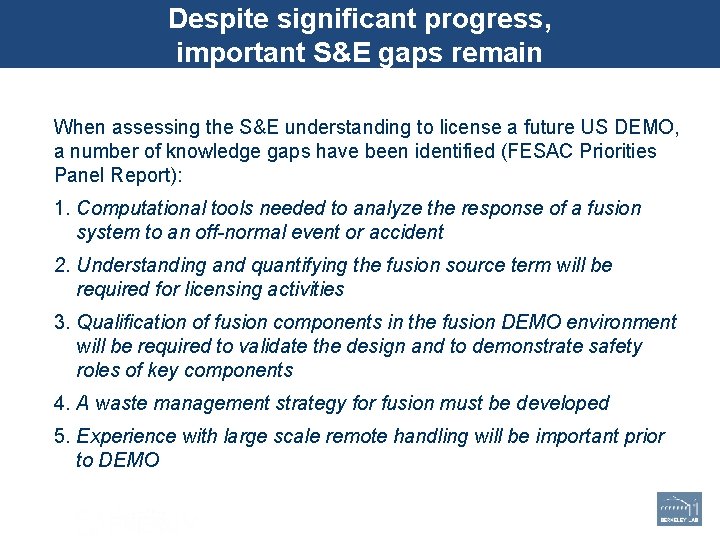
Despite significant progress, important S&E gaps remain When assessing the S&E understanding to license a future US DEMO, a number of knowledge gaps have been identified (FESAC Priorities Panel Report): 1. Computational tools needed to analyze the response of a fusion system to an off-normal event or accident 2. Understanding and quantifying the fusion source term will be required for licensing activities 3. Qualification of fusion components in the fusion DEMO environment will be required to validate the design and to demonstrate safety roles of key components 4. A waste management strategy for fusion must be developed 5. Experience with large scale remote handling will be important prior to DEMO Office of Science 4 4
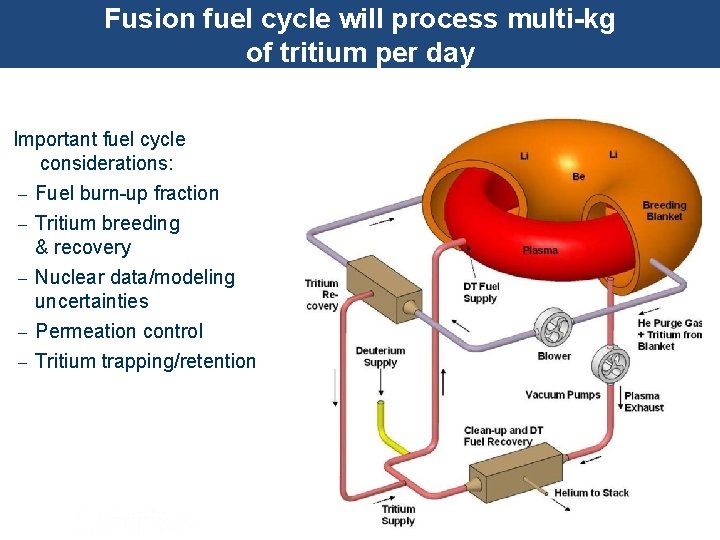
Fusion fuel cycle will process multi-kg of tritium per day Important fuel cycle considerations: – Fuel burn-up fraction – Tritium breeding & recovery – Nuclear data/modeling uncertainties – Permeation control – Tritium trapping/retention Office of Science 5 5
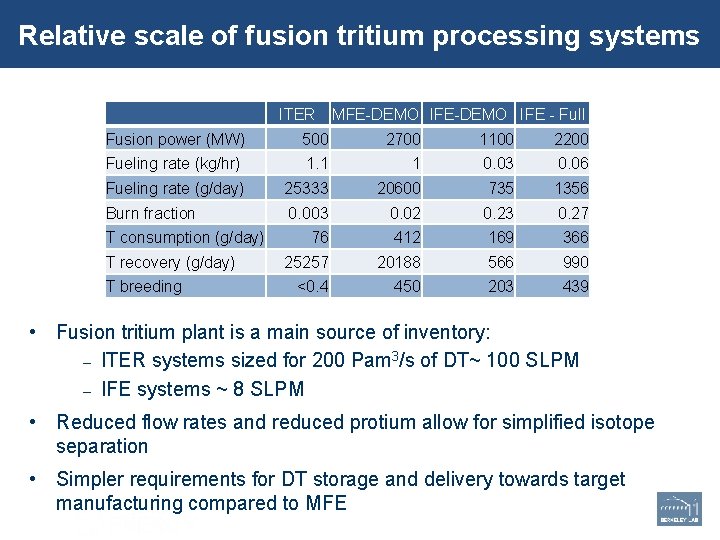
Relative scale of fusion tritium processing systems ITER MFE-DEMO IFE - Full Fusion power (MW) 500 2700 1100 2200 Fueling rate (kg/hr) 1. 1 1 0. 03 0. 06 Fueling rate (g/day) 25333 20600 735 1356 Burn fraction 0. 003 0. 02 0. 23 0. 27 76 412 169 366 25257 20188 566 990 <0. 4 450 203 439 T consumption (g/day) T recovery (g/day) T breeding • Fusion tritium plant is a main source of inventory: – ITER systems sized for 200 Pam 3/s of DT~ 100 SLPM – IFE systems ~ 8 SLPM • Reduced flow rates and reduced protium allow for simplified isotope separation • Simpler requirements for DT storage and delivery towards target manufacturing compared to MFE Office of Science 6 6
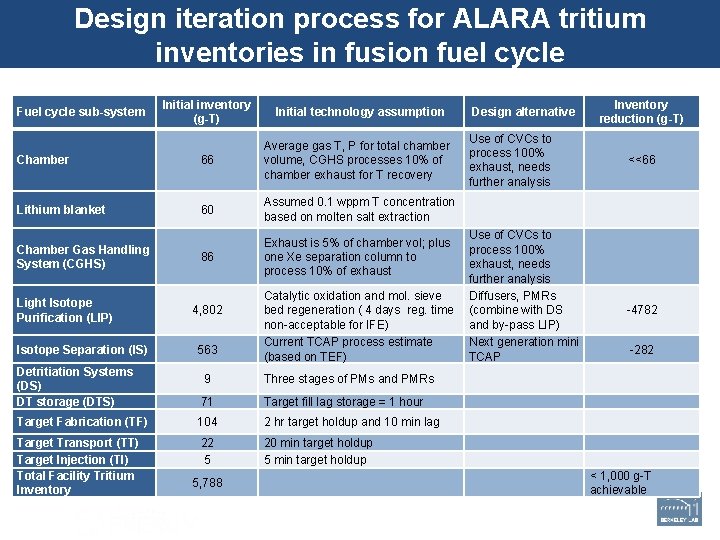
Design iteration process for ALARA tritium inventories in fusion fuel cycle Fuel cycle sub-system Initial inventory (g-T) Initial technology assumption Chamber 66 Average gas T, P for total chamber volume, CGHS processes 10% of chamber exhaust for T recovery Lithium blanket 60 Assumed 0. 1 wppm T concentration based on molten salt extraction 86 Exhaust is 5% of chamber vol; plus one Xe separation column to process 10% of exhaust Chamber Gas Handling System (CGHS) Light Isotope Purification (LIP) Isotope Separation (IS) 4, 802 563 Catalytic oxidation and mol. sieve bed regeneration ( 4 days reg. time non-acceptable for IFE) Current TCAP process estimate (based on TEF) Detritiation Systems (DS) DT storage (DTS) 9 Three stages of PMs and PMRs 71 Target fill lag storage = 1 hour Target Fabrication (TF) 104 2 hr target holdup and 10 min lag Target Transport (TT) Target Injection (TI) Total Facility Tritium Inventory 22 5 20 min target holdup 5 min target holdup Use of CVCs to process 100% exhaust, needs further analysis Diffusers, PMRs (combine with DS and by-pass LIP) Next generation mini TCAP Inventory reduction (g-T) <<66 -4782 -282 < 1, 000 g-T achievable 5, 788 Office of Science Design alternative 7 7
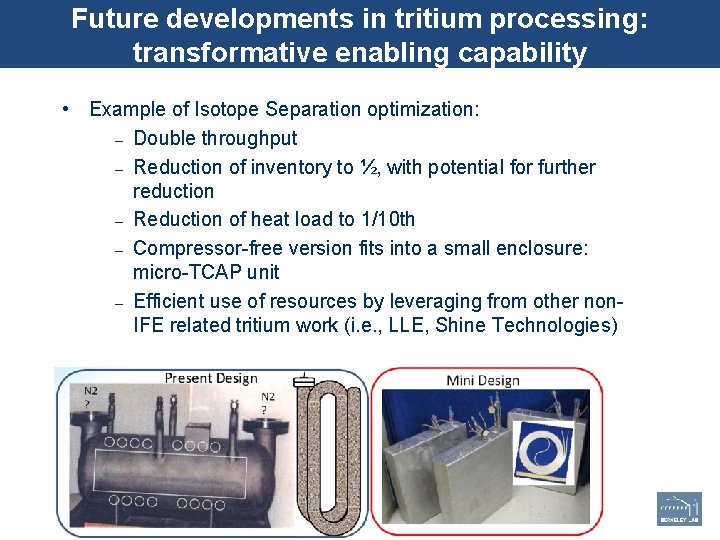
Future developments in tritium processing: transformative enabling capability • Example of Isotope Separation optimization: – Double throughput – Reduction of inventory to ½, with potential for further reduction – Reduction of heat load to 1/10 th – Compressor-free version fits into a small enclosure: micro-TCAP unit – Efficient use of resources by leveraging from other non. IFE related tritium work (i. e. , LLE, Shine Technologies) Office of Science 8 8
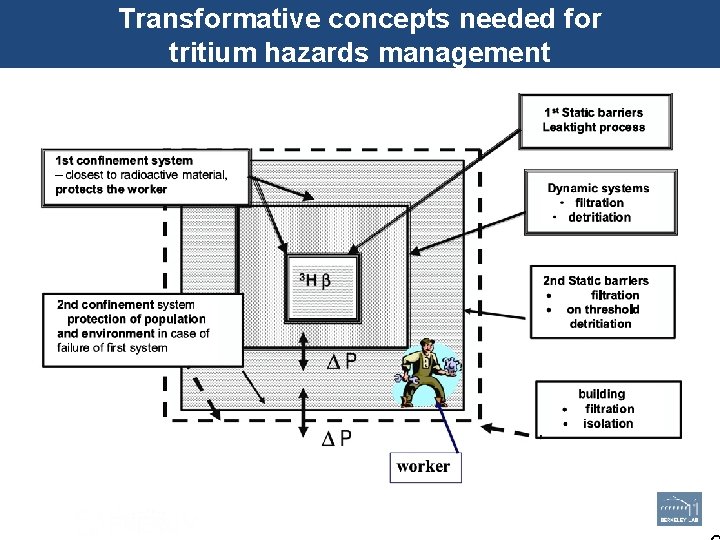
Transformative concepts needed for tritium hazards management Office of Science 9 9
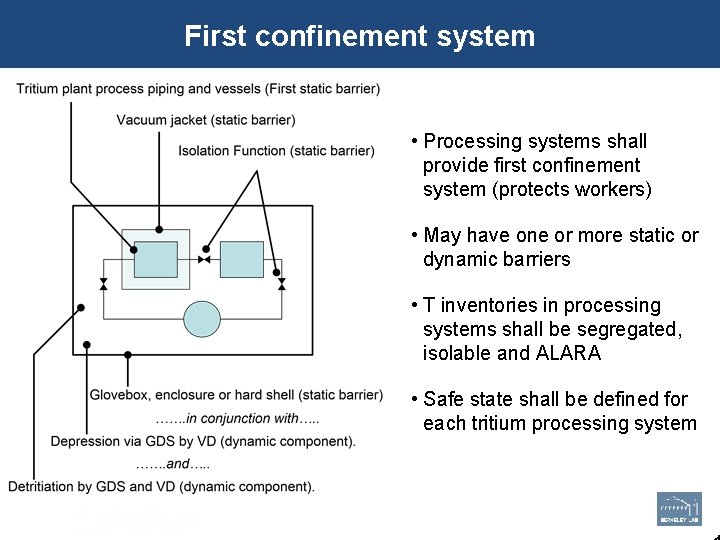
First confinement system • Processing systems shall provide first confinement system (protects workers) • May have one or more static or dynamic barriers • T inventories in processing systems shall be segregated, isolable and ALARA • Safe state shall be defined for each tritium processing system Office of Science 10 10
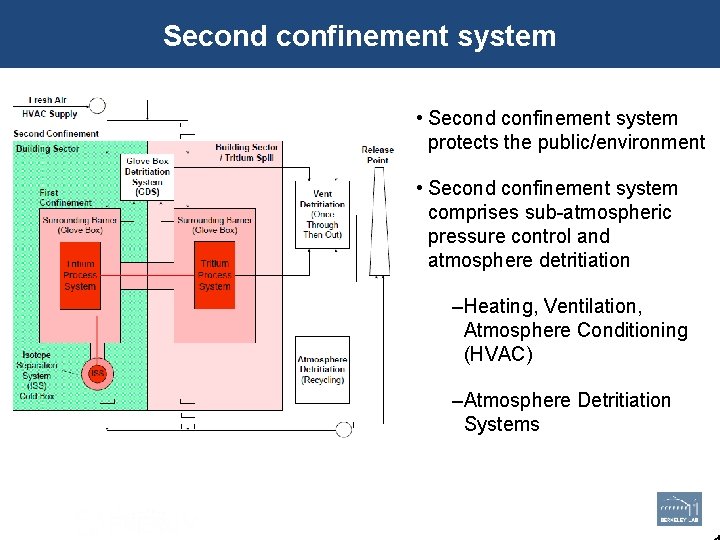
Second confinement system • Second confinement system protects the public/environment • Second confinement system comprises sub-atmospheric pressure control and atmosphere detritiation – Heating, Ventilation, Atmosphere Conditioning (HVAC) – Atmosphere Detritiation Systems Office of Science 11 11
Let’s talk about lithium… • Lithium has been proposed as blanket and/or PFC material • T has a very high solubility in Li • To meet safety objectives, recovery system must reduce steady state inventory to very low (0. 1 -1 appm) level • Low T vapor pressure makes recovery from vapor phase difficult • Various methods have been proposed, each presents challenges: – Gettering process (slow kinetics, some JA work for IFMIF) – Permeation window (too slow, impurity effects, not practical at low T-concentration) – Cold trap (Na fast reactors, ITER-JA, requires low temperatures) – Vacuum distillation (some RF work, not practical below 1000 C) – Molten salt recovery (TITAN, ITER, LIFE) Office of Science 12 12
Pros and cons of liquid lithium • Li has several advantages: – Good tritium breeding, no need for Be multiplier – Low corrosion – Good heat transfer – Low density and low hydrostatic stress – Same FW and blanket coolant simplifies design – Low T permeation due to high solubility • However there are two potential issues that require attention – Need to control fire hazards posed by Li – Need to demonstrate tritium extraction from Li Office of Science 13 13
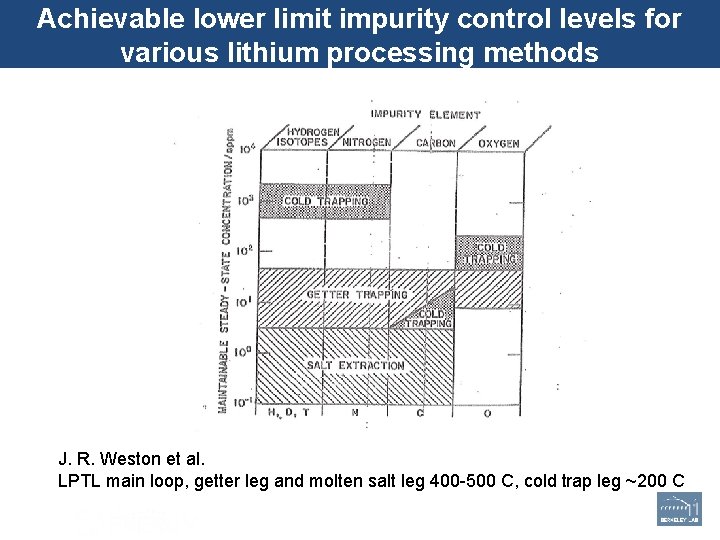
Achievable lower limit impurity control levels for various lithium processing methods J. R. Weston et al. LPTL main loop, getter leg and molten salt leg 400 -500 C, cold trap leg ~200 C Office of Science 14 14
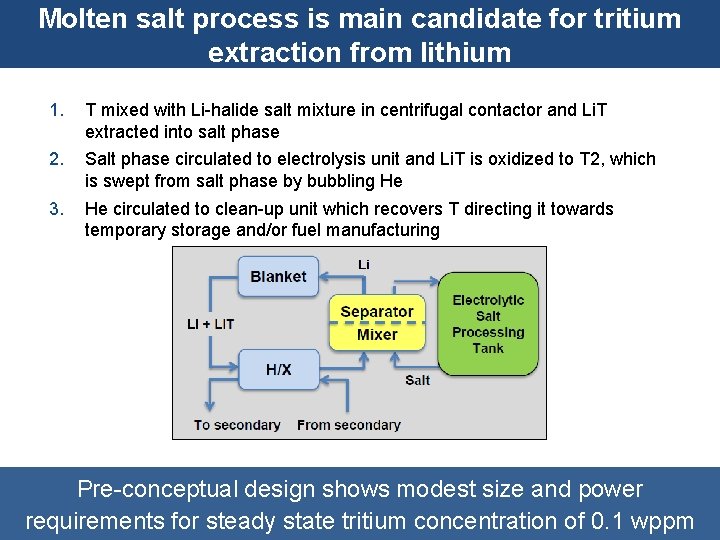
Molten salt process is main candidate for tritium extraction from lithium 1. T mixed with Li-halide salt mixture in centrifugal contactor and Li. T extracted into salt phase 2. Salt phase circulated to electrolysis unit and Li. T is oxidized to T 2, which is swept from salt phase by bubbling He 3. He circulated to clean-up unit which recovers T directing it towards temporary storage and/or fuel manufacturing Pre-conceptual design shows modest size and power Office of requirements for steady state tritium concentration of 0. 1 wppm 15 Science 15
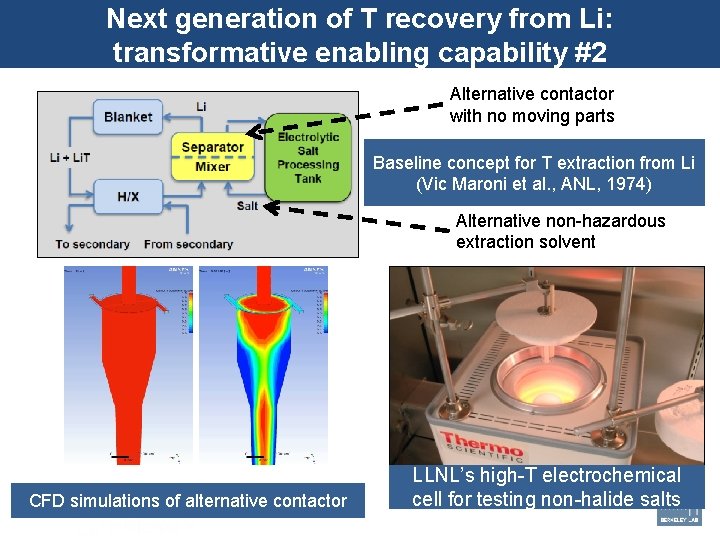
Next generation of T recovery from Li: transformative enabling capability #2 Alternative contactor with no moving parts Baseline concept for T extraction from Li (Vic Maroni et al. , ANL, 1974) Alternative non-hazardous extraction solvent LLNL’s high-T electrochemical cell for testing non-halide salts CFD simulations of alternative contactor Office of Science 16 16
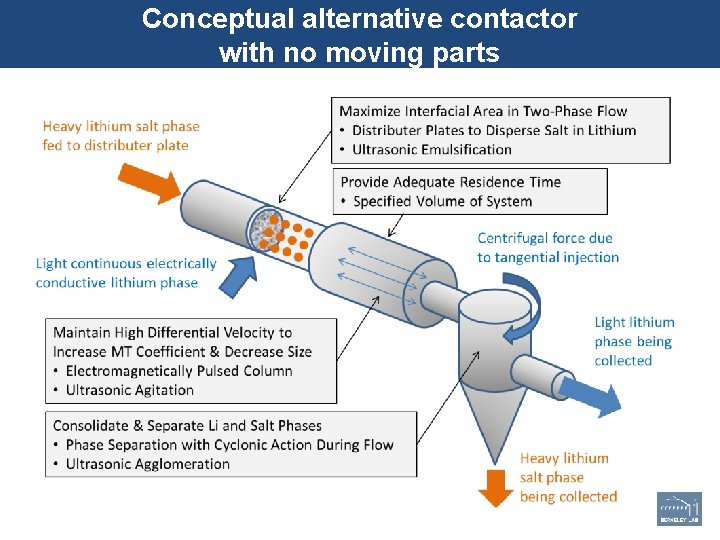
Conceptual alternative contactor with no moving parts Office of Science 17 17
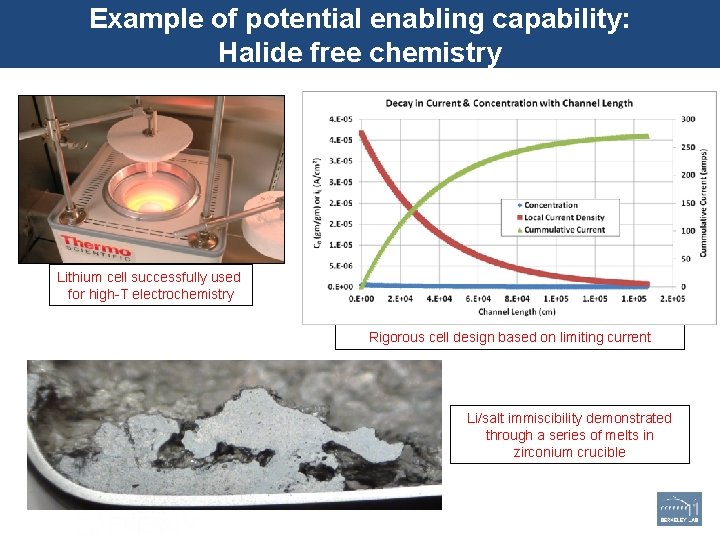
Example of potential enabling capability: Halide free chemistry Lithium cell successfully used for high-T electrochemistry Rigorous cell design based on limiting current Li/salt immiscibility demonstrated through a series of melts in zirconium crucible Office of Science 18 18
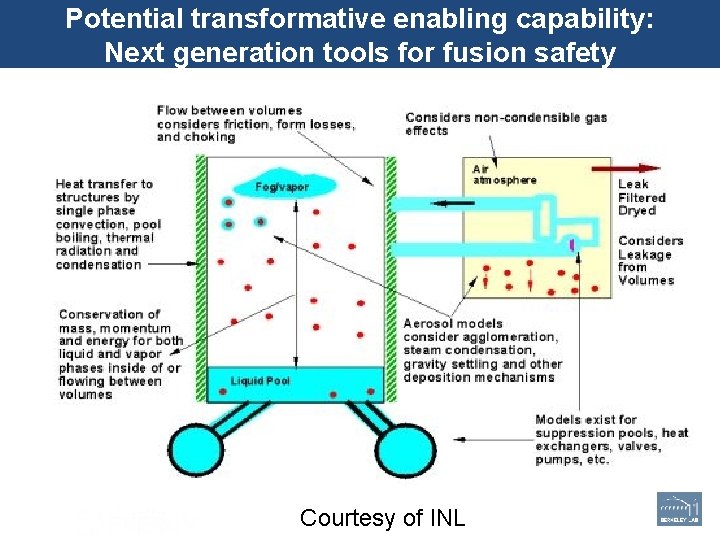
Potential transformative enabling capability: Next generation tools for fusion safety Office of Science Courtesy of INL 19 19
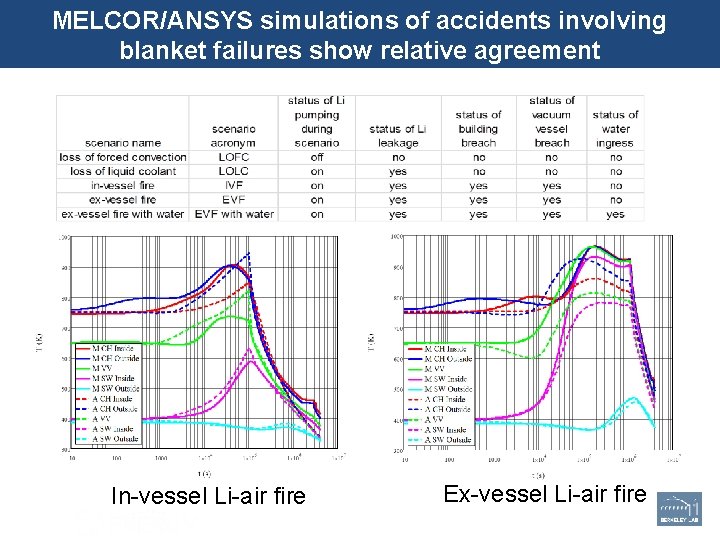
MELCOR/ANSYS simulations of accidents involving blanket failures show relative agreement Ex-vessel Li-air fire In-vessel Li-air fire Office of Science 20 20
Summary • Tritium safety enabling capabilities are inherently TRANSFORMATIVE as they are KEY for success of fusion • Areas in need of work are: ü Tritium processing technologies that allow minimization of inventories ü Tritium confinement technologies that allow for mitigation of accident consequences ü Enhanced simulation tools for improved understanding of tritium transport and release the environment during normal and off-normal events 21 Office of Science 21 21
- Slides: 21