
ENA detection techniques Instrument considerations Elisabetta De Angelis
ENA detection techniques: Instrument considerations Elisabetta De Angelis IFSI-INAF Rome, Italy Joint SERENA-HEWG Conference Santa Fe, May 12 -14, 2008
Outline • Energetic Neutral Atoms instrument brief history • Principal ENA generating processes • ENA instrument schematic • Low-Energetic Neutral Atoms case Joint SERENA-HEWG Conference Santa Fe, May 12 -14, 2008 2
The detection of ENA: Hystorical survey • • • • 1950 evidence of ENA in the Earth environment (Doppler shifted emission of Ha (6563 Å) in an aurora) 1959 study of ENA investigation possibility 1961 1968 1° instrument that detect ENA (in situ). 1971 failed experiment ( Mars 3/RIEP) 1975 project not used (slotted disk velocity selector for LENA, J. H. Moore et al, Sp. Sci. Instrum. 1, 377 , 1975) 1982 IMP 7, 8 – ISEE 1 validation of remote sensing magnetosphere processes with ENA detection 1985 1° ENA image from ISEE-1 (Roleof et al. JGR 90, 10991, 1985) 1990 ULYSSES (GAS) 1991 CRRES 1992 GEOTAIL (MICS) 1995 ASTRID (PIPPI) 1995 SAC/B (ISENA) 1997 CASSINI (INCA) } New millenium • • • 2000 IMAGE 2003 Mars. EXpress (Aspera 3) 2003 Double Star (NUADU) 2005 Venus Express (Aspera 4) 2006 Twins To be launched • 2008 Chandrayyan • 2008 IBEX • 2013 BEPI COLOMBO Joint SERENA-HEWG Conference Santa Fe, May 12 -14, 2008 3
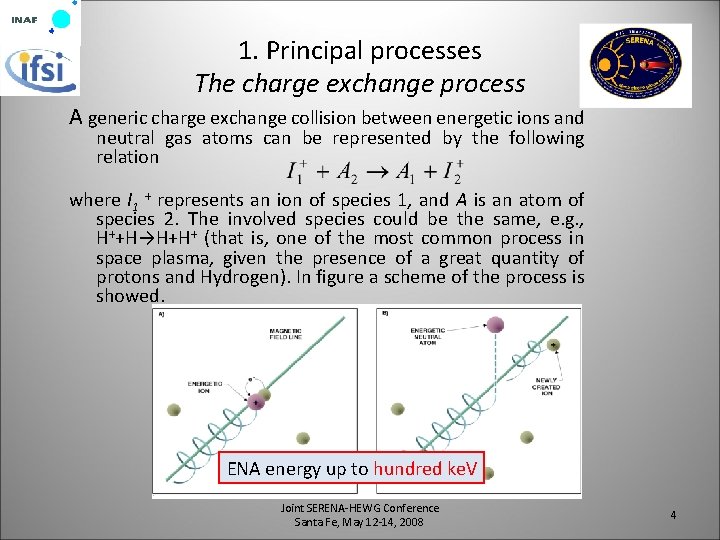
1. Principal processes The charge exchange process A generic charge exchange collision between energetic ions and neutral gas atoms can be represented by the following relation where I 1 + represents an ion of species 1, and A is an atom of species 2. The involved species could be the same, e. g. , H++H→H+H+ (that is, one of the most common process in space plasma, given the presence of a great quantity of protons and Hydrogen). In figure a scheme of the process is showed. ENA energy up to hundred ke. V Joint SERENA-HEWG Conference Santa Fe, May 12 -14, 2008 4
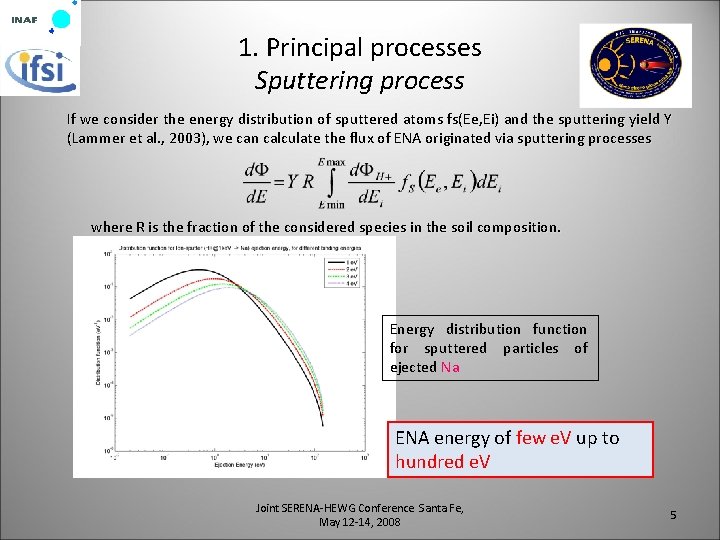
1. Principal processes Sputtering process If we consider the energy distribution of sputtered atoms fs(Ee, Ei) and the sputtering yield Y (Lammer et al. , 2003), we can calculate the flux of ENA originated via sputtering processes where R is the fraction of the considered species in the soil composition. Energy distribution function for sputtered particles of ejected Na ENA energy of few e. V up to hundred e. V Joint SERENA-HEWG Conference Santa Fe, May 12 -14, 2008 5
2. The ENA instruments When we speak about an ENA instrument we should always specify the energy range of the instrument, because each design is chosen in order to accomplish a specific energy range. In fact, nowadays a unique detection technique for the entire ENA energy range doesn’t exist. It starts from few e. V up to hundreds of ke. V, and such an extended range is able to acquire different information, useful for different environments. Conventionally, we can consider the ENA separated into three categories, depending on the energy range: LENA (Low Energetic Neutral Atom) few e. V- 1 ke. V MENA (Medium Energetic Neutral Atom) 1 ke. V – 30 Ke. V HENA (High Energetic Neutral Atom) 30 Ke. V- hundreds of Ke. V The limits of these ranges are not frozen, and often they differ from each other or are partially superposed, but they will help us to distinguish the diverse techniques applied. Joint SERENA-HEWG Conference Santa Fe, May 12 -14, 2008 6
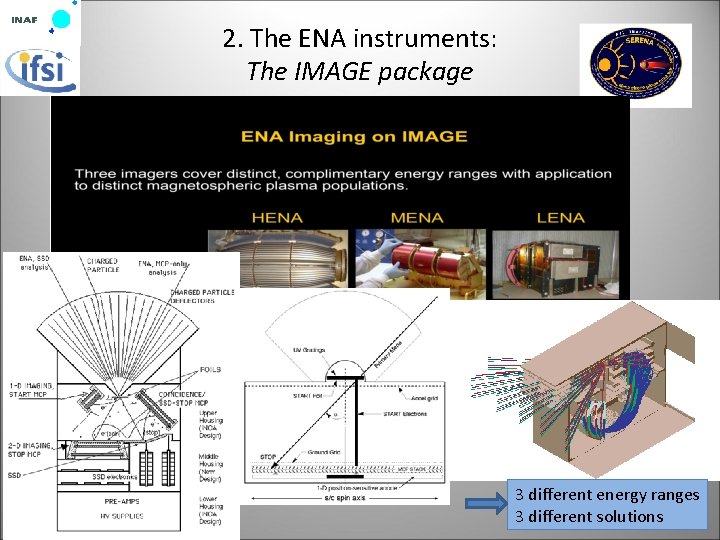
2. The ENA instruments: The IMAGE package 3 different energy ranges 3 different solutions

2. ENA instrument schematic Input Analysis 1. ENA direction Task 1. Particle 2. Photons rejections identification 3. Charged particles 2. Energy analyses Detection 1. Time of Flight 2. Energy resolution deflection 1. Sectored collimator to Elements and Solutions 1. Carbon Foil or 1. Start and Stop have needed angular conversion surface detectors: 1 -D, 2 -D resolution generating secondary MCP; SSD 2. Rejection techniques: electrons Filters-gratings- 2. Electrostatic photons/ENA trajectory analyser for ionised separation ENA 2. Pulse height signal or position detection 3. Deflection plates Joint SERENA-HEWG Conference Santa Fe, May 12 -14, 2008 8
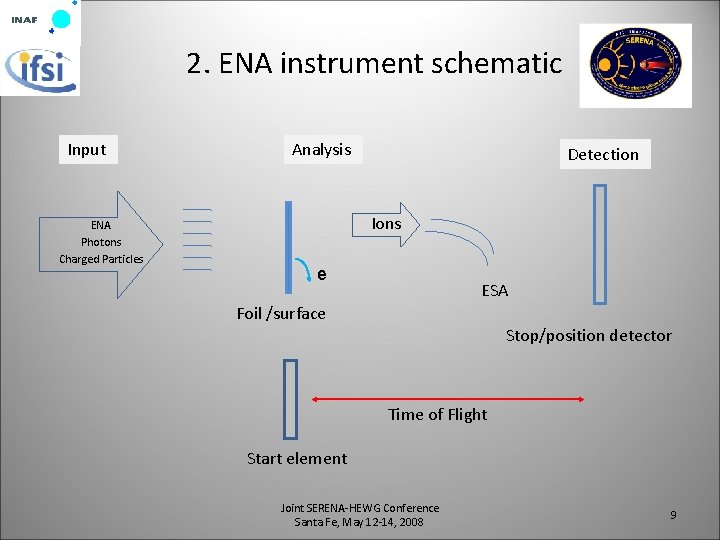
2. ENA instrument schematic Input ENA Photons Charged Particles Analysis Detection Ions e ESA Foil /surface Stop/position detector Time of Flight Start element Joint SERENA-HEWG Conference Santa Fe, May 12 -14, 2008 9
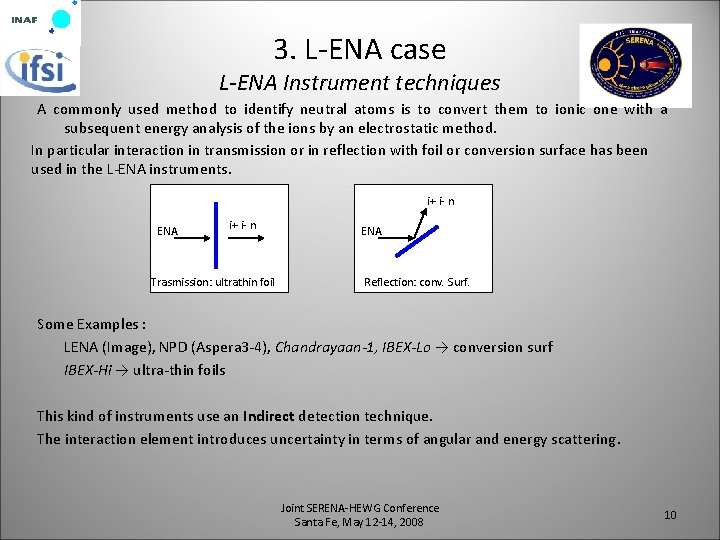
3. L-ENA case L-ENA Instrument techniques A commonly used method to identify neutral atoms is to convert them to ionic one with a subsequent energy analysis of the ions by an electrostatic method. In particular interaction in transmission or in reflection with foil or conversion surface has been used in the L-ENA instruments. i+ i- n ENA i+ i- n Trasmission: ultrathin foil ENA Reflection: conv. Surf. Some Examples : LENA (Image), NPD (Aspera 3 -4), Chandrayaan-1, IBEX-Lo → conversion surf IBEX-Hi → ultra-thin foils This kind of instruments use an Indirect detection technique. The interaction element introduces uncertainty in terms of angular and energy scattering. Joint SERENA-HEWG Conference Santa Fe, May 12 -14, 2008 10
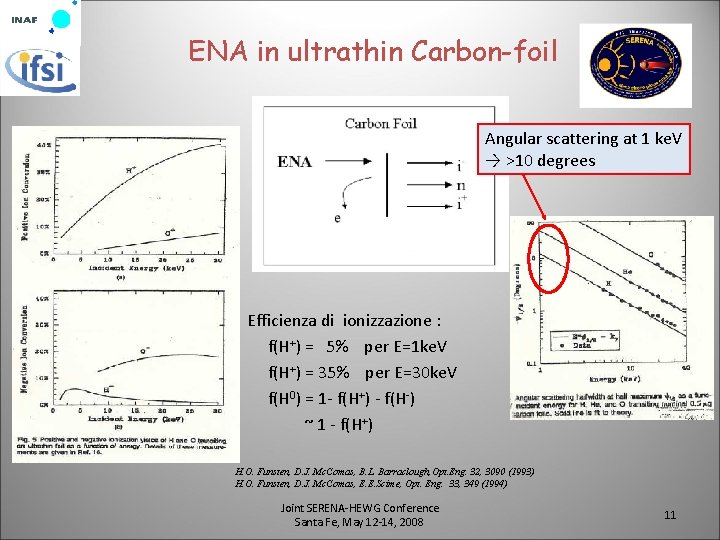
ENA in ultrathin Carbon-foil Angular scattering at 1 ke. V → >10 degrees Efficienza di ionizzazione : f(H+) = 5% per E=1 ke. V f(H+) = 35% per E=30 ke. V f(H 0) = 1 - f(H+) - f(H-) ~ 1 - f(H+) H. O. Funsten, D. J. Mc. Comas, B. L. Barraclough, Opt. Eng. 32, 3090 (1993) H. O. Funsten, D. J. Mc. Comas, E. E. Scime, Opt. Eng. 33, 349 (1994) Joint SERENA-HEWG Conference Santa Fe, May 12 -14, 2008 11
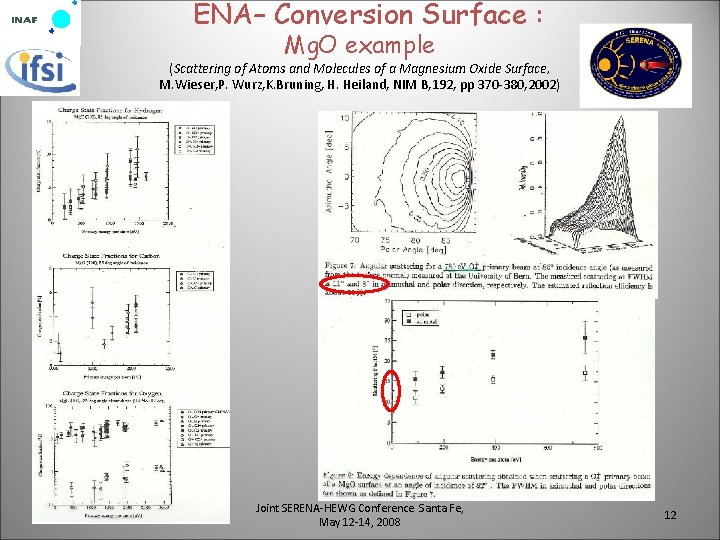
ENA– Conversion Surface : Mg. O example (Scattering of Atoms and Molecules of a Magnesium Oxide Surface, M. Wieser, P. Wurz, K. Bruning, H. Heiland, NIM B, 192, pp 370 -380, 2002) Joint SERENA-HEWG Conference Santa Fe, May 12 -14, 2008 12
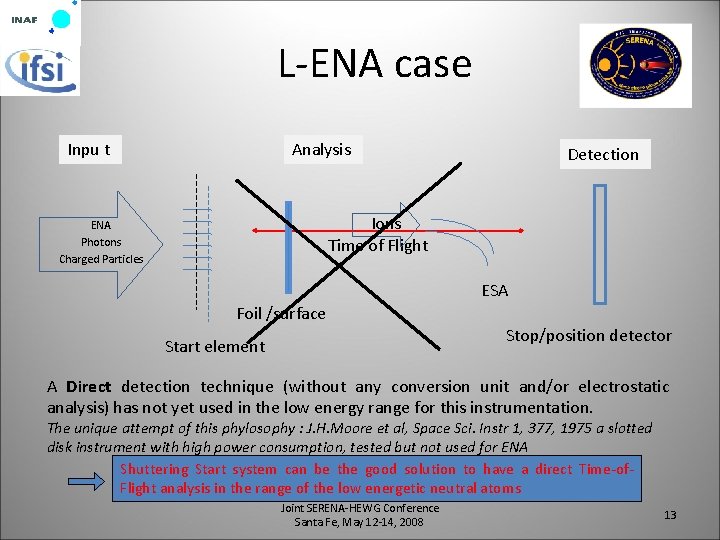
L-ENA case Inpu t Analysis Detection Ions Time of Flight ENA Photons Charged Particles ESA Foil /surface Stop/position detector Start element A Direct detection technique (without any conversion unit and/or electrostatic analysis) has not yet used in the low energy range for this instrumentation. The unique attempt of this phylosophy : J. H. Moore et al, Space Sci. Instr 1, 377, 1975 a slotted disk instrument with high power consumption, tested but not used for ENA Shuttering Start system can be the good solution to have a direct Time-of. Flight analysis in the range of the low energetic neutral atoms Joint SERENA-HEWG Conference Santa Fe, May 12 -14, 2008 13
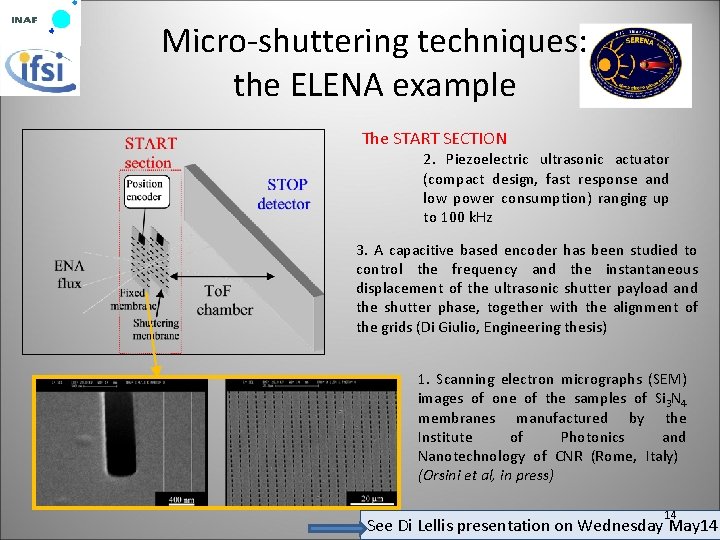
Micro-shuttering techniques: the ELENA example The START SECTION 2. Piezoelectric ultrasonic actuator (compact design, fast response and low power consumption) ranging up to 100 k. Hz 3. A capacitive based encoder has been studied to control the frequency and the instantaneous displacement of the ultrasonic shutter payload and the shutter phase, together with the alignment of the grids (Di Giulio, Engineering thesis) 1. Scanning electron micrographs (SEM) images of one of the samples of Si 3 N 4 membranes manufactured by the Institute of Photonics and Nanotechnology of CNR (Rome, Italy) (Orsini et al, in press) 14 See Di Lellis presentation on Wednesday May 14
Direct detection of L-ENA PRO • No interactions of ENA with any element preserve information of energy and direction • Low weight and consumption • Photons can be distinguished from ENA CONTRO • Detector efficiency at low energies • Limit on mass resolution • Photons can enter into the entrance with ENA and reach detector Joint SERENA-HEWG Conference Santa Fe, May 12 -14, 2008 15
Conclusions • From Scientific point of view the ENA detection has proved a great potentiality and now it promise new goals with the L-ENA detection • From Technological point of view new solution has been solicited and the under development systems could open new possibilities of investigation. Joint SERENA-HEWG Conference Santa Fe, May 12 -14, 2008 16
- Slides: 16