
Emulating Massively Parallel Peta FLOPS Machines Neelam Saboo
Emulating Massively Parallel (Peta. FLOPS) Machines Neelam Saboo, Arun Kumar Singla Joshua Mostkoff Unger, Gengbin Zheng, Laxmikant V. Kalé http: //charm. cs. uiuc. edu Department of Computer Science Parallel Programming Laboratory
Roadmap • • • Blue. Gene Architecture Need for an Emulator Charm++ Blue. Gene Converse Blue. Gene Future Work
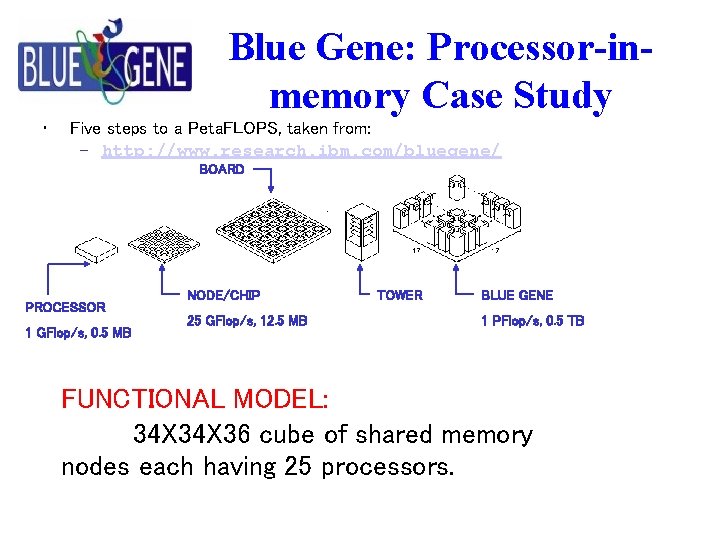
Blue Gene: Processor-inmemory Case Study • Five steps to a Peta. FLOPS, taken from: – http: //www. research. ibm. com/bluegene/ BOARD PROCESSOR 1 GFlop/s, 0. 5 MB NODE/CHIP 25 GFlop/s, 12. 5 MB TOWER BLUE GENE 1 PFlop/s, 0. 5 TB FUNCTIONAL MODEL: 34 X 36 cube of shared memory nodes each having 25 processors.
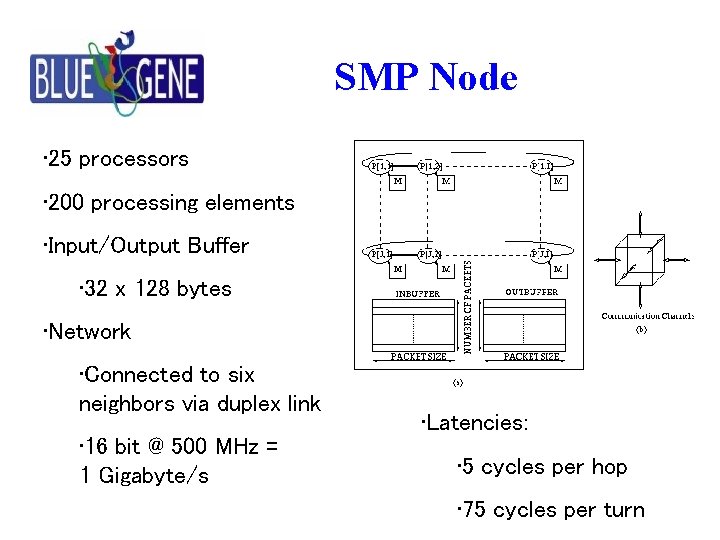
SMP Node • 25 processors • 200 processing elements • Input/Output Buffer • 32 x 128 bytes • Network • Connected to six neighbors via duplex link • 16 bit @ 500 MHz = 1 Gigabyte/s • Latencies: • 5 cycles per hop • 75 cycles per turn
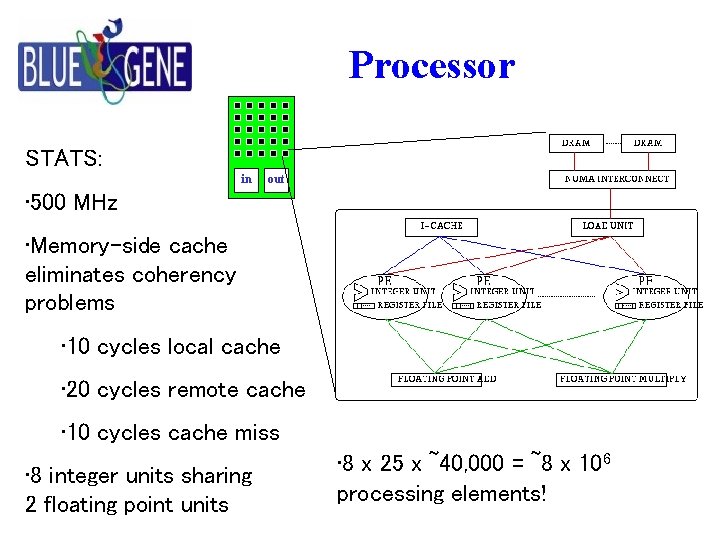
Processor STATS: in out • 500 MHz • Memory-side cache eliminates coherency problems • 10 cycles local cache • 20 cycles remote cache • 10 cycles cache miss • 8 integer units sharing 2 floating point units • 8 x 25 x ~40, 000 = ~8 x 10⁶ processing elements!
Need for Emulator • Emulator – enables programmer to develop, compile, and run software using programming interface that will be used in actual machine
Emulator Objectives • Emulate Blue Gene and other peta. FLOPS machines. • Memory limitations and time limitations on single processor requires that simulation MUST be performed on parallel architecture. • Issues: – Assume that program written for processor-inmemory machine will handle out-of-order execution and messaging. – Therefore don’t need complex event queue/rollback.
Emulator Implementation • What are basic data structures/interface? – Machine configuration (topology), handler registration – Nodes with node-level shared data – Threads (associated with each node) representing processing elements – Communication between nodes • How to handle all these objects on parallel architecture? How to handle object-to-object communication? • Difficulties of implementation eased by using Charm++, object-oriented parallel programming paradigm.
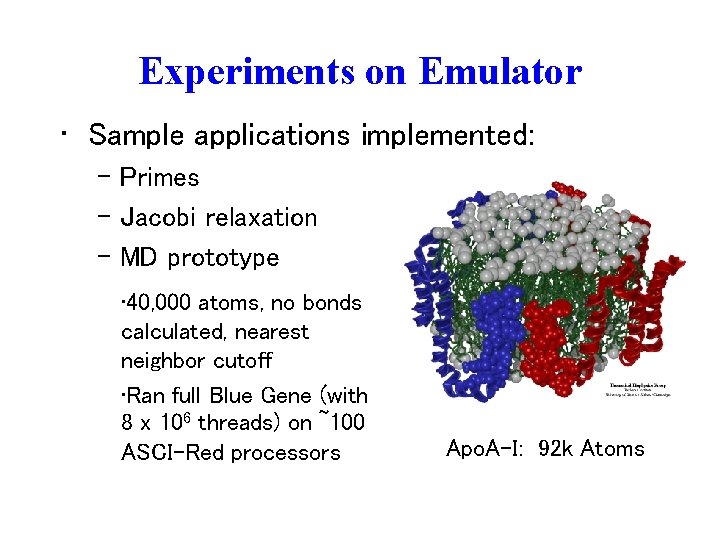
Experiments on Emulator • Sample applications implemented: – Primes – Jacobi relaxation – MD prototype • 40, 000 atoms, no bonds calculated, nearest neighbor cutoff • Ran full Blue Gene (with 8 x 10⁶ threads) on ~100 ASCI-Red processors Apo. A-I: 92 k Atoms
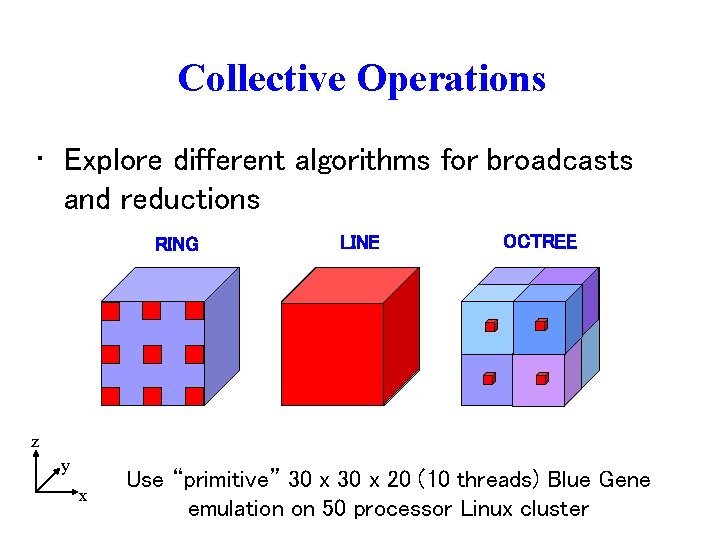
Collective Operations • Explore different algorithms for broadcasts and reductions RING LINE OCTREE z y x Use “primitive” 30 x 20 (10 threads) Blue Gene emulation on 50 processor Linux cluster
Converse Blue. Gene Emulator Objective • Performance estimation (with proper time stamping) • Provide API for building Charm++ on top of emulator.
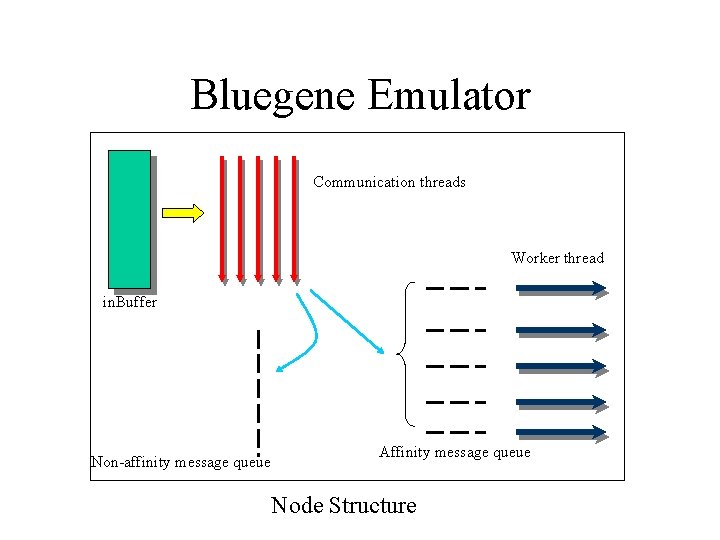
Bluegene Emulator Communication threads Worker thread in. Buffer Non-affinity message queue Affinity message queue Node Structure
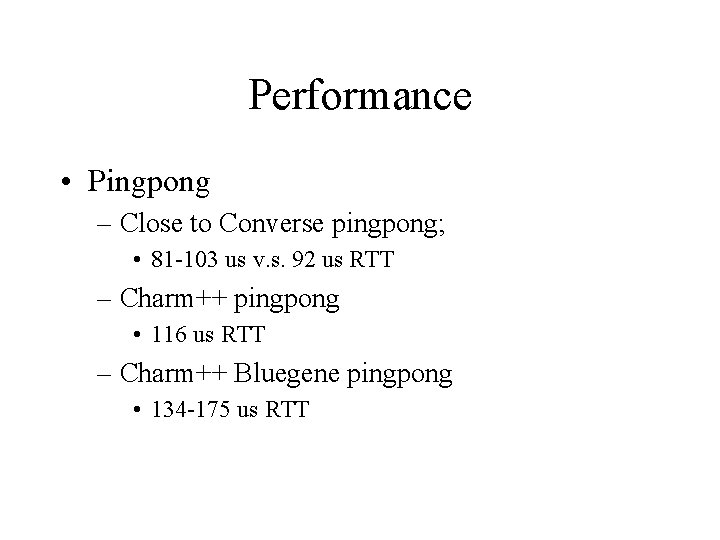
Performance • Pingpong – Close to Converse pingpong; • 81 -103 us v. s. 92 us RTT – Charm++ pingpong • 116 us RTT – Charm++ Bluegene pingpong • 134 -175 us RTT
Charm++ on top of Emulator • Blue. Gene thread represents Charm++ node; • Name conflict: – Cpv, Ctv – Msg. Send, etc – Ck. My. Pe(), Ck. Num. Pes(), etc
Future Work: Simulator • Lean. MD : Fully functional MD with only cutoff • How can we examine performance of algorithms on variants of processor-in-memory design in massive system? • Several layers of detail to measure – Basic: Correctly model performance, timestamp messages with correction for out-of-order execution – More detailed: network performance, memory access, modeling sharing of floating-point unit, estimation techniques
- Slides: 15