
EMT 1124 ANALOG ELECTRONIC I LECTURE 4 BJT
EMT 112/4 ANALOG ELECTRONIC I LECTURE 4 BJT AC ANALYSIS (COMMON-EMITTER AMPLIFIERS) 13 TH JANUARY 2009 DKP 2 1700 -1800
INTRODUCTION 3 basic single-transistor amplifier configuration that can be formed are: ◦ Common-Emitter (C-E configuration) ◦ Common-Collector / emitter follower (C-C configuration) ◦ Common-Base (C-B configuration) Each configuration has its own advantages in form of: ◦ Input impedance ◦ Output impedance ◦ Current / voltage amplification
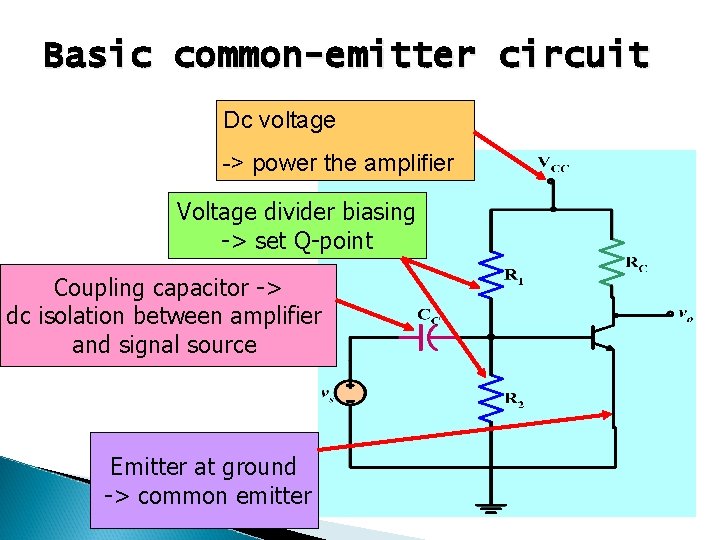
Basic common-emitter circuit Dc voltage -> power the amplifier Voltage divider biasing -> set Q-point Coupling capacitor -> dc isolation between amplifier and signal source Emitter at ground -> common emitter
DC & AC LOAD LINE ANALYSIS DC load line ◦ Visualized the relationship between Q-point & transistor characteristics AC load line ◦ Visualized the relationship between small-signal response & transistor characteristics ◦ Occurs when capacitors added in transistor circuit
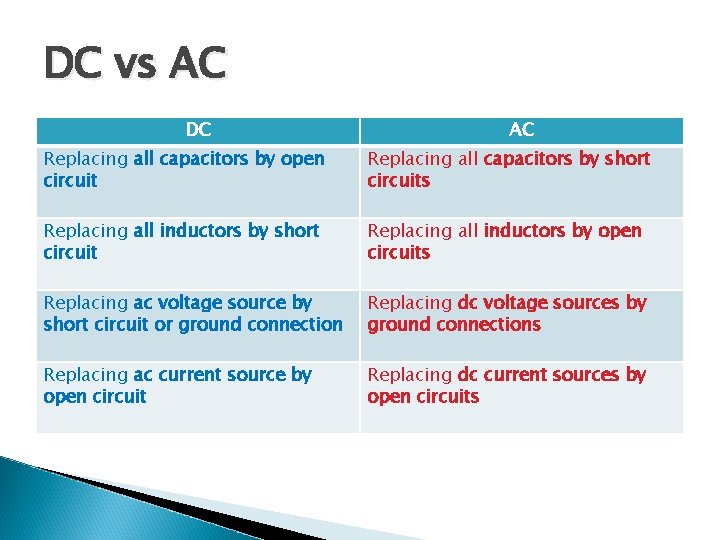
DC vs AC DC AC Replacing all capacitors by open circuit Replacing all capacitors by short circuits Replacing all inductors by short circuit Replacing all inductors by open circuits Replacing ac voltage source by short circuit or ground connection Replacing dc voltage sources by ground connections Replacing ac current source by open circuit Replacing dc current sources by open circuits
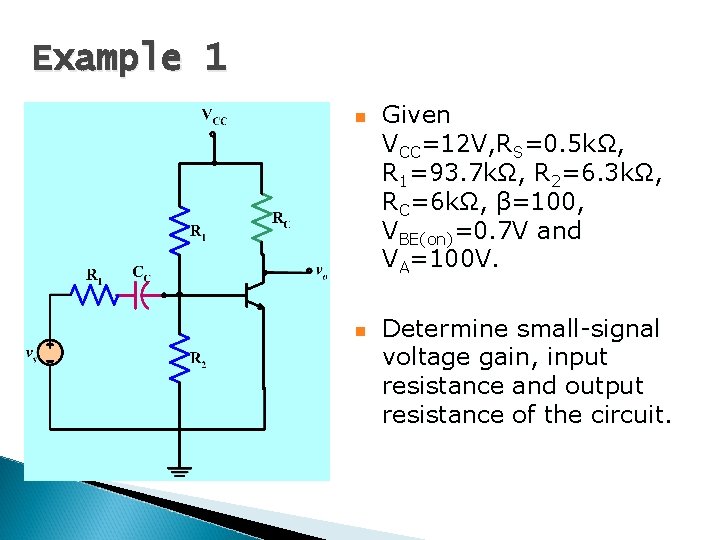
Example 1 n n Given VCC=12 V, RS=0. 5 kΩ, R 1=93. 7 kΩ, R 2=6. 3 kΩ, RC=6 kΩ, β=100, VBE(on)=0. 7 V and VA=100 V. Determine small-signal voltage gain, input resistance and output resistance of the circuit.
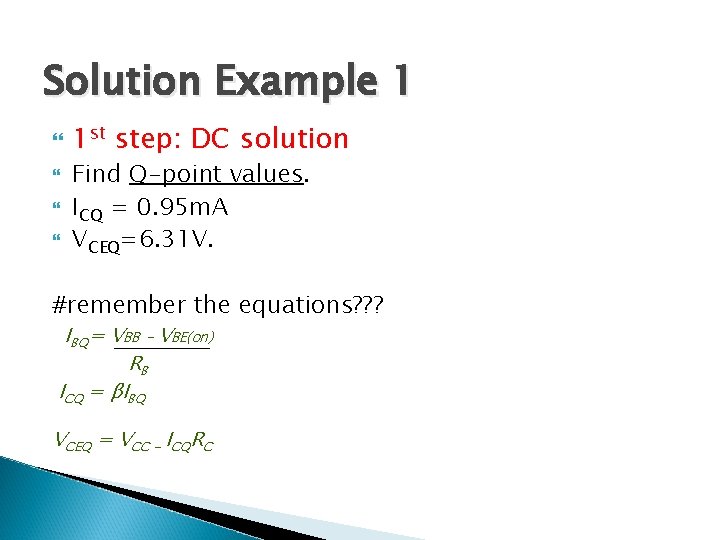
Solution Example 1 1 st step: DC solution Find Q-point values. ICQ = 0. 95 m. A VCEQ=6. 31 V. #remember the equations? ? ? IBQ= VBB – VBE(on) RB ICQ = βIBQ VCEQ = VCC - ICQRC
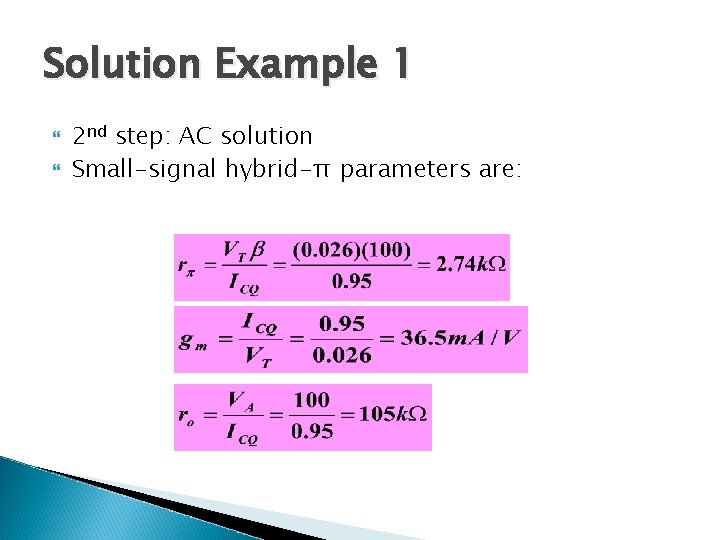
Solution Example 1 2 nd step: AC solution Small-signal hybrid-π parameters are:
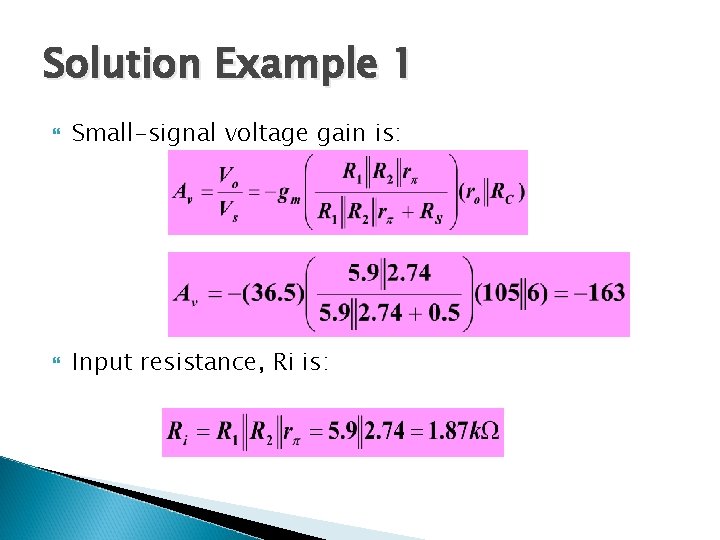
Solution Example 1 Small-signal voltage gain is: Input resistance, Ri is:
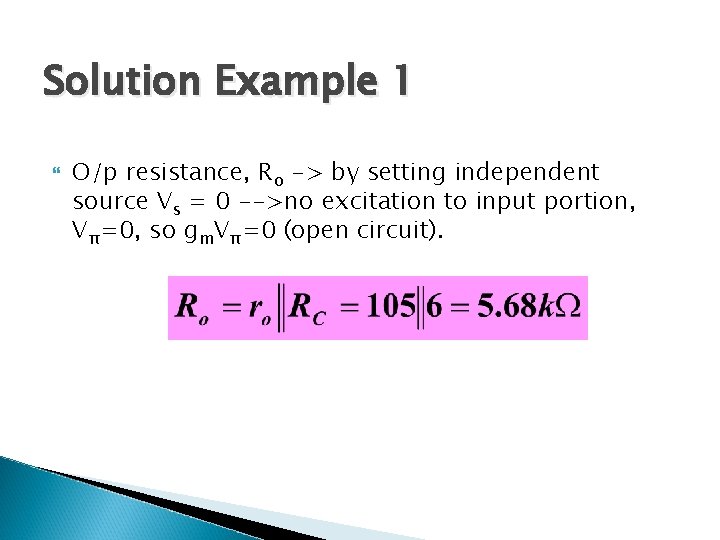
Solution Example 1 O/p resistance, Ro -> by setting independent source Vs = 0 -->no excitation to input portion, Vπ=0, so gm. Vπ=0 (open circuit).
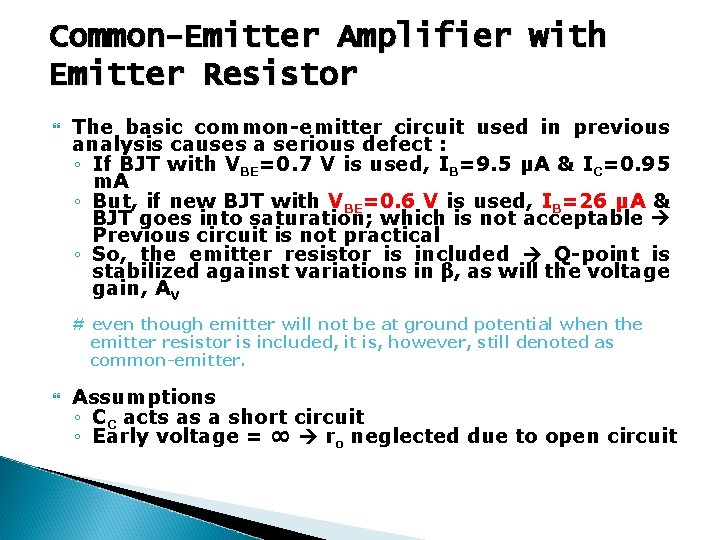
Common-Emitter Amplifier with Emitter Resistor The basic common-emitter circuit used in previous analysis causes a serious defect : ◦ If BJT with VBE=0. 7 V is used, IB=9. 5 μA & IC=0. 95 m. A ◦ But, if new BJT with VBE=0. 6 V is used, IB=26 μA & BJT goes into saturation; which is not acceptable Previous circuit is not practical ◦ So, the emitter resistor is included Q-point is stabilized against variations in β, as will the voltage gain, AV # even though emitter will not be at ground potential when the emitter resistor is included, it is, however, still denoted as common-emitter. Assumptions ◦ CC acts as a short circuit ◦ Early voltage = ∞ ro neglected due to open circuit
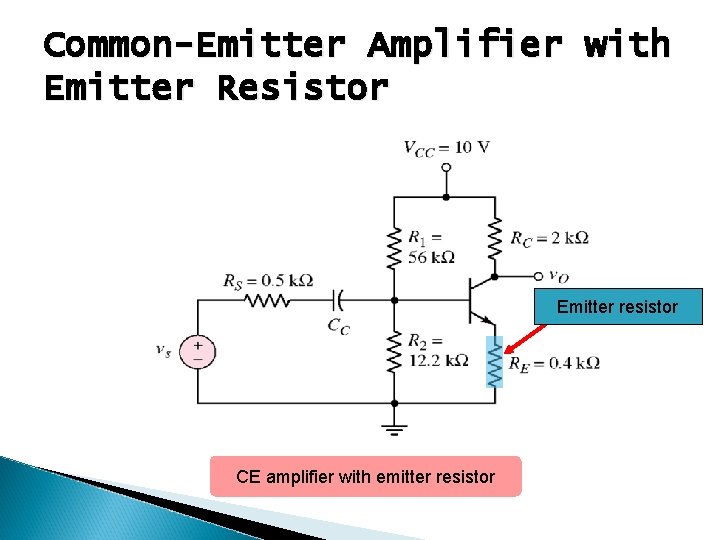
Common-Emitter Amplifier with Emitter Resistor Emitter resistor CE amplifier with emitter resistor
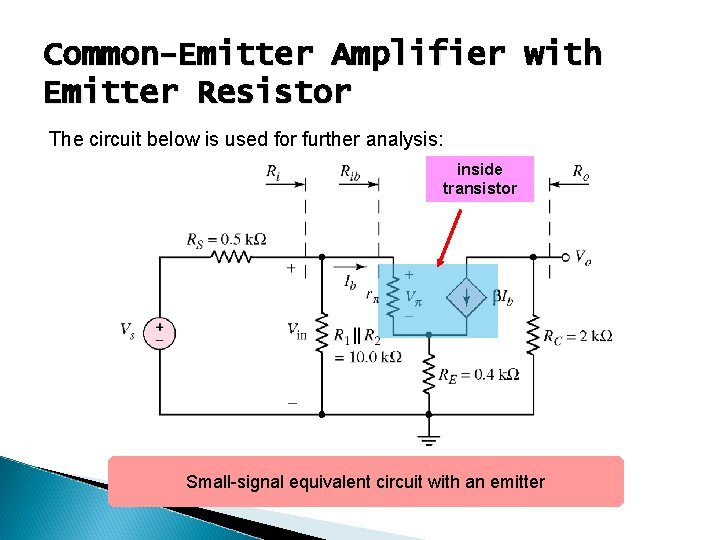
Common-Emitter Amplifier with Emitter Resistor The circuit below is used for further analysis: inside transistor Small-signal equivalent circuit with an emitter
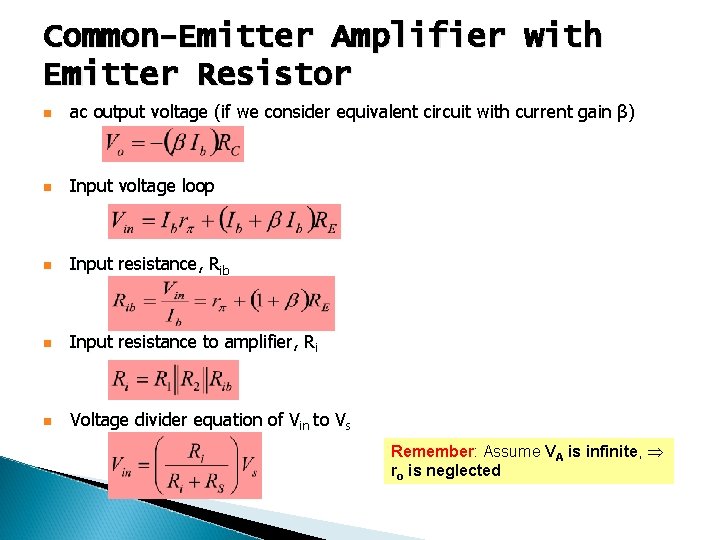
Common-Emitter Amplifier with Emitter Resistor n ac output voltage (if we consider equivalent circuit with current gain β) n Input voltage loop n Input resistance, Rib n Input resistance to amplifier, Ri n Voltage divider equation of Vin to Vs Remember: Assume VA is infinite, ro is neglected
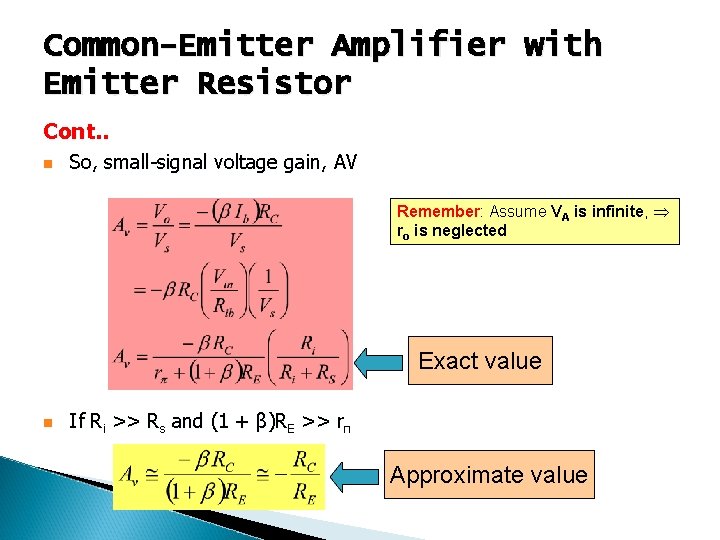
Common-Emitter Amplifier with Emitter Resistor Cont. . n So, small-signal voltage gain, AV Remember: Assume VA is infinite, ro is neglected Exact value n If Ri >> Rs and (1 + β)RE >> rπ Approximate value

Please submit your lab report The end for today
- Slides: 16