
EMSL Our Path Forward as a National Scientific


- Slides: 23
EMSL Our Path Forward as a National Scientific User Facility Andy Felmy EMSL Chief Scientist for Scientific Programs
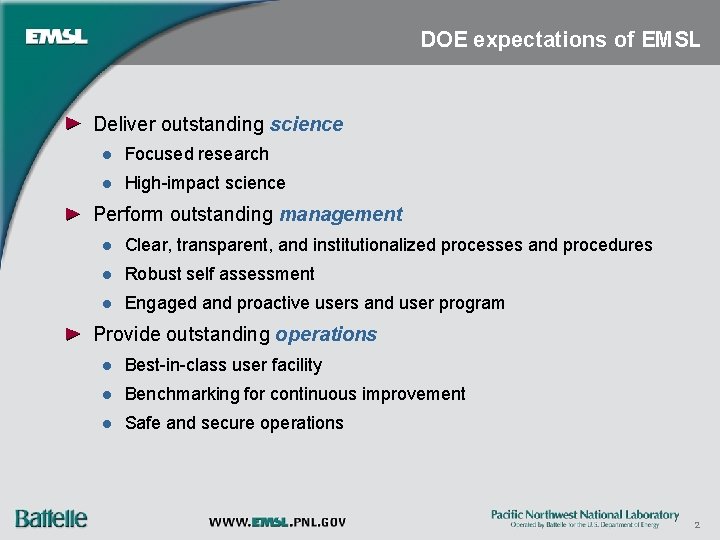
DOE expectations of EMSL Deliver outstanding science l Focused research l High-impact science Perform outstanding management l Clear, transparent, and institutionalized processes and procedures l Robust self assessment l Engaged and proactive users and user program Provide outstanding operations l Best-in-class user facility l Benchmarking for continuous improvement l Safe and secure operations 2
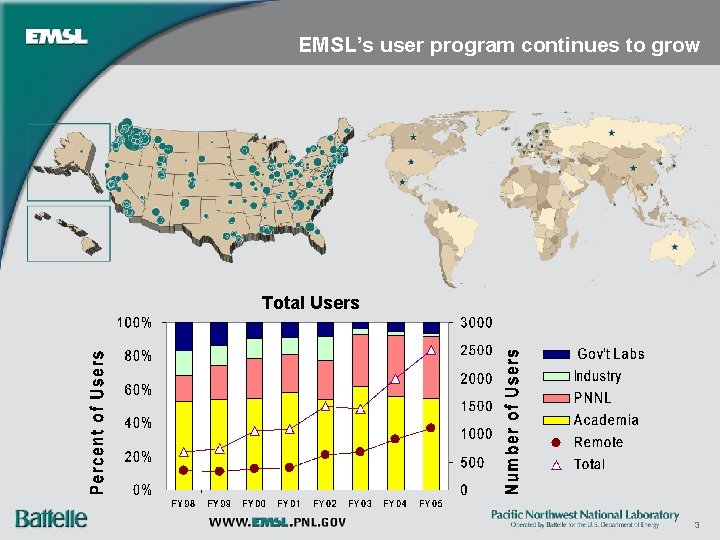
EMSL’s user program continues to grow Total Users 3
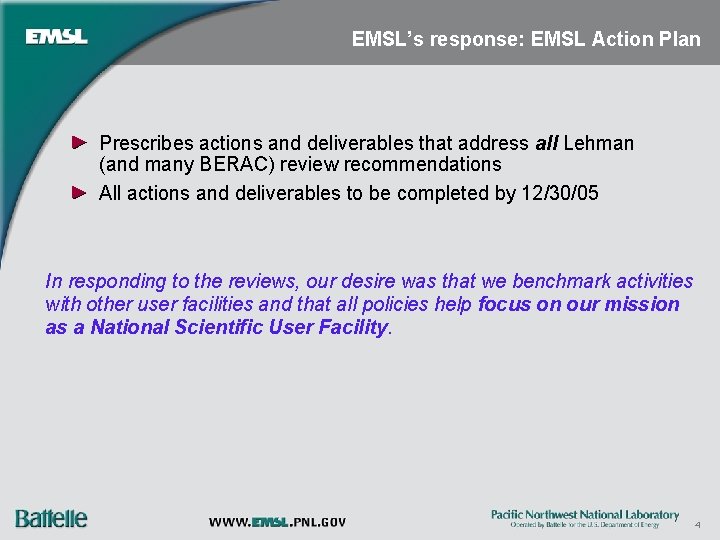
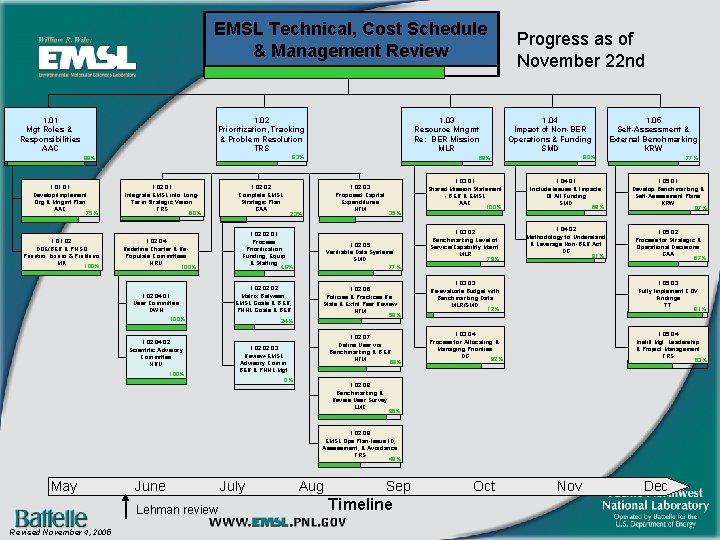
EMSL’s response: EMSL Action Plan Prescribes actions and deliverables that address all Lehman (and many BERAC) review recommendations All actions and deliverables to be completed by 12/30/05 In responding to the reviews, our desire was that we benchmark activities with other user facilities and that all policies help focus on our mission as a National Scientific User Facility. 4
EMSL Technical, Cost Schedule & Management Review 1. 01 Mgt Roles & Responsibilities AAC 1. 02 Prioritization, Tracking & Problem Resolution TRS 63% 88% 1. 01 Develop/Implement Org & Mngmt Plan AAC 75% 1. 02 DOE/BER & PNSO Priorities, Issues & Problems MK 100% 1. 03 Resource Mngmt Re: BER Mission MLR 1. 02. 01 Integrate EMSL into Long. Term Strategic Vision TRS 60% 1. 02. 04 Redefine Charter & Re. Populate Committees HRU 100% 1. 02. 04. 01 User Committee DWH 1. 02 Complete EMSL Strategic Plan GAA 1. 02. 04. 02 Scientific Advisory Committee HRU 100% 1. 02. 03 Proposed Capital Expenditures NFM 1. 02. 01 Process Prioritization Funding, Equip & Staffing 46% 100% 24% 1. 04 Impact of Non-BER Operations & Funding SMD 35% 1. 02. 05 Verifiable Data Systems SMD 77% 1. 02. 06 Policies & Practices Re: Stats & Extnl Peer Review NFM 59% 1. 02. 07 Define User via Benchmarking & BER NFM 69% 1. 02. 03 Review-EMSL Advisory Comm. BER & PNNL Mgt. 0% 1. 02. 08 Benchmarking & Revise User Survey LMC 1. 05 Self-Assessment & External Benchmarking KRW 80% 68% 23% 1. 02. 02 Matrix Between EMSL Goals & BER, PNNL Goals & BER Progress as of November 22 nd 77% 1. 03. 01 Shared Mission Statement - BER & EMSL AAC 100% 1. 04. 01 Include Issues & Impacts Of All Funding SMD 69% 1. 05. 01 Develop Benchmarking & Self-Assessment Plans KRW 87% 1. 03. 02 Benchmarking Level of Service/Capability Maint. MLR 78% 1. 04. 02 Methodology to Understand & Leverage Non-BER Act DG 91% 1. 05. 02 Process for Strategic & Operational Decisions GAA 67% 1. 03 Re-evaluate Budget with Benchmarking Data MLR/SMD 12% 1. 05. 03 Fully Implement COV Findings TT 91% 1. 03. 04 Process for Allocating & Managing Priorities DG 82% 1. 05. 04 Instill Mgt. Leadership & Project Management TRS 63% 96% 1. 02. 09 EMSL Ops Plan-Issue ID, Assessment, & Avoidance TRS 49% May June Lehman review Revised November 4, 2005 July Aug Sep Timeline Oct Nov Dec
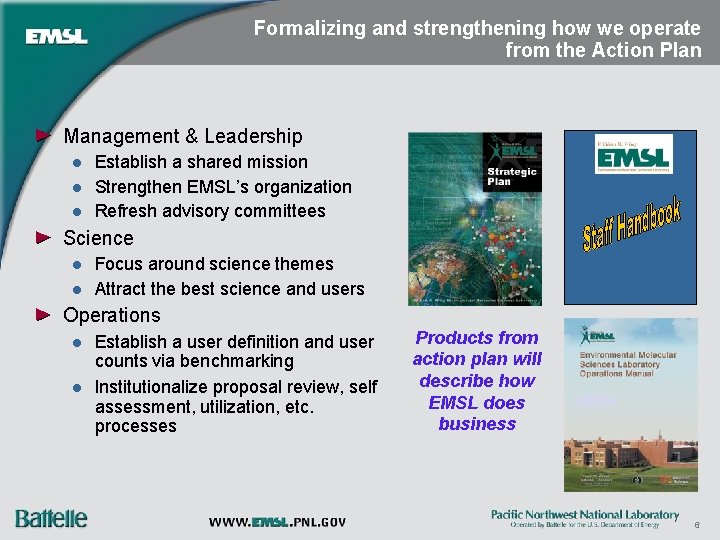
Formalizing and strengthening how we operate from the Action Plan Management & Leadership l l l Establish a shared mission Strengthen EMSL’s organization Refresh advisory committees Science l l Focus around science themes Attract the best science and users Operations l l Establish a user definition and user counts via benchmarking Institutionalize proposal review, self assessment, utilization, etc. processes Products from action plan will describe how EMSL does business 6
Recommendation: establish a shared mission (EMSL, PNNL, PNSO and BER) Mission EMSL, a national scientific user facility, provides integrated experimental and computational resources for discovery and technological innovation in the environmental molecular sciences to support the needs of DOE and the nation 7
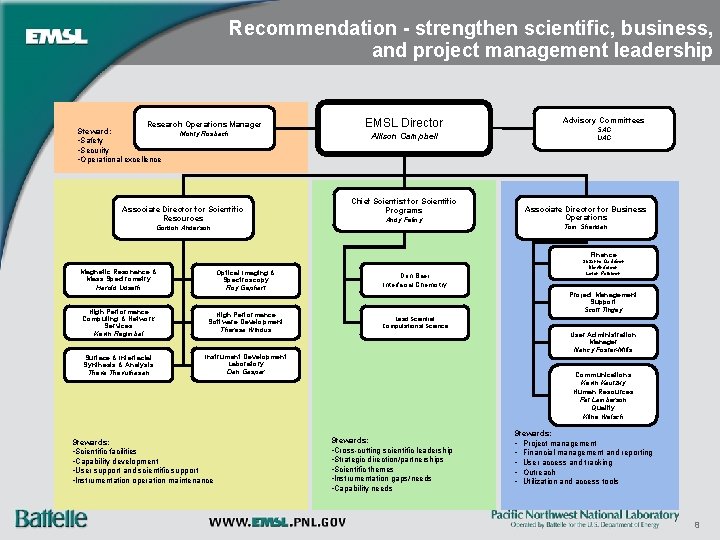
Recommendation - strengthen scientific, business, and project management leadership Research Operations Manager Steward: Monty Rosbach • Safety • Security • Operational excellence Associate Director for Scientific Resources EMSL Director Allison Campbell Chief Scientist for Scientific Programs Andy Felmy Gordon Anderson Advisory Committees SAC UAC Associate Director for Business Operations Tom Sheridan Finance Magnetic Resonance & Mass Spectrometry Harold Udseth Optical Imaging & Spectroscopy Roy Gephart Don Baer Interfacial Chemistry High Performance Computing & Network Services Kevin Regimbal High Performance Software Development Theresa Windus Lead Scientist Computational Science Surface & Interfacial Synthesis & Analysis Theva Thevuthasan Instrument Development Laboratory Dan Gaspar Stewards: • Scientific facilities • Capability development • User support and scientific support • Instrumentation operation maintenance Suzanne Davidson Iris Anderson Loren Peterson Project Management Support Scott Tingey User Administration Manager Nancy Foster-Mills Communications Kevin Kautzky Human Resources Pat Lamberson Quality Kline Welsch Stewards: • Cross-cutting scientific leadership • Strategic direction/partnerships • Scientific themes • Instrumentation gaps/needs • Capability needs Stewards: • Project management • Financial management and reporting • User access and tracking • Outreach • Utilization and access tools 8
Recommendation: refresh advisory committees Developed new charters for both SAC and UAC l SAC n n l Re-energized & empowered Focused on science and strategic focus UAC n n n Self election of members Focused on user needs User advocate Path forward l l New membership of UAC, elections Identify new Chair and renew membership for SAC 9
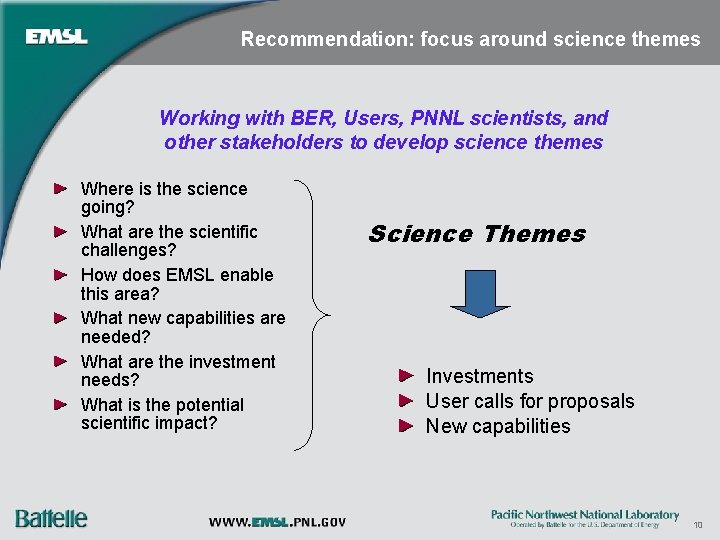
Recommendation: focus around science themes Working with BER, Users, PNNL scientists, and other stakeholders to develop science themes Where is the science going? What are the scientific challenges? How does EMSL enable this area? What new capabilities are needed? What are the investment needs? What is the potential scientific impact? Science Themes Investments User calls for proposals New capabilities 10
Recommendation: strengthen outreach to attract users Establish calls for proposals around science themes Have stronger presence at major scientific meetings Establish close ties with research programs 11
Recommendation: benchmark and refine EMSL user definitions and counts New “user” definition l Any individual, not in the EMSL organization, who makes use of the facility as part of an active user proposal in the EMSL User System (EUS) n n n Onsite Remote operating equipment Remote not operating equipment New “user” counts l Individuals are counted once, per proposal, in a reporting period regardless of the number of visits or accesses 12
Recommendation: institutionalize processes Peer Review l l Proposals for oversubscribed instruments will be externally reviewed Proposals for instruments with available time will be internally reviewed Access EMSL Capabilities l All research performed in the EMSL facility will be covered in an active proposal through EMSL’s User System (EUS) n n Allows tracking research products from all research that benefits from EMSL One consistent access model for all users (PNNL and external) 13
Recommendation: self assessment and continuous improvement Performance-Assessment Program l l l Measure progress against metrics on a defined schedule Assess effectiveness of metrics on a defined schedule Fine tune metrics to ensure continued progress toward meeting EMSL’s strategic goals 14
Outcomes, policies, and operating standards wrapped into various documents Strategic Plan l Forward looking, direction setting n n Mission, visions, values, alignment with stakeholders Scientific direction Operations Manual l Tactical, how we implement our strategy n Policies, procedures, practices Staff Handbook l Procedural, what we expect from our staff n SDR, training, travel, purchasing, ERICA, etc. 15
Anticipated outcomes More integrated approach to furthering our science Ensure that staff and operations are safe More accountability for how we manage the user program More outreach to broadly share our great successes 16
Science Highlights
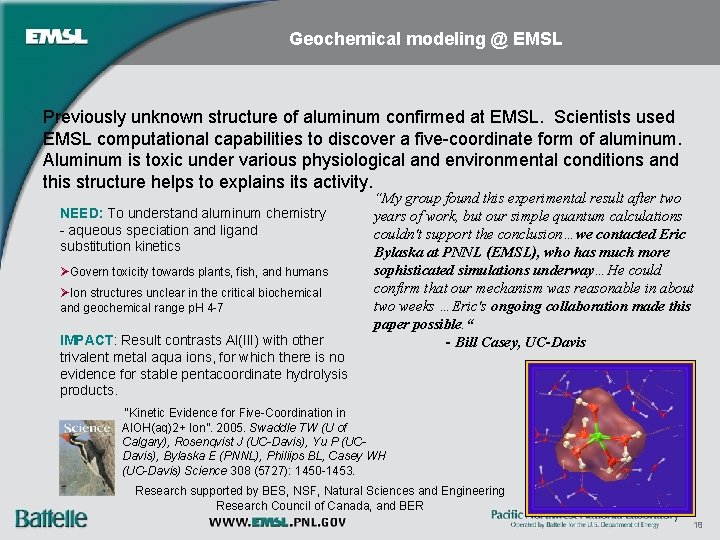
Geochemical modeling @ EMSL Previously unknown structure of aluminum confirmed at EMSL. Scientists used EMSL computational capabilities to discover a five-coordinate form of aluminum. Aluminum is toxic under various physiological and environmental conditions and this structure helps to explains its activity. NEED: To understand aluminum chemistry - aqueous speciation and ligand substitution kinetics ØGovern toxicity towards plants, fish, and humans ØIon structures unclear in the critical biochemical and geochemical range p. H 4 -7 IMPACT: Result contrasts Al(III) with other trivalent metal aqua ions, for which there is no evidence for stable pentacoordinate hydrolysis products. “My group found this experimental result after two years of work, but our simple quantum calculations couldn't support the conclusion…we contacted Eric Bylaska at PNNL (EMSL), who has much more sophisticated simulations underway…He could confirm that our mechanism was reasonable in about two weeks …Eric's ongoing collaboration made this paper possible. “ - Bill Casey, UC-Davis “Kinetic Evidence for Five-Coordination in Al. OH(aq)2+ Ion”. 2005. Swaddle TW (U of Calgary), Rosenqvist J (UC-Davis), Yu P (UCDavis), Bylaska E (PNNL), Philiips BL, Casey WH (UC-Davis) Science 308 (5727): 1450 -1453. Research supported by BES, NSF, Natural Sciences and Engineering Research Council of Canada, and BER 18
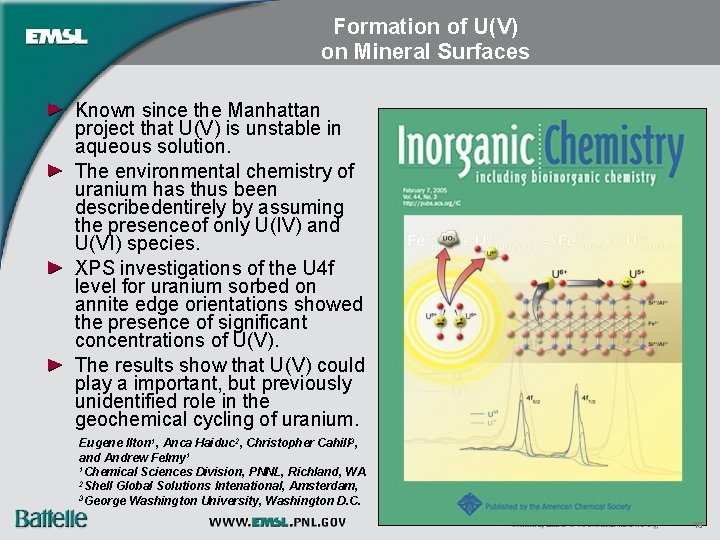
Formation of U(V) on Mineral Surfaces Known since the Manhattan project that U(V) is unstable in aqueous solution. The environmental chemistry of uranium has thus been describedentirely by assuming the presenceof only U(IV) and U(VI) species. XPS investigations of the U 4 f level for uranium sorbed on annite edge orientations showed the presence of significant concentrations of U(V). The results show that U(V) could play a important, but previously unidentified role in the geochemical cycling of uranium. May 2 issue Eugene Ilton 1, Anca Haiduc 2, Christopher Cahill 3, and Andrew Felmy 1 1 Chemical Sciences Division, PNNL, Richland, WA 2 Shell Global Solutions Intenational, Amsterdam, 3 George Washington University, Washington D. C. 19
Coming Attractions
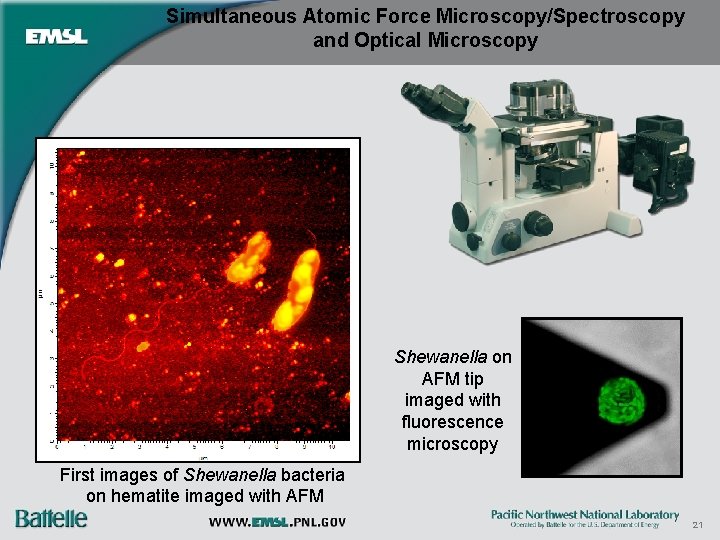
Simultaneous Atomic Force Microscopy/Spectroscopy and Optical Microscopy Shewanella on AFM tip imaged with fluorescence microscopy First images of Shewanella bacteria on hematite imaged with AFM 21
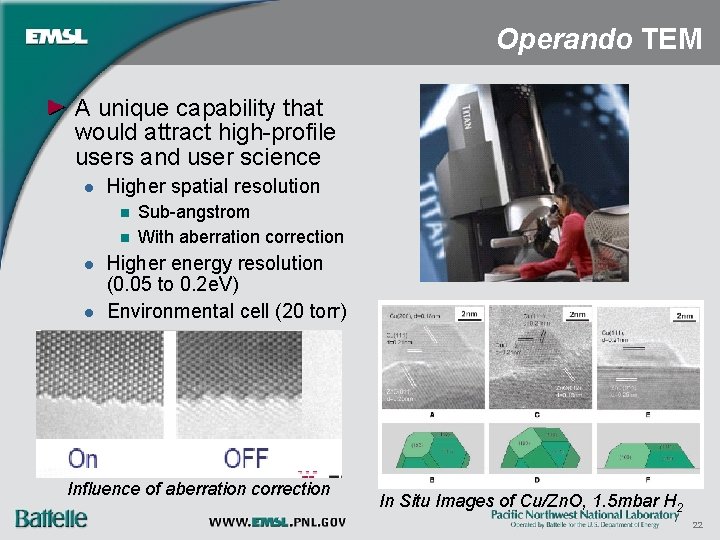
Operando TEM A unique capability that would attract high-profile users and user science l Higher spatial resolution n n l l Sub-angstrom With aberration correction Higher energy resolution (0. 05 to 0. 2 e. V) Environmental cell (20 torr) Influence of aberration correction In Situ Images of Cu/Zn. O, 1. 5 mbar H 2 22
Questions?