
EMRLD A RIMbased Data Integration Approach Pradeep Chowdhury
EMRLD A RIM-based Data Integration Approach Pradeep Chowdhury Manager, Data Integration
Agenda • Introduction and Acknowledgements • EMRLD Approach • Pilot Details • Q&A
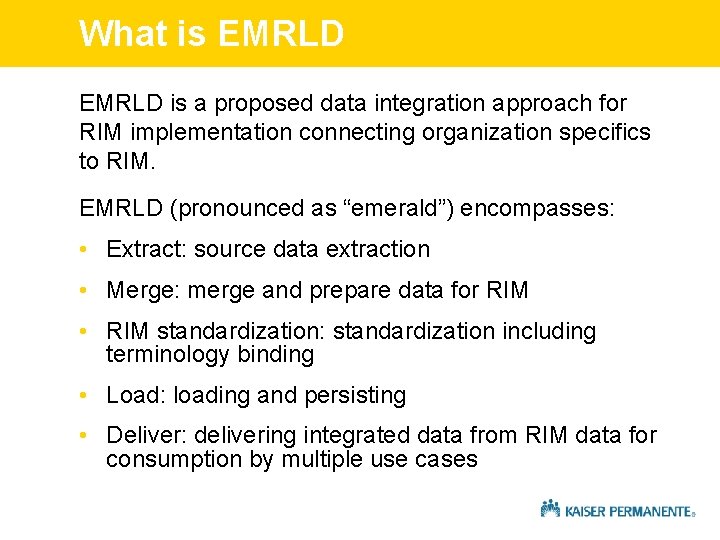
What is EMRLD is a proposed data integration approach for RIM implementation connecting organization specifics to RIM. EMRLD (pronounced as “emerald”) encompasses: • Extract: source data extraction • Merge: merge and prepare data for RIM • RIM standardization: standardization including terminology binding • Load: loading and persisting • Deliver: delivering integrated data from RIM data for consumption by multiple use cases
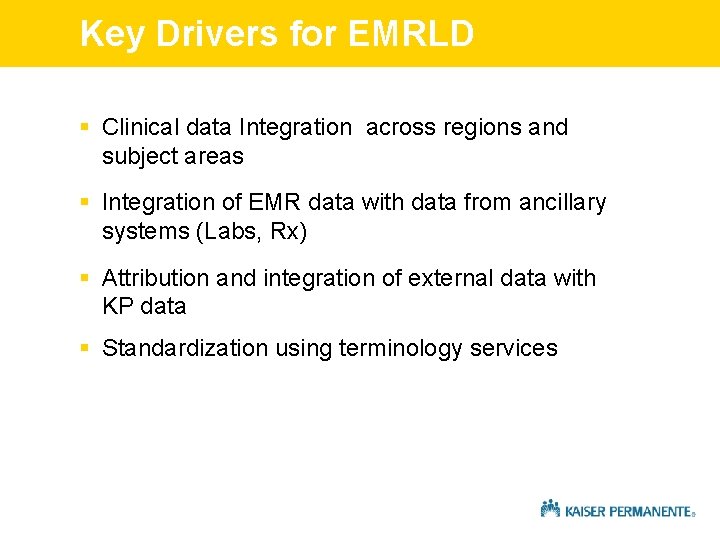
Key Drivers for EMRLD § Clinical data Integration across regions and subject areas § Integration of EMR data with data from ancillary systems (Labs, Rx) § Attribution and integration of external data with KP data § Standardization using terminology services
Alternatives to RIM • Build a home-grown integration model according to business needs • Purchase and deploy industry available models OR • Adopt a reference information model (model of meaning): HL 7 V 3 RIM
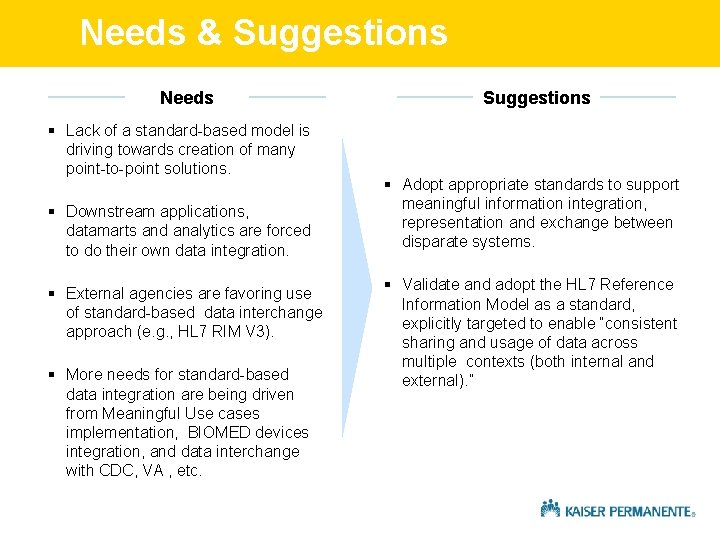
Needs & Suggestions Needs § Lack of a standard-based model is driving towards creation of many point-to-point solutions. § Downstream applications, datamarts and analytics are forced to do their own data integration. § External agencies are favoring use of standard-based data interchange approach (e. g. , HL 7 RIM V 3). § More needs for standard-based data integration are being driven from Meaningful Use cases implementation, BIOMED devices integration, and data interchange with CDC, VA , etc. Suggestions § Adopt appropriate standards to support meaningful information integration, representation and exchange between disparate systems. § Validate and adopt the HL 7 Reference Information Model as a standard, explicitly targeted to enable “consistent sharing and usage of data across multiple contexts (both internal and external). ”
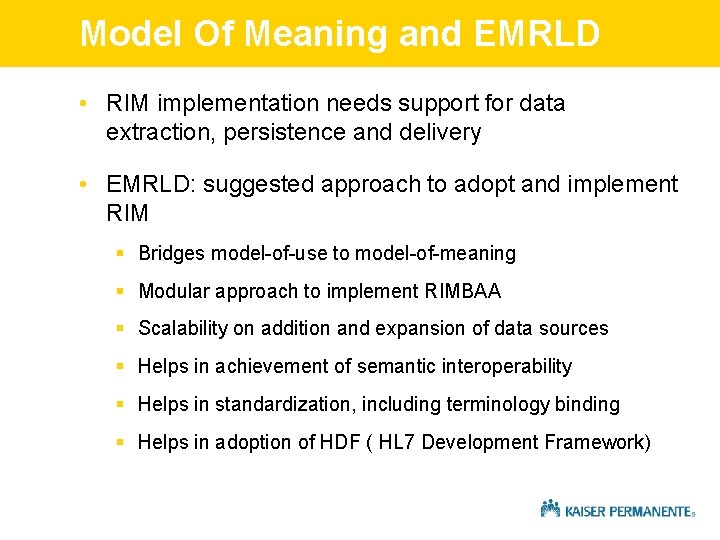
Model Of Meaning and EMRLD • RIM implementation needs support for data extraction, persistence and delivery • EMRLD: suggested approach to adopt and implement RIM § Bridges model-of-use to model-of-meaning § Modular approach to implement RIMBAA § Scalability on addition and expansion of data sources § Helps in achievement of semantic interoperability § Helps in standardization, including terminology binding § Helps in adoption of HDF ( HL 7 Development Framework)
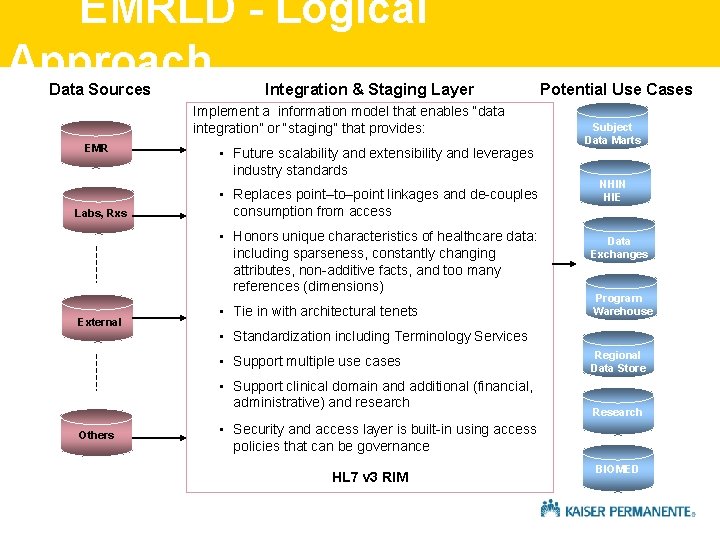
EMRLD - Logical Approach Data Sources Integration & Staging Layer Implement a information model that enables “data integration” or “staging” that provides: EMR • Future scalability and extensibility and leverages Potential Use Cases Subject Data Marts industry standards • Replaces point–to–point linkages and de-couples Labs, Rxs consumption from access • Honors unique characteristics of healthcare data: including sparseness, constantly changing attributes, non-additive facts, and too many references (dimensions) External NHIN HIE • Tie in with architectural tenets Data Exchanges Program Warehouse • Standardization including Terminology Services • Support multiple use cases Regional Data Store • Support clinical domain and additional (financial, administrative) and research Others Research • Security and access layer is built-in using access policies that can be governance HL 7 v 3 RIM BIOMED
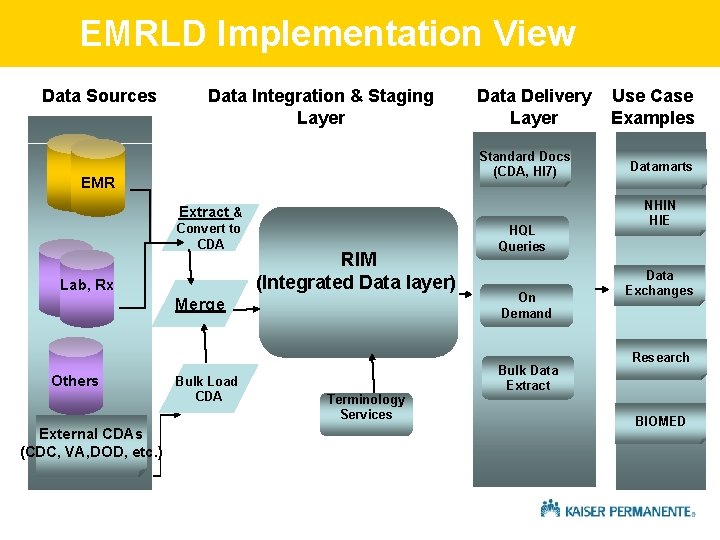
EMRLD Implementation View Data Sources Data Integration & Staging Layer Data Delivery Layer Standard Docs (CDA, Hl 7) EMR Extract & Convert to CDA Lab, Rx RIM (Integrated Data layer) Merge Others External CDAs (CDC, VA, DOD, etc. ) Bulk Load CDA Terminology Services HQL Queries On Demand Bulk Data Extract Use Case Examples Datamarts NHIN HIE Data Exchanges Research BIOMED
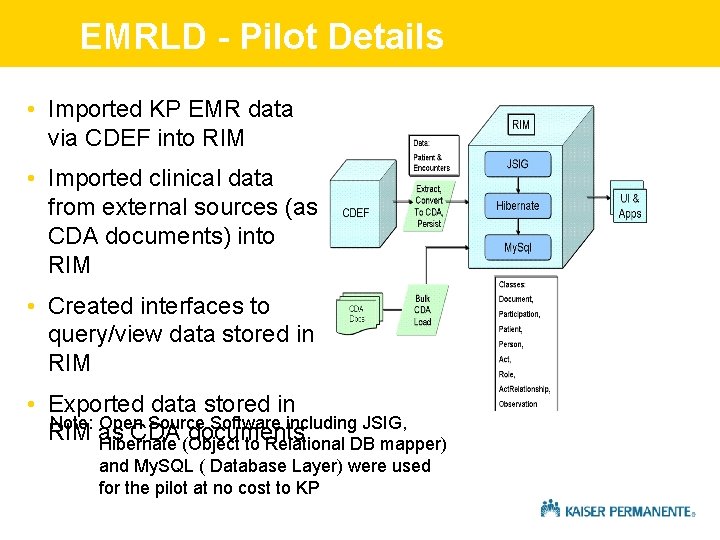
EMRLD - Pilot Details • Imported KP EMR data via CDEF into RIM • Imported clinical data from external sources (as CDA documents) into RIM • Created interfaces to query/view data stored in RIM • Exported data stored in Note: Open Source Software including JSIG, RIM as CDA documents Hibernate (Object to Relational DB mapper) and My. SQL ( Database Layer) were used for the pilot at no cost to KP
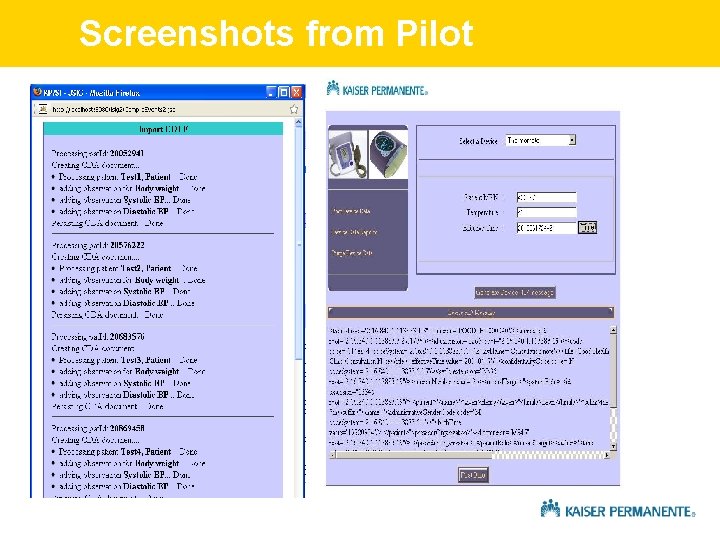
Screenshots from Pilot
EMRLD Pilot - Observations • Pilot was successful to demonstrate that the KP EMR clinical data can be imported and persisted in a HL 7 RIM environment. • In addition the pilot demonstrated capability to import external CDA documents (bulk data import), export clinical data as CDA, and views the imported data using HQL queries. • This pilot was done using Open source platform created by the Java. SIG. ** KP System Integration team’s developed CDEF framework engine was used to extract information from KP EMR. • CDEF is Custom Data Extract Framework which extracts KP EMR real-time transaction data. The extraction is based on pre-defined events and rules. The data is available from CDEF in table format. • JSIG is an open source HL 7 RIM implementation. It maps all RIM classes to SQL tables using hibernate. Provides helper classes to create CDA document and persist in RIM data model. • Any database can be used to support RIM and for demonstration purposes, My. SQL was used. • KP-JSIG is a web application built on top of JSIG to incorporate a way to import KP EMR data, external CDA documents, export CDA documents, and execute HQL queries on RIM classes.
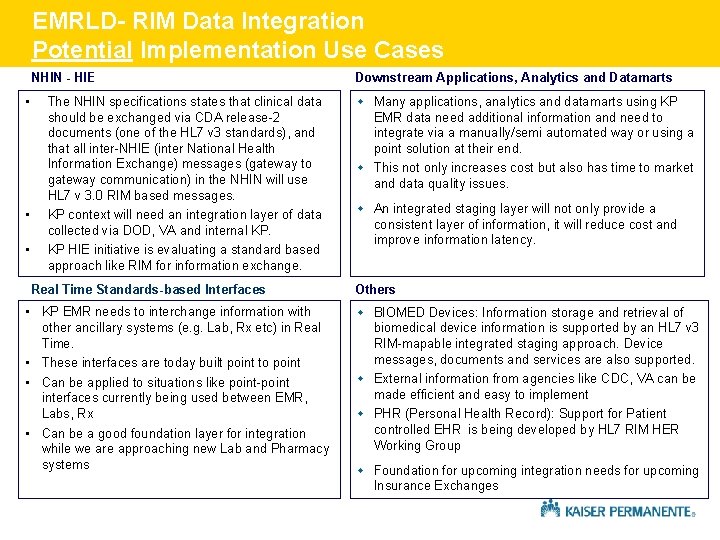
EMRLD- RIM Data Integration Potential Implementation Use Cases NHIN - HIE • The NHIN specifications states that clinical data should be exchanged via CDA release-2 documents (one of the HL 7 v 3 standards), and that all inter-NHIE (inter National Health Information Exchange) messages (gateway to gateway communication) in the NHIN will use HL 7 v 3. 0 RIM based messages. • KP context will need an integration layer of data collected via DOD, VA and internal KP. • KP HIE initiative is evaluating a standard based approach like RIM for information exchange. Real Time Standards-based Interfaces • KP EMR needs to interchange information with other ancillary systems (e. g. Lab, Rx etc) in Real Time. • These interfaces are today built point to point • Can be applied to situations like point-point interfaces currently being used between EMR, Labs, Rx • Can be a good foundation layer for integration while we are approaching new Lab and Pharmacy systems Downstream Applications, Analytics and Datamarts w Many applications, analytics and datamarts using KP EMR data need additional information and need to integrate via a manually/semi automated way or using a point solution at their end. w This not only increases cost but also has time to market and data quality issues. w An integrated staging layer will not only provide a consistent layer of information, it will reduce cost and improve information latency. Others w BIOMED Devices: Information storage and retrieval of biomedical device information is supported by an HL 7 v 3 RIM-mapable integrated staging approach. Device messages, documents and services are also supported. w External information from agencies like CDC, VA can be made efficient and easy to implement w PHR (Personal Health Record): Support for Patient controlled EHR is being developed by HL 7 RIM HER Working Group w Foundation for upcoming integration needs for upcoming Insurance Exchanges

Questions? pradeep. k. chowdhury@kp. org
- Slides: 14