
EMR 6550 Experimental and Quasi Experimental Designs Dr



- Slides: 34
EMR 6550: Experimental and Quasi. Experimental Designs Dr. Chris L. S. Coryn Kristin A. Hobson Fall 2013
Agenda • Basic design elements and notation • Quasi-experimental designs that either lack a control group or lack pretest observations on the outcome • Midterm examination • Case study
Questions to Consider • What are the limitations of designs lacking either control groups and/or pretest observations? • What simple strategies can be used to improve these types of designs? • Why are such designs sometimes the only ones that can be used?
Basic Design Elements and Notation
Assignment • • • Random assignment Cutoff-based assignment Other nonrandom assignment Matching and stratifying Masking
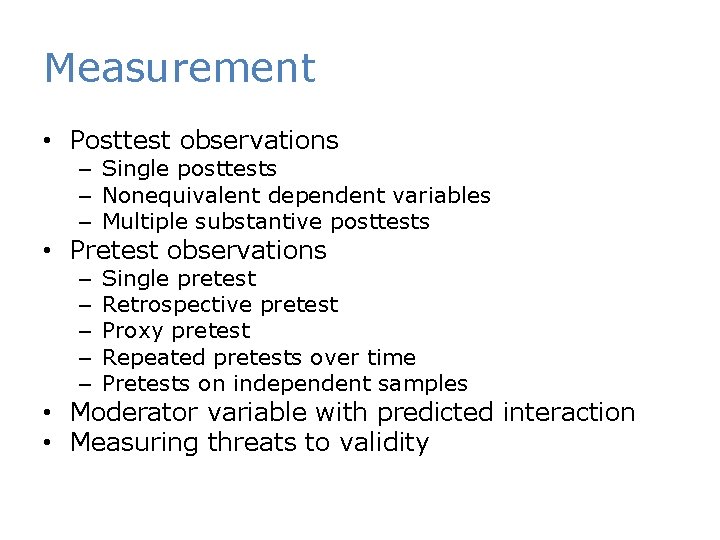
Measurement • Posttest observations – Single posttests – Nonequivalent dependent variables – Multiple substantive posttests • Pretest observations – – – Single pretest Retrospective pretest Proxy pretest Repeated pretests over time Pretests on independent samples • Moderator variable with predicted interaction • Measuring threats to validity
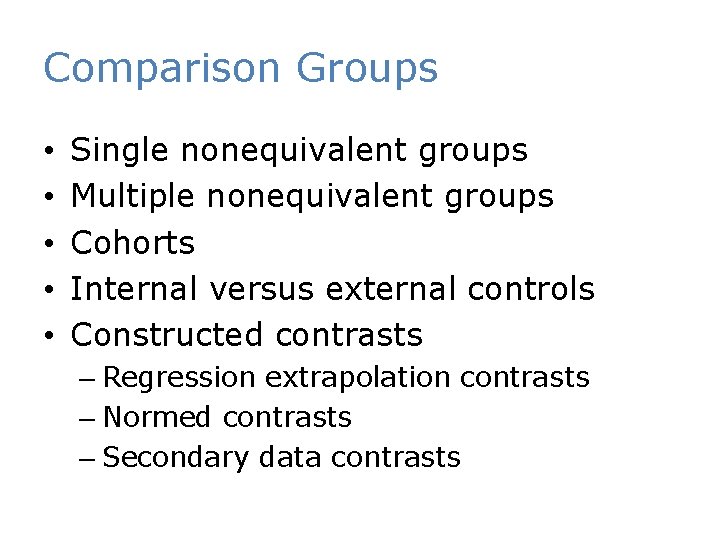
Comparison Groups • • • Single nonequivalent groups Multiple nonequivalent groups Cohorts Internal versus external controls Constructed contrasts – Regression extrapolation contrasts – Normed contrasts – Secondary data contrasts
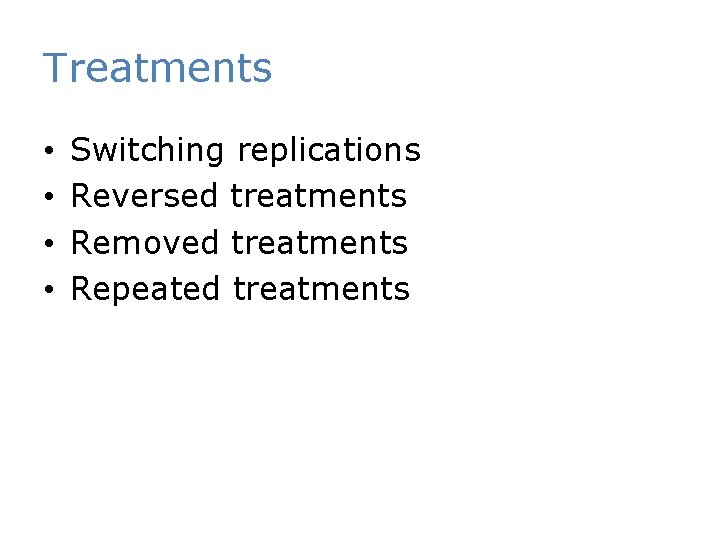
Treatments • • Switching replications Reversed treatments Removed treatments Repeated treatments
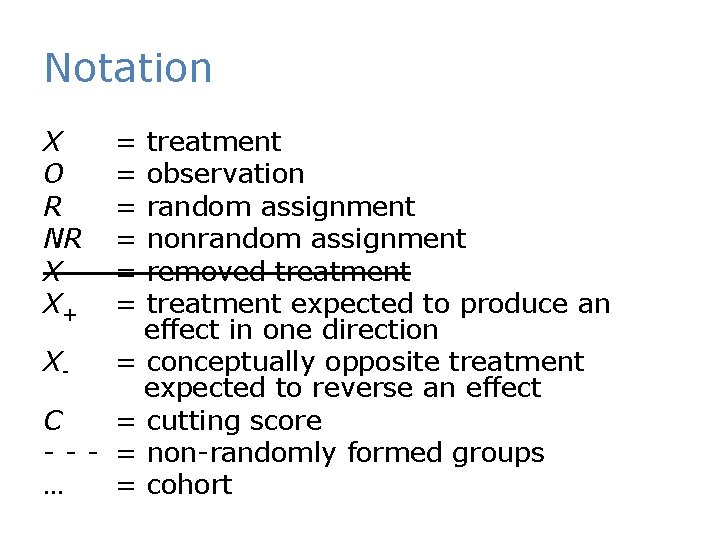
Notation X O R NR X X+ = = = treatment observation random assignment nonrandom assignment removed treatment expected to produce an effect in one direction X= conceptually opposite treatment expected to reverse an effect C = cutting score - - - = non-randomly formed groups … = cohort
Logic of Quasi-Experimentation
Rationale • Quasi-experiments are often a necessity given practical and logistical constraints – Greater emphasis on construct or external validity rather than cause-effect associations (least common) – Funding, ethics, administration (somewhat common) – The intervention has already occurred (most common) • Sometimes they are the best alternative, even if causal inferences are weaker than is possible with other designs • Even so, great care must be taken when planning such studies as numerous threats that cannot be controlled are often operating
Central Principles • Identification and study of plausible threats to internal validity – Careful scrutiny of plausible alternative explanations for treatment-outcome covariation • Primacy of control by design – Use carefully planned and implemented design elements rather than statistical controls for anticipated confounds • Coherent pattern matching – Complex (a priori) causal hypotheses that reduce the plausibility of alternative explanations
Designs without Control Groups
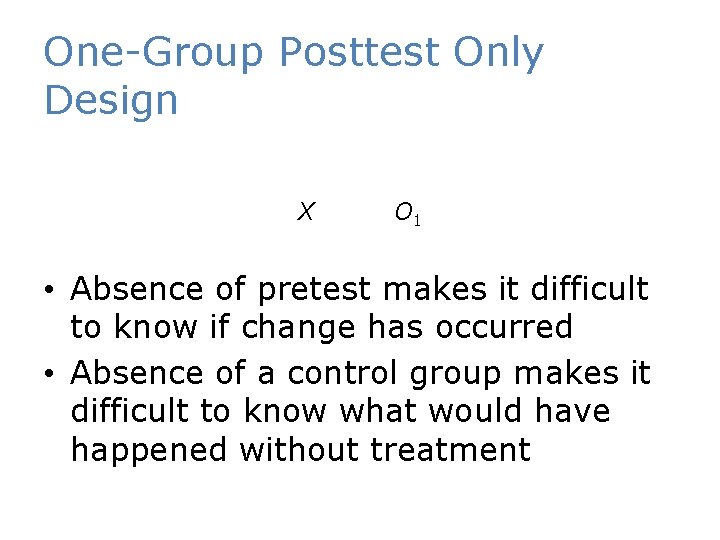
One-Group Posttest Only Design X O 1 • Absence of pretest makes it difficult to know if change has occurred • Absence of a control group makes it difficult to know what would have happened without treatment
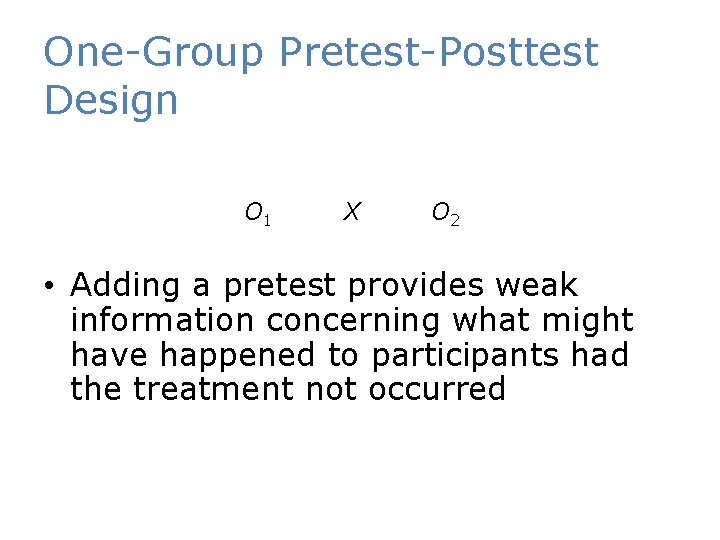
One-Group Pretest-Posttest Design O 1 X O 2 • Adding a pretest provides weak information concerning what might have happened to participants had the treatment not occurred
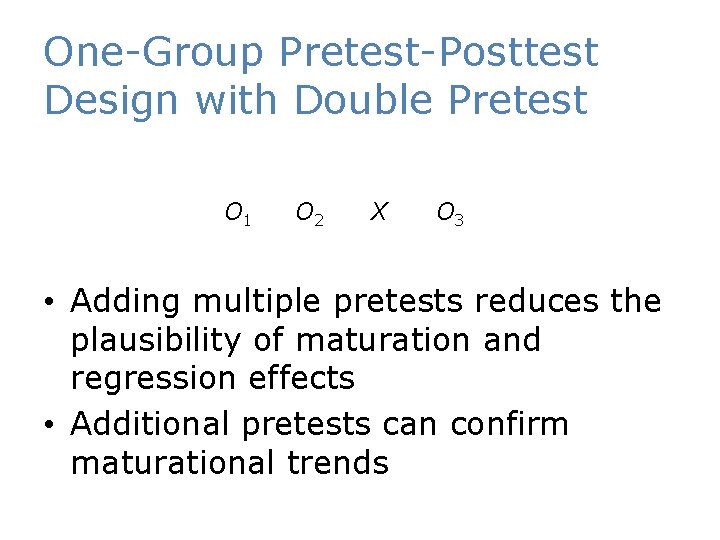
One-Group Pretest-Posttest Design with Double Pretest O 1 O 2 X O 3 • Adding multiple pretests reduces the plausibility of maturation and regression effects • Additional pretests can confirm maturational trends
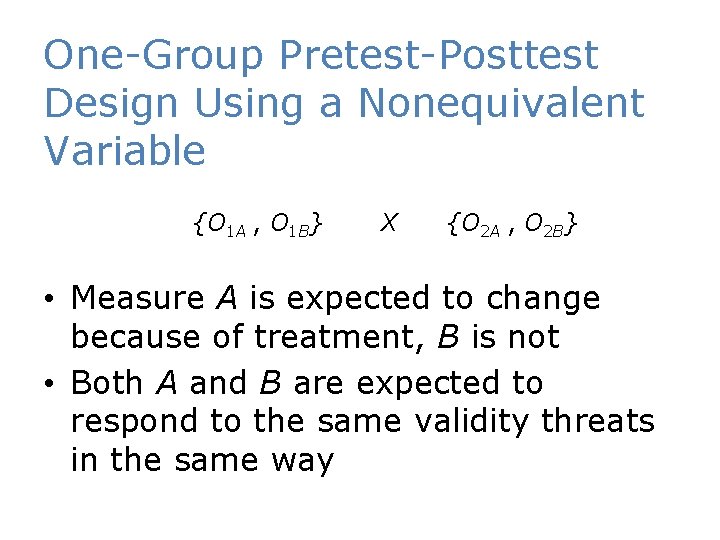
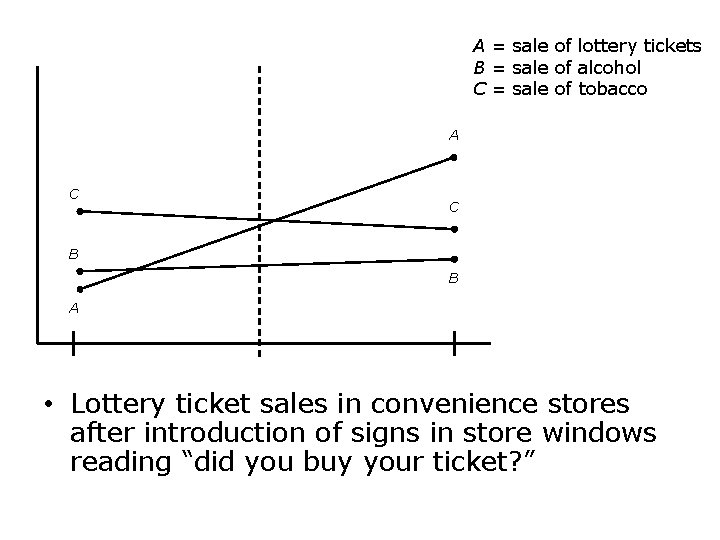
One-Group Pretest-Posttest Design Using a Nonequivalent Variable {O 1 A , O 1 B} X {O 2 A , O 2 B} • Measure A is expected to change because of treatment, B is not • Both A and B are expected to respond to the same validity threats in the same way
A = sale of lottery tickets B = sale of alcohol C = sale of tobacco A C C B B A • Lottery ticket sales in convenience stores after introduction of signs in store windows reading “did you buy your ticket? ”
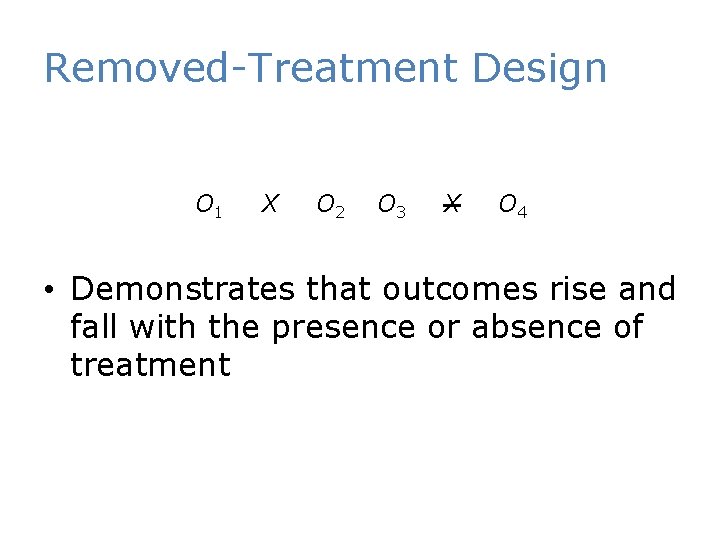
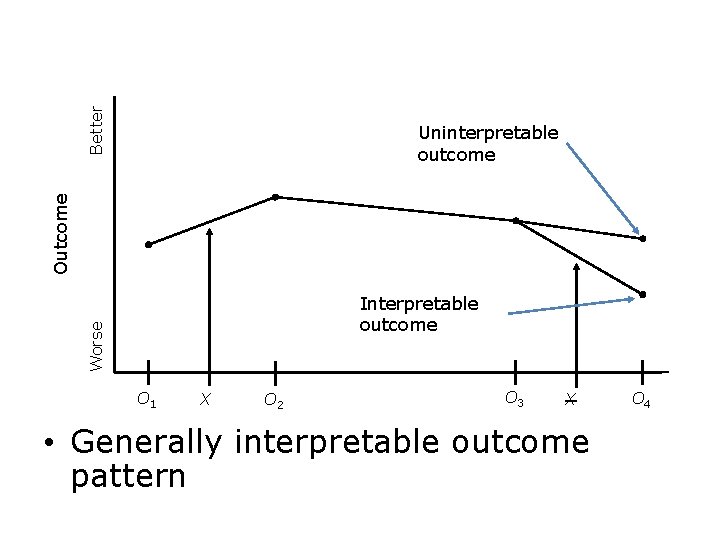
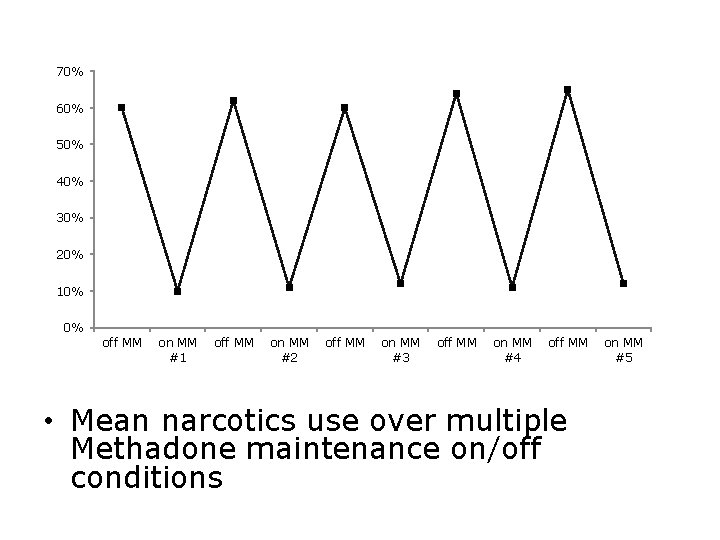
Removed-Treatment Design O 1 X O 2 O 3 X O 4 • Demonstrates that outcomes rise and fall with the presence or absence of treatment
Better Outcome Uninterpretable outcome Worse Interpretable outcome O 1 X O 2 O 3 X • Generally interpretable outcome pattern O 4
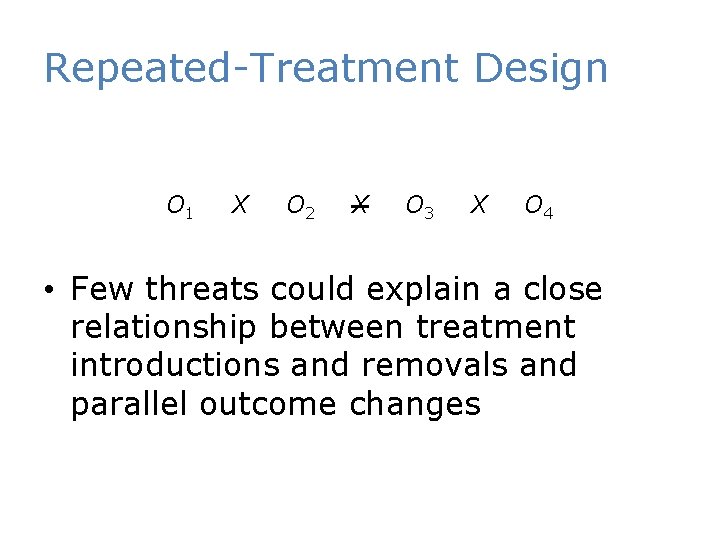
Repeated-Treatment Design O 1 X O 2 X O 3 X O 4 • Few threats could explain a close relationship between treatment introductions and removals and parallel outcome changes
70% 60% 50% 40% 30% 20% 10% 0% off MM on MM #1 off MM on MM #2 off MM on MM #3 off MM on MM #4 off MM • Mean narcotics use over multiple Methadone maintenance on/off conditions on MM #5
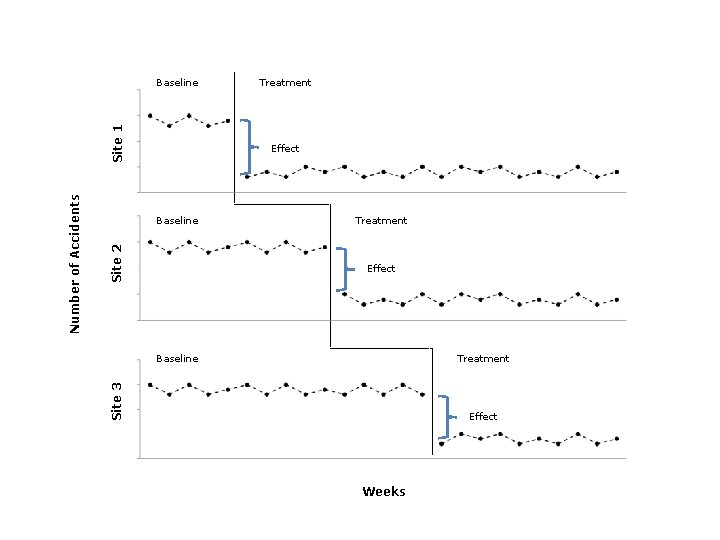
A-B Designs • Multiple-baseline design (a class of singlesubject designs), or collection of A-B designs, to assess the effects of an intervention across separate baselines A = baseline B = treatment • The intervention is introduced in a staggered manner and the baseline provides a predicted level of the dependent variable in absence of the treatment • A-B-A designs are sometimes called removal designs (i. e. , the treatment is removed)
Treatment Effect Site 2 Baseline Treatment Effect Baseline Treatment Site 3 Number of Accidents Site 1 Baseline Effect Weeks
Designs that use a Control Group but no Pretest
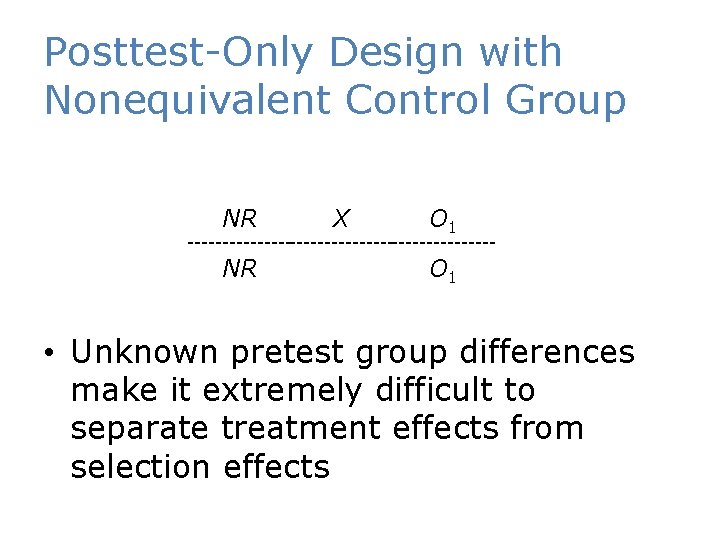
Posttest-Only Design with Nonequivalent Control Group NR NR X O 1 • Unknown pretest group differences make it extremely difficult to separate treatment effects from selection effects
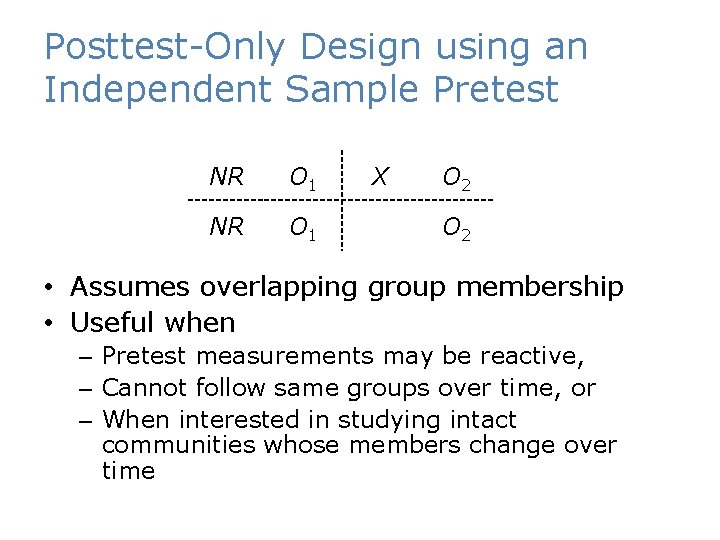
Posttest-Only Design using an Independent Sample Pretest NR O 1 X O 2 • Assumes overlapping group membership • Useful when – Pretest measurements may be reactive, – Cannot follow same groups over time, or – When interested in studying intact communities whose members change over time
Posttest-Only Design using Proxy Pretest NR OA 1 X OB 2 • Proxy measures should be conceptually related to and correlated with the outcome • Can be used for a variety of purposes including indexing selection bias and/or attrition
Case Control Studies • Predominant method for many forms of epidemiological research • Used to identify factors that may contribute to a condition by comparing subjects who have that condition (i. e. , 'cases') with those who do not have the condition but are otherwise similar (i. e. , 'controls') • Famously, the association between smoking and lung cancer • Similar in many respects to Scriven’s GEM and MOM
Midterm Examination
Midterm Examination • The examination will consist of 50 -75 multiple-choice items, scored as 0 or 1 • You will have 2½ hours to complete the examination • You may use one page of notes (front and back) on 8½” X 11’’ paper – You will be asked questions about statistical power, but will not be required to calculate power
Case Study
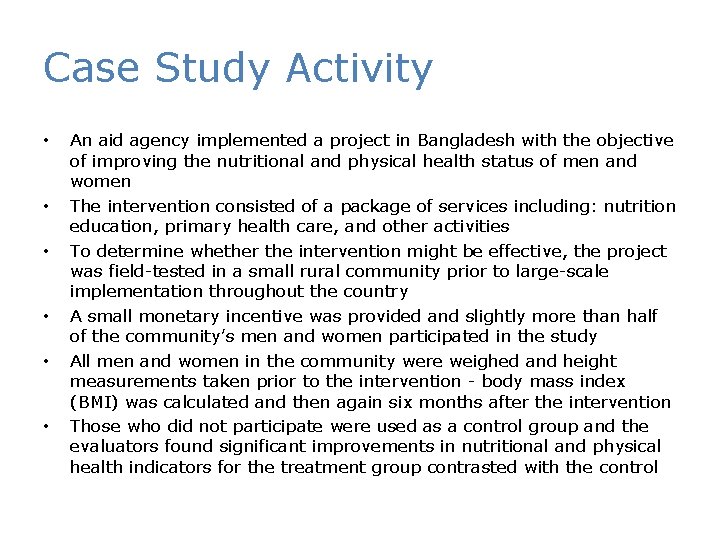
Case Study Activity • • • An aid agency implemented a project in Bangladesh with the objective of improving the nutritional and physical health status of men and women The intervention consisted of a package of services including: nutrition education, primary health care, and other activities To determine whether the intervention might be effective, the project was field-tested in a small rural community prior to large-scale implementation throughout the country A small monetary incentive was provided and slightly more than half of the community’s men and women participated in the study All men and women in the community were weighed and height measurements taken prior to the intervention - body mass index (BMI) was calculated and then again six months after the intervention Those who did not participate were used as a control group and the evaluators found significant improvements in nutritional and physical health indicators for the treatment group contrasted with the control
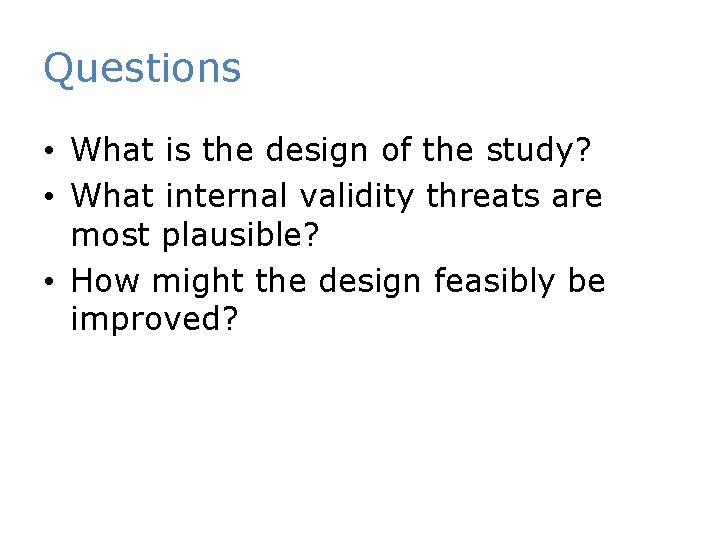
Questions • What is the design of the study? • What internal validity threats are most plausible? • How might the design feasibly be improved?