
empty chair workunfinished business 1 task marker typically
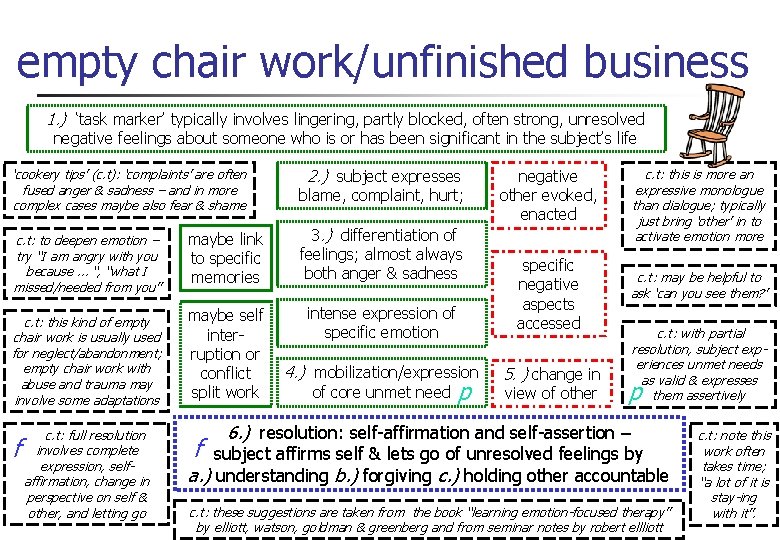
empty chair work/unfinished business 1. ) ‘task marker’ typically involves lingering, partly blocked, often strong, unresolved negative feelings about someone who is or has been significant in the subject’s life ‘cookery tips’ (c. t): ‘complaints’ are often fused anger & sadness – and in more complex cases maybe also fear & shame 2. ) subject expresses blame, complaint, hurt; c. t: to deepen emotion – try “I am angry with you because … “, “what I missed/needed from you” maybe link to specific memories 3. ) differentiation of feelings; almost always both anger & sadness c. t: this kind of empty chair work is usually used for neglect/abandonment; empty chair work with abuse and trauma may involve some adaptations maybe self interruption or conflict split work intense expression of specific emotion f c. t: full resolution involves complete expression, selfaffirmation, change in perspective on self & other, and letting go f 4. ) mobilization/expression of core unmet need p c. t: this is more an expressive monologue than dialogue; typically just bring ‘other’ in to activate emotion more negative other evoked, enacted specific negative aspects accessed 5. ) change in view of other c. t: may be helpful to ask ‘can you see them? ’ c. t: with partial resolution, subject experiences unmet needs as valid & expresses them assertively p 6. ) resolution: self-affirmation and self-assertion – subject affirms self & lets go of unresolved feelings by a. ) understanding b. ) forgiving c. ) holding other accountable c. t: these suggestions are taken from the book “learning emotion-focused therapy” by elliott, watson, goldman & greenberg and from seminar notes by robert ellliott c. t: note this work often takes time; “a lot of it is stay-ing with it”.
- Slides: 1