
Employment Status HMRC presentation Who We Are H







- Slides: 53
Employment Status HMRC presentation
Who We Are • H M Revenue & Customs (HMRC) Employment Status & Intermediaries Team • John Lauder and Russell Kirk (Employment Status & Intermediaries) • Approx. 250 staff nationwide • Specialist team created with the task of reviewing the employment status of workers and all associated risks • Demonstrates the Government’s commitment to tackling this area of risk • John Milburn and Brendan Dewar (Large Business)
Aims/Objectives for today • To assist with an understanding of how you may go about determining employment status • To look at some of the key factors that come together to present the overall picture of an engagement • To understand the industry view and concerns around getting employment status right • To agree what our mutual “next steps” might be after today
Good Work https: //www. gov. uk/government/publications/good-work-plan
Why does it matter? 1) Access to Employment Rights (Employment Rights Act 1996) (for example - Unfair dismissal, redundancy, written particulars of employment, request to work flexibly, maternity leave, paternity leave) 2) Correct tax treatment (Tax and National Insurance Contributions paid via PAYE or via Self-Assessment)
Office There is no statutory definition of the word ‘office’ However, an ‘office’ possesses certain qualities role is required not desired important cog in the machine often created by legislation or constitution Guidance at ESM 2500 onwards
‘Worker’ It should be noted that the term "worker", identically defined, appears in different kinds of employment legislation Such as: s. 230 (3) of the Employment Rights Act 1996 s. 54 (3) of the National Minimum Wage Act 1998 s. 13 of the Employment Relations Act 1999.
Current landscape - taxation There around 26 Million workers in the UK who are taxed under the PAYE system There around 5 million self-employed who selfassess
Employment Status (Tax Purposes) – key principles • Not just a matter of choice or whether it suits one party or both • Looks at the factual reality of how an engagement works in practice • We consider employment status indicators – as established by case law – and true contractual arrangements between engager and worker • Indicators combine together to provide an overall picture of the engagement position in terms of employment status
Case Law - creates the ‘tests’ to be applied Decisions are made based on Case Law. This in turn creates the “statute”. The correct approach for identifying the status of a working relationship is to consider a range of factors relevant to the relationship. It can’t be achieved by running through a ‘tick list’ Ready Mixed Concrete (SE) Ltd v Minister of Pensions and National Insurance set out what the Courts see as a strong basis for what must be present
3 conditions: Contract ‘of service’ or ‘for services’ • From the judgement of Mac. Kenna J in the case of Ready Mixed Concrete (South East) Ltd v Minister of Pensions and National Insurance, a contract of service exists if 3 conditions are fulfilled: • The servant agrees that, in consideration of a wage or other remuneration, he will provide his own work and skill in the performance of some services for his master • He agrees, expressly or impliedly, that in the performance of that service he will be subject to the other’s control in a sufficient degree to make that other master • The other provisions of the contract are consistent with its being a contract of service
Firstly, is there a contract at all? (“Mutuality of Obligation”) • Establishes whethere is a contract in existence at all • Can be present in both self-employed and employed scenarios • Contract is in existence when (1) Worker accepts engager’s offer of work and (2) Engager pays for the services provided by the worker
Mutuality of Obligation - Case law Court of Appeal decision in Cornwall CC v. Prater ‘…The important point is that, once a contract was entered into and while that contract continued, she was under an obligation to teach the pupil and the Council was under an obligation to pay her for teaching the pupil made available to her by the Council under that contract. That was all that was legally necessary to support the finding that each individual teaching engagement was a contract of service…’
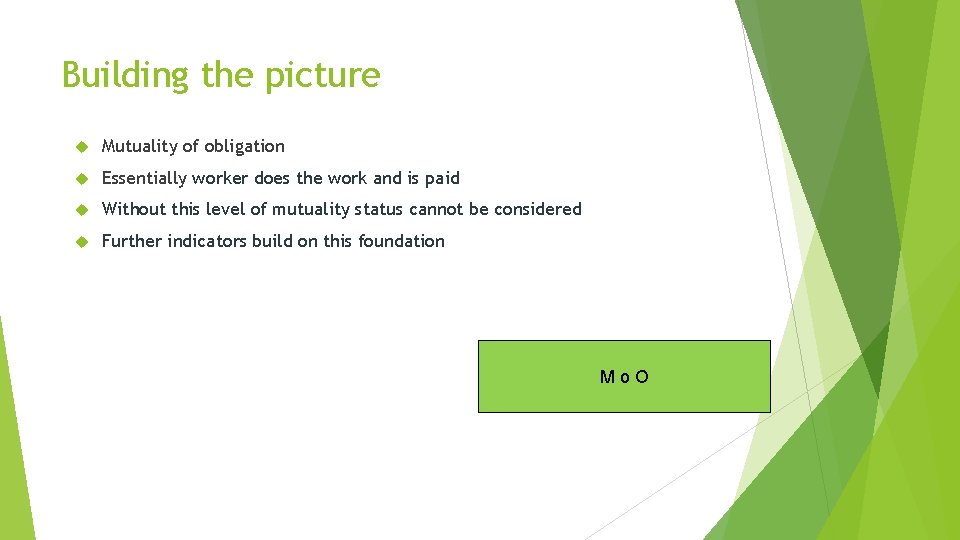
Building the picture Mutuality of obligation Essentially worker does the work and is paid Without this level of mutuality status cannot be considered Further indicators build on this foundation Mo. O
Personal Service EMPLOYMENT The worker is PERSONALLY REQUIRED to perform the work Do they have to perform the work themselves? SELF-EMPLOYMENT Can truly send anyone they want to complete the task
Can HMRC confirm that for the locum population whether or not it is feasible to have the right of substitute in a contract? Understanding the key aspect of status and getting to an agreed position with the Sector is really important There either is a requirement for personal service, or there is not If there is personal service this does not automatically mean that the worker is an employee
Personal Service and the right to provide a substitute If a worker has a genuine unfettered right to provide a substitute then they will not be providing a personal service. The contract cannot be a contract of service It is the right to send a substitute that is important, not whether the right is exercised in practice If the right is exercised, the worker must have a real choice about who they wish to provide as a substitute, and they must pay the worker themselves A worker’s right to provide a substitute is ‘fettered’ if it is limited in some way
Personal Service and the right to provide a substitute The right to provide a substitute must be genuine and realistic. Always consider whether the obligation is genuine where other factors (for example, membership of the employer’s pension scheme, payment of sick pay, etc. ) or a dispassionate consideration of the engager’s requirements and the nature of the work simply do not fit with such an obligation Where the worker may only suggest a substitute, there is of course no right to send a substitute
CEST Output ‘About substitutes and helpers’ - We ask these questions to find out if the worker is being engaged as a business or on a personal service basis. If the end client has not or would not agree to the worker’s business arranging for a paid substitute to work instead of them, it suggests that they are being engaged on a personal service basis.
Personal Service The relevant principles underlying personal service are: Where a worker has an unfettered right to provide a substitute then the worker will not be an employee (Express and Echo Publications Ltd v Tanton) This doesn’t work the other way around. Where a worker has a right to provide a substitute but that right is sufficiently fettered then this fact alone is not determinative that the worker is an employee. The weight of the substitution indicator is taken into account when forming a view of the status position, however In order for substitution to be genuine the substitute must be accountable to the worker and be paid by the worker. If, for example, a worker swaps a shift with another worker, this is not true substitution
Personal Service The facts can be interpreted in two ways: The locums have an unfettered right of substitution and therefore this fact is determinative – the locums are self-employed Alternatively, the locums have a range of contractual terms and conditions. This means that a given locum may have: an unfettered right of substitution (self-employment); or a fettered right (potentially employment); or no right of substitution at all (even more likely to indicate employment)
Control – Questions raised 1. 1 Can HMRC define “control” and where they see its applicability to locums who are part of a regulated profession? There are elements of control that are driven by professional medical boards, such as the GMC and GPh. C, which are not imposed by employers/contractors 1. 2 Does HMRC accept that as SOPs are a statutory requirement in Pharmacy, professionals operating within the bounds of an SOP does not confer control? 1. 3 Does HMRC agree that an SOP is there to help professionals operationalise processes and does not remove a professional’s obligation to exercise professional or good judgement on a case by case basis?
Control When we consider control, what we are concerned with is the right to control what the worker has to do, where it has to be done, when it has to be done and how it has to be done. It is the right to exert control that is significant; not whether that right is exercised. HMRC guidance surrounding control can be found in ESM 0500 Where the engager has no right of control whatsoever over the worker, there will not be a contract of service. In general, the more control that exists the more likely it is that the relationship between the engager and the worker is that of employment
Control over experts – ESM 0528 Where the right to control how the work is done is present it can be a strong pointer towards employment. However, control over how a job is done can only be exercised where there is scope for it Many employees are professionals or skilled workers where control over how they work is not really appropriate and they do not work under the direct supervision of their employer. Examples of such jobs cited by the courts include the master of a ship, an engine driver, a head chef and a consulting engineer
Employment Status - Control Some quotes from judges: “Control includes the power of deciding the thing to be done, the way in which it shall be done, the means to be employed in doing it, the time when, and the place where it shall be done. All these aspects of control must be considered in deciding whether the right exists in a sufficient degree to make one party the master and the other his servant. The right need not be unrestricted “ 'What matters is lawful authority to command, so far as there is scope for it. And there must always be some room for it, if only in incidental or collateral matters To find where the right resides one must look first to the express terms of the contract, and if they deal fully with the matter one may look no further. If the contract does not expressly provide which party shall have the right, the question must be answered in the ordinary way by implication. "
Employment Status Indicators - Control Lord justice Sedley (Autoclenz): " Employment judges have a good knowledge of the world of work and a sense, derived from experience, of what is real there and what is window-dressing. The conclusion that Autoclenz's valeters were employees in all but name was a perfectly tenable on the evidence which the judge had before him. The elaborate protestations in the contractual documents that the men were self-employed were odd in themselves and, when examined, bore no practical relation to the reality of the relationship The contracts began by spelling out that each worker was required to 'perform the services which he agrees to carry out for Autoclenz within a reasonable time and in a good and workmanlike manner' - an obligation entirely consistent with employment. Notwithstanding the repeated interpolation of the word 'sub-contractor' and the introduction of terms inconsistent with employment which, as the judge found, were unreal, there was ample evidence on which the judge could find, as he did, that this was in truth an employment relationship
How do we equate regulations and control? Many industries and professions are regulated Regulations are set for all to follow What impact does this have in the relationship?
Control The level of day-to-day control over the individual’s activities is relevant as to whether he is an employee but is not determinative The question of control is not determined by whether the individual has day -to-day control over his own work but by whethere is a contractual right of control over him (White and another v Troutbeck SA [2013] UKEAT 0177/12 (upheld by the Court of Appeal)
Financial Risk In general terms, the greater the financial risk, the stronger the pointer towards self-employment Could the worker actually lose money? Could the worker increase the profit from the engagement by sound management?
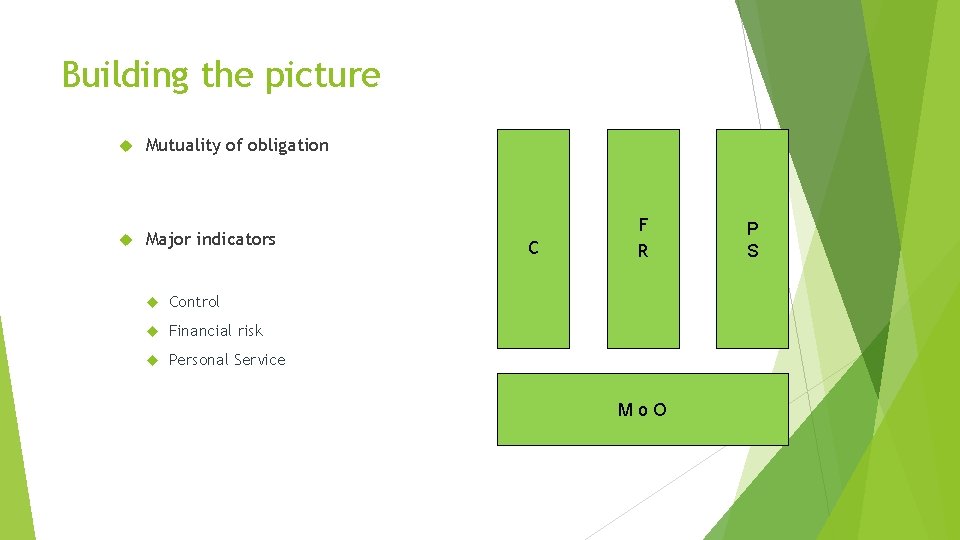
Building the picture Mutuality of obligation Major indicators Control Financial risk Personal Service C F R Mo. O P S
Further test – ‘Business in own account’ In Market Investigations v Minister of Social Security [1969] 2 QB 173 criteria that could assist in such a distinction included ‘. . . whether the man performing the services provides his own equipment, whether he hires his own helpers, what degree of financial risk he takes, what degree of responsibility for investment and management he has, and whether and how far he has an opportunity of profiting from sound management in the performance of his task. ’ Cotswold Developments Construction Ltd v Williams [2006] IRLR 181. “… a focus upon whether the purported worker actively markets his services as an independent person to the world in general (a person who will thus have a client or customer) on the one hand, or whether he is recruited by the principal to work for that principal as an integral part of the principal’s operations, will in most cases demonstrate on which side of the line a given person falls
Business in own account? Who is responsible for the success or failure of their business and can the individual make a loss or a profit? Can someone else be hired to carry out the work? Can the individual negotiate a price for their work? Or is it broadly fixed by the work provider and the same as many others who carry out similar work? Does the individual use their own money to invest (capital), buy main assets, cover running costs? Who is responsible for the success or failure of their business and can the individual make a loss or a profit?
Determinative Factors • Personal service • ‘Sufficient Degree’ of control • These will normally determine whether an engagement is employment or self-employment • But we also need to consider the overall picture of the engagement (The other provisions of the contract are consistent with its being a contract of service)
‘Paint a picture’ In the Judgement of Hall v Lorimer, Lord justice Nolan provided these comments, which is generally accepted as being a sound principle: In order to decide whether a person carries on business on his own account it is necessary to consider many different aspects of that person’s work activity. This is not a mechanical exercise of running through items on a check list to see whether they are present in, or absent from, a given situation. The object of the exercise is to paint a picture from the accumulation of detail. The overall effect can only be appreciated by standing back from the detailed picture which has been painted, by viewing it from a distance and by making an informed, considered, qualitative appreciation of the whole. It is a matter of evaluation of the overall effect, which is not necessarily the same as the sum total of the individual details. Not all details are of equal weight or importance in any given situation. The details may also vary in importance from one situation to another. The process involves painting a picture in each individual case
Helpful pointers…? Employee An employee is generally reimbursed for expenses incurred in the course of their employment Contractor An independent contractor is responsible for their own expenses.
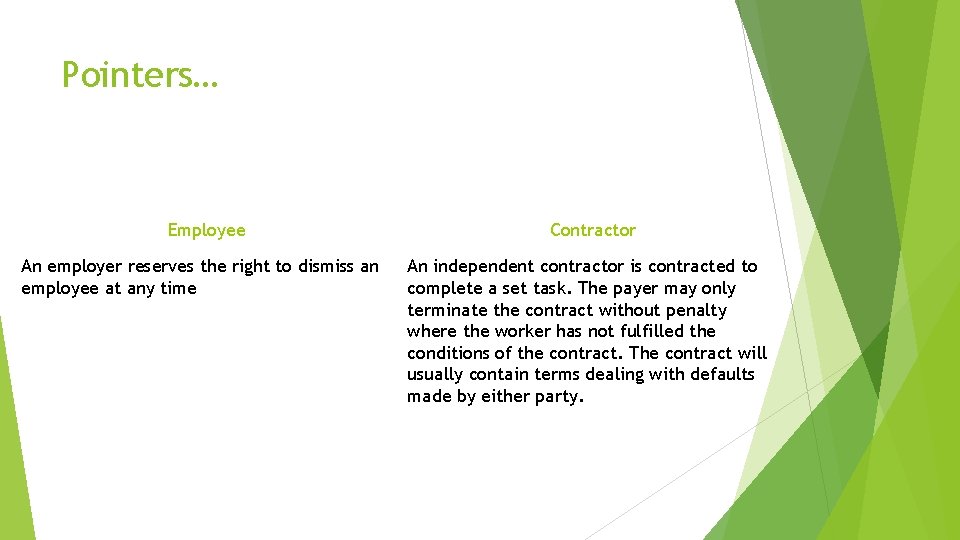
Pointers… Employee An employer reserves the right to dismiss an employee at any time Contractor An independent contractor is contracted to complete a set task. The payer may only terminate the contract without penalty where the worker has not fulfilled the conditions of the contract. The contract will usually contain terms dealing with defaults made by either party.
Pointers Employee An employee is generally recruited through an advertisement by the employer. Contractor An independent contractor is likely to advertise their services to the public at large.
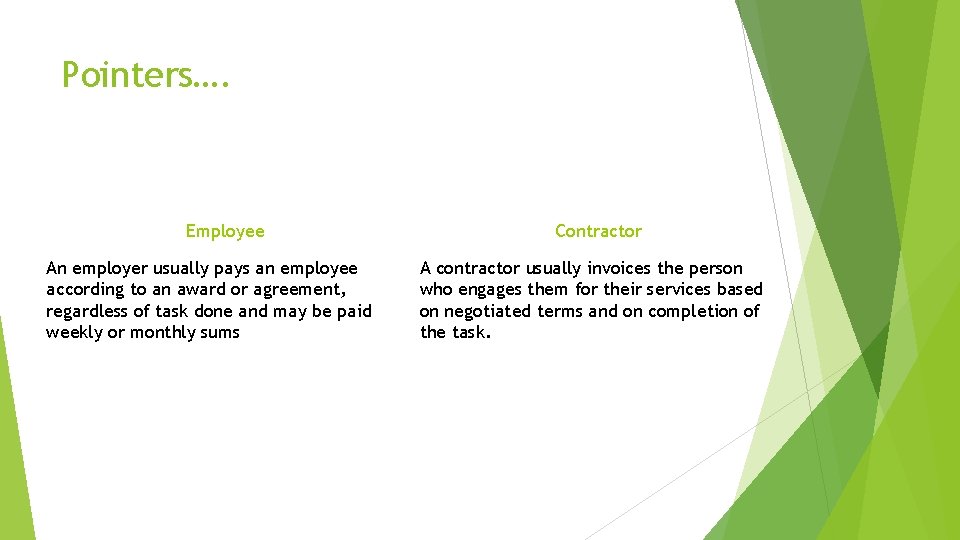
Pointers…. Employee An employer usually pays an employee according to an award or agreement, regardless of task done and may be paid weekly or monthly sums Contractor A contractor usually invoices the person who engages them for their services based on negotiated terms and on completion of the task.
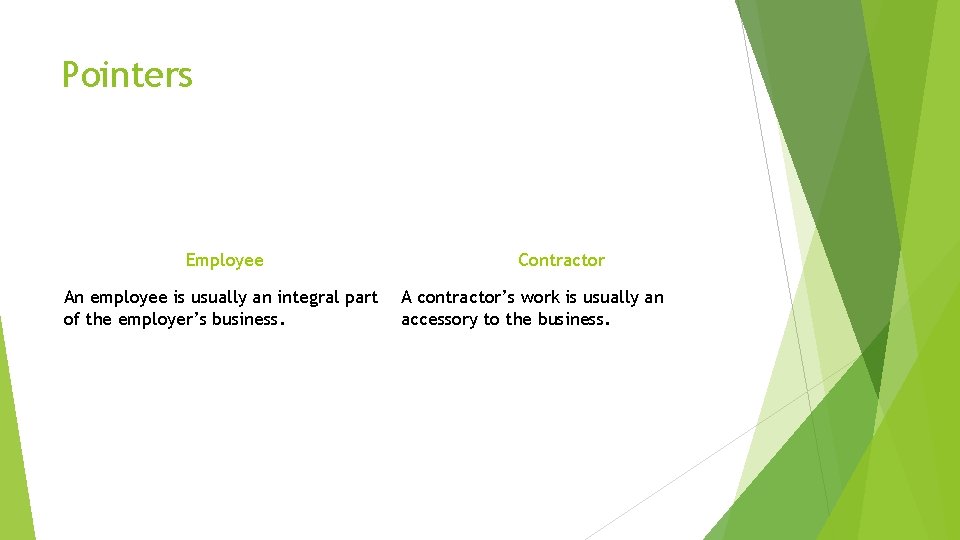
Pointers Employee An employee is usually an integral part of the employer’s business. Contractor A contractor’s work is usually an accessory to the business.
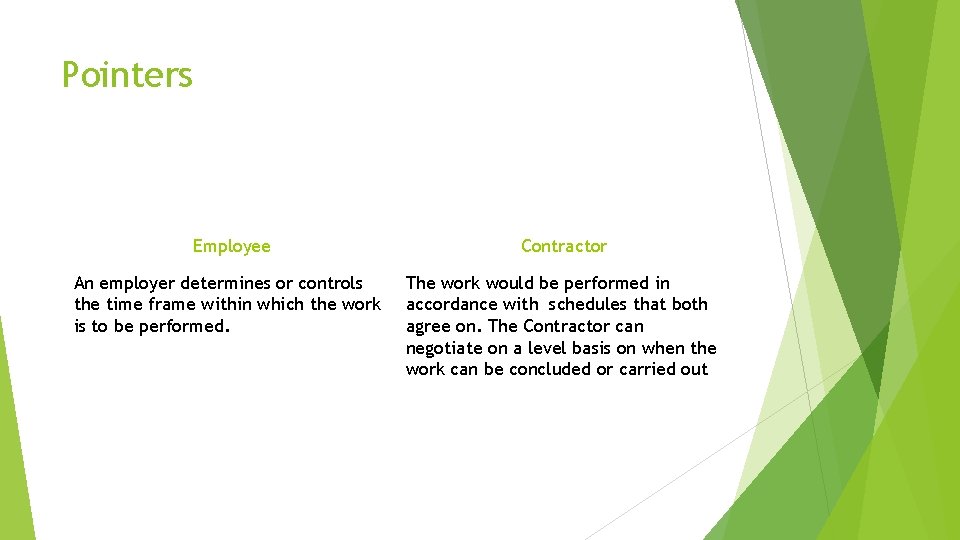
Pointers Employee Contractor An employer determines or controls the time frame within which the work is to be performed. The work would be performed in accordance with schedules that both agree on. The Contractor can negotiate on a level basis on when the work can be concluded or carried out
Building the picture O Mutuality of obligation Major indicators Control Financial risk Substitution C F R Mo. O Other indicators P S
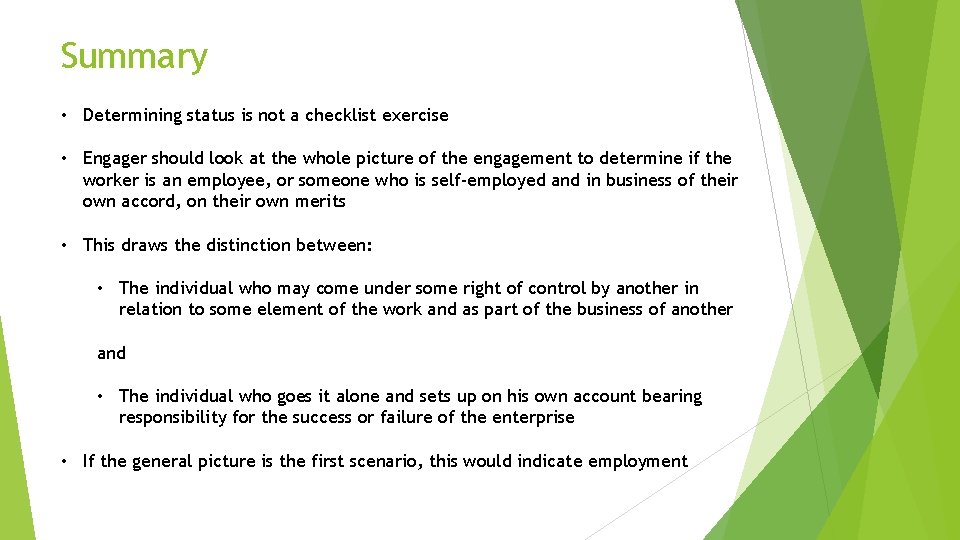
Summary • Determining status is not a checklist exercise • Engager should look at the whole picture of the engagement to determine if the worker is an employee, or someone who is self-employed and in business of their own accord, on their own merits • This draws the distinction between: • The individual who may come under some right of control by another in relation to some element of the work and as part of the business of another and • The individual who goes it alone and sets up on his own account bearing responsibility for the success or failure of the enterprise • If the general picture is the first scenario, this would indicate employment
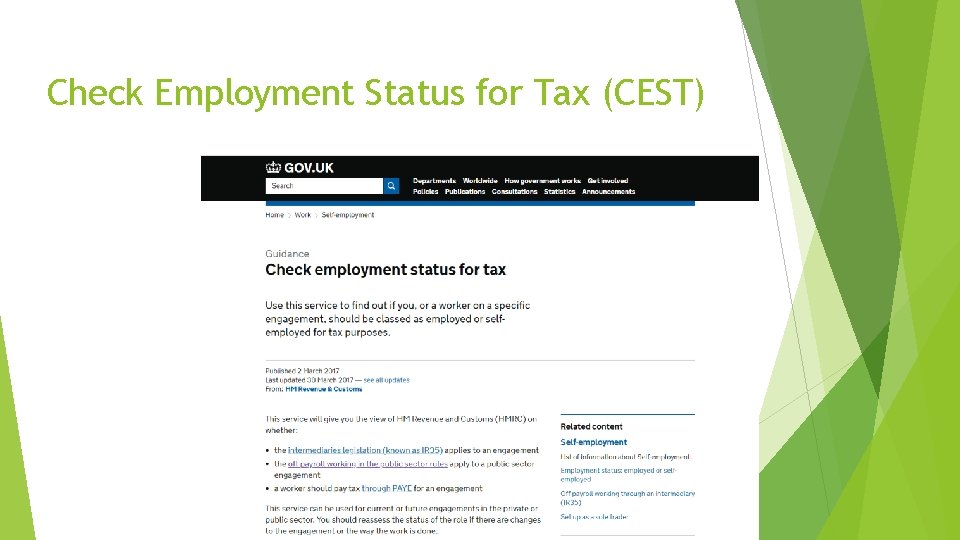
Check Employment Status for Tax (CEST)
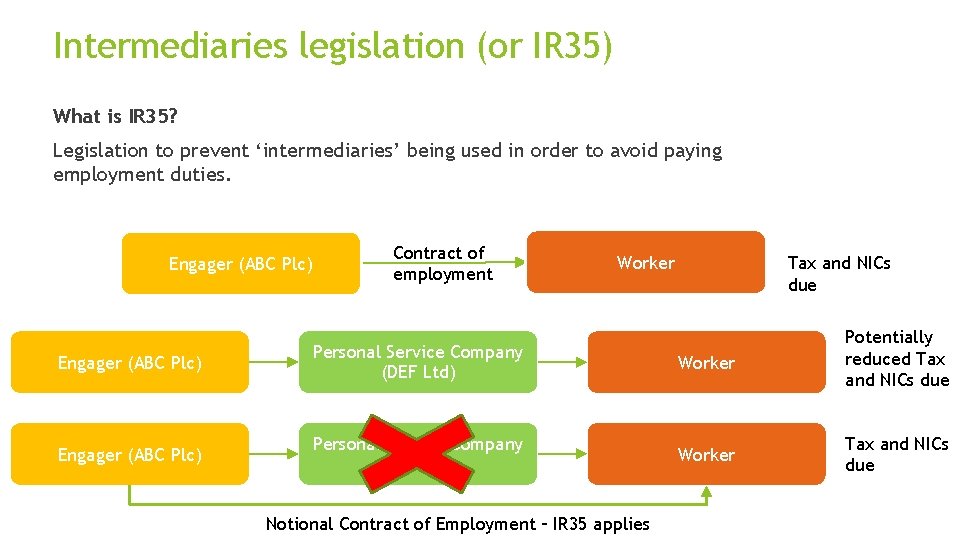
Intermediaries legislation (or IR 35) What is IR 35? Legislation to prevent ‘intermediaries’ being used in order to avoid paying employment duties. Engager (ABC Plc) Contract of employment Worker Tax and NICs due Engager (ABC Plc) Personal Service Company (DEF Ltd) Worker Potentially reduced Tax and NICs due Engager (ABC Plc) Personal Service Company (DEF Ltd) Worker Tax and NICs due Notional Contract of Employment – IR 35 applies
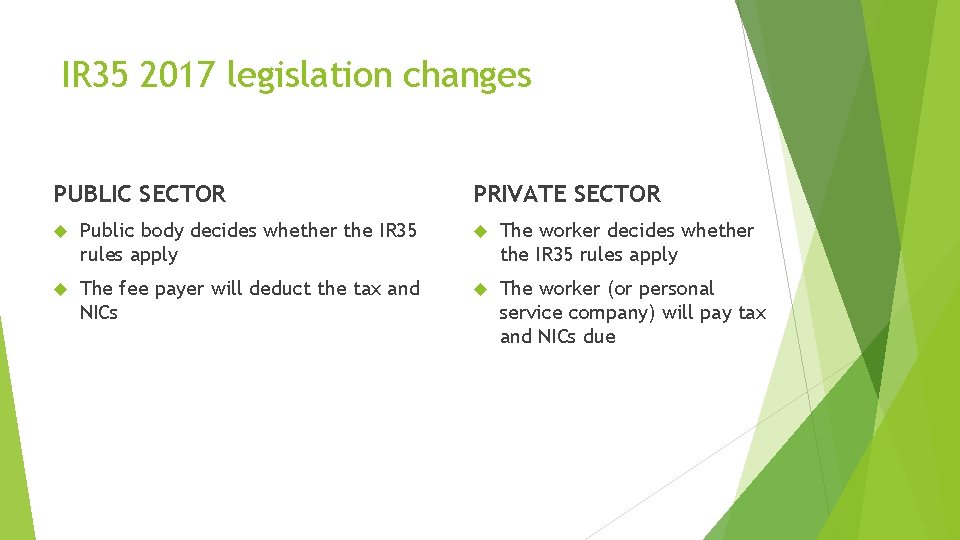
IR 35 2017 legislation changes PUBLIC SECTOR PRIVATE SECTOR Public body decides whether the IR 35 rules apply The worker decides whether the IR 35 rules apply The fee payer will deduct the tax and NICs The worker (or personal service company) will pay tax and NICs due
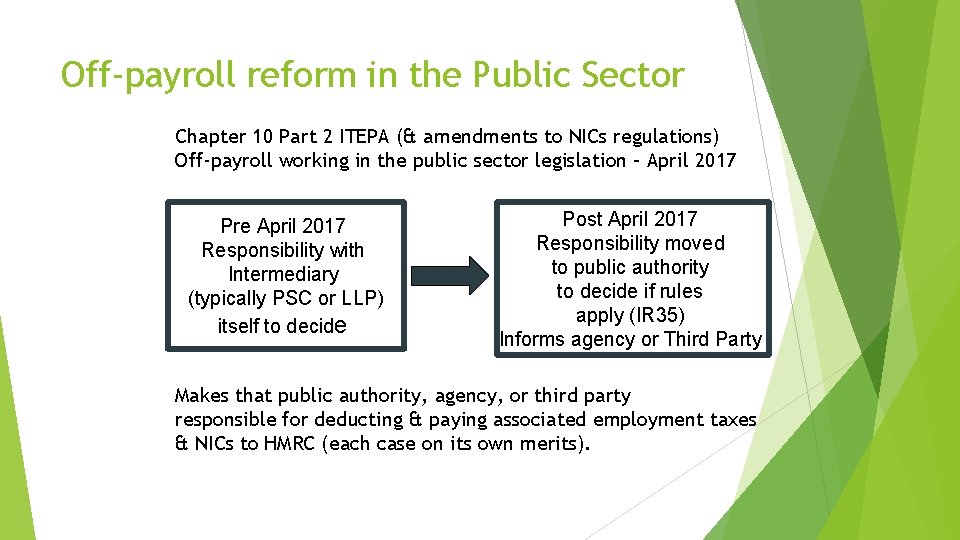
Off-payroll reform in the Public Sector Chapter 10 Part 2 ITEPA (& amendments to NICs regulations) Off-payroll working in the public sector legislation – April 2017 Pre April 2017 Responsibility with Intermediary (typically PSC or LLP) itself to decide Post April 2017 Responsibility moved to public authority to decide if rules apply (IR 35) Informs agency or Third Party Makes that public authority, agency, or third party responsible for deducting & paying associated employment taxes & NICs to HMRC (each case on its own merits).
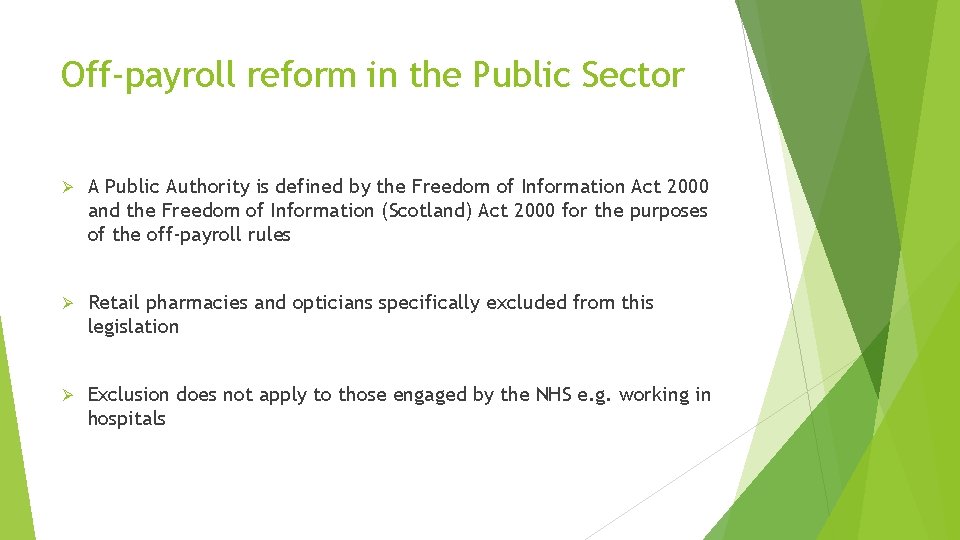
Off-payroll reform in the Public Sector Ø A Public Authority is defined by the Freedom of Information Act 2000 and the Freedom of Information (Scotland) Act 2000 for the purposes of the off-payroll rules Ø Retail pharmacies and opticians specifically excluded from this legislation Ø Exclusion does not apply to those engaged by the NHS e. g. working in hospitals
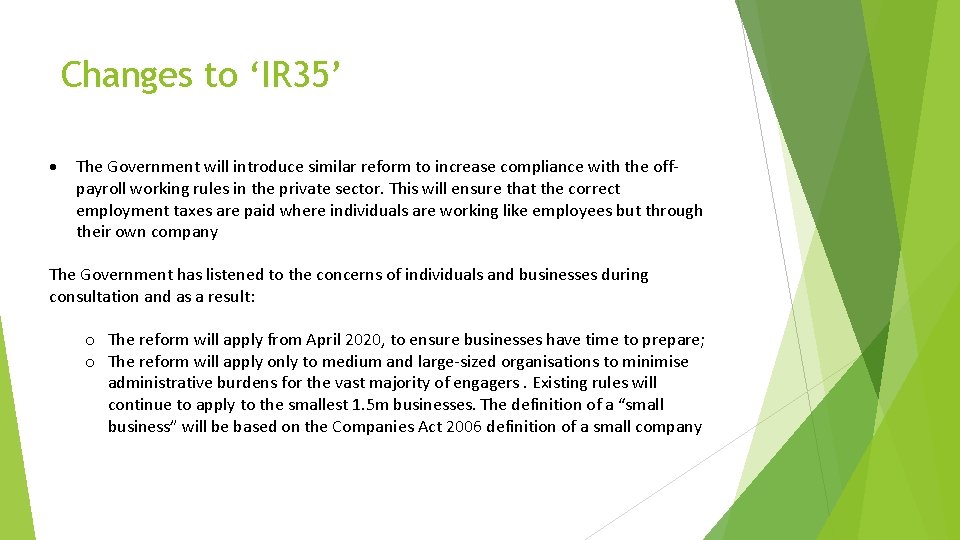
Changes to ‘IR 35’ The Government will introduce similar reform to increase compliance with the offpayroll working rules in the private sector. This will ensure that the correct employment taxes are paid where individuals are working like employees but through their own company The Government has listened to the concerns of individuals and businesses during consultation and as a result: o The reform will apply from April 2020, to ensure businesses have time to prepare; o The reform will apply only to medium and large-sized organisations to minimise administrative burdens for the vast majority of engagers. Existing rules will continue to apply to the smallest 1. 5 m businesses. The definition of a “small business” will be based on the Companies Act 2006 definition of a small company
New reform (IR 35) • HMRC will continue to improve CEST and guidance to ensure they fit the needs of the private sector • HMRC will focus their compliance efforts on helping businesses to comply, not targeting historic cases • A further consultation on the detailed operation of the reform will be published in the coming months. This consultation will inform the draft Finance Bill legislation, which is expected to be published in Summer 2019
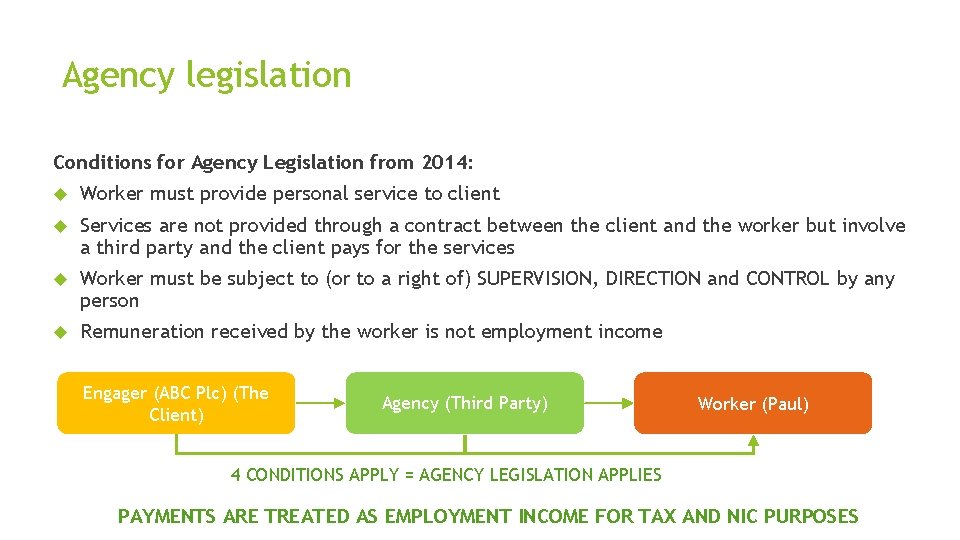
Agency legislation Conditions for Agency Legislation from 2014: Worker must provide personal service to client Services are not provided through a contract between the client and the worker but involve a third party and the client pays for the services Worker must be subject to (or to a right of) SUPERVISION, DIRECTION and CONTROL by any person Remuneration received by the worker is not employment income Engager (ABC Plc) (The Client) Agency (Third Party) Worker (Paul) 4 CONDITIONS APPLY = AGENCY LEGISLATION APPLIES PAYMENTS ARE TREATED AS EMPLOYMENT INCOME FOR TAX AND NIC PURPOSES
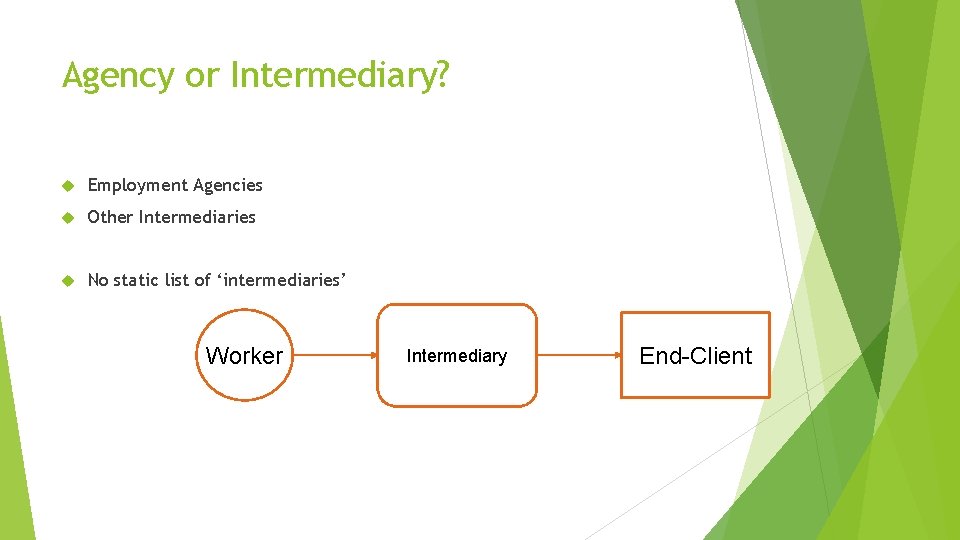
Agency or Intermediary? Employment Agencies Other Intermediaries No static list of ‘intermediaries’ Worker Intermediary End-Client
Agency legislation S 44 -47 ITEPA 03 – if conditions are met, the worker’s services are treated as duties of an employment and the remuneration is treated as employment income. PAYE must be operated by the payer Can apply in a range of circumstances, some outside traditional agency type business Where an agency sits off-shore, liabilities can shift back on-shore Agencies should speak to engager and worker to establish facts
Any QUESTIONS?