
EMPLOYMENT RIGHTS What responsibilities do employees have To
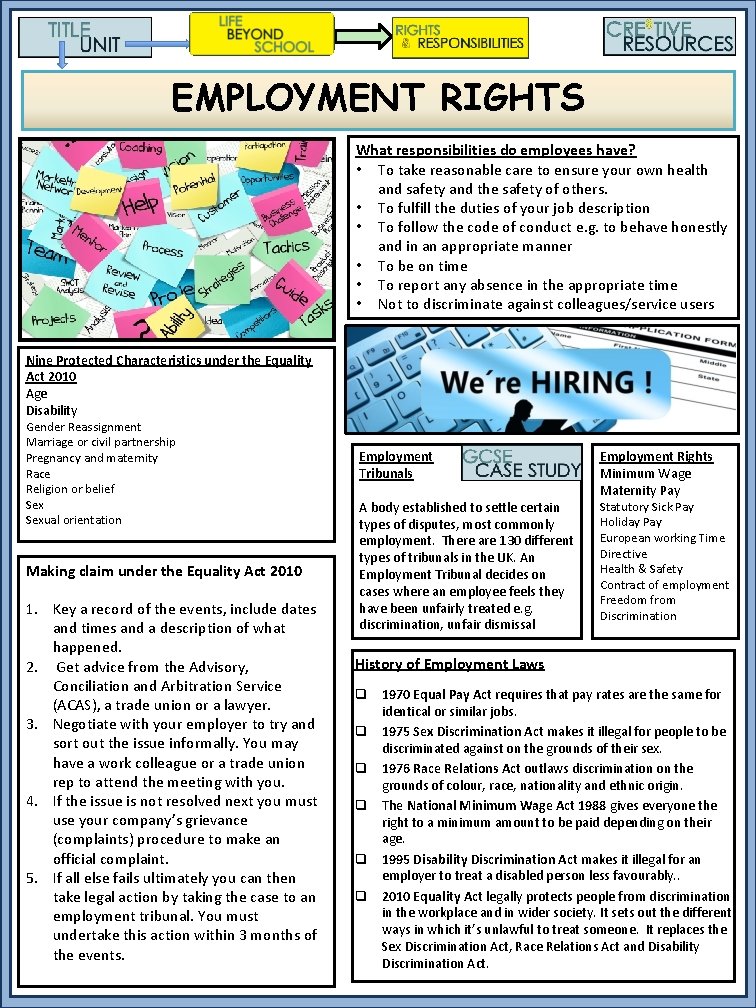
EMPLOYMENT RIGHTS What responsibilities do employees have? • To take reasonable care to ensure your own health and safety and the safety of others. • To fulfill the duties of your job description • To follow the code of conduct e. g. to behave honestly and in an appropriate manner • To be on time • To report any absence in the appropriate time • Not to discriminate against colleagues/service users Nine Protected Characteristics under the Equality Act 2010 Age Disability Gender Reassignment Marriage or civil partnership Pregnancy and maternity Race Religion or belief Sexual orientation Making claim under the Equality Act 2010 1. Key a record of the events, include dates and times and a description of what happened. 2. Get advice from the Advisory, Conciliation and Arbitration Service (ACAS), a trade union or a lawyer. 3. Negotiate with your employer to try and sort out the issue informally. You may have a work colleague or a trade union rep to attend the meeting with you. 4. If the issue is not resolved next you must use your company’s grievance (complaints) procedure to make an official complaint. 5. If all else fails ultimately you can then take legal action by taking the case to an employment tribunal. You must undertake this action within 3 months of the events. Employment Tribunals A body established to settle certain types of disputes, most commonly employment. There are 130 different types of tribunals in the UK. An Employment Tribunal decides on cases where an employee feels they have been unfairly treated e. g. discrimination, unfair dismissal Employment Rights Minimum Wage Maternity Pay Statutory Sick Pay Holiday Pay European working Time Directive Health & Safety Contract of employment Freedom from Discrimination History of Employment Laws q 1970 Equal Pay Act requires that pay rates are the same for identical or similar jobs. q 1975 Sex Discrimination Act makes it illegal for people to be discriminated against on the grounds of their sex. q 1976 Race Relations Act outlaws discrimination on the grounds of colour, race, nationality and ethnic origin. q The National Minimum Wage Act 1988 gives everyone the right to a minimum amount to be paid depending on their age. q 1995 Disability Discrimination Act makes it illegal for an employer to treat a disabled person less favourably. . q 2010 Equality Act legally protects people from discrimination in the workplace and in wider society. It sets out the different ways in which it’s unlawful to treat someone. It replaces the Sex Discrimination Act, Race Relations Act and Disability Discrimination Act.
- Slides: 1