
Employment Relations Management Training for Line ManagersSupervisors Inspiring
- Slides: 35
Employment Relations Management Training for Line Managers/Supervisors Inspiring excellence. Transforming lives.
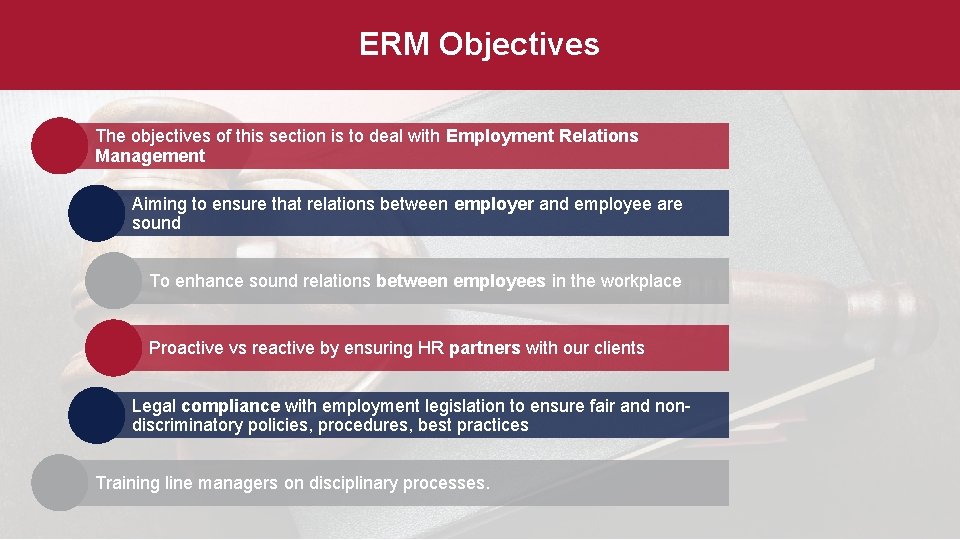
ERM Objectives The objectives of this section is to deal with Employment Relations Management Aiming to ensure that relations between employer and employee are sound To enhance sound relations between employees in the workplace Proactive vs reactive by ensuring HR partners with our clients Legal compliance with employment legislation to ensure fair and nondiscriminatory policies, procedures, best practices Training line managers on disciplinary processes.
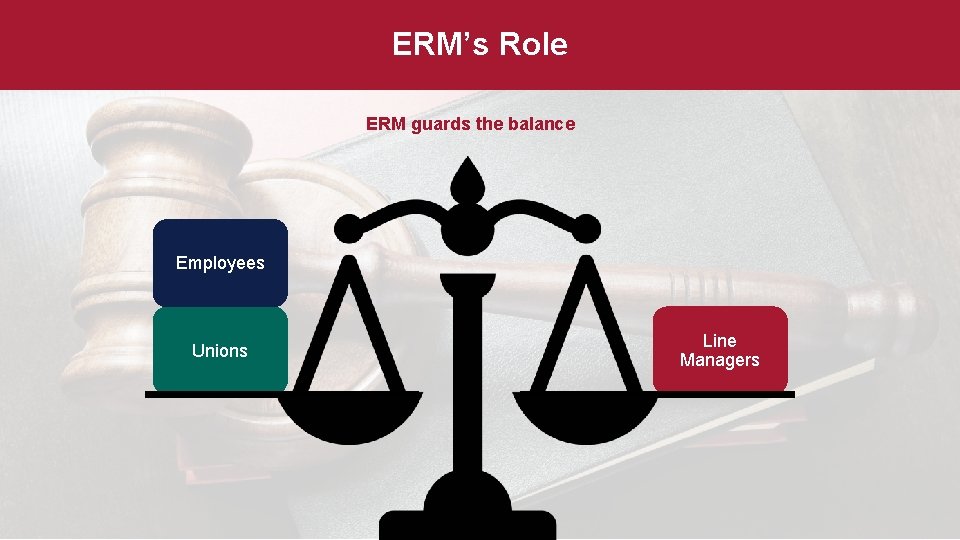
ERM’s Role ERM guards the balance Employees Unions Line Managers
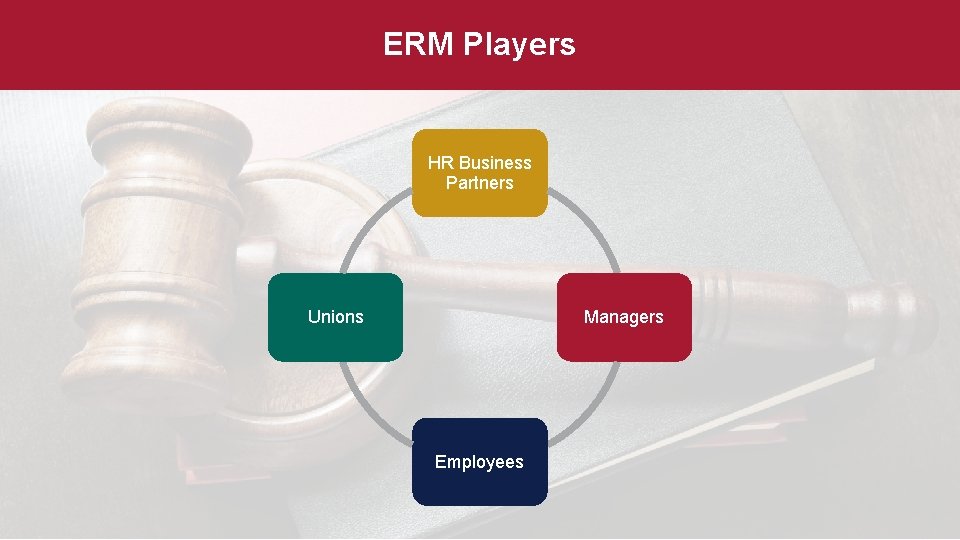
ERM Players HR Business Partners Unions Managers Employees
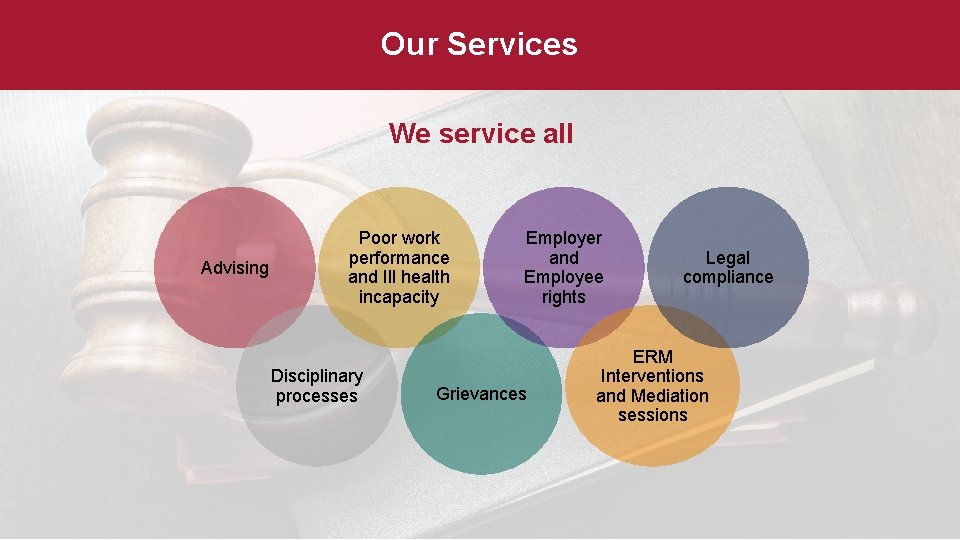
Our Services We service all Advising Poor work performance and Ill health incapacity Disciplinary processes Employer and Employee rights Grievances Legal compliance ERM Interventions and Mediation sessions
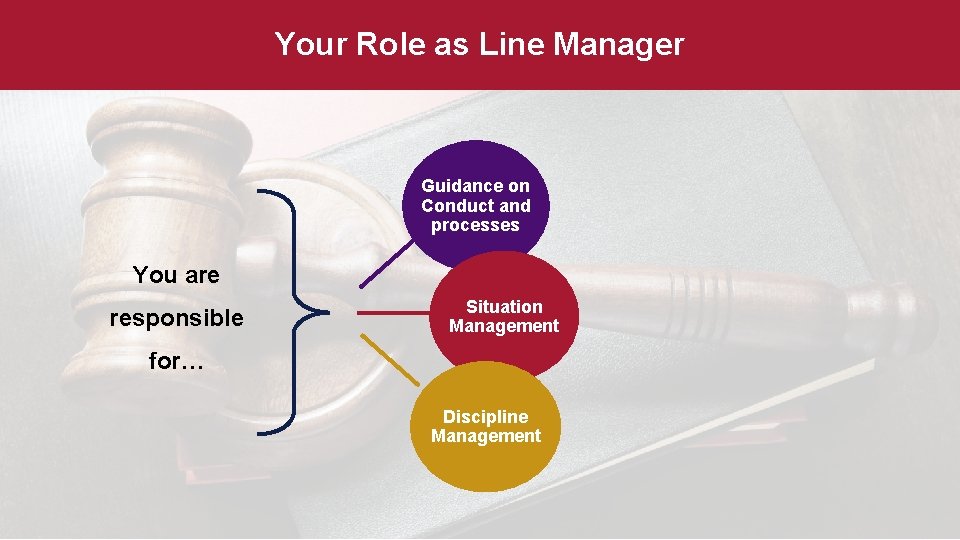
Your Role as Line Manager Guidance on Conduct and processes You are responsible Situation Management for… Discipline Management
Conduct to be managed by the line manager Employees should: • • • Attend work regularly and punctually Apply for leave, prior to absence (subjected to approval) Show good cause if absent from work Conform to reasonable dress and uniform requirement Perform their duties diligently Obey lawful and reasonable instruction Act with honesty and integrity Acting in the best interest of the employer Don’t participate in disrupting of employer’s operations Ensure protection of University property Disclosure of privileged information prohibited Consuming of alcohol or drugs prohibited
Overview q • • • Link between socio-economic growth and discipline SA has sophisticated labour law system Unproductive workforce and high unemployment figures Labour relationship is interdependent Work in return for wage Both has duties & responsibilities Common law: Master & servant principle • Employer -Remunerates employee -Safe working conditions -Enforcing & maintaining discipline • Employee -Serve interests of employer -Refrain from misconduct -Duty to obey all lawful and -reasonable instructions GUIDELINES OF EMPLOYERS’RIGHT TO DISCIPLINE • Regulated by LRA and developments in Industrial Court • Basis is progressive discipline, system of graduated disciplinary measures e. g. counseling and warnings etc.
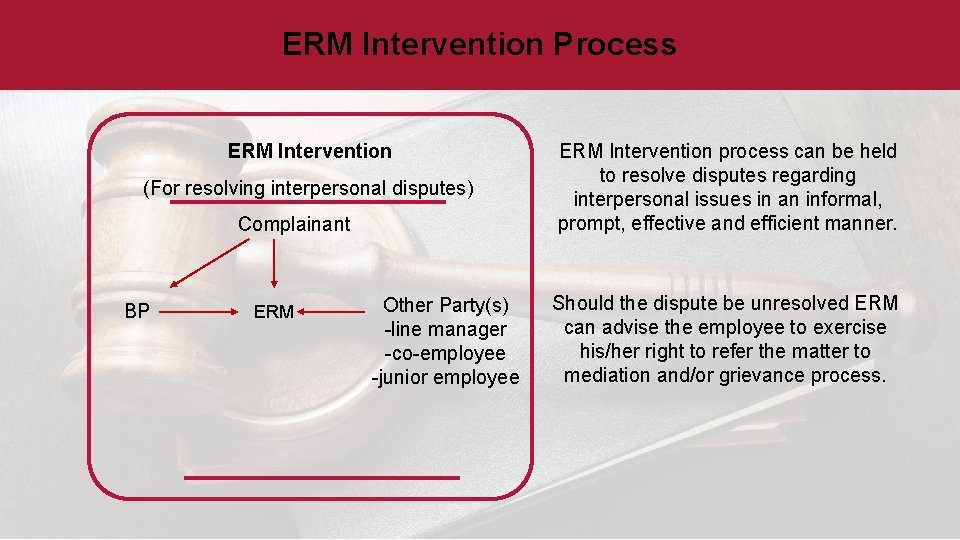
ERM Intervention Process ERM Intervention (For resolving interpersonal disputes) Complainant BP ERM Other Party(s) -line manager -co-employee -junior employee ERM Intervention process can be held to resolve disputes regarding interpersonal issues in an informal, prompt, effective and efficient manner. Should the dispute be unresolved ERM can advise the employee to exercise his/her right to refer the matter to mediation and/or grievance process.
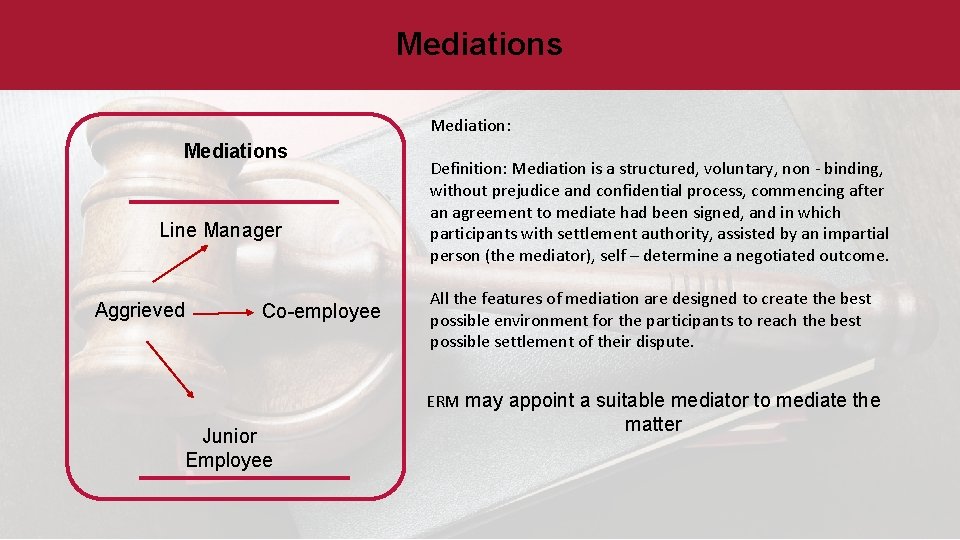
Mediations Mediation: Mediations Line Manager Aggrieved Co-employee Definition: Mediation is a structured, voluntary, non - binding, without prejudice and confidential process, commencing after an agreement to mediate had been signed, and in which participants with settlement authority, assisted by an impartial person (the mediator), self – determine a negotiated outcome. All the features of mediation are designed to create the best possible environment for the participants to reach the best possible settlement of their dispute. ERM may appoint a suitable mediator to mediate the Junior Employee matter
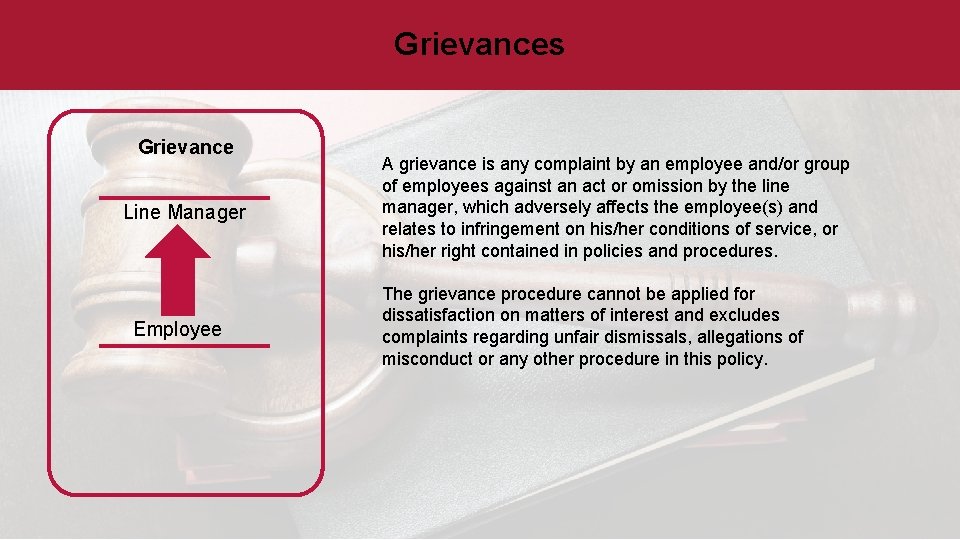
Grievances Grievance Line Manager Employee A grievance is any complaint by an employee and/or group of employees against an act or omission by the line manager, which adversely affects the employee(s) and relates to infringement on his/her conditions of service, or his/her right contained in policies and procedures. The grievance procedure cannot be applied for dissatisfaction on matters of interest and excludes complaints regarding unfair dismissals, allegations of misconduct or any other procedure in this policy.
Probation Management q. Probation Ø New employees Ø Purpose is to evaluate employee Ø Distinguished from permanent employees Ø Period be determined in advance & should be reasonable Ø Purpose is to establish employees’ suitability Ø Performance should be assessed 2 times per annum Ø Probation meetings to be documented and signed by parties Ø Reasonable evaluation, training, counseling & guidance Ø Inform of failing to meet standards Ø Invite employee to give representations Ø Extend period / dismiss (less compelling reasons)
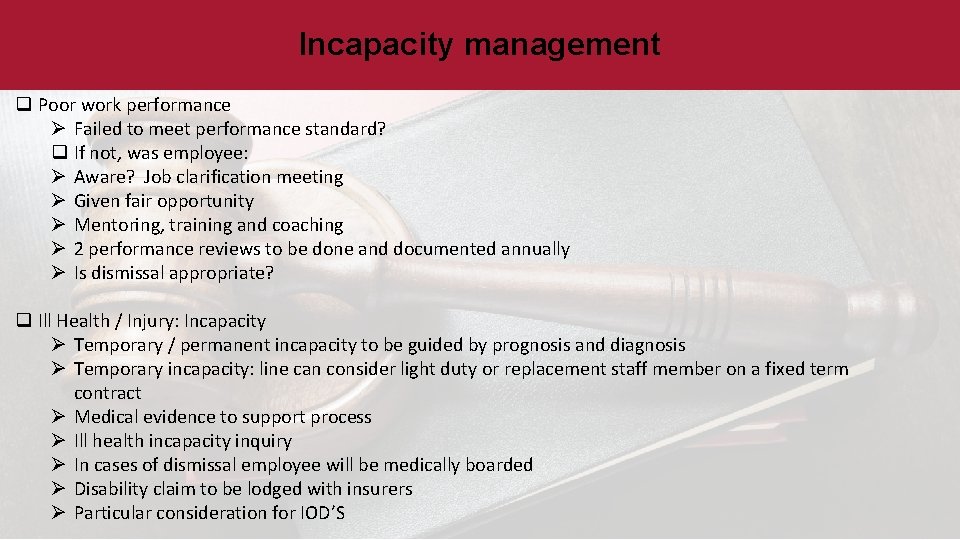
Incapacity management q Poor work performance Ø Failed to meet performance standard? q If not, was employee: Ø Aware? Job clarification meeting Ø Given fair opportunity Ø Mentoring, training and coaching Ø 2 performance reviews to be done and documented annually Ø Is dismissal appropriate? q Ill Health / Injury: Incapacity Ø Temporary / permanent incapacity to be guided by prognosis and diagnosis Ø Temporary incapacity: line can consider light duty or replacement staff member on a fixed term contract Ø Medical evidence to support process Ø Ill health incapacity inquiry Ø In cases of dismissal employee will be medically boarded Ø Disability claim to be lodged with insurers Ø Particular consideration for IOD’S
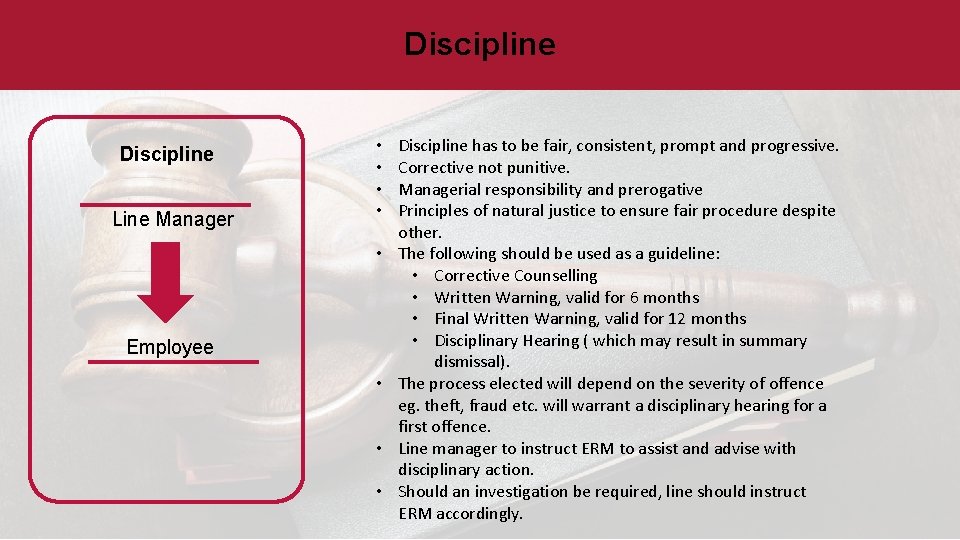
Discipline Line Manager • • • Employee • • • Discipline has to be fair, consistent, prompt and progressive. Corrective not punitive. Managerial responsibility and prerogative Principles of natural justice to ensure fair procedure despite other. The following should be used as a guideline: • Corrective Counselling • Written Warning, valid for 6 months • Final Written Warning, valid for 12 months • Disciplinary Hearing ( which may result in summary dismissal). The process elected will depend on the severity of offence eg. theft, fraud etc. will warrant a disciplinary hearing for a first offence. Line manager to instruct ERM to assist and advise with disciplinary action. Should an investigation be required, line should instruct ERM accordingly.
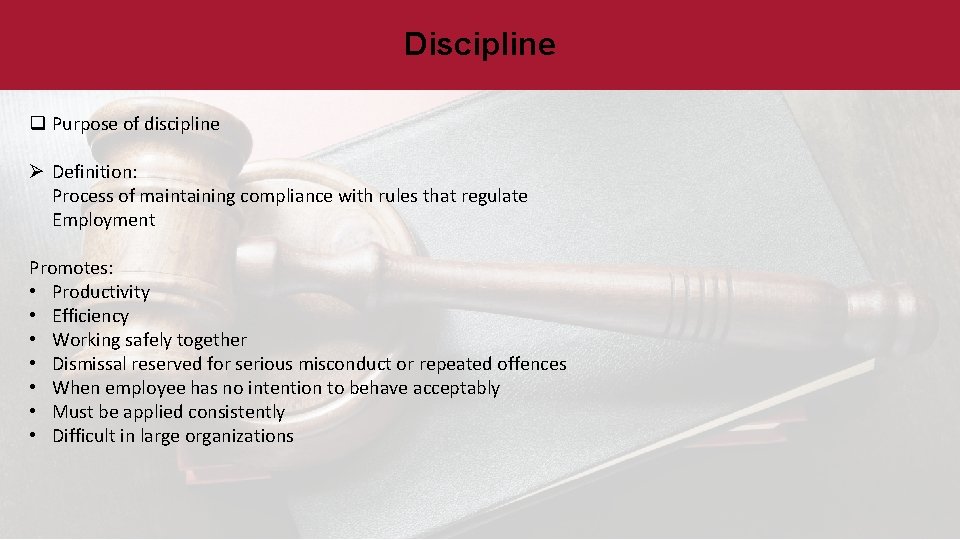
Discipline q Purpose of discipline Ø Definition: Process of maintaining compliance with rules that regulate Employment Promotes: • Productivity • Efficiency • Working safely together • Dismissal reserved for serious misconduct or repeated offences • When employee has no intention to behave acceptably • Must be applied consistently • Difficult in large organizations
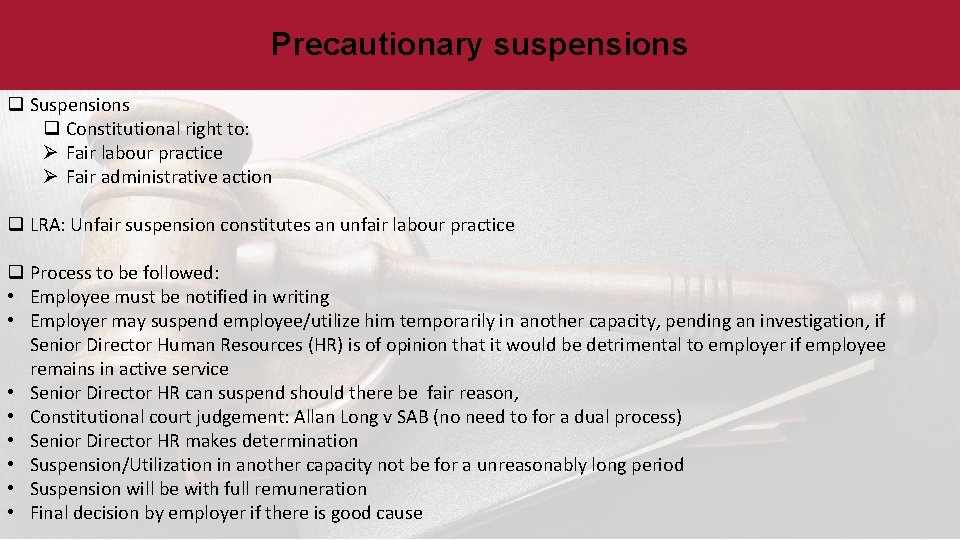
Precautionary suspensions q Suspensions q Constitutional right to: Ø Fair labour practice Ø Fair administrative action q LRA: Unfair suspension constitutes an unfair labour practice q Process to be followed: • Employee must be notified in writing • Employer may suspend employee/utilize him temporarily in another capacity, pending an investigation, if Senior Director Human Resources (HR) is of opinion that it would be detrimental to employer if employee remains in active service • Senior Director HR can suspend should there be fair reason, • Constitutional court judgement: Allan Long v SAB (no need to for a dual process) • Senior Director HR makes determination • Suspension/Utilization in another capacity not be for a unreasonably long period • Suspension will be with full remuneration • Final decision by employer if there is good cause
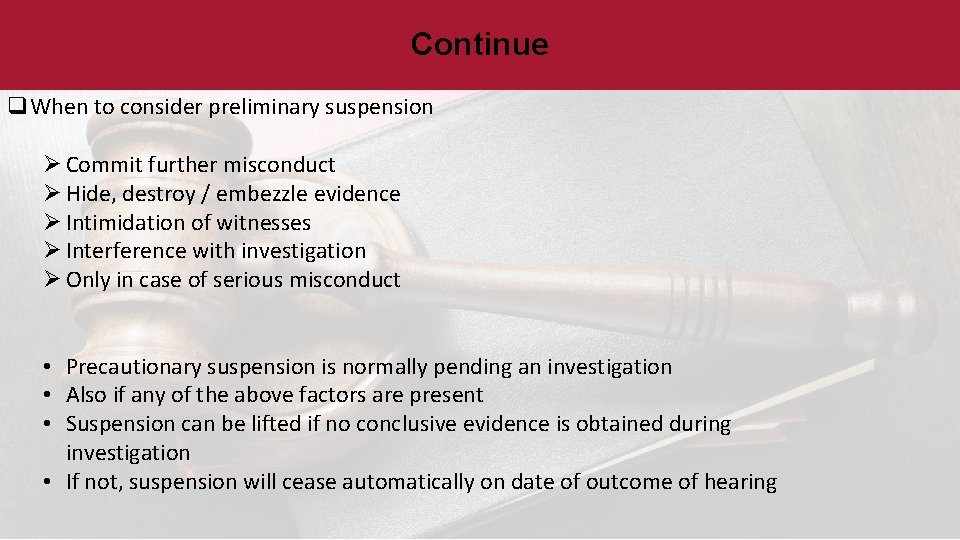
Continue q. When to consider preliminary suspension Ø Commit further misconduct Ø Hide, destroy / embezzle evidence Ø Intimidation of witnesses Ø Interference with investigation Ø Only in case of serious misconduct • Precautionary suspension is normally pending an investigation • Also if any of the above factors are present • Suspension can be lifted if no conclusive evidence is obtained during investigation • If not, suspension will cease automatically on date of outcome of hearing
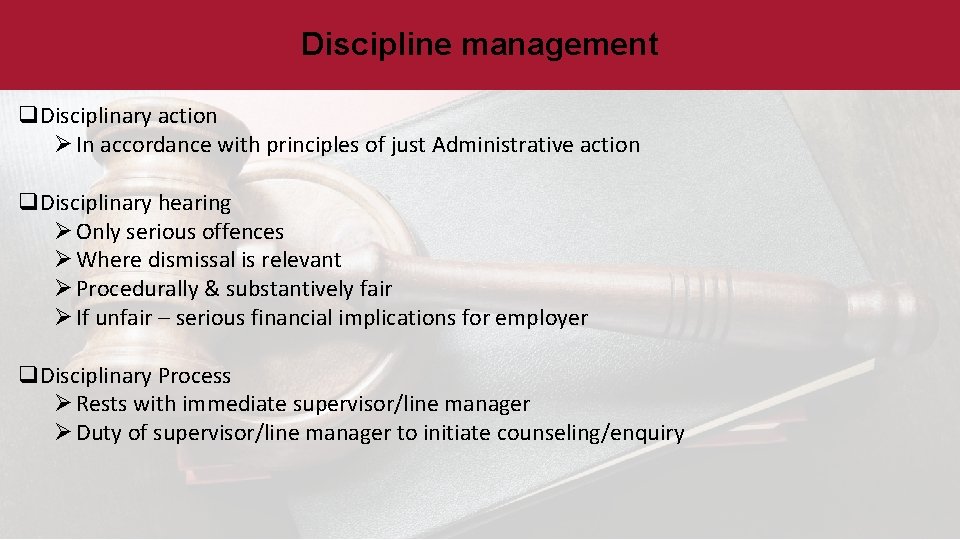
Discipline management q. Disciplinary action Ø In accordance with principles of just Administrative action q. Disciplinary hearing Ø Only serious offences Ø Where dismissal is relevant Ø Procedurally & substantively fair Ø If unfair – serious financial implications for employer q. Disciplinary Process Ø Rests with immediate supervisor/line manager Ø Duty of supervisor/line manager to initiate counseling/enquiry
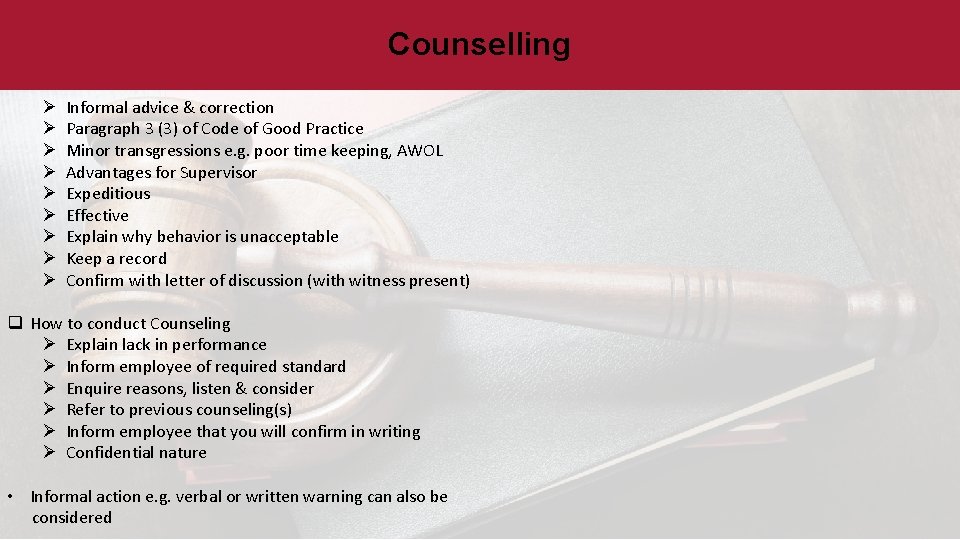
Counselling Ø Ø Ø Ø Ø Informal advice & correction Paragraph 3 (3) of Code of Good Practice Minor transgressions e. g. poor time keeping, AWOL Advantages for Supervisor Expeditious Effective Explain why behavior is unacceptable Keep a record Confirm with letter of discussion (with witness present) q How to conduct Counseling Ø Explain lack in performance Ø Inform employee of required standard Ø Enquire reasons, listen & consider Ø Refer to previous counseling(s) Ø Inform employee that you will confirm in writing Ø Confidential nature • Informal action e. g. verbal or written warning can also be considered
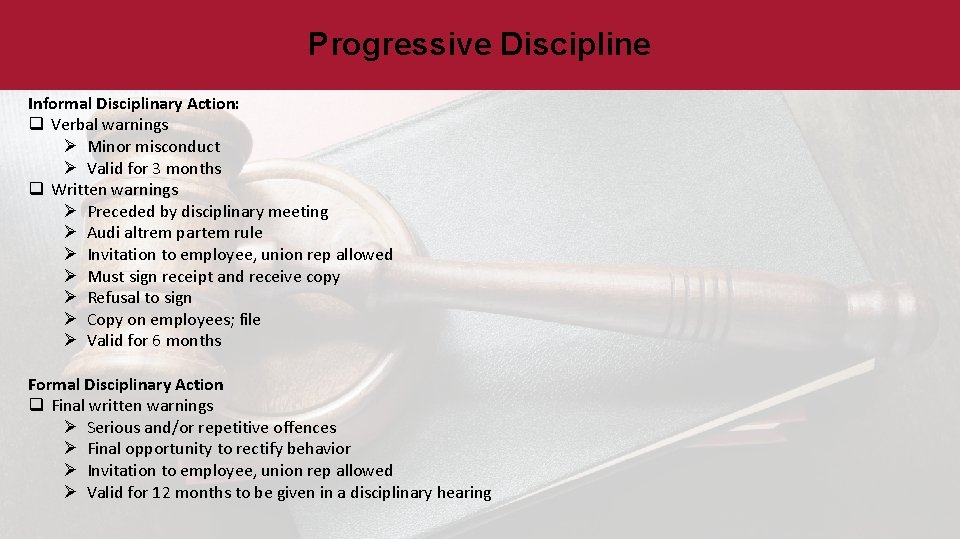
Progressive Discipline Informal Disciplinary Action: q Verbal warnings Ø Minor misconduct Ø Valid for 3 months q Written warnings Ø Preceded by disciplinary meeting Ø Audi altrem partem rule Ø Invitation to employee, union rep allowed Ø Must sign receipt and receive copy Ø Refusal to sign Ø Copy on employees; file Ø Valid for 6 months Formal Disciplinary Action q Final written warnings Ø Serious and/or repetitive offences Ø Final opportunity to rectify behavior Ø Invitation to employee, union rep allowed Ø Valid for 12 months to be given in a disciplinary hearing
Disciplinary Hearings q. Schedule 8 (Code of Good Practice) • Substantive & procedural fairness • Disciplinary rules create certainty & consistency in application of discipline • Breach or rule – disciplinary action • Corrective approach • Sanction depends on transgression and frequency of transgression • Dismissal is last resort • Consultation with union leadership prior to Disciplinary Action against Shop Steward
Types of sanctions to be given at a hearing q Final written warning valid for 12 months q Demotion mainly for incapacity and poor work performance subject to the availability of a vacant suitable alternative position q Dismissal q Presiding Officer decision is a recommendation q DVC or his delegated authority can accept/overrule q No double jeopardy, except if permitted by Case Law q Double jeopardy is trying a matter twice on the same set of facts q Disciplinary action is taken in terms of: • Disciplinary code (Schedule 8) • Employee Relations Management Policy q LRA (Schedule 8) • Section 185 ‒ Right not to be dismissed unfairly
Definitions of Dismissals q. Section 186 Ø Termination of contract Ø Non renewal / worse terms Fixed term and legitimate expectations Ø Resume work after maternity (automatic unfair) Ø Several dismissed for same reason and only some re-employed (selective re-employment) Ø Constructive dismissal Ø Section 197 transfer • Less favorable conditions • Also makes provision for automatic unfair dismissals • Sec 198 (B) fixed term contracts of employees below the threshold(BCEA), should not exceed 3 months. Deemed permanency
Dismissals q Previous warnings or q First offender for • Intimidation; fighting; assault • Theft; unauthorized possession of council property; malicious damage to property • Under influence of alcohol or drugs and performance seriously impaired • Consumption of alcohol and drugs through which safety of employees at risk • Dishonesty • Gross negligence • Disclosure of privileged information • Bribery or corruption • Sexual harassment • Plagiarism • Any other act that infringes trust relationship
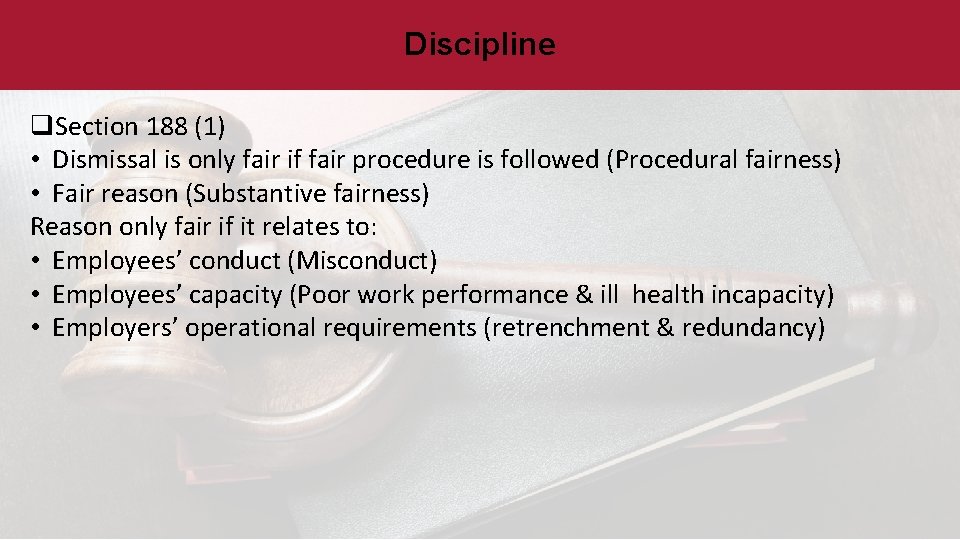
Discipline q. Section 188 (1) • Dismissal is only fair if fair procedure is followed (Procedural fairness) • Fair reason (Substantive fairness) Reason only fair if it relates to: • Employees’ conduct (Misconduct) • Employees’ capacity (Poor work performance & ill health incapacity) • Employers’ operational requirements (retrenchment & redundancy)
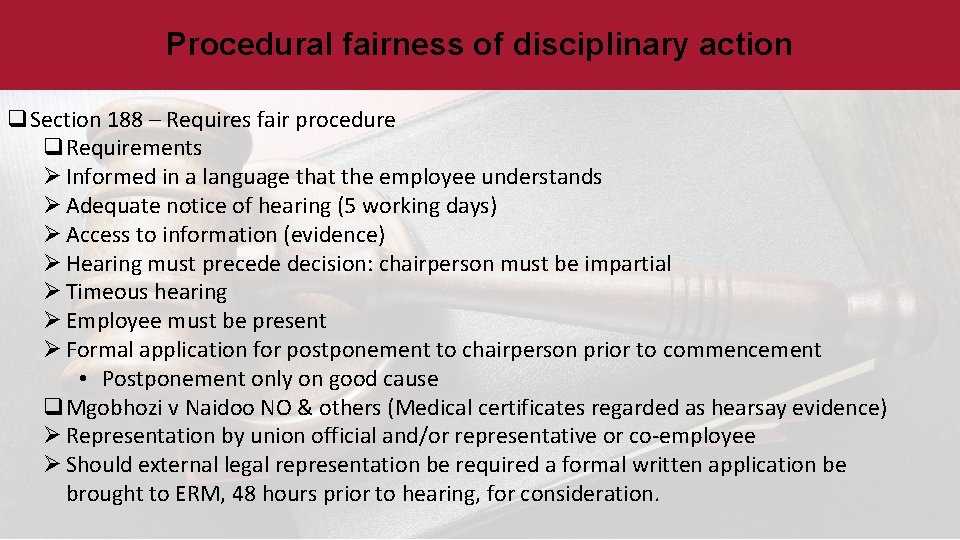
Procedural fairness of disciplinary action q. Section 188 – Requires fair procedure q. Requirements Ø Informed in a language that the employee understands Ø Adequate notice of hearing (5 working days) Ø Access to information (evidence) Ø Hearing must precede decision: chairperson must be impartial Ø Timeous hearing Ø Employee must be present Ø Formal application for postponement to chairperson prior to commencement • Postponement only on good cause q. Mgobhozi v Naidoo NO & others (Medical certificates regarded as hearsay evidence) Ø Representation by union official and/or representative or co-employee Ø Should external legal representation be required a formal written application be brought to ERM, 48 hours prior to hearing, for consideration.
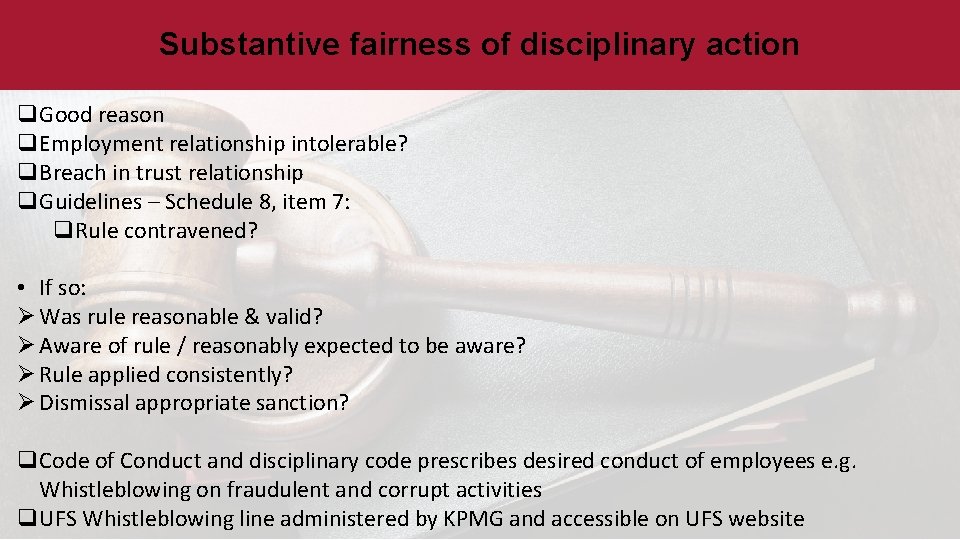
Substantive fairness of disciplinary action q. Good reason q. Employment relationship intolerable? q. Breach in trust relationship q. Guidelines – Schedule 8, item 7: q. Rule contravened? • If so: Ø Was rule reasonable & valid? Ø Aware of rule / reasonably expected to be aware? Ø Rule applied consistently? Ø Dismissal appropriate sanction? q. Code of Conduct and disciplinary code prescribes desired conduct of employees e. g. Whistleblowing on fraudulent and corrupt activities q. UFS Whistleblowing line administered by KPMG and accessible on UFS website
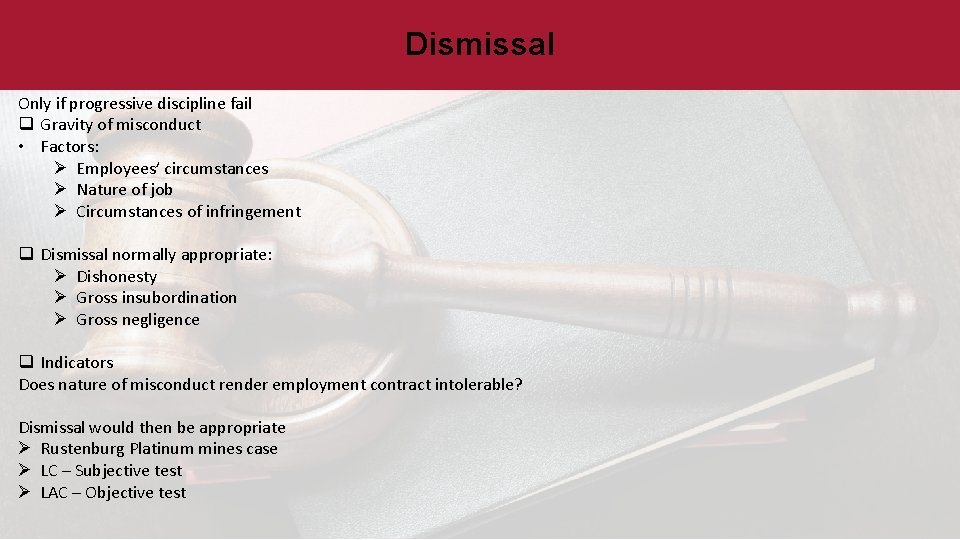
Dismissal Only if progressive discipline fail q Gravity of misconduct • Factors: Ø Employees’ circumstances Ø Nature of job Ø Circumstances of infringement q Dismissal normally appropriate: Ø Dishonesty Ø Gross insubordination Ø Gross negligence q Indicators Does nature of misconduct render employment contract intolerable? Dismissal would then be appropriate Ø Rustenburg Platinum mines case Ø LC – Subjective test Ø LAC – Objective test
Appeals q. Appeal Ø According to Disciplinary policy, should be within writing 5 working days after the outcome of the disciplinary hearing Ø Should be submitted to ERM Ø Submissions has to be submitted in writing Ø ERM to forward appeal to Appeals Committee Ø Will not be a de novo hearing Ø New Chairperson to be appointed for Appeal Ø Chairperson to review evidence led at disciplinary hearing to determine fairness of finding and sanction Ø ERM to communicate outcome of appeal to parties
Off-Duty Misconduct q Employers and employees are often under impression that if employee misbehaves outside work context no action can be taken against him/her. q Following rules apply: Ø If misconduct has a negative impact on: Ø Business of the employer Ø Working relationship between staff members Ø Working relationship between employer and employee Ø Continued service rendered by the employee • Employer shall be entitled to take disciplinary action and even dismiss such employee q Sufficient nexus present q Arrested for offences e. g. rape q If employee is refused bail and remains in custody – service contract may be terminated, objectively impossible for employee to perform duties
Unfair Labour Practice • Definition: Ø Unfair conduct – promotion, demotion, probation, training & provision of benefits Ø Unfair suspension / action short of dismissal Ø Failure / refusal to re-instate / re-employ in terms of any agreement Ø Occupational detriment – Protective Disclosures Act • Will include suspension / demotion / transfer of employee making disclosure • Re: Any right an employee has in terms of legislation, contract of service, policies, procedures and/or practices • Apollo Case
continue q. If employee challenges an unfair labour practice they may approach the CCMA with 90 days from when the dispute arose ØArbitrator issues an award ØMay make any reasonable & fair order under circumstances e. g. compensation, re-instatement / reemployment ØDiscrimination now in Employment Equity Act section 6 listed grounds(includes sexual harassment) Section 60 of the EEA places a positive obligation on employer to protect employees from harassment.
Other ERM processes • Advising on substance abuse matters • Desertion • Line Manager to advise ERM if employee is absent for 3 days without notification. • Line Manager to must make attempts to get hold of employee • ERM to serve a desertion letter on employee • ERM to issue dismissal letter if employee is absent for 5 days or longer without notification • Employee will be afforded an opportunity for written submissions as to why dismissal should not be confirmed • Line Managers discretion will be final • No work, no pay deductions (any unauthorised absenteeism will be unpaid and BP should be alerted) • Redeployment/Transfer • Restructuring • Strike management
ERM Contact Details q. Marguarite Von Wielligh Ø Email Address: vonwiellighm@ufs. ac. za Ø Contact number: 051 401 7716 q. Janine Da Gama Ø Email Address: dagamajy@ufs. ac. za Ø Contact number: 051 401 9012 q. Ayanda Vani Ø Email Address: vaniap@ufs. ac. za Ø Contact number: 051 401 9434 q. Letshego Mokupi Ø Email Address: Mokupi. LBC@ufs. ac. za Ø Contact number: 051 401 3048
Thank you! Inspiring excellence. Transforming lives.