
Employment Protection Collective Bargaining and Labour Market Transition
Employment Protection, Collective Bargaining, and Labour Market Transition Samuel Engblom Policy Director TCO @samuelengblom @TCOSverige
TCO – The Swedish Confederation for Professional Employees White collar trade union confederation. 13 affiliated unions with 1. 4 million members.
Context § Economic model: small open economy, competitiveness built on a skilled workforce and high productivity. § Need to facilitate structural change as well as mitigate the negative consequences – ”protect people, not jobs”. § High unionisation rate – 67 percent. § High level of collective bargaining coverage – 90 percent. § Sectoral collective bargaining. § Traditionally ambitious active labour market policies – but increased focused on those who have the greatest difficulties finding a job. § Public (voluntary) unemployment insurance less and less generous.
Employment Protection in Sweden § Employers are free to decide the need for dismissals for economic or organisational reasons. § Employer must give notice and negotiate with trade unions. § If several employees have the necessary competence for the same remaining job, the seniority principle last-in-first-out applies. § Unions at the workplace level can negotiate a different order of priority for dismissals. § No statutory severance pay, the voluntary unemployment insurance has a replacement rate below the OECD average. § Employers not obliged to have a plan social or take equivalent measures to facilitate transition.
Collective Agreements on Transition § Starting in the 1970 s, trade unions and employers’ organisations have negotiated sectoral level collective agreements on transition (transition agreements). § Through the transition agreements, employers are given more influence over which workers are going to be dismissed, while the workers that are dismissed get better economic benefits and assistance in finding new jobs. § The employment security councils are bi-partite collective agreement foundations, financed by employers paying a fee (commonly 0, 3 percent of their sum of all wages). § No government funding involved. § The ten employment security councils cover 90 percent of the workforce.
Example I – TRR Trygghetsrådet § Covers 700 000 private sector white collar workers in 32 000 companies. § Employers fee 0, 3 percent of the wage sum. § 40 offices and 230 staff. § TRR offers advice to employers and trade unions on how to handle dismissals for economic or organisational reasons. § Provide redundant workers with assessments, advice, outplacement, training, or help to start a business through their own staff. § Often come in early, already before the employee has been laid off.
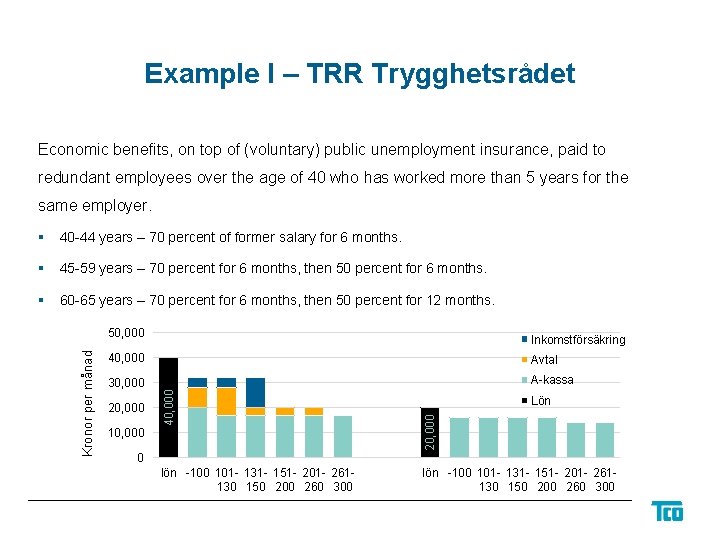
Example I – TRR Trygghetsrådet Economic benefits, on top of (voluntary) public unemployment insurance, paid to redundant employees over the age of 40 who has worked more than 5 years for the same employer. § 40 -44 years – 70 percent of former salary for 6 months. § 45 -59 years – 70 percent for 6 months, then 50 percent for 6 months. § 60 -65 years – 70 percent for 6 months, then 50 percent for 12 months. Inkomstförsäkring 40, 000 Avtal 30, 000 A-kassa 10, 000 Lön 20, 000 40, 000 Kronor per månad 50, 000 0 lön -100 101 - 131 - 151 - 201 - 261130 150 200 260 300
Example I – TRR Trygghetsrådet Annex to the agreement stipulates that when employers and trade unions on the work place level, negotiate redundancies § The selection of employees to be made redundant should be made with the company’s need to keep competent staff and retain competitiveness in mind. § If these cannot be met under the statutory last-in-first-out principle, the parties should agree on a different order of selection. § If no agreement can be reached on the workplace level, the organisations can step in to solve the situation according to the guidelines of the annex. § The annex does not constitute a legal obligation to reach an agreement that deviates from the last-in-first-out principle but is a strong directive to do so.
Example II – Trygghetsfonden TSL § Covers 900 000 private sector blue collar employees in 100 000 companies. Collective agreement signed in 2004 – replaced collectively agreed severance pay. § Employers fee 0, 3 percent of the wage sum. § TSL does not provide services on their own, but reimburse costs up to 2200 EUR/redundant worker that the employer buys from a transition services provider listed by TSL. § To be eligible for services, the employee must have had an indefinite term contract and been dismissed for economic or organisational reasons. Must have worked for at least 12 months, 16 h/week.
Example II – Trygghetsfonden TSL § Economic benefit handled by jointly owned insurance company Afa, which also handles other collectively agreed insurances. § Benefits are paid as a lump sum of 3350 -4900 EUR depending on age and working time. § To be eligible, the dismissed employee must: § have had an indefinite term contract and been dismissed for economic/organisational reasons, § be between 40 and 65 years of age. § have been employed for at least 50 months during a five-year period at one or several companies covered by the agreement.
Results § Very high transition rates to new jobs – TRR 88%, TSL 80% and municipal sector Omställningsfonden 77%. § Results not comparable with public employment service (PES) as the composition of clients differ significantly. § OECD: the employment security councils “appear to have made a significant contribution to the unusally rapid re-employment rate of displaced workers in Sweden. ” § NB: Recent evaluation of TSL lump sum benefit indicate longer duration of unemployment.
Comments § The employment security councils are a good example of how labour law and collective bargaining can be used to manage restructuring and promote labour market adaptability. § Offers a way to retain protective role of employment protection legislation while increasing flexibility for employers. § Collectively bargained solution more robust than state system. § Desire among the social partners to develop the transition agreements – include new groups of employees, offer new services. § Political desire to change employment protection legislation create complications, but also momentum for negotiations.
Transferability? Three necessary conditions for transition agreements: § Sectoral level collective bargaining – the agreements function as an insurance system, and require a sufficiently large pool of employers to share the costs. § Sufficient trade union leverage. In order for employers to be interested in paying the necessary premiums, the trade unions must have something to offer them in return. § Employee representation at the workplace level. The transition agreements involve an interplay between negotiations on the sectoral and the workplace level.
- Slides: 13