
Employment Opportunities for the Indigenous Workforce in Major
- Slides: 45
Employment Opportunities for the Indigenous Workforce in Major Projects PRESENTERS: Stephen Crocker, AHRC Board Executive Kelly Lendsay, President and CEO & Craig Hall, Chief Fulfillment Officer, AHRC Marie-Christine Bernard, Conference Board December 11, 2015 Indigenoushr. ca 1
Agenda § § § § Introductions About the Aboriginal Human Resource Council LMI Data Presentation – Major Projects Implications and Applications of LMI Results Indigenous Participation in major projects Company Engagement Adjourn Indigenoushr. ca
Aboriginal Human Resource Council (1998) • • • Leaders in Indigenous inclusion Public-private social enterprise ISO certified Innovations in workplace learning Supply/demand orientation Workplace & partnership focused Indigenoushr. ca
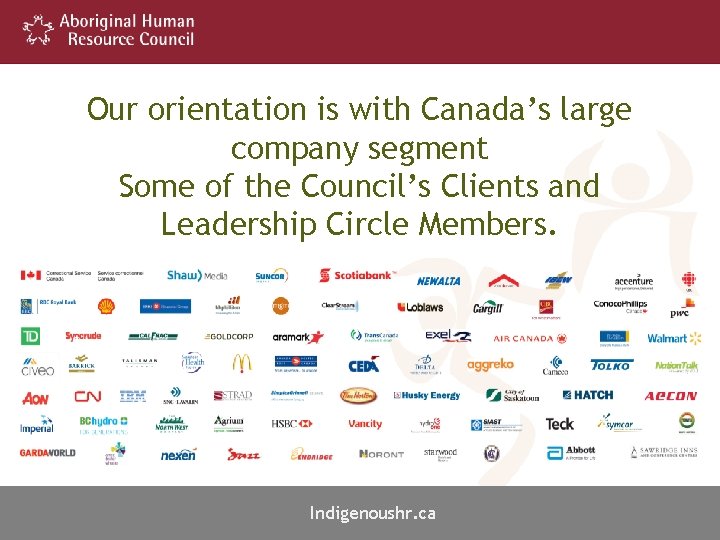
Our orientation is with Canada’s large company segment Some of the Council’s Clients and Leadership Circle Members. Indigenoushr. ca
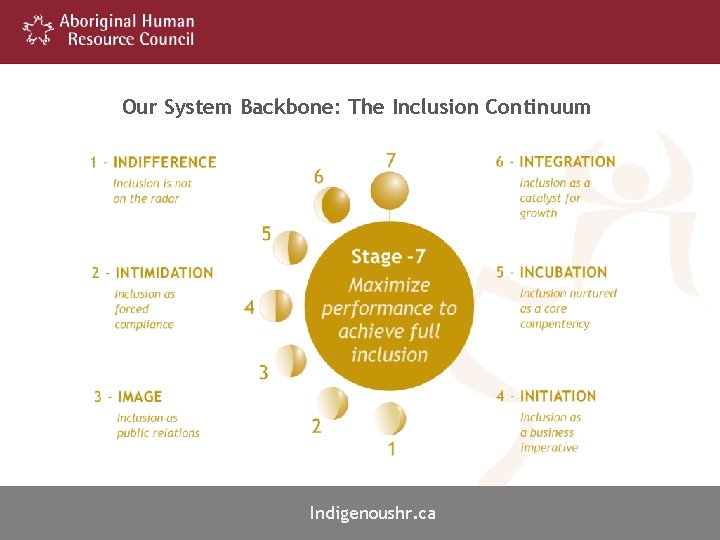
Our System Backbone: The Inclusion Continuum Indigenoushr. ca
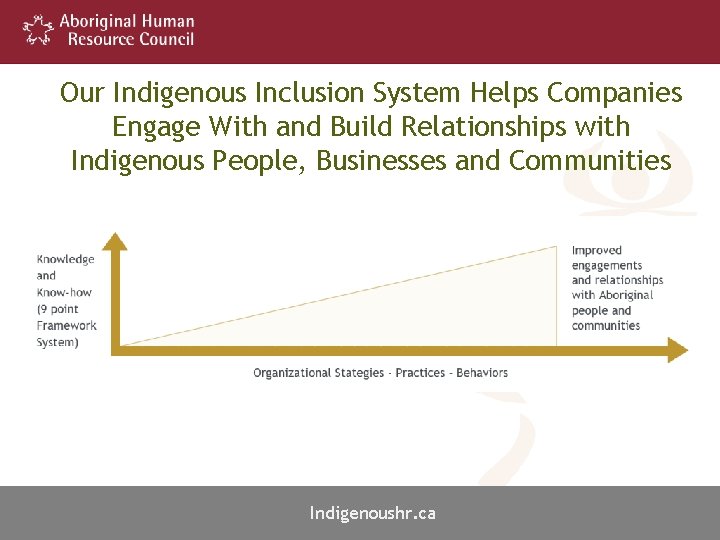
Our Indigenous Inclusion System Helps Companies Engage With and Build Relationships with Indigenous People, Businesses and Communities Indigenoushr. ca
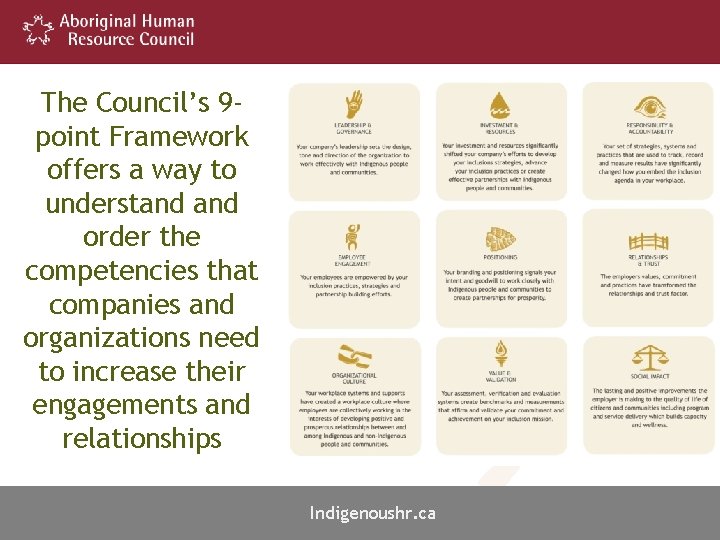
The Council’s 9 point Framework offers a way to understand order the competencies that companies and organizations need to increase their engagements and relationships Indigenoushr. ca
Labour Market Project Update Employment Opportunities for the Indigenous Workforce in Major Projects • • • Data presentation Canada’s economy and major projects Data Implications and Applications Indigenoushr. ca 8
Welcome to Marie-Christine Bernard Associate Director, Provincial Forecasts Indigenoushr. ca 9
Background Information on Research Project • With this project the Conference Board of Canada assessed labour market demand associated with Canada’s major resource development projects over the next 10 years • We identified projected future job openings by occupation and by region • This information can help inform Aboriginal leaders and policymakers to ensure that the Aboriginal labour force has access to the training required to take advantage of the upcoming opportunities in Canada’s resource sector • Our analysis focused solely on labour market needs in resource extraction • We did not include occupations related to the development phase of resource extraction projects
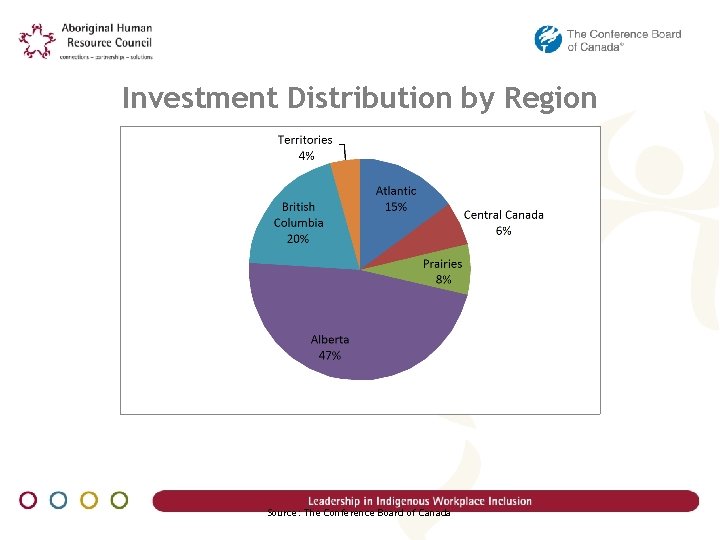
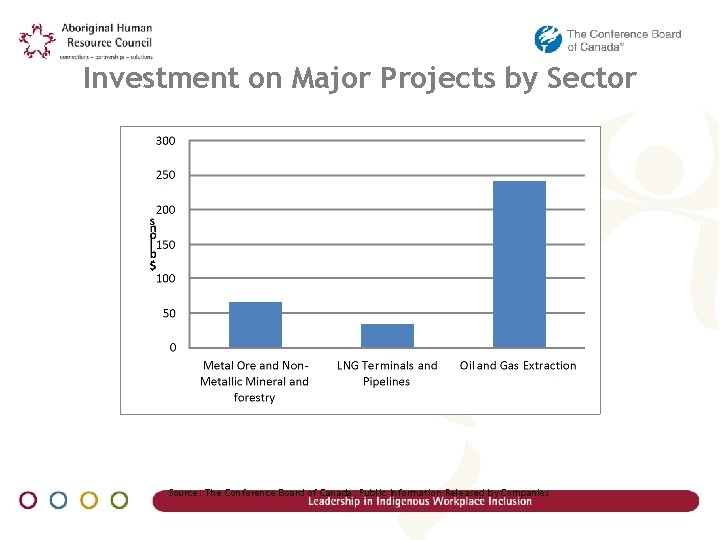
Major Natural Resource Projects • The Conference Board compiled a list of close to 115 of Canada’s largest and most important proposed natural resource projects. • Not a full list of every project that will move ahead over the next decade but they represent the majority of likely new major investment spending given current and expected market conditions. • Value of the major projects • In total, investment spending is estimate to be $342 billion over the next ten years. • About $240 billion are energy related projects and will occur mainly in Alberta • About $68 billion are mineral mines. • $17 billion (energy and minerals) are in the territories.
Investment Distribution by Region Source: The Conference Board of Canada
Investment on Major Projects by Sector Source: The Conference Board of Canada; Public Information Released by Companies
Methodology • To derive labour demand, we estimated the economic impact of the major projects expected to get underway in the resource sector. • We used our detailed econometric forecasting models for each of the 10 provincial economies and three territories to establish a forecast for the resource sector from 2015 to 2025. • With a forecast for output in hand we were able to derive an employment forecast. We broke out the employment forecast in two groups: expansion and replacement demand. • Finally we broke down the forecast results even further by estimating the demand for workers by occupation.
Results • I will be presenting the results for Canada. • We want to know where labour demand pressures are going to be felt. • This will help to establish what trades and skills will be most in demand as a result of the expansion in the resource sector and the ageing of the workforce.
Results for Canada
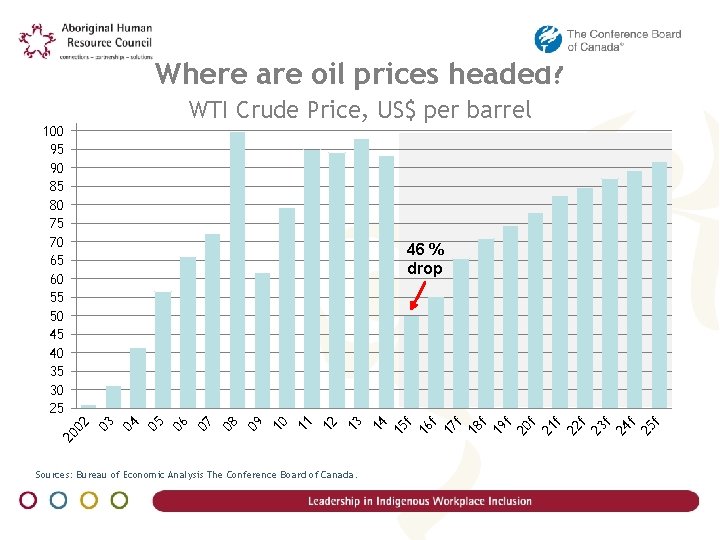
Where are oil prices headed? WTI Crude Price, US$ per barrel 100 95 90 85 80 75 70 65 60 55 50 45 40 35 30 25 Sources: Bureau of Economic Analysis The Conference Board of Canada. f 19 f 20 f 21 f 22 f 23 f 24 f 25 f 18 f 17 f f 16 15 14 13 12 11 10 09 08 07 06 05 04 03 20 02 46 % drop
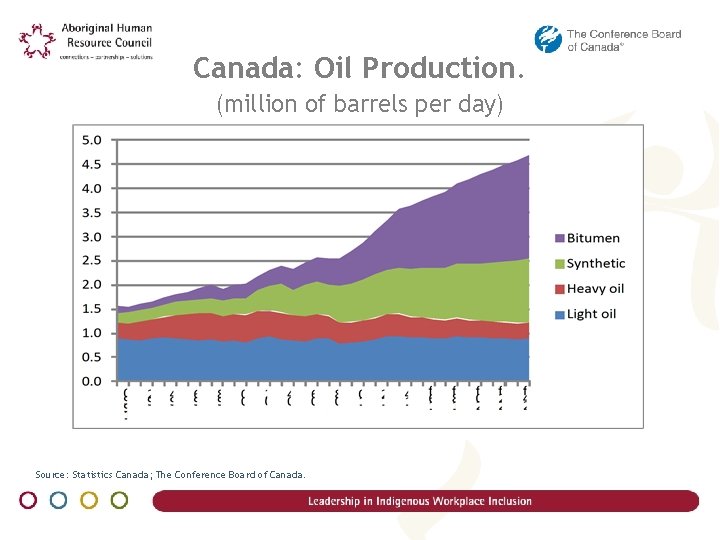
Canada: Oil Production. (million of barrels per day) Source: Statistics Canada; The Conference Board of Canada.
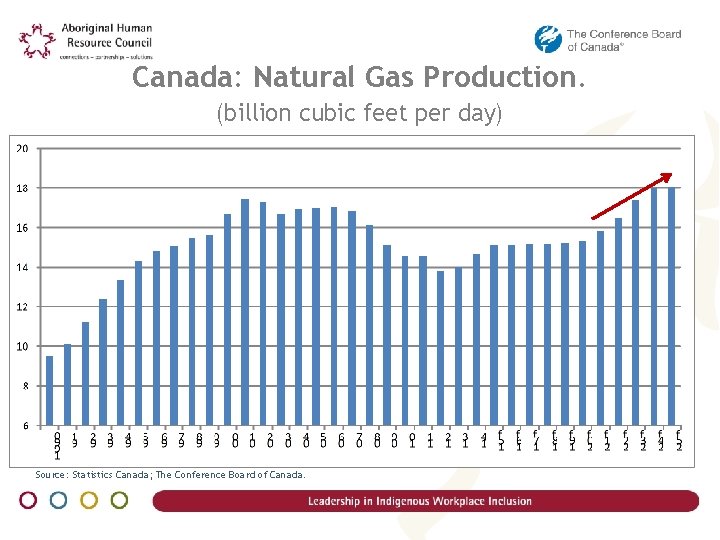
Canada: Natural Gas Production. (billion cubic feet per day) Source: Statistics Canada; The Conference Board of Canada.
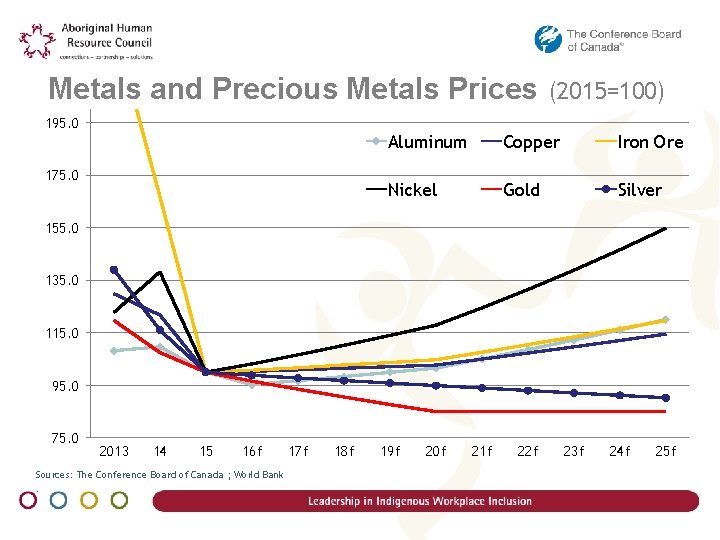
Metals and Precious Metals Prices 195. 0 175. 0 (2015=100) Aluminum Copper Iron Ore Nickel Gold Silver 155. 0 135. 0 115. 0 95. 0 75. 0 2013 14 15 16 f Sources: The Conference Board of Canada ; World Bank. 17 f 18 f 19 f 20 f 21 f 22 f 23 f 24 f 25 f
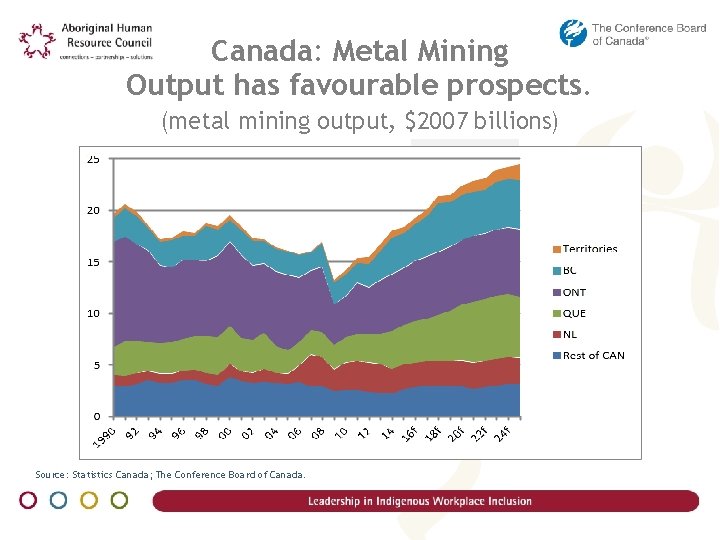
Canada: Metal Mining Output has favourable prospects. (metal mining output, $2007 billions) Source: Statistics Canada; The Conference Board of Canada.
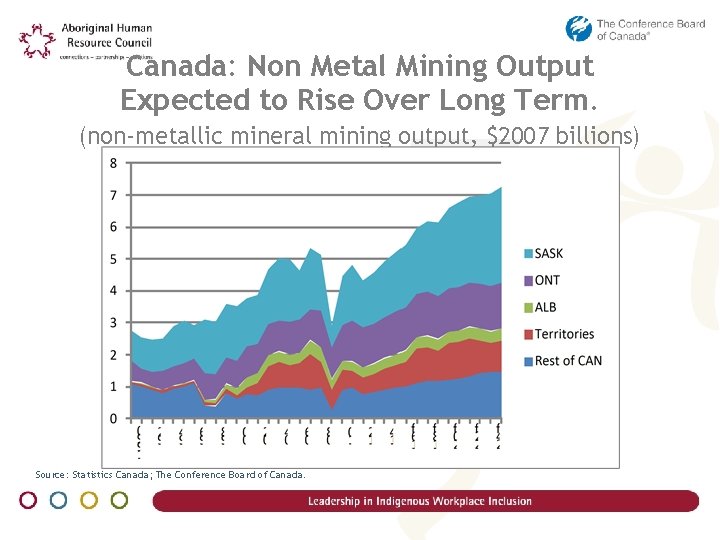
Canada: Non Metal Mining Output Expected to Rise Over Long Term. (non-metallic mineral mining output, $2007 billions) Source: Statistics Canada; The Conference Board of Canada.
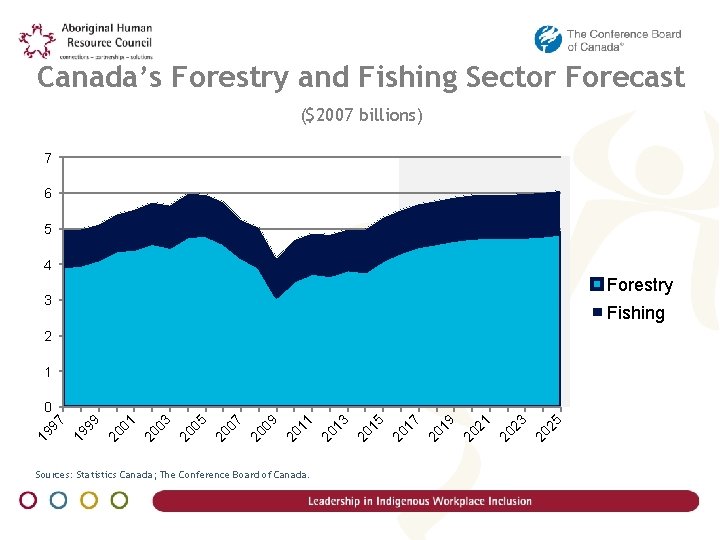
Canada’s Forestry and Fishing Sector Forecast ($2007 billions) 7 6 5 4 Forestry 3 Fishing 2 1 Sources: Statistics Canada; The Conference Board of Canada. 25 20 23 20 21 20 19 20 17 20 15 20 13 20 11 20 09 20 07 20 05 20 03 20 01 20 99 19 19 97 0
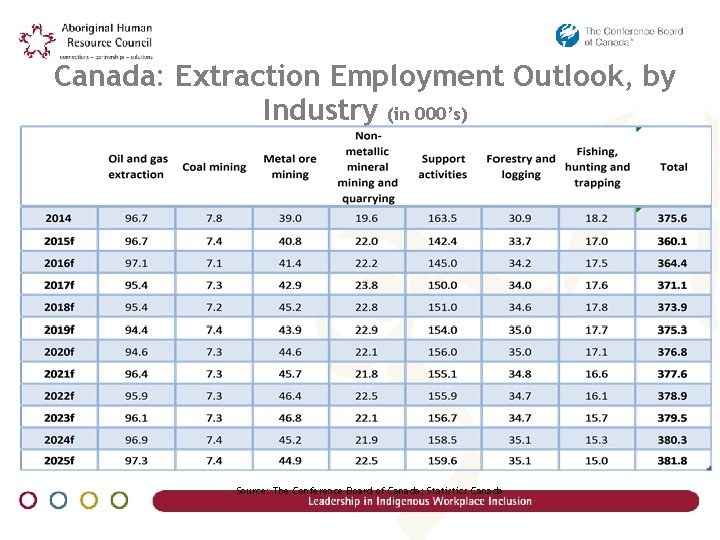
Canada: Extraction Employment Outlook, by Industry (in 000’s) Source: The Conference Board of Canada; Statistics Canada
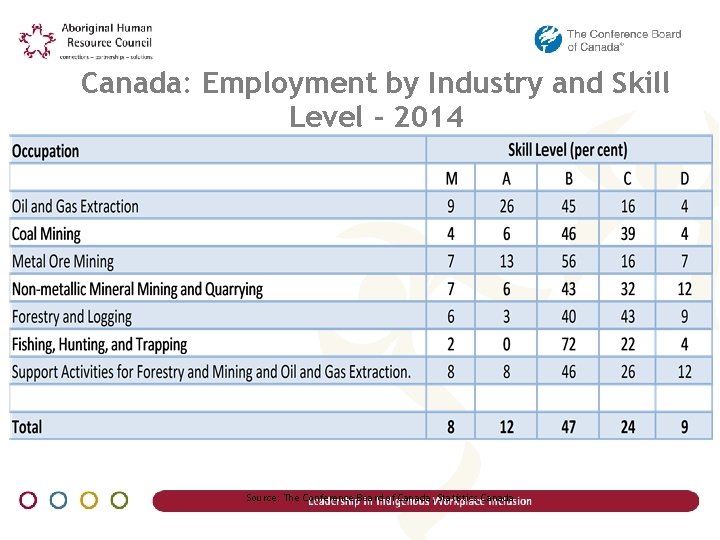
Canada: Employment by Industry and Skill Level - 2014 Source: The Conference Board of Canada; Statistics Canada
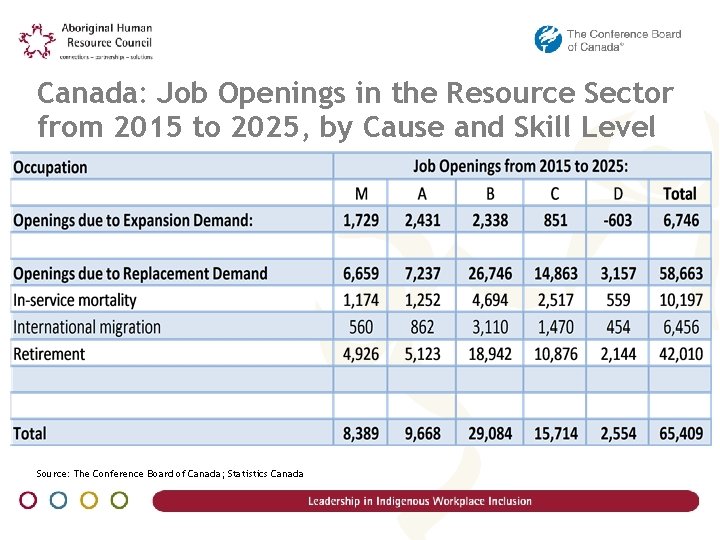
Canada: Job Openings in the Resource Sector from 2015 to 2025, by Cause and Skill Level Source: The Conference Board of Canada; Statistics Canada
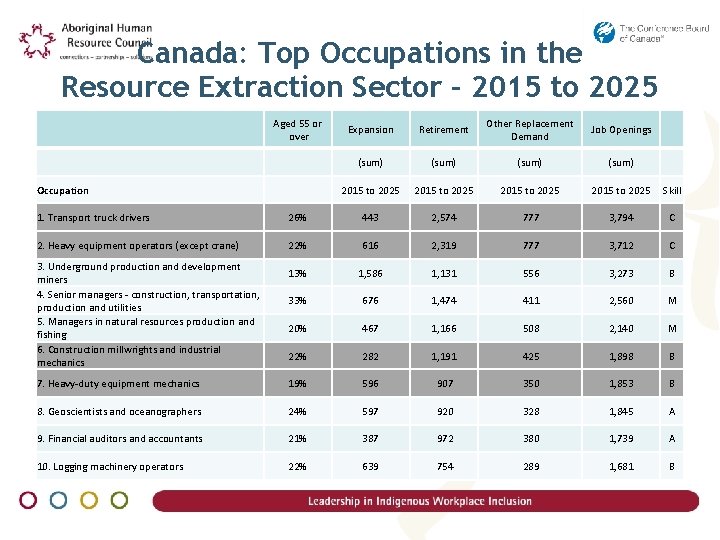
Canada: Top Occupations in the Resource Extraction Sector – 2015 to 2025 Aged 55 or over Occupation Expansion Retirement Other Replacement Demand Job Openings (sum) 2015 to 2025 Skill 1. Transport truck drivers 26% 443 2, 574 777 3, 794 C 2. Heavy equipment operators (except crane) 22% 616 2, 319 777 3, 712 C 13% 1, 586 1, 131 556 3, 273 B 33% 676 1, 474 411 2, 560 M 20% 467 1, 166 508 2, 140 M 22% 282 1, 191 425 1, 898 B 7. Heavy-duty equipment mechanics 19% 596 907 350 1, 853 B 8. Geoscientists and oceanographers 24% 597 920 328 1, 845 A 9. Financial auditors and accountants 21% 387 972 380 1, 739 A 289 1, 681 B 3. Underground production and development miners 4. Senior managers - construction, transportation, production and utilities 5. Managers in natural resources production and fishing 6. Construction millwrights and industrial mechanics 10. Logging machinery operators 22% 754 Canada Source: The Conference Board 639 of Canada; Statistics
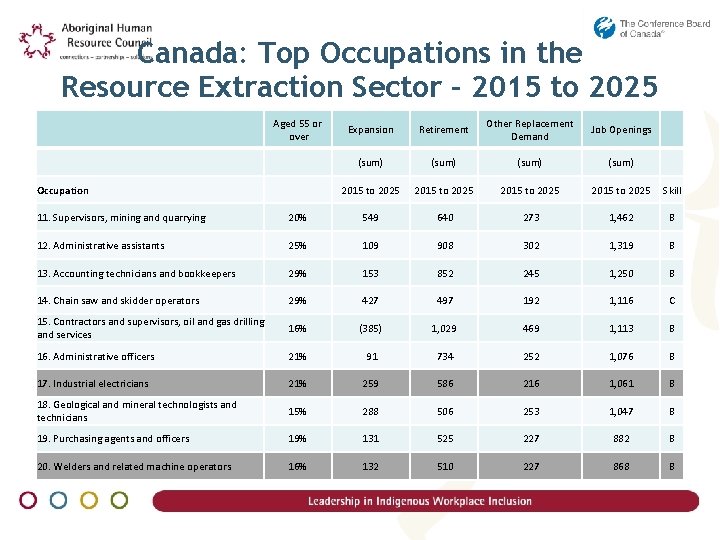
Canada: Top Occupations in the Resource Extraction Sector – 2015 to 2025 Aged 55 or over Occupation Expansion Retirement Other Replacement Demand Job Openings (sum) 2015 to 2025 Skill 11. Supervisors, mining and quarrying 20% 549 640 273 1, 462 B 12. Administrative assistants 25% 109 908 302 1, 319 B 13. Accounting technicians and bookkeepers 29% 153 852 245 1, 250 B 14. Chain saw and skidder operators 29% 427 497 192 1, 116 C 15. Contractors and supervisors, oil and gas drilling and services 16% (385) 1, 029 469 1, 113 B 16. Administrative officers 21% 91 734 252 1, 076 B 17. Industrial electricians 21% 259 586 216 1, 061 B 18. Geological and mineral technologists and technicians 15% 288 506 253 1, 047 B 19. Purchasing agents and officers 19% 131 525 227 882 B 227 868 B 20. Welders and related machine operators. Source: The Conference 16% 510 Canada Board 132 of Canada; Statistics
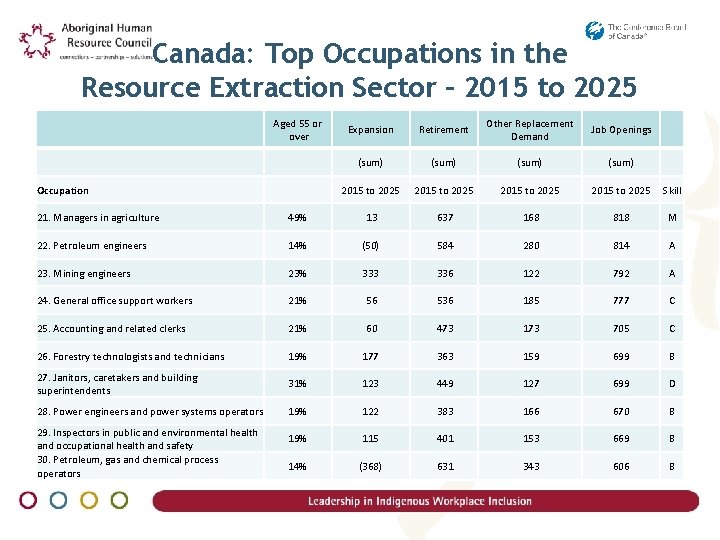
Canada: Top Occupations in the Resource Extraction Sector – 2015 to 2025 Aged 55 or over Occupation Expansion Retirement Other Replacement Demand Job Openings (sum) 2015 to 2025 Skill 21. Managers in agriculture 49% 13 637 168 818 M 22. Petroleum engineers 14% (50) 584 280 814 A 23. Mining engineers 23% 333 336 122 792 A 24. General office support workers 21% 56 536 185 777 C 25. Accounting and related clerks 21% 60 473 173 705 C 26. Forestry technologists and technicians 19% 177 363 159 699 B 27. Janitors, caretakers and building superintendents 31% 123 449 127 699 D 28. Power engineers and power systems operators 19% 122 383 166 670 B 153 669 B 343 606 B 29. Inspectors in public and environmental health 19% 115 401 and occupational health and safety 30. Petroleum, gas and chemical process 14% (368) 631 Canada Source: The Conference Board of Canada; Statistics operators
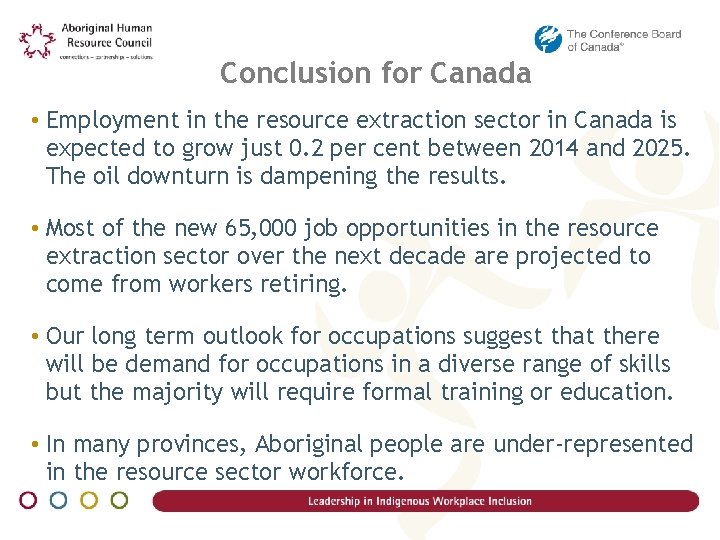
Conclusion for Canada • Employment in the resource extraction sector in Canada is expected to grow just 0. 2 per cent between 2014 and 2025. The oil downturn is dampening the results. • Most of the new 65, 000 job opportunities in the resource extraction sector over the next decade are projected to come from workers retiring. • Our long term outlook for occupations suggest that there will be demand for occupations in a diverse range of skills but the majority will require formal training or education. • In many provinces, Aboriginal people are under-represented in the resource sector workforce.
Questions for Marie-Christine On The Data Analysis Indigenoushr. ca 31
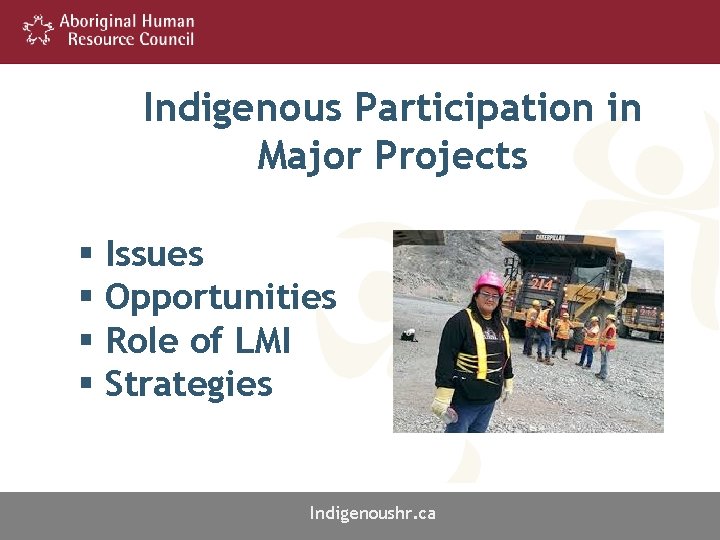
Indigenous Participation in Major Projects § Issues § Opportunities § Role of LMI § Strategies Indigenoushr. ca 32
Value of this LMI Data § Highly useful information: An impetus for increased engagement and relationship building; § Multiple uses to stakeholders e. g. information helps guide training investments for ASETs, course offering for post-secondaries and engagement/recruitment plans for companies; § But, how to best leverage this information? Different strategies are needed…we need to drill deeper to probe this question using an example. Indigenoushr. ca 33
Encouraging Indigenous entry to Transport Truck Driver occupation: Roles of Various Groups Company Roles: • • • Leadership needed and Policy adoption Will and resolve – e. g. “Convince me to hire Indigenous versus new Canadians”; Both HR and joint venture approaches required; Engagement competencies required; Specific attraction campaigns needed (e. g. career information, employer branding, ) Indigenoushr. ca 34
Encouraging entry to Transport Truck Driver occupation Indigenous Organizations’ Roles • Career awareness; • Identify candidates (do they know who wants to become a truck driver? ); • Pre-career readiness – literacy etc. , soft skills? • Facilitate the application process; • Support to companies and new hires? • Funding to stay in school? • Business support for ventures/ partnerships. • Learning how to participate in supply chain. Indigenoushr. ca 35
Encouraging entry to Transport Truck Driver occupation Education/Training Organization Roles • • • The right program offer in place? Do they know how to attract Indigenous people to their programs? Right supports for students? To retain them? Establish training standards Manage the “pipeline of graduates”, aligning with demand Indigenoushr. ca 36
Pulling all the levers as once… § First awareness… then engagement… then relationships need to happen; § The company needs a business case to hire Indigenous (in a major project context perhaps it’s the Indigenous content requirements for large business procurement. Also needs to align with company’s business cycle); § Indigenous small business or development corporations need to be ready for a partnership or joint venture. (issues include scale, business fit, complementary skills available). Indigenoushr. ca 37
Pulling all the levers as once…cont. § In this situation there is a clear business case for the training facilities that provide truck driver training. So the issue is more about “access to training”; § The size and scale of the need for truck drivers suggests a need for coordinated strategies instead of each Aboriginal training organization trying to respond to this demand on their own. § Training and employment funds need to be aligned with needs. Pulling the funding levers is itself a challenge, requiring partnership development which requires preinvestment from all parties. Indigenoushr. ca 38
Perspectives on “Engagement” § What does engagement mean in the context of Indigenous/non-Indigenous relations? – Company, Indigenous and Post Secondary Perspectives? § What do we mean by effective or successful engagement? § How will better engagements lead to better results in Indigenous employment, business development, participation in major projects, community wellness? Indigenoushr. ca 39
On Engagement… – Indigenous Perspective “The companies we have been most successful with have taken the time to get to know us better. Just as we have got to know them as well. Good relationships whether it be for business, employment or social development reasons all hinge on discovering the similarities as well as the differences we share. ” -Dan Christmas, Long time Senior Advisor at Membertou First Nation. Indigenoushr. ca 40
On Engagement… – Company Perspective “The economy is brutal in Alberta right now. Companies have had to make some radical changes, just to survive. Once active in Indigenous engagement, many companies are making severe cuts or eliminating entirely their Indigenous Relations Divisions or programs ” -Stephen Crocker – 40 years in the workforce Indigenoushr. ca 41
On Engagement… – Post Secondary Perspective “The linkages still aren’t there. Even if Indigenous people earn the learning credentials, where are the bridges to the companies that will employ them? As education attainments improve and we gain more graduates, where will they work? We grapple with career services and how they need to be delivered to meet the particular needs of Indigenous grads. ” -U of Manitoba Professor Indigenoushr. ca 42
Increasing Indigenous Participation in Major Projects • LMI Data offers an important piece of information which can be a catalyst for Companies, Indigenous organizations and Post-Secondaries to begin the process of building engagements then relationships; • There is a need to further facilitate these engagements and these relationships -- a role the Council can play. Indigenoushr. ca 43
Closing Observation Recently the Truth and Reconciliation Commission of Canada made a call to action setting three challenges for corporate Canada. • • • Meaningful consultation, respectful relationships on major projects; Equitable access to jobs, training, education opportunities in the corporate sector; Provide education to management and staff on Indigenous history, training to gain cross cultural competencies Indigenoushr. ca 44
Discussion Q&A To learn more about workplace inclusion services and the Leadership Circle: Kelly J Lendsay, President & CEO klendsay@Indigenoushr. ca 306 291 0424 Craig J Hall, Chief Fulfillment Officer chall@Indigenoushr. ca 902 665 2257 Indigenoushr. ca