
Employment opportunities for economically inactive peoplebreaking down barriers

Employment opportunities for economically inactive people-breaking down barriers European economic and Social Committee Anna Ludwinek
Policy relevance Proposal for a Council recommendation on the integration of the long term unemployed into the labour market – September 2015 European Commission/OECD/World Bank work on faces of joblessness - exclusion. OECD/EC/WB: Fernandez et al (2016) Faces of joblessness Eurofound: inactive, mapping: the inactive population (characteristics, living conditions, barriers); what Member States are doing to (re-)activate groups of inactive.
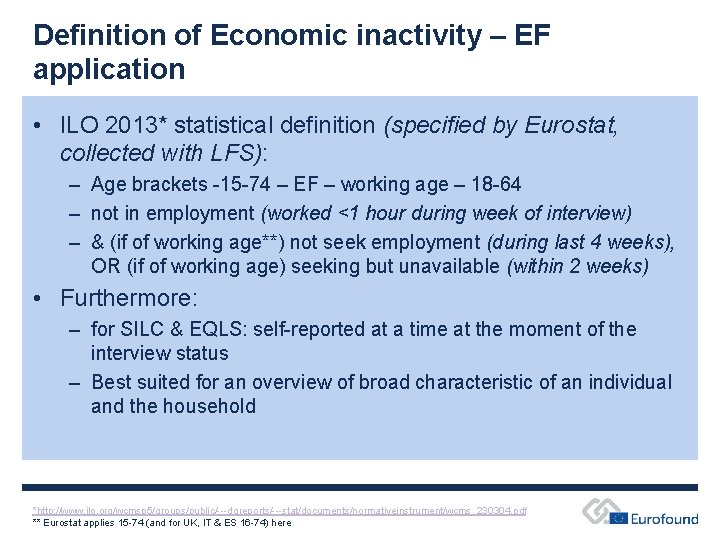
Definition of Economic inactivity – EF application • ILO 2013* statistical definition (specified by Eurostat, collected with LFS): – Age brackets -15 -74 – EF – working age – 18 -64 – not in employment (worked <1 hour during week of interview) – & (if of working age**) not seek employment (during last 4 weeks), OR (if of working age) seeking but unavailable (within 2 weeks) • Furthermore: – for SILC & EQLS: self-reported at a time at the moment of the interview status – Best suited for an overview of broad characteristic of an individual and the household *http: //www. ilo. org/wcmsp 5/groups/public/---dgreports/---stat/documents/normativeinstrument/wcms_230304. pdf ** Eurostat applies 15 -74 (and for UK, IT & ES 16 -74) here
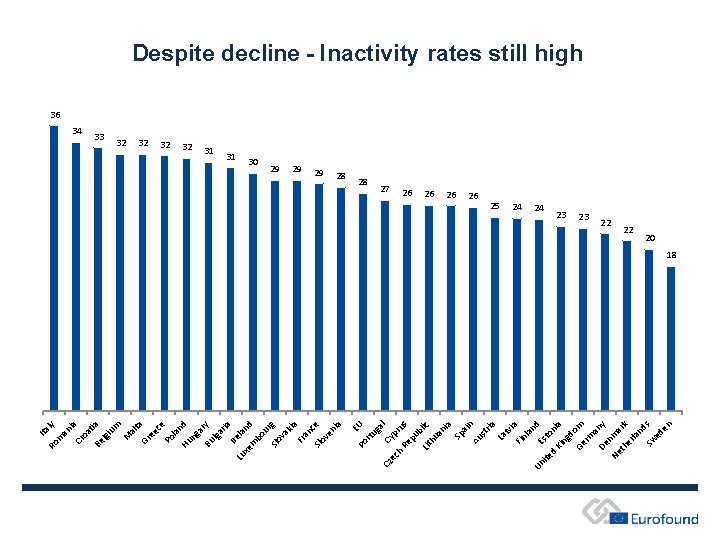
29 29 29 28 28 pr us pu b Lit lic hu an ia Sp ai n Au st ria La tv i Fin a la nd Un ite Esto d ni Ki a ng do Ge m rm a De ny nm Ne th ark er la nd Sw s ed en 30 Re 31 h 31 ec 32 ga l 32 Cy 32 Cz 32 rtu 33 EU 34 Po It Ro aly m an i Cr a oa t Be ia lgi um M al t Gr a ee ce Po la n Hu d ng a Bu ry lga ria I Lu rela n xe m d bo u Slo rg va kia Fr an Slo ce ve ni a Despite decline - Inactivity rates still high 36 27 26 26 25 24 24 23 23 22 22 20 18
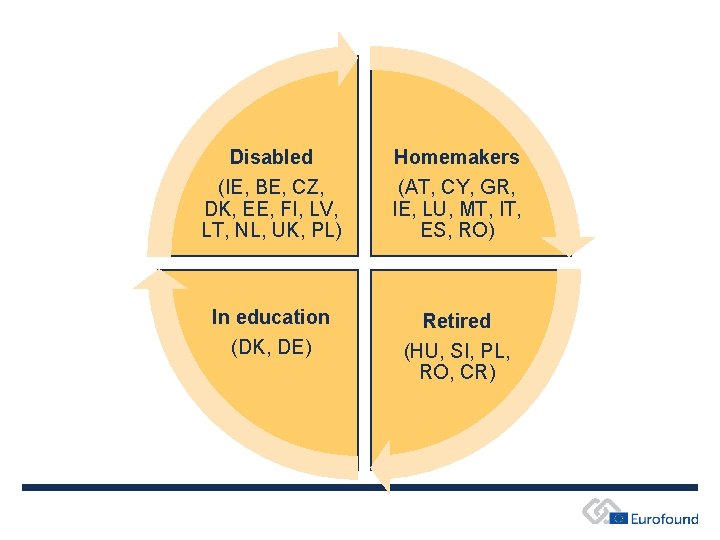
Disabled (IE, BE, CZ, DK, EE, FI, LV, LT, NL, UK, PL) Homemakers (AT, CY, GR, IE, LU, MT, IT, ES, RO) In education (DK, DE) Retired (HU, SI, PL, RO, CR)
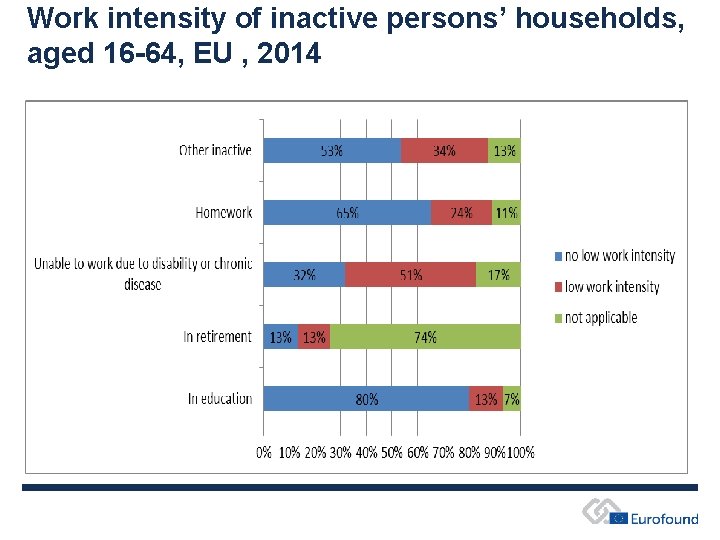
Work intensity of inactive persons’ households, aged 16 -64, EU , 2014

Prevalence of arrears and housing cost burden among unemployed people and inactive groups (%), EU, 2014 All households Retired In education Other inactive Homemaker Disabled Unemployed 6 34 8 8 Households with low work intensity 38 10 11 12 11 Retired In education 47 15 Other inactive 50 17 21 24 14 14 Homemaker 51 16 10 Disabled 60 Unemployed 38 13 53 19 19 13 49 20 60 26 55 20 25 29 65
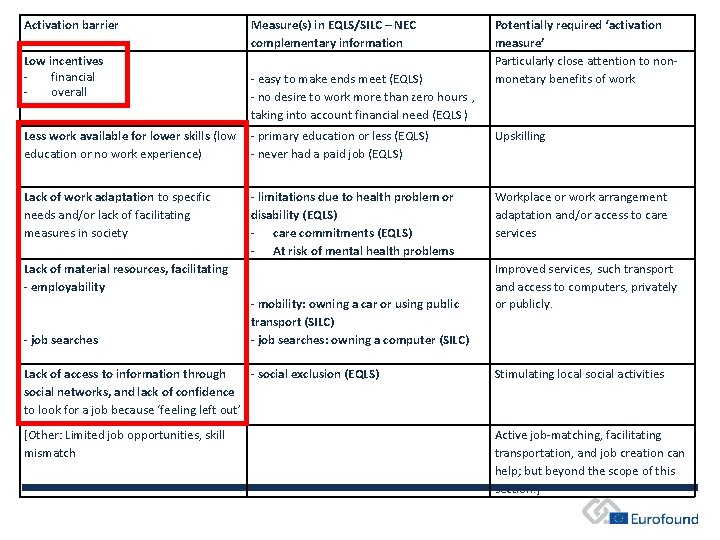
Activation barrier Low incentives financial overall Measure(s) in EQLS/SILC – NEC complementary information - easy to make ends meet (EQLS) - no desire to work more than zero hours , taking into account financial need (EQLS ) Potentially required ‘activation measure’ Particularly close attention to nonmonetary benefits of work Less work available for lower skills (low education or no work experience) - primary education or less (EQLS) - never had a paid job (EQLS) Upskilling Lack of work adaptation to specific needs and/or lack of facilitating measures in society - limitations due to health problem or disability (EQLS) - care commitments (EQLS) - At risk of mental health problems Workplace or work arrangement adaptation and/or access to care services Lack of material resources, facilitating - employability - job searches - mobility: owning a car or using public transport (SILC) - job searches: owning a computer (SILC) Improved services, such transport and access to computers, privately or publicly. Lack of access to information through - social exclusion (EQLS) social networks, and lack of confidence to look for a job because ‘feeling left out’ Stimulating local social activities [Other: Limited job opportunities, skill mismatch Active job-matching, facilitating transportation, and job creation can help; but beyond the scope of this section. ]
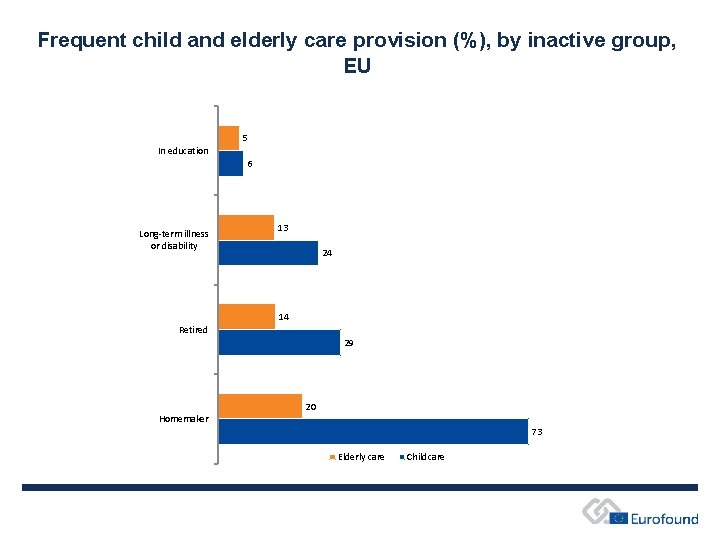
Frequent child and elderly care provision (%), by inactive group, EU 5 In education 6 Long-term illness or disability 13 24 14 Retired 29 20 Homemaker 73 Elderly care Childcare
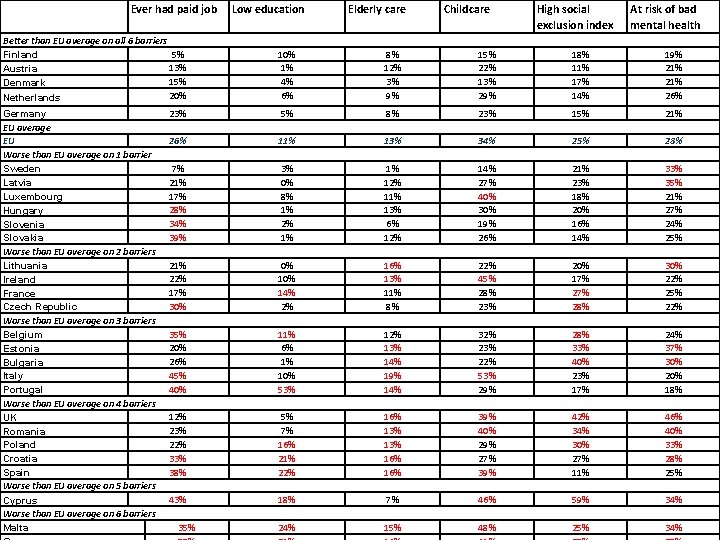
Ever had paid job Low education Elderly care Childcare High social exclusion index At risk of bad mental health Better than EU average on all 6 barriers 5% Finland 13% Austria 15% Denmark 20% Netherlands 10% 1% 4% 6% 8% 12% 3% 9% 15% 22% 13% 29% 18% 11% 17% 14% 19% 21% 26% 23% 5% 8% 23% 15% 21% 26% 11% 13% 34% 25% 28% 7% 21% 17% 28% 34% 39% 3% 0% 8% 1% 2% 1% 1% 12% 11% 13% 6% 12% 14% 27% 40% 30% 19% 26% 21% 23% 18% 20% 16% 14% 33% 35% 21% 27% 24% 25% 21% 22% 17% 30% 0% 14% 2% 16% 13% 11% 8% 22% 45% 28% 23% 20% 17% 28% 30% 22% 25% 22% 35% 20% 26% 45% 40% 11% 6% 1% 10% 53% 12% 13% 14% 19% 14% 32% 23% 22% 53% 29% 28% 33% 40% 23% 17% 24% 37% 30% 20% 18% 12% 23% 22% 33% 38% 5% 7% 16% 21% 22% 16% 13% 16% 39% 40% 29% 27% 39% 42% 34% 30% 27% 11% 46% 40% 33% 28% 25% 43% 18% 7% 46% 59% 34% 24% 15% 48% 25% 34% Germany EU average EU Worse than EU average on 1 barrier Sweden Latvia Luxembourg Hungary Slovenia Slovakia Worse than EU average on 2 barriers Lithuania Ireland France Czech Republic Worse than EU average on 3 barriers Belgium Estonia Bulgaria Italy Portugal Worse than EU average on 4 barriers UK Romania Poland Croatia Spain Worse than EU average on 5 barriers Cyprus Worse than EU average on 6 barriers Malta 35%

Preferred working hours among inactive groups, EU, 18– 64 years All inactive In education Homemaker Long-term illness or disability Retired 21 8 9 14 27 43 26 17 52 8 24 38 4 37 25 7 0 hours 37 1– 15 hours 47 18 16– 31 hours 38 32+ hours

Barriers – service providers perspective • Reaching out/locating inactive population (in most MS) • High unemployment meaning limited employment opportunities especially for those that have been outside the labour market for a long time(FI) • Issues of skills – AT, CR • Other factors with which service providers cannot deal in straightforward manner such as health (mental health) or care responsibilities (complex needs) – lack of coordination • Lack of motivation on the side of beneficiaries – perception of the service providers (DK), Perception of employers - CR • Lack of robust evidence of what works (FI, DK) • Non-take up, lack of democratic representation and the voice of inactive in policymaking (FR)
Policy pointers • Policymakers could reflect on whether rates of inactivity should be more visible (possibly as a complementary indicator to unemployment rates) in efforts to monitor progress and achieve the goals of Europe 2020. • Policymakers should pay attention to the high level of heterogeneity in the inactive population and of differences between Member States, • There is a need for policies to address the inactive population as a specific issue; these may build on the positive and effective elements of labour market activation programmes but must take into account the specific challenges the economically inactive face. • Considering the growing complexity of the labour market and the trend towards more high-skilled professions, a policy priority should be to invest in the education of people who have been outside the labour market for a long time and whose skills may be outdated • Many inactive people may need extra time to prepare themselves for the job market, so policy measures that facilitate a transition from inactivity to employment should be encouraged

Thank you Anna. ludwinek@eurofound. europa. eu
- Slides: 14