
Employment Discrimination Wage Discrimination against Migrating Peasants in

- Slides: 31
Employment Discrimination & Wage Discrimination against Migrating Peasants in Urban Labor Market of China: A Decomposition Method Zhang Yuan China Center for Economic Studies, Fudan University Yiu por Chen City University of Hong Kong
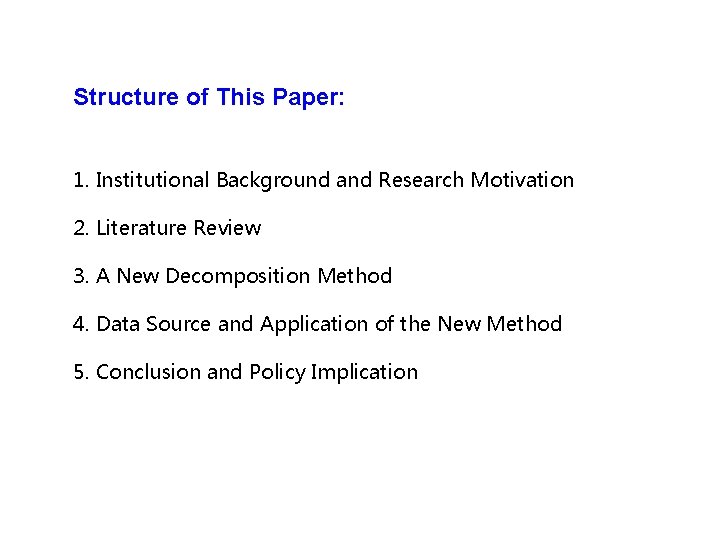
Structure of This Paper: 1. Institutional Background and Research Motivation 2. Literature Review 3. A New Decomposition Method 4. Data Source and Application of the New Method 5. Conclusion and Policy Implication
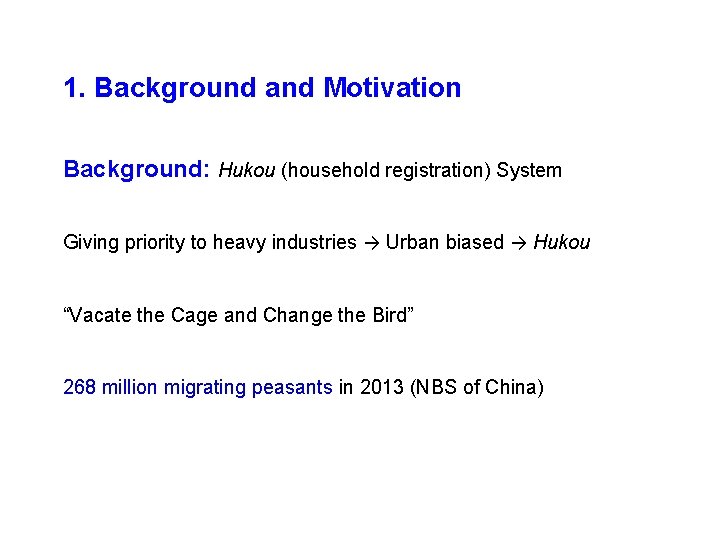
1. Background and Motivation Background: Hukou (household registration) System Giving priority to heavy industries → Urban biased → Hukou “Vacate the Cage and Change the Bird” 268 million migrating peasants in 2013 (NBS of China)
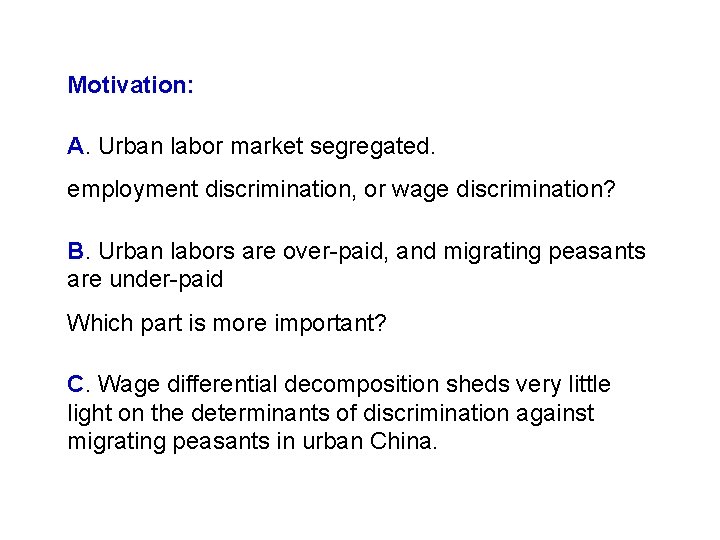
Motivation: A. Urban labor market segregated. employment discrimination, or wage discrimination? B. Urban labors are over-paid, and migrating peasants are under-paid Which part is more important? C. Wage differential decomposition sheds very little light on the determinants of discrimination against migrating peasants in urban China.
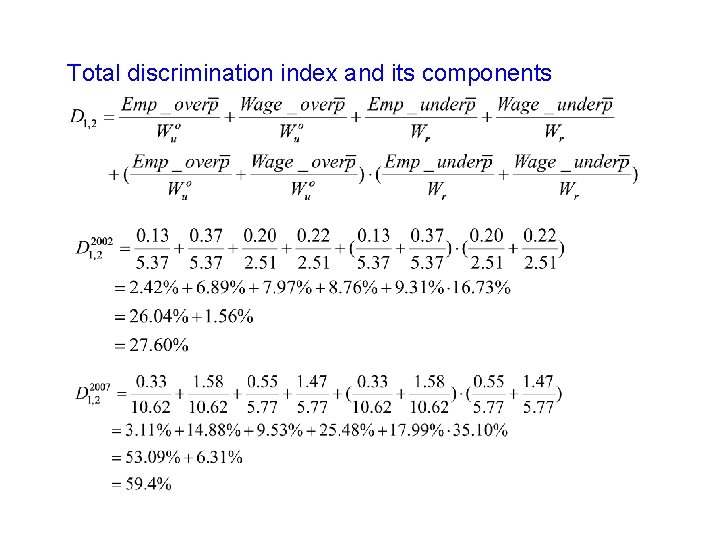
Questions: Becker(1957), Arrow(1973), Dickens and Kevin(1985), Cotton(1988) Minorities suffer unfair treatment on both employment and wages only because of different gender or racial. We call them employment discrimination, and wage discrimination. Minorities are paid less than their marginal product, while majorities are paid more than their marginal product. We call them under-paid, or over-paid, respectively. A. To what extent that total discrimination index is attributable to employment discrimination or wage discrimination? B. To what extent that total discrimination index is attributable to over-paid index or under-paid index? C. What are the trends of them over time in urban China?
2. Literature Review A. Segregated labor market Doeringer and Piore(1971): Dual labor market (primary and secondary labor market) Two-tier labor market in urban China: Meng and Miller(1995); Wang and Zuo (1999); Knight et al. (1999); Meng(2000); Meng and Zhang(2001)
B. Migrating peasants have less opportunities to get jobs in the formal sectors, and even in the same sector, other things being equal, migrating peasants are paid less than their counter parts in urban labor market Meng and Miller (1995); Knight et al. (1999); Meng (2000); Meng and Zhang (2001); Yang and Chen (2000); Cai et al. (2000; 2003); Dong and Bowles (2002); Wang (2003; 2005); Yan (2006; 2007); Li and Li (2008); Démurger et al. (2009); Zhang et al. (2013). In the segmented urban labor market of China, urban labors are over-paid, and migrating peasants are under-paid. Knight et al. (1999); Meng (2000); Meng and Zhang (2001).
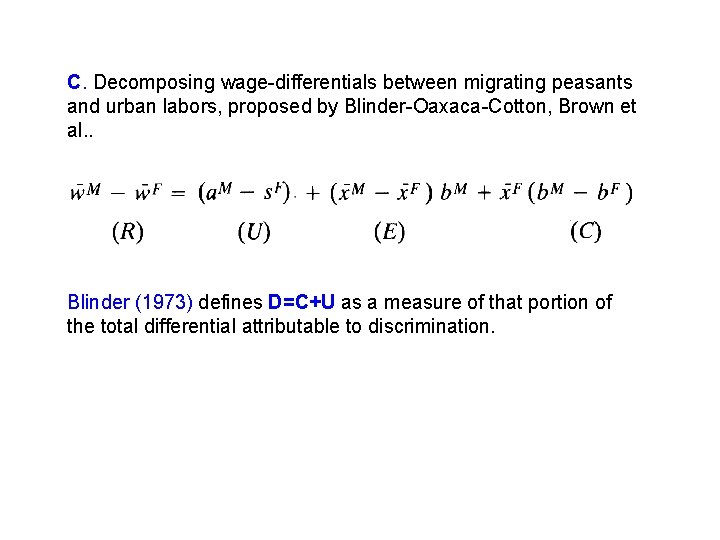
C. Decomposing wage-differentials between migrating peasants and urban labors, proposed by Blinder-Oaxaca-Cotton, Brown et al. . Blinder (1973) defines D=C+U as a measure of that portion of the total differential attributable to discrimination.
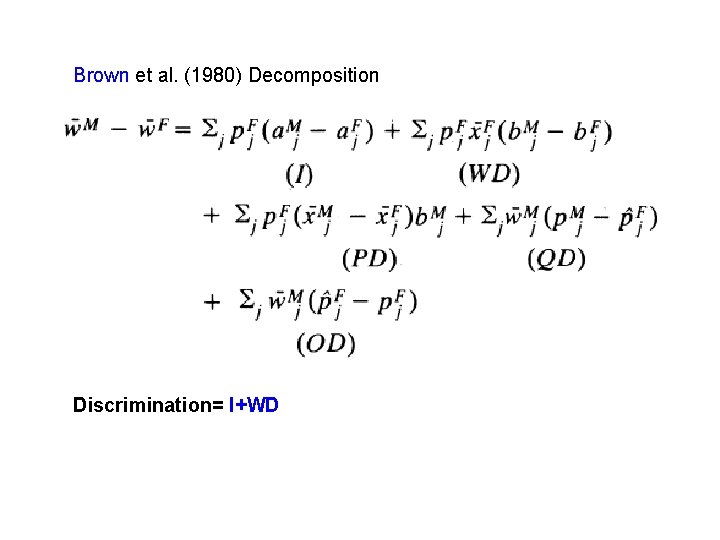
Brown et al. (1980) Decomposition Discrimination= I+WD
Using Brown et al. (1980) decomposition method, Meng and Zhang (2001), finds that a significant difference in occupational attainment and wages exists between rural migrants and urban residents. Most of the difference cannot be explained by productivity-related differences between the two groups, implying that urban residents are favorably treated while their migrant counterparts are discriminated against. Employing a similar decomposition, Démurger et al. (2009) finds that, the impact of sector allocation on earnings differences between migrating peasants and urban labors is neither strong nor robust. And also, they find a stronger, but only partly robust within sector earnings discrimination effect between urban residents and rural migrants. Using Oaxaca (1973) and Brown et al. (1980) decomposition method, Wang (2003; 2005) finds that more than 43 per cent of wage differentials is attributable to discrimination against migrating peasants and other unobservables. Employing Blinder-Oaxaca-Cotton method, Xie and Yao (2006) arrives at similar conclusions.
Blinder-Oaxaca-Cotton-Brown-Neumark decomposition, First, the discrimination component from these methods is not an accurate measure of discrimination (Meng and Zhang, 2001; Liu et al. 2004; Jann, 2008; ). Second, these methods reveal nothing about the role of job discrimination and wage discrimination, or the role of under-pay and over-pay in the total discrimination index. Third, these methods cannot be applied to a segregated labor market, because the wage equations in two sub-labor markets are different.
Zhiming Cheng, Fei Guo, Graeme Hugo, Xin Yuan, 2013, “Employment and Wage Discrimination in the Chinese Cities: A Comparative Study of Migrants and Locals, ” Habitat International, 39, pp. 246 -255. Liu Pak-Wai, Junsen Zhang, Shu-Chuen Chong, 2005, “Occupational Segregation and Wage Differentials between Natives and Immigrants: Evidence from Hong Kong, ” Journal of Development Economics, Vol. 73, pp. 395 -413.
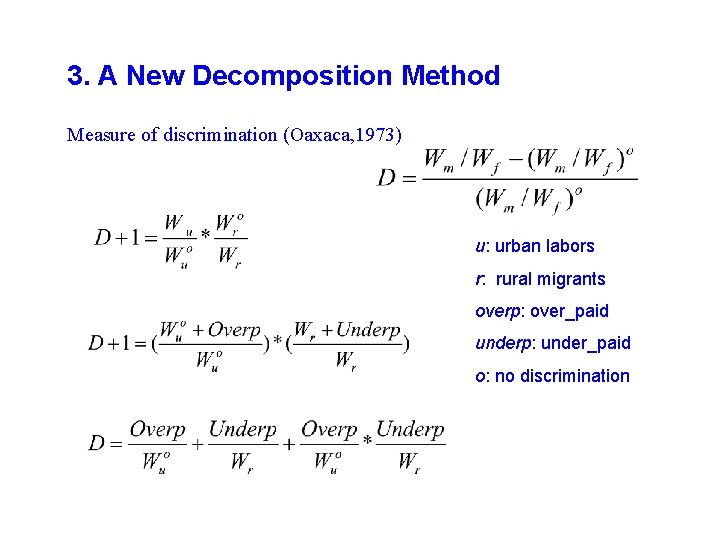
3. A New Decomposition Method Measure of discrimination (Oaxaca, 1973) u: urban labors r: rural migrants overp: over_paid underp: under_paid o: no discrimination
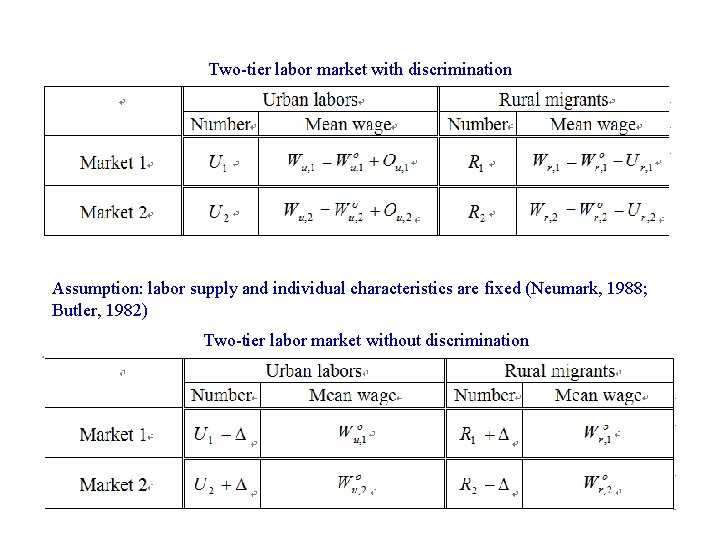
Two-tier labor market with discrimination Assumption: labor supply and individual characteristics are fixed (Neumark, 1988; Butler, 1982) Two-tier labor market without discrimination
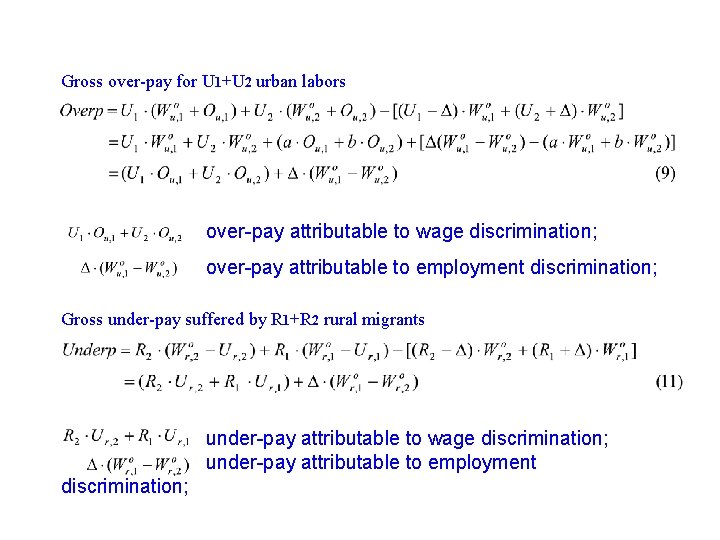
Gross over-pay for U 1+U 2 urban labors over-pay attributable to wage discrimination; over-pay attributable to employment discrimination; Gross under-pay suffered by R 1+R 2 rural migrants under-pay attributable to wage discrimination; under-pay attributable to employment discrimination;
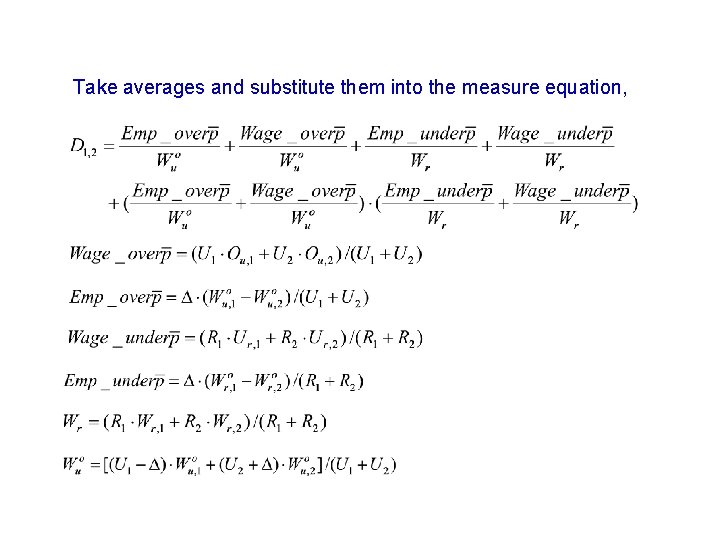
Take averages and substitute them into the measure equation,
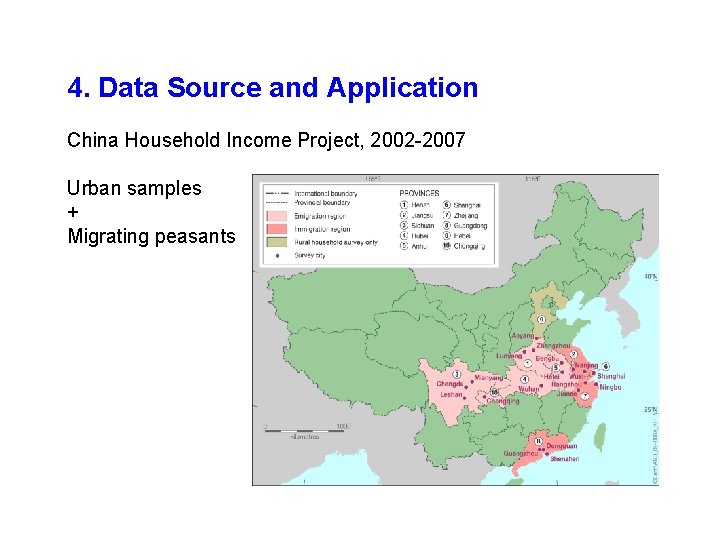
4. Data Source and Application China Household Income Project, 2002 -2007 Urban samples + Migrating peasants
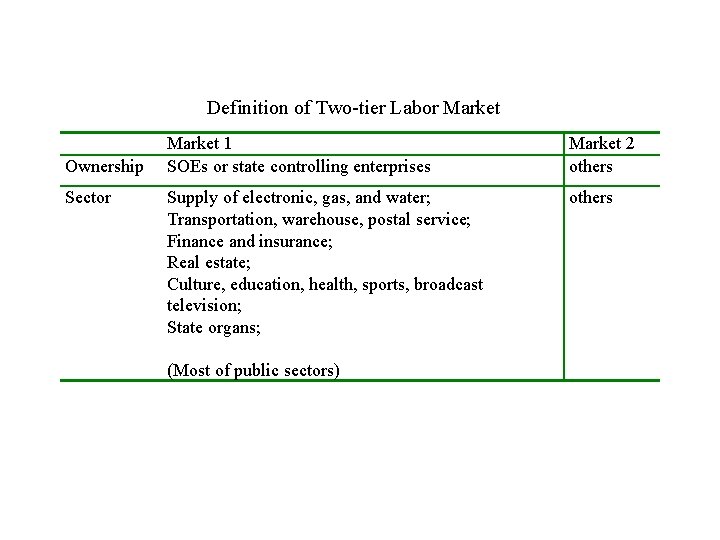
Definition of Two-tier Labor Market Ownership Sector Market 1 SOEs or state controlling enterprises Market 2 others Supply of electronic, gas, and water; Transportation, warehouse, postal service; Finance and insurance; Real estate; Culture, education, health, sports, broadcast television; State organs; others (Most of public sectors)
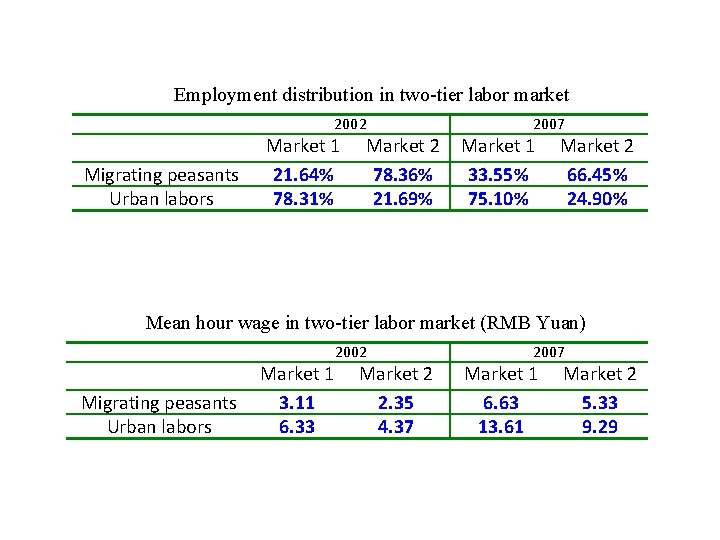
Employment distribution in two-tier labor market 2002 Migrating peasants Urban labors Market 1 21. 64% 78. 31% Market 2 78. 36% 21. 69% 2007 Market 1 33. 55% 75. 10% Market 2 66. 45% 24. 90% Mean hour wage in two-tier labor market (RMB Yuan) 2002 Migrating peasants Urban labors Market 1 3. 11 6. 33 Market 2 2. 35 4. 37 2007 Market 1 6. 63 13. 61 Market 2 5. 33 9. 29
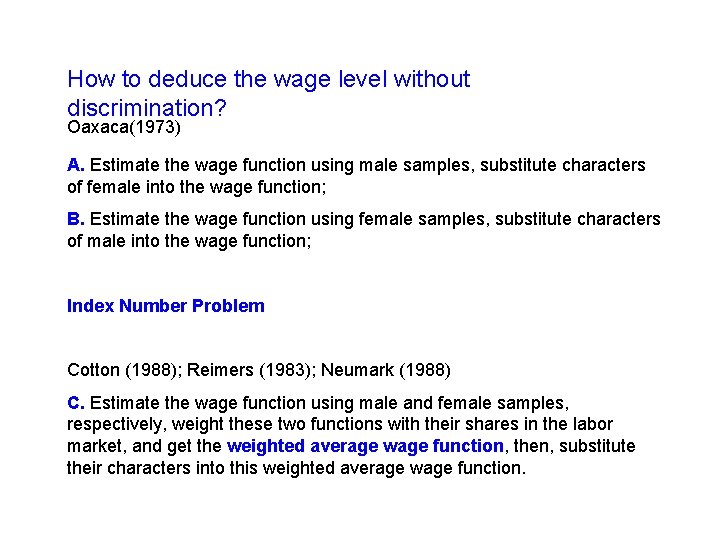
How to deduce the wage level without discrimination? Oaxaca(1973) A. Estimate the wage function using male samples, substitute characters of female into the wage function; B. Estimate the wage function using female samples, substitute characters of male into the wage function; Index Number Problem Cotton (1988); Reimers (1983); Neumark (1988) C. Estimate the wage function using male and female samples, respectively, weight these two functions with their shares in the labor market, and get the weighted average wage function, then, substitute their characters into this weighted average wage function.
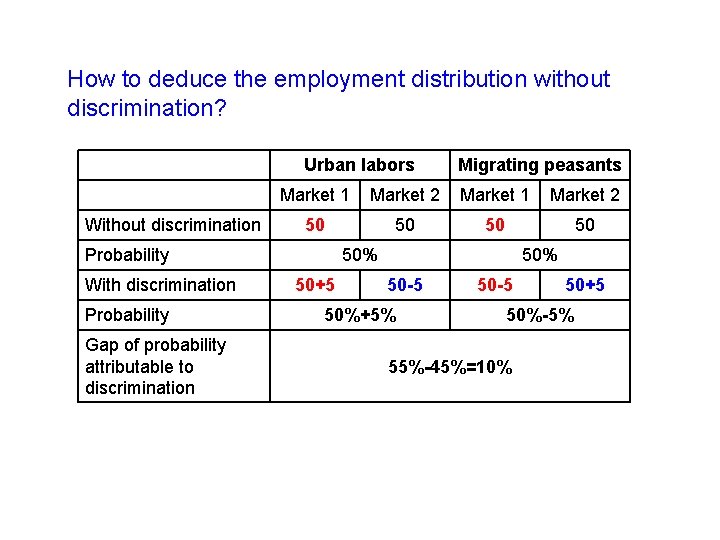
How to deduce the employment distribution without discrimination? Urban labors Without discrimination Market 1 Market 2 50 50 Probability With discrimination Probability Gap of probability attributable to discrimination Migrating peasants 50% 50+5 50% 50 -5 50%+5% 50 -5 50+5 50%-5% 55%-45%=10%
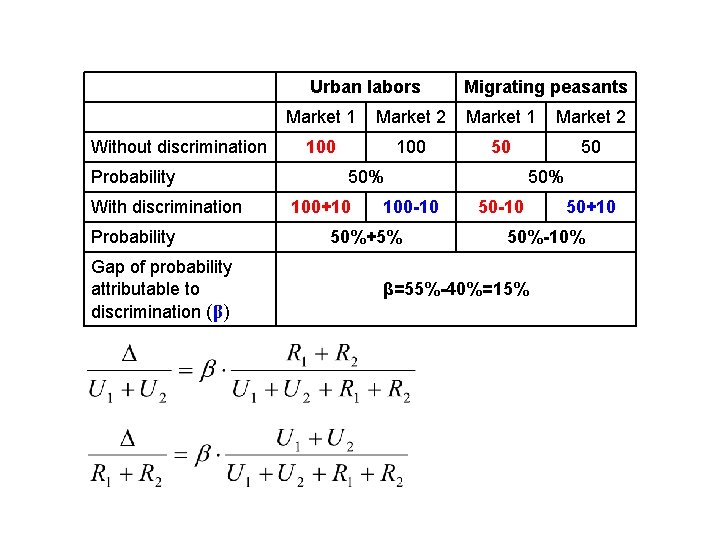
Urban labors Without discrimination Probability With discrimination Probability Gap of probability attributable to discrimination (β) Migrating peasants Market 1 Market 2 100 50 50 50% 100+10 100 -10 50%+5% 50 -10 50+10 50%-10% β=55%-40%=15%
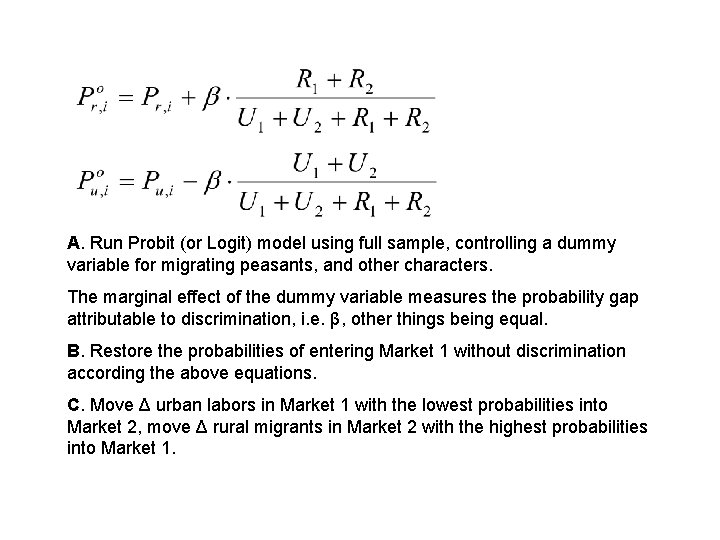
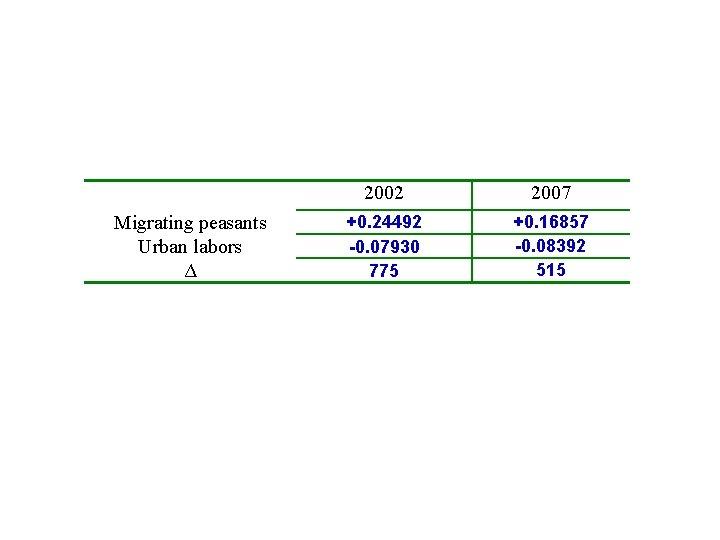
A. Run Probit (or Logit) model using full sample, controlling a dummy variable for migrating peasants, and other characters. The marginal effect of the dummy variable measures the probability gap attributable to discrimination, i. e. β, other things being equal. B. Restore the probabilities of entering Market 1 without discrimination according the above equations. C. Move Δ urban labors in Market 1 with the lowest probabilities into Market 2, move Δ rural migrants in Market 2 with the highest probabilities into Market 1.
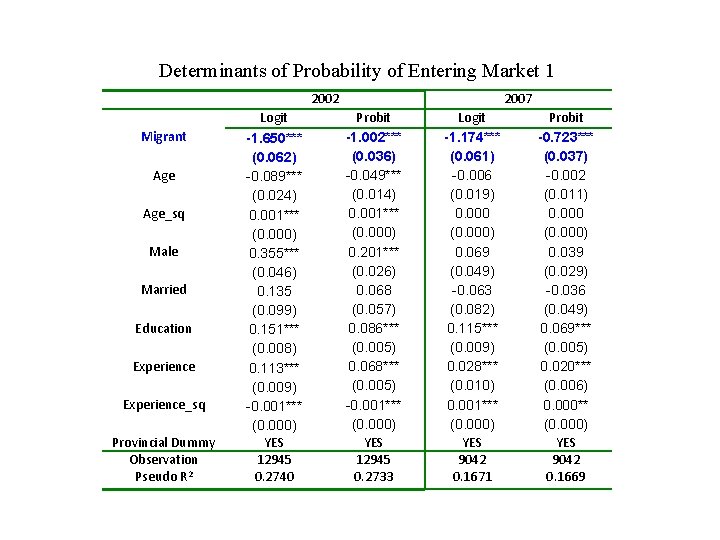
Determinants of Probability of Entering Market 1 2002 Migrant Age_sq Male Married Education Experience_sq Provincial Dummy Observation Pseudo R 2 Logit -1. 650*** (0. 062) -0. 089*** (0. 024) 0. 001*** (0. 000) 0. 355*** (0. 046) 0. 135 (0. 099) 0. 151*** (0. 008) 0. 113*** (0. 009) -0. 001*** (0. 000) YES 12945 0. 2740 2007 Probit -1. 002*** (0. 036) -0. 049*** (0. 014) 0. 001*** (0. 000) 0. 201*** (0. 026) 0. 068 (0. 057) 0. 086*** (0. 005) 0. 068*** (0. 005) -0. 001*** (0. 000) YES 12945 0. 2733 Logit -1. 174*** (0. 061) -0. 006 (0. 019) 0. 000 (0. 000) 0. 069 (0. 049) -0. 063 (0. 082) 0. 115*** (0. 009) 0. 028*** (0. 010) 0. 001*** (0. 000) YES 9042 0. 1671 Probit -0. 723*** (0. 037) -0. 002 (0. 011) 0. 000 (0. 000) 0. 039 (0. 029) -0. 036 (0. 049) 0. 069*** (0. 005) 0. 020*** (0. 006) 0. 000** (0. 000) YES 9042 0. 1669
Migrating peasants Urban labors Δ 2002 2007 +0. 24492 -0. 07930 775 +0. 16857 -0. 08392 515
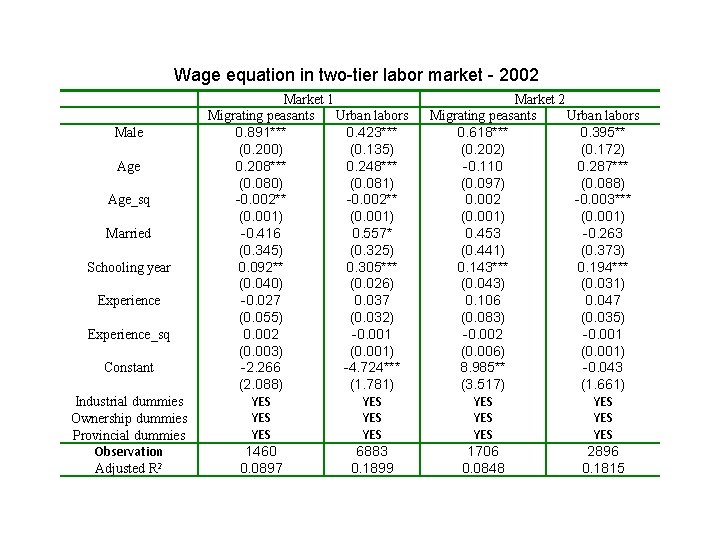
Wage equation in two-tier labor market - 2002 Male Age_sq Married Schooling year Experience_sq Constant Industrial dummies Ownership dummies Provincial dummies Observation Adjusted R 2 Market 1 Migrating peasants Urban labors 0. 891*** 0. 423*** (0. 200) (0. 135) 0. 208*** 0. 248*** (0. 080) (0. 081) -0. 002** (0. 001) -0. 416 0. 557* (0. 345) (0. 325) 0. 092** 0. 305*** (0. 040) (0. 026) -0. 027 0. 037 (0. 055) (0. 032) 0. 002 -0. 001 (0. 003) (0. 001) -2. 266 -4. 724*** (2. 088) (1. 781) YES YES YES 1460 6883 0. 0897 0. 1899 Market 2 Migrating peasants Urban labors 0. 618*** 0. 395** (0. 202) (0. 172) -0. 110 0. 287*** (0. 097) (0. 088) 0. 002 -0. 003*** (0. 001) 0. 453 -0. 263 (0. 441) (0. 373) 0. 143*** 0. 194*** (0. 043) (0. 031) 0. 106 0. 047 (0. 083) (0. 035) -0. 002 -0. 001 (0. 006) (0. 001) 8. 985** -0. 043 (3. 517) (1. 661) YES YES YES 1706 2896 0. 0848 0. 1815
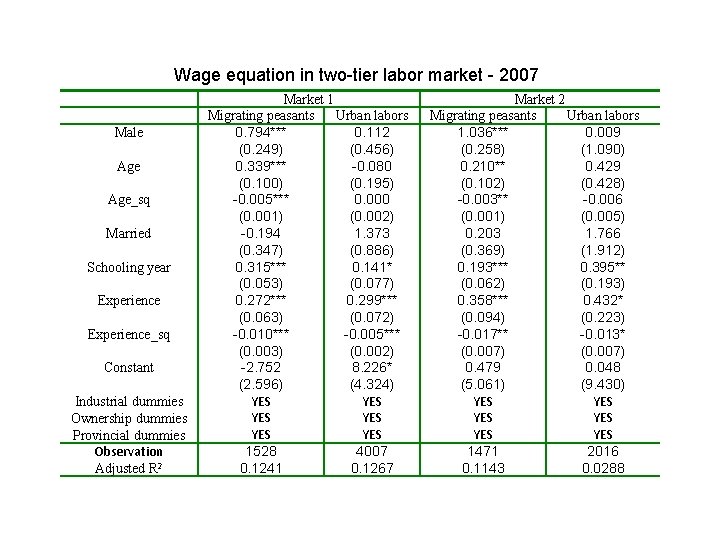
Wage equation in two-tier labor market - 2007 Male Age_sq Married Schooling year Experience_sq Constant Industrial dummies Ownership dummies Provincial dummies Observation Adjusted R 2 Market 1 Migrating peasants Urban labors 0. 794*** 0. 112 (0. 249) (0. 456) 0. 339*** -0. 080 (0. 100) (0. 195) -0. 005*** 0. 000 (0. 001) (0. 002) -0. 194 1. 373 (0. 347) (0. 886) 0. 315*** 0. 141* (0. 053) (0. 077) 0. 272*** 0. 299*** (0. 063) (0. 072) -0. 010*** -0. 005*** (0. 003) (0. 002) -2. 752 8. 226* (2. 596) (4. 324) YES YES YES 1528 4007 0. 1241 0. 1267 Market 2 Migrating peasants Urban labors 1. 036*** 0. 009 (0. 258) (1. 090) 0. 210** 0. 429 (0. 102) (0. 428) -0. 003** -0. 006 (0. 001) (0. 005) 0. 203 1. 766 (0. 369) (1. 912) 0. 193*** 0. 395** (0. 062) (0. 193) 0. 358*** 0. 432* (0. 094) (0. 223) -0. 017** -0. 013* (0. 007) 0. 479 0. 048 (5. 061) (9. 430) YES YES YES 1471 2016 0. 1143 0. 0288
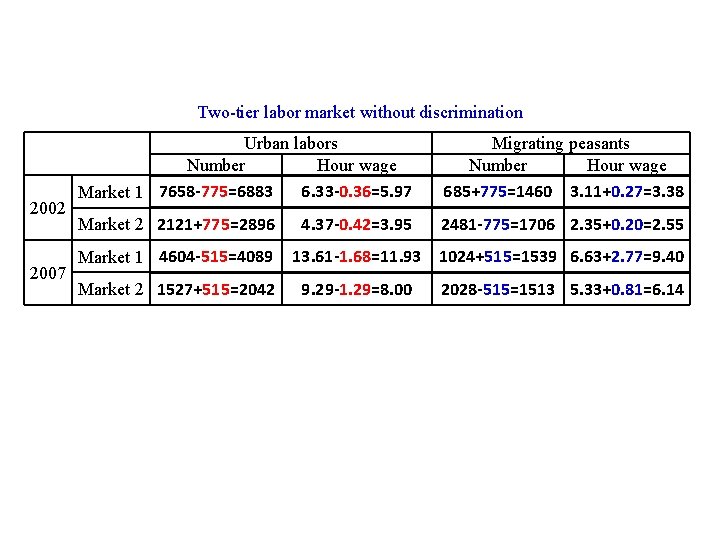
Two-tier labor market without discrimination 2002 2007 Urban labors Number Hour wage 6. 33 -0. 36=5. 97 Market 1 7658 -775=6883 Migrating peasants Number Hour wage 685+775=1460 3. 11+0. 27=3. 38 Market 2 2121+775=2896 2481 -775=1706 2. 35+0. 20=2. 55 Market 1 4604 -515=4089 Market 2 1527+515=2042 4. 37 -0. 42=3. 95 13. 61 -1. 68=11. 93 1024+515=1539 6. 63+2. 77=9. 40 9. 29 -1. 29=8. 00 2028 -515=1513 5. 33+0. 81=6. 14
Total discrimination index and its components
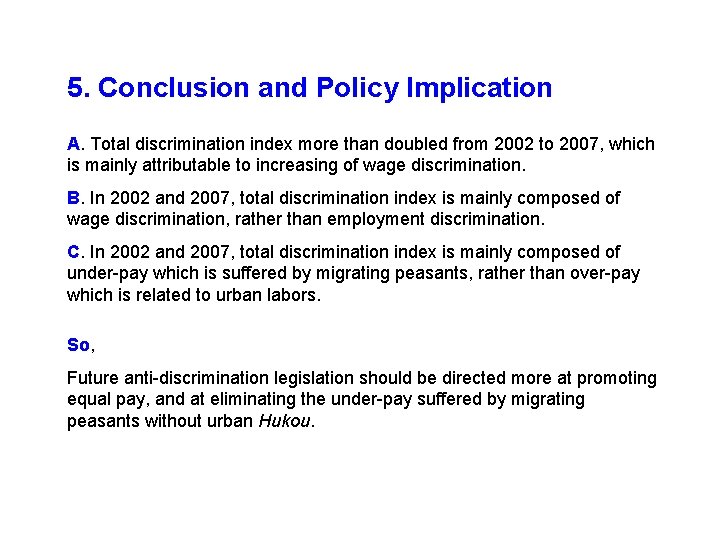
5. Conclusion and Policy Implication A. Total discrimination index more than doubled from 2002 to 2007, which is mainly attributable to increasing of wage discrimination. B. In 2002 and 2007, total discrimination index is mainly composed of wage discrimination, rather than employment discrimination. C. In 2002 and 2007, total discrimination index is mainly composed of under-pay which is suffered by migrating peasants, rather than over-pay which is related to urban labors. So, Future anti-discrimination legislation should be directed more at promoting equal pay, and at eliminating the under-pay suffered by migrating peasants without urban Hukou.
Thank you for your attention! zhangyuanfd@fudan. edu. cn