
Employee Workplace Behaviors and Attitudes INVESTIGATION FOLLOWING A
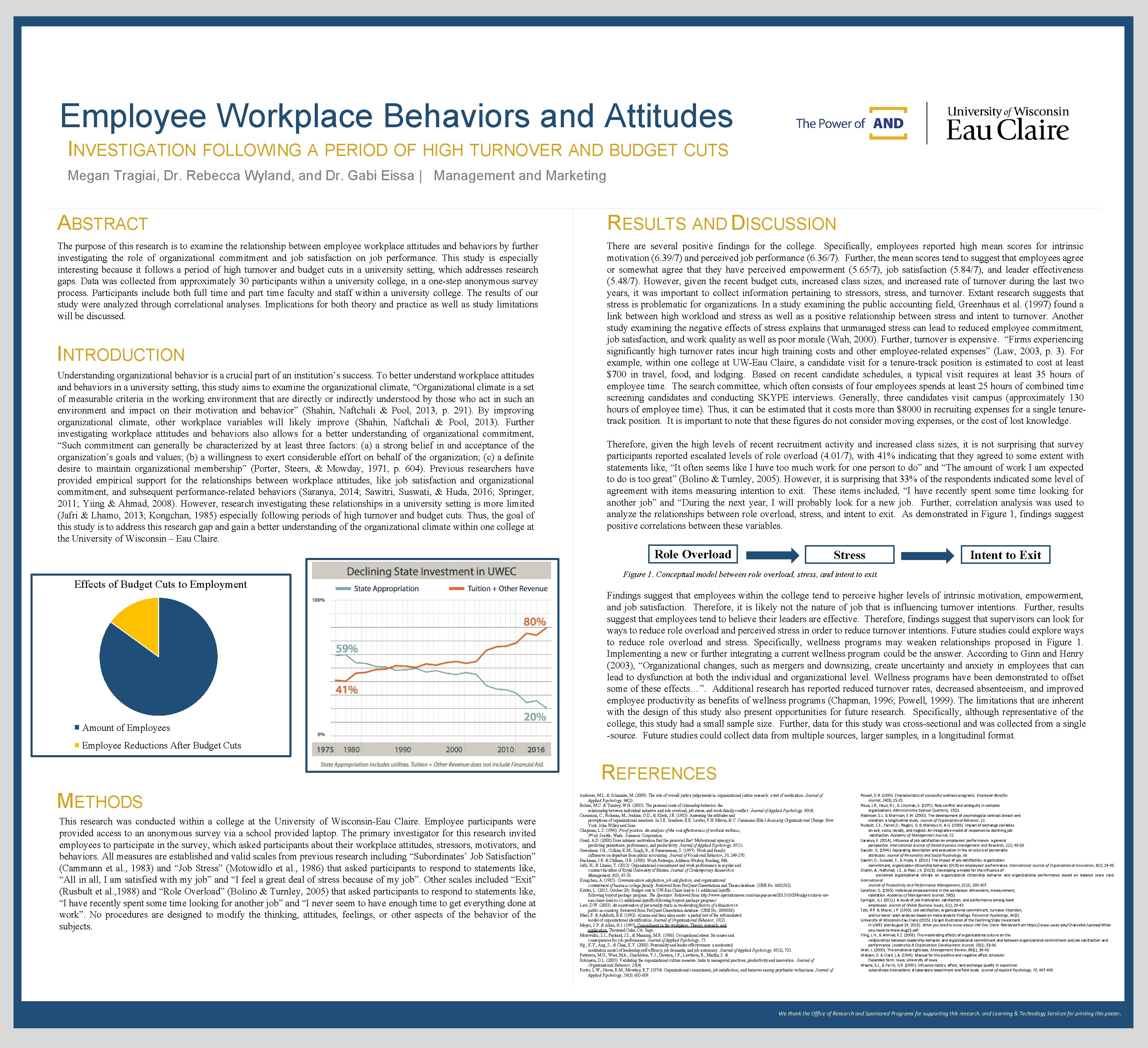
Employee Workplace Behaviors and Attitudes INVESTIGATION FOLLOWING A PERIOD OF HIGH TURNOVER AND BUDGET CUTS Megan Tragiai, Dr. Rebecca Wyland, and Dr. Gabi Eissa | Management and Marketing ABSTRACT RESULTS AND DISCUSSION The purpose of this research is to examine the relationship between employee workplace attitudes and behaviors by further investigating the role of organizational commitment and job satisfaction on job performance. This study is especially interesting because it follows a period of high turnover and budget cuts in a university setting, which addresses research gaps. Data was collected from approximately 30 participants within a university college, in a one-step anonymous survey process. Participants include both full time and part time faculty and staff within a university college. The results of our study were analyzed through correlational analyses. Implications for both theory and practice as well as study limitations will be discussed. There are several positive findings for the college. Specifically, employees reported high mean scores for intrinsic motivation (6. 39/7) and perceived job performance (6. 36/7). Further, the mean scores tend to suggest that employees agree or somewhat agree that they have perceived empowerment (5. 65/7), job satisfaction (5. 84/7), and leader effectiveness (5. 48/7). However, given the recent budget cuts, increased class sizes, and increased rate of turnover during the last two years, it was important to collect information pertaining to stressors, stress, and turnover. Extant research suggests that stress is problematic for organizations. In a study examining the public accounting field, Greenhaus et al. (1997) found a link between high workload and stress as well as a positive relationship between stress and intent to turnover. Another study examining the negative effects of stress explains that unmanaged stress can lead to reduced employee commitment, job satisfaction, and work quality as well as poor morale (Wah, 2000). Further, turnover is expensive. “Firms experiencing significantly high turnover rates incur high training costs and other employee-related expenses” (Law, 2003, p. 3). For example, within one college at UW-Eau Claire, a candidate visit for a tenure-track position is estimated to cost at least $700 in travel, food, and lodging. Based on recent candidate schedules, a typical visit requires at least 35 hours of employee time. The search committee, which often consists of four employees spends at least 25 hours of combined time screening candidates and conducting SKYPE interviews. Generally, three candidates visit campus (approximately 130 hours of employee time). Thus, it can be estimated that it costs more than $8000 in recruiting expenses for a single tenuretrack position. It is important to note that these figures do not consider moving expenses, or the cost of lost knowledge. INTRODUCTION Understanding organizational behavior is a crucial part of an institution’s success. To better understand workplace attitudes and behaviors in a university setting, this study aims to examine the organizational climate, “Organizational climate is a set of measurable criteria in the working environment that are directly or indirectly understood by those who act in such an environment and impact on their motivation and behavior” (Shahin, Naftchali & Pool, 2013, p. 291). By improving organizational climate, other workplace variables will likely improve (Shahin, Naftchali & Pool, 2013). Further investigating workplace attitudes and behaviors also allows for a better understanding of organizational commitment, “Such commitment can generally be characterized by at least three factors: (a) a strong belief in and acceptance of the organization’s goals and values; (b) a willingness to exert considerable effort on behalf of the organization; (c) a definite desire to maintain organizational membership” (Porter, Steers, & Mowday, 1971, p. 604). Previous researchers have provided empirical support for the relationships between workplace attitudes, like job satisfaction and organizational commitment, and subsequent performance-related behaviors (Saranya, 2014; Sawitri, Suswati, & Huda, 2016; Springer, 2011; Yiing & Ahmad, 2008). However, research investigating these relationships in a university setting is more limited (Jafri & Lhamo, 2013; Kongchan, 1985) especially following periods of high turnover and budget cuts. Thus, the goal of this study is to address this research gap and gain a better understanding of the organizational climate within one college at the University of Wisconsin – Eau Claire. Therefore, given the high levels of recent recruitment activity and increased class sizes, it is not surprising that survey participants reported escalated levels of role overload (4. 01/7), with 41% indicating that they agreed to some extent with statements like, “It often seems like I have too much work for one person to do” and “The amount of work I am expected to do is too great” (Bolino & Turnley, 2005). However, it is surprising that 33% of the respondents indicated some level of agreement with items measuring intention to exit. These items included, “I have recently spent some time looking for another job” and “During the next year, I will probably look for a new job. Further, correlation analysis was used to analyze the relationships between role overload, stress, and intent to exit. As demonstrated in Figure 1, findings suggest positive correlations between these variables. Role Overload Effects of Budget Cuts to Employment Amount of Employees Employee Reductions After Budget Cuts Stress Intent to Exit Figure 1. Conceptual model between role overload, stress, and intent to exit. Findings suggest that employees within the college tend to perceive higher levels of intrinsic motivation, empowerment, and job satisfaction. Therefore, it is likely not the nature of job that is influencing turnover intentions. Further, results suggest that employees tend to believe their leaders are effective. Therefore, findings suggest that supervisors can look for ways to reduce role overload and perceived stress in order to reduce turnover intentions. Future studies could explore ways to reduce role overload and stress. Specifically, wellness programs may weaken relationships proposed in Figure 1. Implementing a new or further integrating a current wellness program could be the answer. According to Ginn and Henry (2003), “Organizational changes, such as mergers and downsizing, create uncertainty and anxiety in employees that can lead to dysfunction at both the individual and organizational level. Wellness programs have been demonstrated to offset some of these effects…”. Additional research has reported reduced turnover rates, decreased absenteeism, and improved employee productivity as benefits of wellness programs (Chapman, 1996; Powell, 1999). The limitations that are inherent with the design of this study also present opportunities for future research. Specifically, although representative of the college, this study had a small sample size. Further, data for this study was cross-sectional and was collected from a single -source. Future studies could collect data from multiple sources, larger samples, in a longitudinal format. REFERENCES METHODS This research was conducted within a college at the University of Wisconsin-Eau Claire. Employee participants were provided access to an anonymous survey via a school provided laptop. The primary investigator for this research invited employees to participate in the survey, which asked participants about their workplace attitudes, stressors, motivators, and behaviors. All measures are established and valid scales from previous research including “Subordinates’ Job Satisfaction” (Cammann et al. , 1983) and “Job Stress” (Motowidlo et al. , 1986) that asked participants to respond to statements like, “All in all, I am satisfied with my job” and “I feel a great deal of stress because of my job”. Other scales included “Exit” (Rusbult et al. , 1988) and “Role Overload” (Bolino & Turnley, 2005) that asked participants to respond to statements like, “I have recently spent some time looking for another job” and “I never seem to have enough time to get everything done at work”. No procedures are designed to modify the thinking, attitudes, feelings, or other aspects of the behavior of the subjects. Ambrose, M. L. & Schminke, M. (2009). The role of overall justice judgements in organizational justice research: a test of medication. Journal of Applied Psychology, 94(2). Bolino, M. C. & Turnley, W. H. (2005). The personal costs of citizenship behavior: the relationship between individual initiative and role overload, job stress, and work-family conflict. Journal of Applied Psychology, 90(4). Cammann, C. , Fichman, M. , Jenkins, G. D. , & Klesh, J. R. (1983). Assessing the attitudes and perceptions of organizational members. In S. E. Seashore, E. E. Lawler, P. H. Mirvis, & C. Cammann (Eds. ) Assessing Organizational Change. New York: John Willey and Sons. Chapman, L. S. (1996). Proof positive: An analysis of the cost-effectiveness of worksite wellness , 3 rd ed. Seattle, Wash. : Summex Corporation. Grant, A. D. (2008) Does intrinsic motivation fuel the prosocial fire? Motivational synergy in predicting persistence, performance, and productivity. Journal of Applied Psychology, 93(1). Greenhaus. J. H. , Collins, K. M. , Singh, R. , & Parasuraman, S. (1997). Work and family influences on departure from public accounting. Journal of Vocational Behavior, 50, 249 -270. Hackman, J. R. & Oldham, G. R. (1980). Work Redesign, Addison-Wesley, Reading, MA. Jafri, H. , & Lhamo, T. (2013). Organizational commitment and work performance in regular and contract faculties of Royal University of Bhutan. Journal of Contemporary Research in Management, 8(2), 47 -58. Kongchan, A. (1985). Communication satisfaction, job satisfaction, and organizational commitment of business college faculty. Retrieved from Pro. Quest Dissertations and Theses database. (UMI No. 8602582). Kritter, L. (2015, October 29). Budget cuts to UW-Eau Claire lead to 11 additional layoffs following buyout package program. The Spectator. Retrieved from http: //www. spectatornews. com/campus-news/2015/10/29/budget-cuts-to-uw- eau-claire-lead-to-11 -additional-layoffs-following-buyout-package-program / Law, D. W. (2003). An examination of personality traits as moderating factors of exhaustion in public accounting. Retrieved from Pro. Quest Dissertation database. (UMI No. 3096886). Mael, F. & Ashforth, B. E. (1992). Alumni and their alma mater: a partial test of the reformulated model of organizational identification. Journal of Organizational Behavior, 13(2). Meyer, J. P. & Allen, N. J. (1997). Commitment in the workplace: Theory, research, and application. Thousand Oaks, CA: Sage. Motowidlo, S. J. , Packard, J. S. , & Manning, M. R. (1986). Occupational stress: Its causes and consequences for job performance. Journal of Applied Psychology, 71. Ng. , K. Y. , Ang, S. , & Chan, K. Y. (2008). Personality and leader effectiveness: a moderated meditation model of leadership self-efficacy, job demands, and job autonomy. Journal of Applied Psychology, 93(2), 733. Patterson, M. G. , West, M. A. , Shackleton, V. J. , Dawson, J. F. , Lawthom, R. , Maitlis, S. & Robinson, D. L. (2005). Validating the organizational culture measure: links to managerial practices, productivity and innovation. Journal of Organizational Behavior, 26(4). Porter, L. W. , Steers, R. M. , Mowday, R. T. (1974). Organizational commitment, job satisfaction , and turnover among psychiatric technicians. Journal of Applied Psychology, 59(5), 603 -609. Powell, D. R. (1999). Characteristics of successful wellness programs. Employee Benefits Journal, 24(3), 15 -21. Rizzo, J. R. , Hous, R. J. , & Lirtzman, S. (1970). Role conflict and ambiguity in complex organizations. Administrative Science Quarterly, 15(2). Robinson, S. L. & Morrison, E. W. (2000). The development of psychological contract breach and violation: a longitudinal study. Journal of Organizational Behavior, 21. Rusbult, C. E. , Farrell, D. , Rogers, G. & Mainous III, A. G. (1988). Impact of exchange variables on exit, voice, loyalty, and neglect: An integrative model of responses to declining job satisfaction. Academy of Management Journal, 31. Saranya, K. (2014). Influence of job satisfaction on employees’ performance- a general perspective. International Journal of Global business management and Research, 2(2), 48 -53. Saucier, G. (1994). Separating description and evaluation in the structure of personality attributes. Journal of Personality and Social Psychology, 66. Sawitri, D. , Suswati, E. , & Huda, K. (2016). The impact of job satisfaction, organization commitment, organization citizenship behavior (OCB) on employees’ performance. International Journal of Organizational Innovation, 9(2), 24 -45. Shahin, A. , Naftchali, J. S. , & Pool, J. K. (2013). Developing a model for the influence of perceived organizational climate on organizational citizenship behavior and organizational performance based on balance score card. International Journal of Productivity and Performance Management, 63(3), 290 -307. Spreitzer, G. (1995). Individual empowerment in the workplace: dimensions, measurement, validation. Academy of Management Journal, 38(5). Springer, G. J. (2011). A study of job motivation, satisfaction, and performance among bank employees. Journal of Global Business Issues, 5(1), 29 -42. Tett, R. P. & Meyer, J. P. (1993). Job satisfaction, organizational commitment, turnover intention, and turnover: path analyses based on meta-analytic findings. Personnel Psychology, 46(2). University of Wisconsin-Eau Claire (2015). [Graph illustration of the Declining State Investment in UWEC plot August 24, 2015]. What you need to know about UW-Eau Claire. Retrieved from https: //www. uwec. edu/Chancellor/upload/Whatyou-need-to-know-Aug 15. pdf Yiing, L. H. , & Ahmad, K. Z. (2008). The moderating effects of organizational culture on the relationships between leadership behavior and organizational commitment and between organizational commitment and job satisfaction and performance. Leadership & Organization Development Journal, 30(1), 53 -86. Wah, L. (2000). The emotional tightrope. Management Review, 89(1), 38 -43. Watson, D. & Clark, L. A. (1994). Manual for the positive and negative affect schedule: Expanded form. Iowa: University of Iowa. Wayne, S. J. , & Ferris, G. R. (1990). Influence tactics, affect, and exchange quality in supervisor subordinate interactions: A laboratory experiment and field study. Journal of Applied Psychology, 75, 487 -499. We thank the Office of Research and Sponsored Programs for supporting this research, and Learning & Technology Services for printing this poster.
- Slides: 1