
Employee Retention Module 4 Retention of Human Resources


- Slides: 25
Employee Retention Module 4
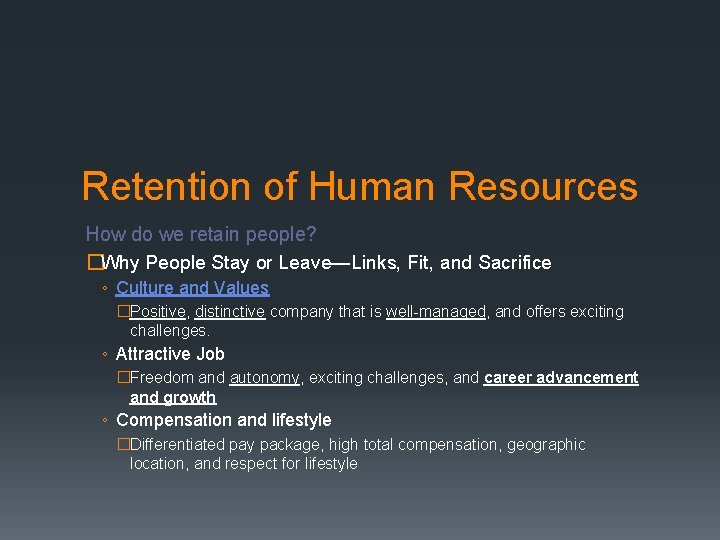
Retention of Human Resources How do we retain people? �Why People Stay or Leave—Links, Fit, and Sacrifice ◦ Culture and Values �Positive, distinctive company that is well-managed, and offers exciting challenges. ◦ Attractive Job �Freedom and autonomy, exciting challenges, and career advancement and growth ◦ Compensation and lifestyle �Differentiated pay package, high total compensation, geographic location, and respect for lifestyle
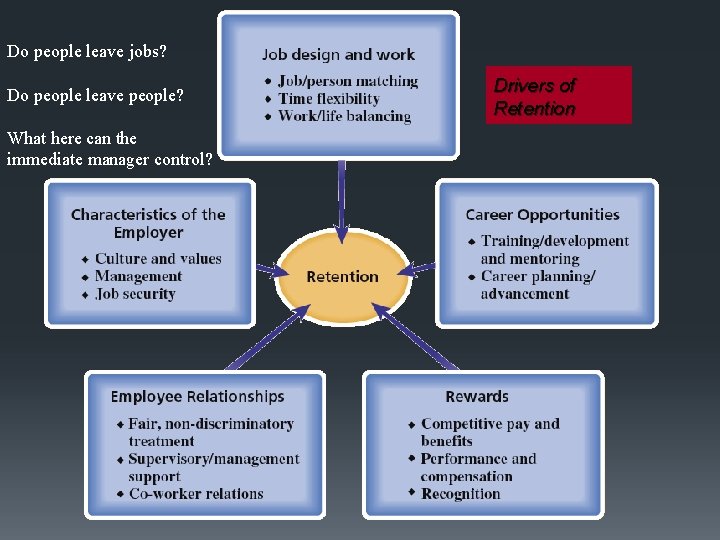
Do people leave jobs? Do people leave people? What here can the immediate manager control? Drivers of Retention
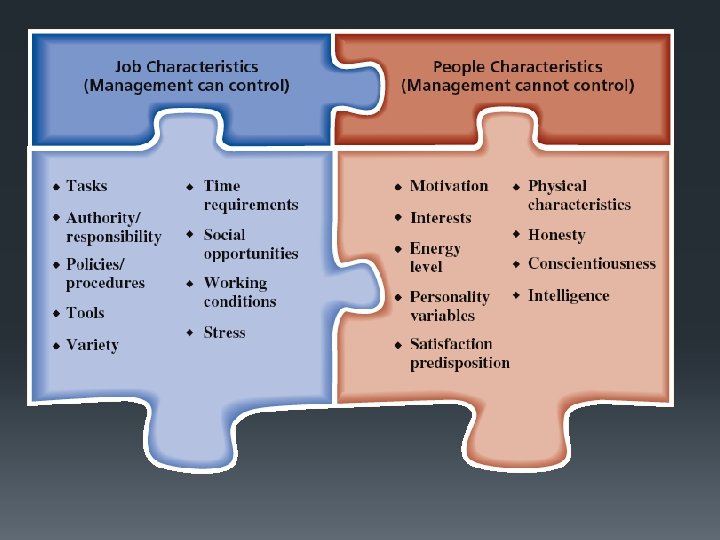
Some Characteristics of People and Jobs
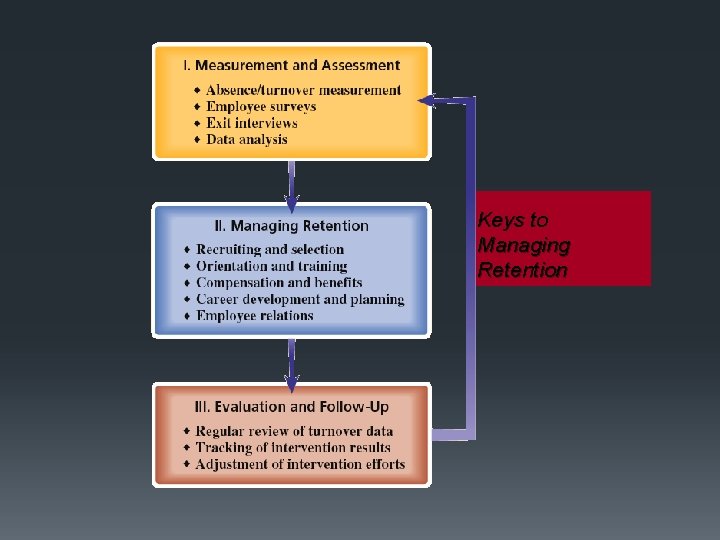
Keys to Managing Retention
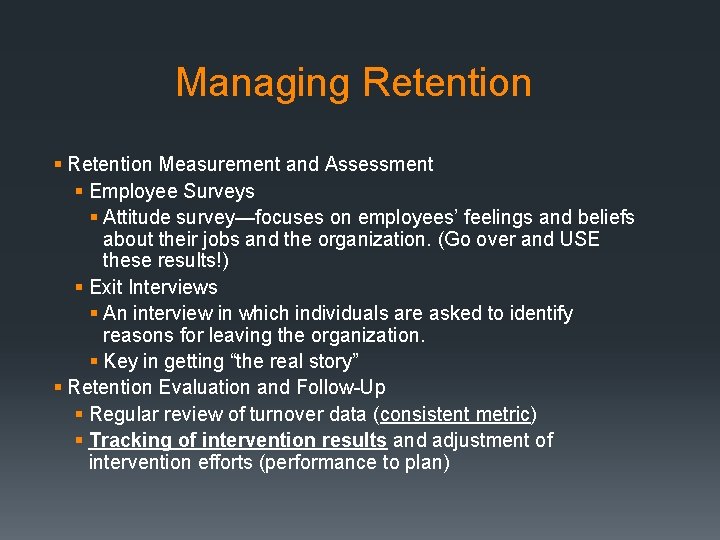
Managing Retention § Retention Measurement and Assessment § Employee Surveys § Attitude survey—focuses on employees’ feelings and beliefs about their jobs and the organization. (Go over and USE these results!) § Exit Interviews § An interview in which individuals are asked to identify reasons for leaving the organization. § Key in getting “the real story” § Retention Evaluation and Follow-Up § Regular review of turnover data (consistent metric) § Tracking of intervention results and adjustment of intervention efforts (performance to plan)
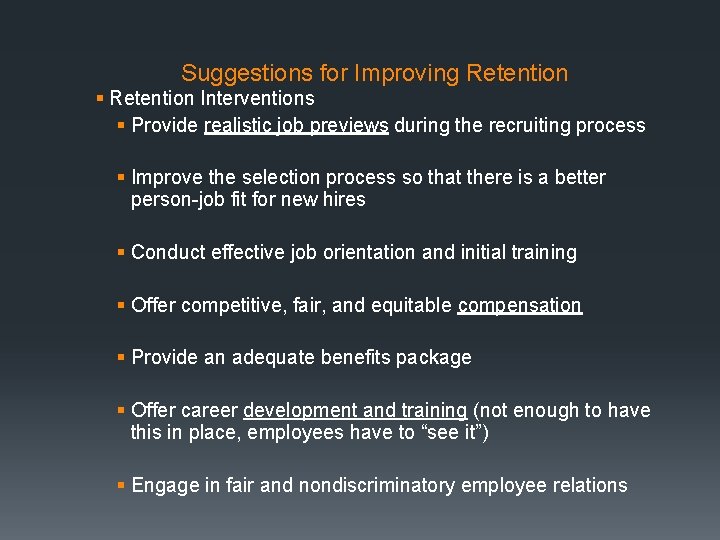
Suggestions for Improving Retention § Retention Interventions § Provide realistic job previews during the recruiting process § Improve the selection process so that there is a better person-job fit for new hires § Conduct effective job orientation and initial training § Offer competitive, fair, and equitable compensation § Provide an adequate benefits package § Offer career development and training (not enough to have this in place, employees have to “see it”) § Engage in fair and nondiscriminatory employee relations
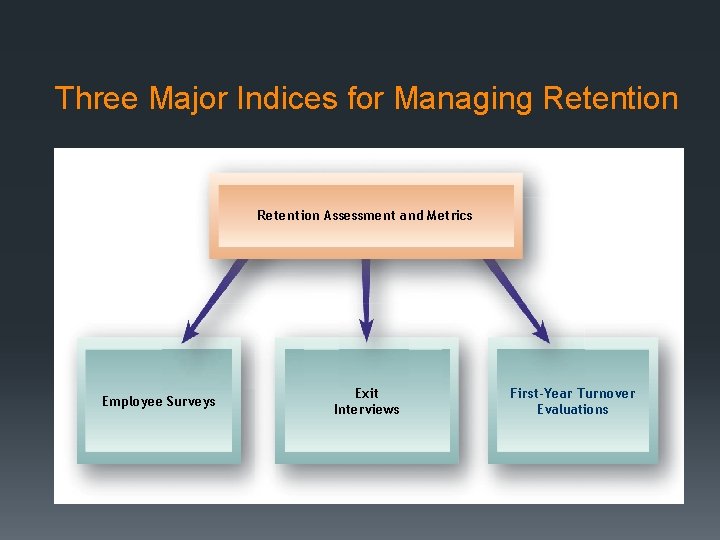
Three Major Indices for Managing Retention Assessment and Metrics Employee Surveys Exit Interviews First-Year Turnover Evaluations
Predicting & Managing Turnover through Job Attitudes & Commitment
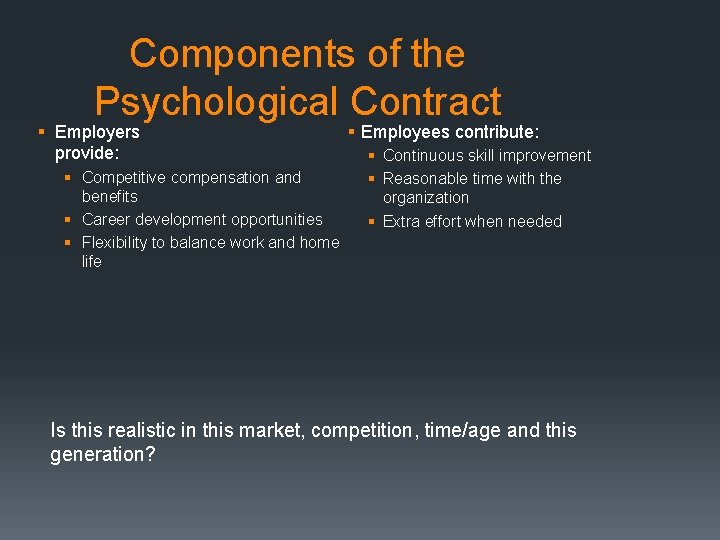
Components of the Psychological Contract § Employers provide: § Competitive compensation and benefits § Career development opportunities § Flexibility to balance work and home life § Employees contribute: § Continuous skill improvement § Reasonable time with the organization § Extra effort when needed Is this realistic in this market, competition, time/age and this generation?
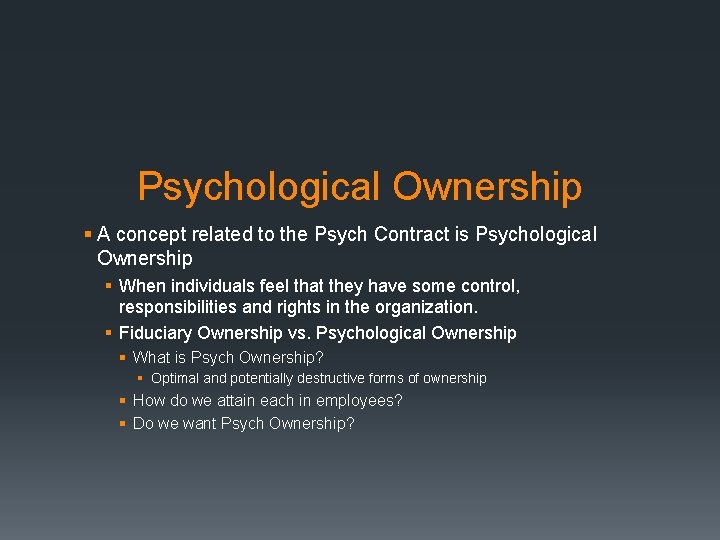
Psychological Ownership § A concept related to the Psych Contract is Psychological Ownership § When individuals feel that they have some control, responsibilities and rights in the organization. § Fiduciary Ownership vs. Psychological Ownership § What is Psych Ownership? § Optimal and potentially destructive forms of ownership § How do we attain each in employees? § Do we want Psych Ownership?
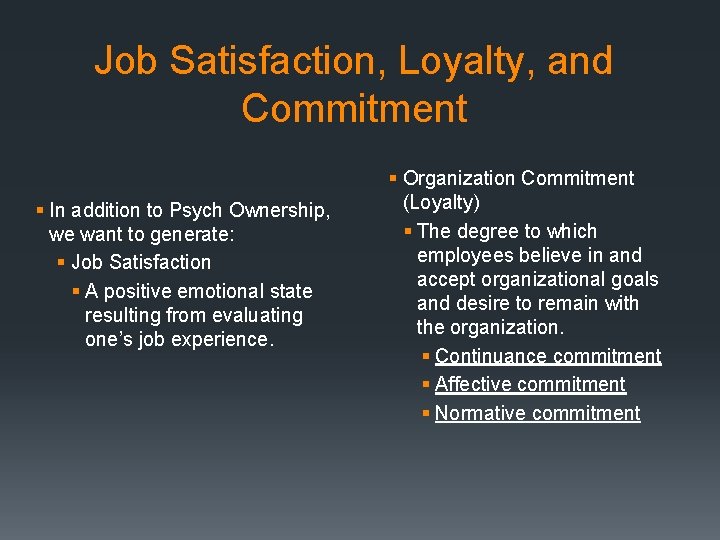
Job Satisfaction, Loyalty, and Commitment § In addition to Psych Ownership, we want to generate: § Job Satisfaction § A positive emotional state resulting from evaluating one’s job experience. § Organization Commitment (Loyalty) § The degree to which employees believe in and accept organizational goals and desire to remain with the organization. § Continuance commitment § Affective commitment § Normative commitment
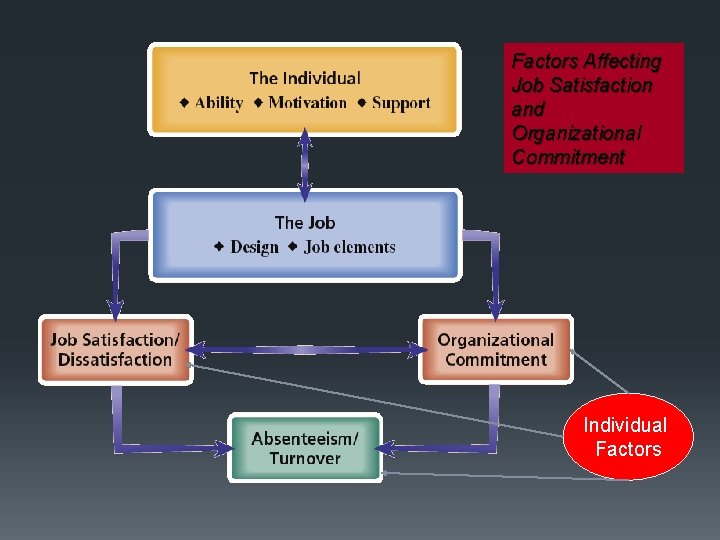
Factors Affecting Job Satisfaction and Organizational Commitment Individual Factors
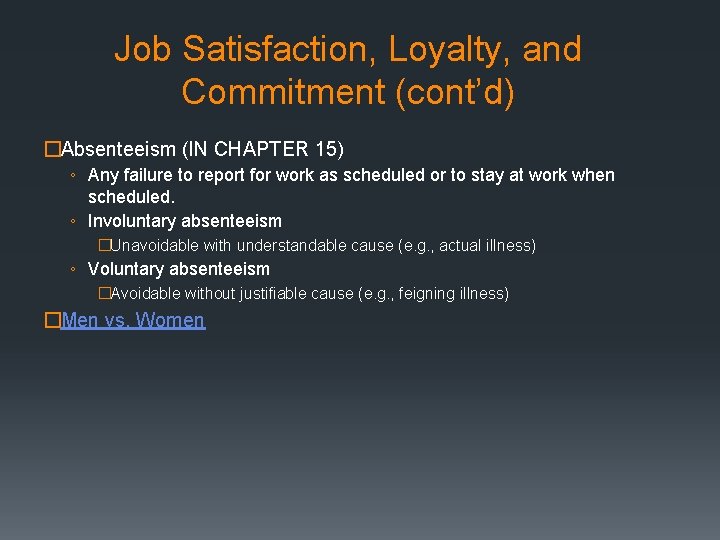
Job Satisfaction, Loyalty, and Commitment (cont’d) �Absenteeism (IN CHAPTER 15) ◦ Any failure to report for work as scheduled or to stay at work when scheduled. ◦ Involuntary absenteeism �Unavoidable with understandable cause (e. g. , actual illness) ◦ Voluntary absenteeism �Avoidable without justifiable cause (e. g. , feigning illness) �Men vs. Women
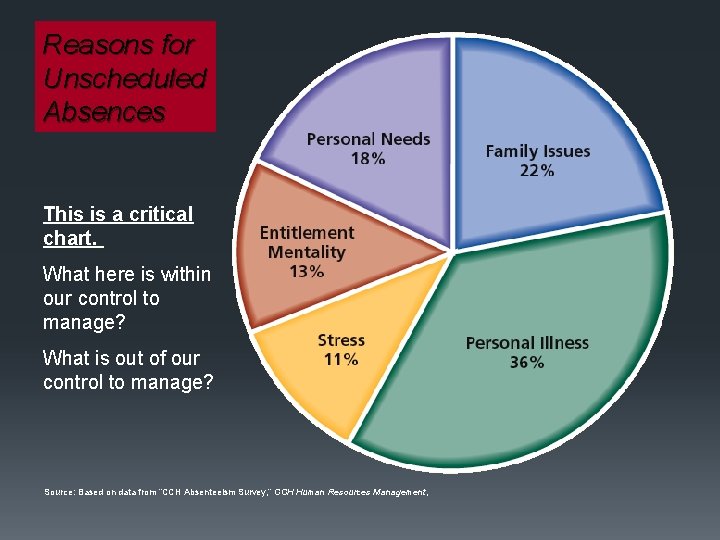
Reasons for Unscheduled Absences This is a critical chart. What here is within our control to manage? What is out of our control to manage? Source: Based on data from “CCH Absenteeism Survey, ” CCH Human Resources Management,
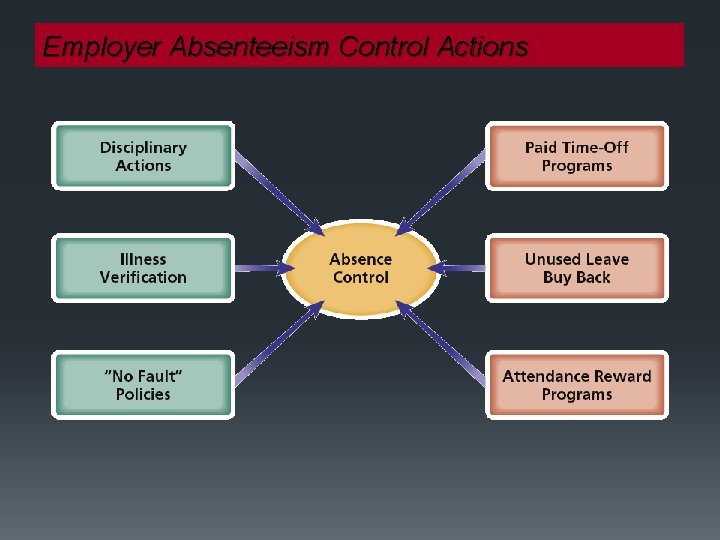
Employer Absenteeism Control Actions
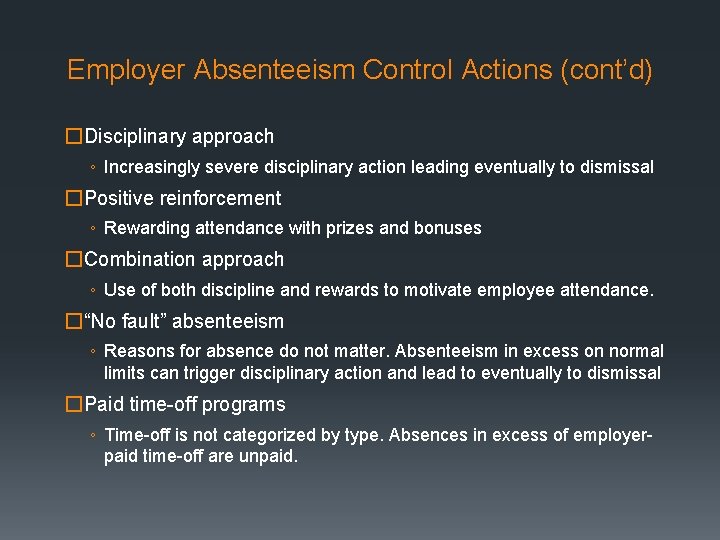
Employer Absenteeism Control Actions (cont’d) �Disciplinary approach ◦ Increasingly severe disciplinary action leading eventually to dismissal �Positive reinforcement ◦ Rewarding attendance with prizes and bonuses �Combination approach ◦ Use of both discipline and rewards to motivate employee attendance. �“No fault” absenteeism ◦ Reasons for absence do not matter. Absenteeism in excess on normal limits can trigger disciplinary action and lead to eventually to dismissal �Paid time-off programs ◦ Time-off is not categorized by type. Absences in excess of employerpaid time-off are unpaid.
HR Metrics: Measuring Absenteeism • Other Measures of Absenteeism: ØIncidence rate—the number of absences per 100 employees each day ØInactivity rate—the percentage of time lost to absenteeism ØSeverity rate—The average time lost per absent employee during a specified period of time ØHow do we know if absenteeism is a problem? Dollarize?
HR Metrics: Measuring Absenteeism (cont’d) § Calculations of the costs of absenteeism should usually include: § § § § Lost wages Benefits Overtime for replacements Fees for temporary employees, if incurred Supervisor’s time Substandard production Overstaffing necessary to cover absences
Employee Turnover § The process in which employees leave the organization and have to be replaced. § Impact of Turnover § Inability to achieve business goals § Loss of “image” to attract other individuals § High costs of turnover and replacement
Types of Turnover § Involuntary turnover—terminations for poor performance or work rule violations. § Voluntary turnover—employees leave by choice. § Functional turnover—lower-performing or disruptive employees leave the organization. § Dysfunctional turnover—key individuals and high performers leave at critical times. § Uncontrollable turnover—employees leave for reasons outside the control of the organization. (environmental jolts- Lee, Mitchell, Holtom et al § Controllable turnover—occurs due to factors that could be influenced by the employer. *Hint: Communicating downsizing should be done very carefully as you will have Dysfunctional Turnover
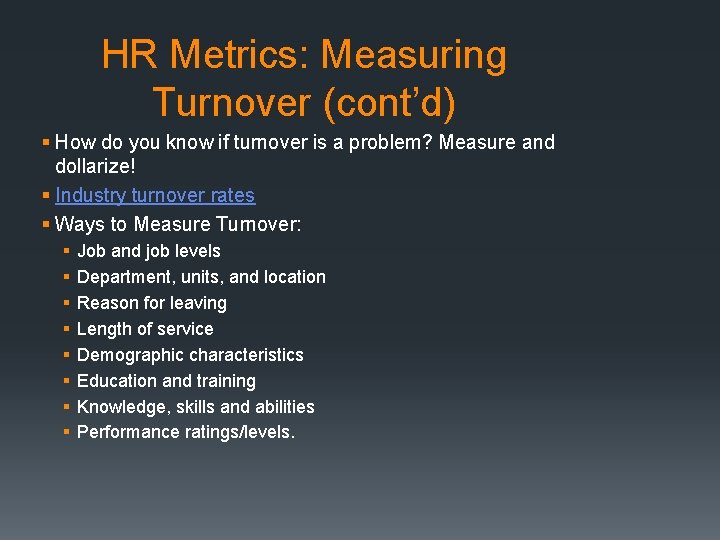
HR Metrics: Measuring Turnover (cont’d) § How do you know if turnover is a problem? Measure and dollarize! § Industry turnover rates § Ways to Measure Turnover: § § § § Job and job levels Department, units, and location Reason for leaving Length of service Demographic characteristics Education and training Knowledge, skills and abilities Performance ratings/levels.
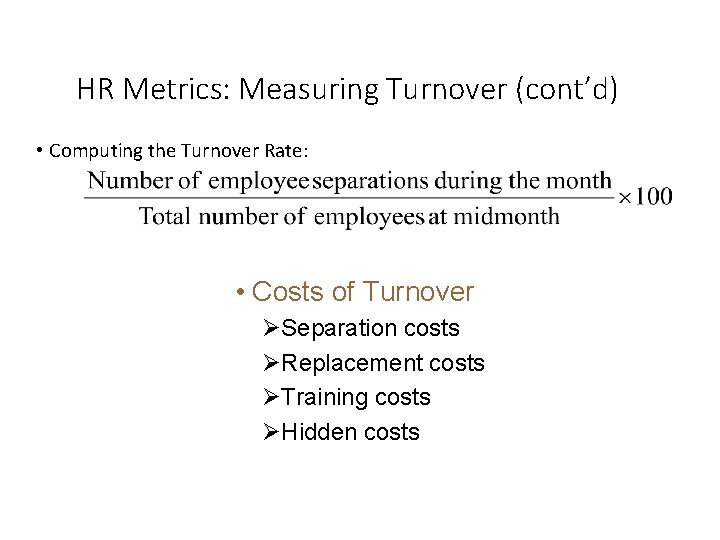
HR Metrics: Measuring Turnover (cont’d) • Computing the Turnover Rate: • Costs of Turnover ØSeparation costs ØReplacement costs ØTraining costs ØHidden costs
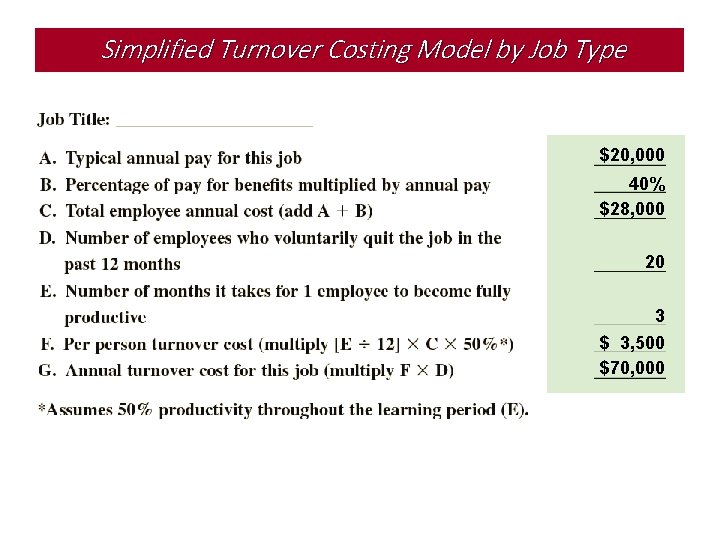
Simplified Turnover Costing Model by Job Type $20, 000 40% $28, 000 20 3 $ 3, 500 $70, 000
HRM Case