
Employee Opinions EMPLOYEES HAVE OPINIONS BUT WHETHER THEY
Employee Opinions EMPLOYEES HAVE OPINIONS, BUT WHETHER THEY SHARE THOSE OPINIONS WITH MANAGEMENT IS ANOTHER STORY. AND IF THEY DO SHARE THOSE OPINIONS, IT’S NOT A FOREGONE CONCLUSION THAT MANAGEMENT WILL ADDRESS THEM, ACT UPON THEM, OR NOT TAKE PUNITIVE ACTION AGAINST EMPLOYEES WHO SPEAK OUT WITH IDEAS FOR CHANGING PROCESSES AND RIGHTING WRONGS. HTTPS: //VBCOURSE. KNOWLEDGEMATTERS. COM/ASSIGNMENT/STARTREADING/135168
Employee Opinions This fear of repercussions for speaking out is not just based on anecdotal evidence. Research by management consultants Kathleen Ryan and Daniel Oestreich showed that seven out of ten employees surveyed across many different industries said they were afraid to speak out or even suggest ideas because they feared retribution. James Detert of Cornell found that barely half (51 percent) of workers in Fortune 100 companies felt it was safe for them to speak up the majority of the time. Ethan Burris, assistant professor of management at the University of Texas–Austin, notes that employees need to feel safe before they’re willing to volunteer feedback or ideas. “A lot of managers think that if they treat their staff respectfully and tell them ‘My door is always open, ’ that should be enough to make their employees trust them, ” Burris says. “But our research shows that employees need more than that in order to feel safe to speak up. ” What can be done to make employees feel free to offer their opinions? HTTPS: //VBCOURSE. KNOWLEDGEMATTERS. COM/ASSIGNMENT/STARTREADING/135168
Why employees’ opinions matter There are two ways to answer the question of why employees’ opinions matter. First, there is the positive connection between ideas and engagement: employees who feel their ideas and feedback are being heard are generally more engaged and productive employees. Second, employees’ ideas and feedback matter because employees often are “closer to the action” than management and thus might have useful ideas for improving efficiency and workplace culture—or maybe even ideas for new products and services. Simply stated, employee engagement—where employees feel an integral part of the day-to-day workings of the organization, where their voice is heard—is one of the key predictors of business success. Research by the Gallup Organization in 2012 found a striking correlation between the degree of employee engagement and the degree to which the larger business was successful. Business or work units that score in the top half of their organization in employee engagement have nearly double the odds of success (based on a composite of financial, customer, retention, safety, quality, shrinkage, and absenteeism metrics) when compared with those in the bottom half. Those at the 99 th percentile have four times the success rate compared with those at the first percentile. HTTPS: //VBCOURSE. KNOWLEDGEMATTERS. COM/ASSIGNMENT/STARTREADING/135168
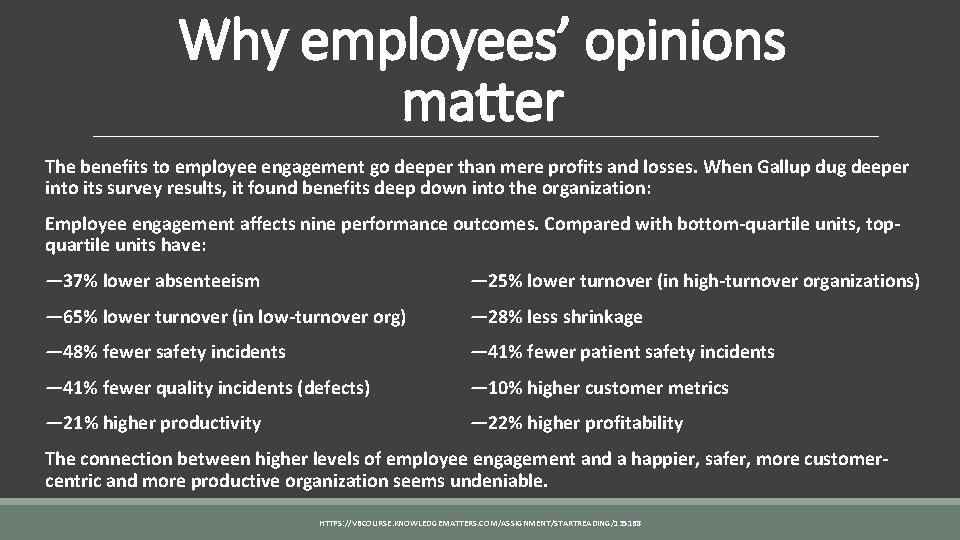
Why employees’ opinions matter The benefits to employee engagement go deeper than mere profits and losses. When Gallup dug deeper into its survey results, it found benefits deep down into the organization: Employee engagement affects nine performance outcomes. Compared with bottom-quartile units, topquartile units have: — 37% lower absenteeism — 25% lower turnover (in high-turnover organizations) — 65% lower turnover (in low-turnover org) — 28% less shrinkage — 48% fewer safety incidents — 41% fewer patient safety incidents — 41% fewer quality incidents (defects) — 10% higher customer metrics — 21% higher productivity — 22% higher profitability The connection between higher levels of employee engagement and a happier, safer, more customercentric and more productive organization seems undeniable. HTTPS: //VBCOURSE. KNOWLEDGEMATTERS. COM/ASSIGNMENT/STARTREADING/135168
Why employees’ opinions matter “There’s lots of research that shows when employees don’t feel involved in the workplace, they tend to withdraw, ” Burris says. “They don’t engage in all the extra activities that aren’t required for the job, such as helping a coworker, staying late, or taking on extra responsibilities. It’s not the formal, required part of the job, but it’s certainly necessary for the organization to succeed. ” Alienated employees can harm morale, and low morale can spread like a cancer throughout an organization—and even beyond. Today, when employees don’t feel like their opinions are being heard, it’s much easier for them to share that information with the wider world and not (unlike in the past) with just a select group of friends and colleagues. Glassdoor, for example, is an extremely popular website where employees rate their company’s culture, including whethere is openness to employee opinions and ideas. (In 2012, almost half a million people submitted reviews to Glassdoor alone. ) Job seekers are increasingly turning to sites like Glassdoor to get a behind-the-scenes assessment of companies before they consider applying for a position. Among other things, a pattern of negative reviews can hurt a company’s recruitment efforts. Employers and managers ignore such websites at their peril. HTTPS: //VBCOURSE. KNOWLEDGEMATTERS. COM/ASSIGNMENT/STARTREADING/135168
How to get employees to speak freely It seems like a tough problem: many employees are reluctant to share feedback or ideas for fear of reprisal, yet managers know that employee feedback is critical to business success. What can be done by managers to get employees to offer that feedback? Ask for it: Managers might need to make the first move and ask employees to share their thoughts and ideas. Walk the talk: Employees likely won’t share ideas and feedback if they believe it will be ignored by management—or worse, if it will fuel hostility between the employee and his or her manager. Become known among your employees as someone who values their input. Acknowledge your blind spots: Understand that you haven’t cornered the market on either truth or good ideas. Use employee feedback as a source of valuable alternative perspectives that could help your company course-correct. Empower them: “We challenge all our employees to be their own CEOs, ” says Dan Satterthwaite, head of human resources at Dreamworks. In addition to letting employees take risks, and even fail, empowerment requires encouraging them to pitch ideas. Offer incentives: Some employees are more likely to offer feedback in exchange for tangible benefits, such as a store gift card, for any ideas that are implemented. HTTPS: //VBCOURSE. KNOWLEDGEMATTERS. COM/ASSIGNMENT/STARTREADING/135168
Offline methods to collect ideas and capture feedback There are several tried-and-true methods to collect employee feedback and ideas, and these offline methods have proven valuable to companies that have consciously created and nurtured a corporate culture in which employees are rewarded (monetarily and otherwise) for providing their feedback and ideas. Town hall meetings: A town hall meeting is essentially an open forum provided by the company in which employees and managers gather together to discuss topics relevant to the company, including new product ideas and employee feedback. Managers typically field questions from employees, and any ideas or feedback gathered will be acted upon subsequent to the meeting. Suggestion box: A decidedly low-tech way to collect employee ideas and feedback, the suggestion box is often put in an employee lunchroom or some other prominent place. Employees then simply write their thoughts on cards and place them in the box, where they’ll be regularly collected and reviewed by managers. Employee meetings: Perhaps the most common way for a manager to get feedback and ideas from an employee is through regular face-to-face meetings. Employee surveys: These surveys can be quite involved, taking weeks or months to create and at least as much time to process when the completed surveys are returned. Employee surveys run the gamut, often asking employee feedback on topics such as creativity, innovation, management, compensation, benefits, and workplace culture. These are often conducted by a company’s human resources department. HTTPS: //VBCOURSE. KNOWLEDGEMATTERS. COM/ASSIGNMENT/STARTREADING/135168
Online methods to collect ideas and capture feedback While many companies still use these offline methods to collect employee feedback, employers and managers also have begun to use various software tools to collect employee feedback and opinions in a more structured and intentional way. These software programs are designed to record employee feedback and opinions in such a way that they can be studied analyzed for patterns across multiple employees. Here a few examples: 15 five. com: Each week employees write a 15 -minute report covering their successes, challenges, and ideas. Managers then take five minutes to review the report, discuss relevant topics with the employee, and then use the individual employee reports to create their own reports for senior management. Happiily: Employees give anonymous feedback about their company, which is shown to managers in real time. Managers can spot trends in employee sentiment and act more quickly on them. Some companies use software like Yammer (an internal corporate social network modeled on Facebook) to allow employees to communicate ideas and offer suggestions related to increasing efficiency and improving customer service. While not as structured as the tools mentioned above, mainly because it also allows what might be called “idle chatter, ” it does provide managers with general insights into employee morale and the company’s broader culture. HTTPS: //VBCOURSE. KNOWLEDGEMATTERS. COM/ASSIGNMENT/STARTREADING/135168
What to do with employee ideas Ideation describes the entire life cycle of an idea, from the original idea on through, in some cases, to the implementation of the idea. In addition to gathering ideas, management should have a way to process the ideas they receive. The ideation process goes roughly like this: An idea is generated and pitched by an employee, it is considered by managers, and the managers respond. Naturally, employees offer ideas because they expect a response. A response may take several forms: Acting on the suggestion/idea as stated Asking the employee for more information or clarification before considering it Proposing a trial or test of the idea before it’s accepted Rejecting the idea or suggestion for specific reasons Whatever the decision, it’s important for managers to develop a transparent process for collecting, triaging, discussing, and acting upon employee feedback. Moreover, it’s important to communicate the results of such deliberations to the employee who offered the feedback or idea and in turn to the organization as a whole. Writing in Inc. magazine, Jeff Haden notes, “Deny employees the opportunity to make suggestions, or shoot their ideas down without consideration, and you create robots. Robots don’t care. ” HTTPS: //VBCOURSE. KNOWLEDGEMATTERS. COM/ASSIGNMENT/STARTREADING/135168
For employees: How to pitch an idea to your boss It’s not enough for employees to come up with good ideas and suggestions. They must know how to pitch them to their manager. Burris’s research provides suggestions for employees who want to maximize the impact of their ideas: Know your audience: Pay attention to what your manager values most. Is it efficiency? Loyalty? Tailor your pitch so your manager sees it as advancing their own ideas about how the workplace should function. Don’t alienate or accuse your manager or the company: If you pitch your idea as the solution to a problem, you’re assuming that management acknowledges that there is a problem in the first place. It’s better, Burris says, to talk about perceptions rather than “facts. ” That is, phrase the idea as a solution to something people within the company perceive to be a problem. Avoid giving the impression that your manager is the problem, as opposed to the solution. Find an advocate: Who are the “idea people” within the company? Consider a “pre-pitch” to them. If they buy in, they might make it easier to gain momentum for your idea with your manager and across the organization as a whole. Talk about opportunities, not problems: Don’t use the “p” word if you can avoid it. Instead, talk about opportunities for the company to improve. Ideas and feedback are the lifeblood of any healthy, growing business. Handled properly, they can keep employee morale high and thus reduce turnover, all while making the business more attractive to possible future employees as well HTTPS: //VBCOURSE. KNOWLEDGEMATTERS. COM/ASSIGNMENT/STARTREADING/135168
Key Terms Employee engagement: The means by which employees are made to feel that they are an integral part of the day-to-day workings of the organization in which their voices are heard. Employee meetings: Face-to-face meetings between managers and employees in which managers solicit feedback and ideas. Employee survey: A formal list of questions sent to all employees designed to accurately gauge employee opinions on one or more topics. Ideation: The life cycle of an idea, from the original idea through, in some cases, its actual implementation. HTTPS: //VBCOURSE. KNOWLEDGEMATTERS. COM/ASSIGNMENT/STARTREADING/135168
Key Terms Suggestion box: A secure box often put in an employee lunchroom or other prominent place. Employees can write their thoughts on cards and place them in the box for collection and review by managers. Town hall meetings: Open forums provided in which employees and managers gather to discuss topics relevant to the company, including new product ideas and other employee feedback. Typically managers field questions from employees, and any ideas or feedback are acted upon subsequent to the meeting. Trust agent: In the context of soliciting ideas and feedback, a trustworthy individual (often a manager) who is seen as having integrity. HTTPS: //VBCOURSE. KNOWLEDGEMATTERS. COM/ASSIGNMENT/STARTREADING/135168
- Slides: 12