
Employee Motivation Definition of Motivation Factors which energize


- Slides: 5
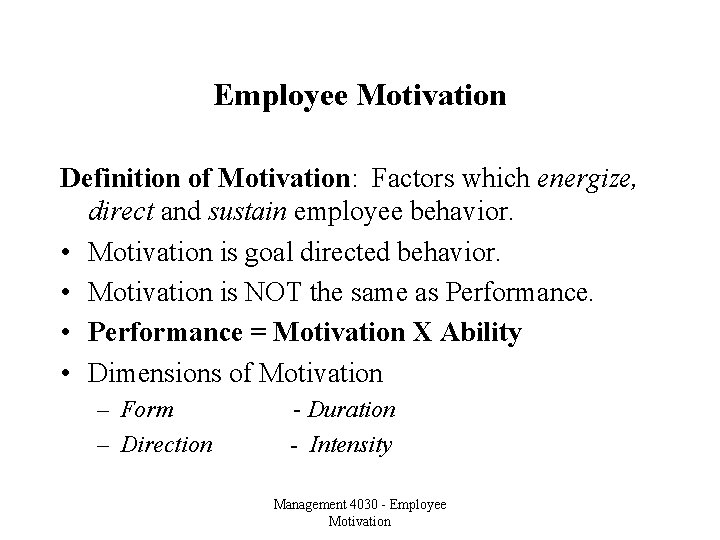
Employee Motivation Definition of Motivation: Factors which energize, direct and sustain employee behavior. • Motivation is goal directed behavior. • Motivation is NOT the same as Performance. • Performance = Motivation X Ability • Dimensions of Motivation – Form – Direction - Duration - Intensity Management 4030 - Employee Motivation
Theories of Motivation • Cognitive Theories; POV = The Employee – Expectancy Theory – Equity Theory • Behavior Theory; POV = The Manager – Reinforcement theory • Financial Theory; POV = The Business Owner – Agency Theory Management 4030 - Employee Motivation
Expectancy Theory (Vroom, 1964) • People’s Behavior results from conscious choices among alternatives. • Valence - A person’s preference among various outcomes or rewards. Ex. Do I prefer to achieve a higher performance goal or more leisure time? • Instrumentality - A person’s belief that a certain level of performance will lead to certain desirable consequences. Ex. If I study 2 hours every day for my finance class, will I earn an A grade? Management 4030 - Employee Motivation
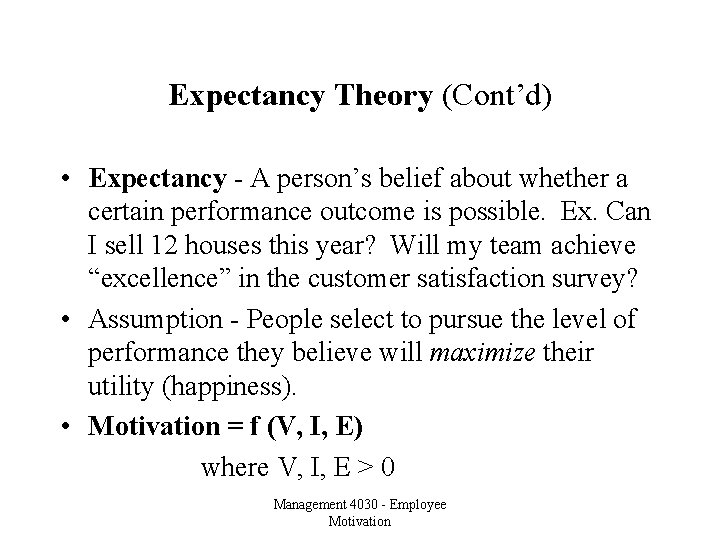
Expectancy Theory (Cont’d) • Expectancy - A person’s belief about whether a certain performance outcome is possible. Ex. Can I sell 12 houses this year? Will my team achieve “excellence” in the customer satisfaction survey? • Assumption - People select to pursue the level of performance they believe will maximize their utility (happiness). • Motivation = f (V, I, E) where V, I, E > 0 Management 4030 - Employee Motivation
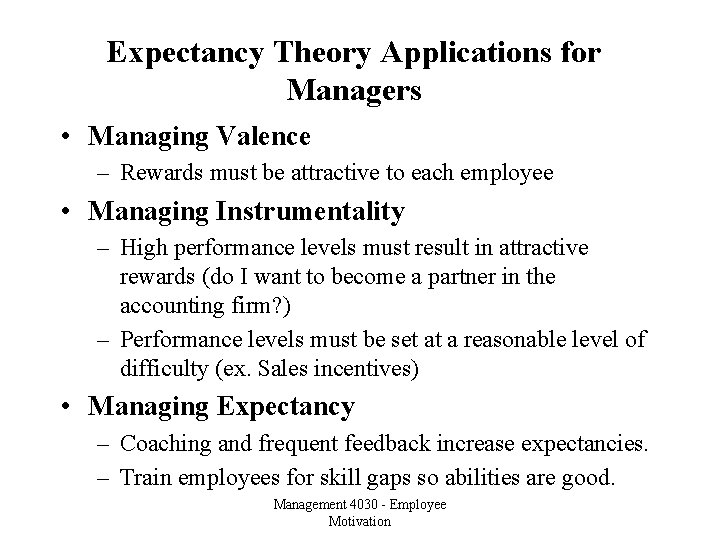
Expectancy Theory Applications for Managers • Managing Valence – Rewards must be attractive to each employee • Managing Instrumentality – High performance levels must result in attractive rewards (do I want to become a partner in the accounting firm? ) – Performance levels must be set at a reasonable level of difficulty (ex. Sales incentives) • Managing Expectancy – Coaching and frequent feedback increase expectancies. – Train employees for skill gaps so abilities are good. Management 4030 - Employee Motivation