
Employee Expectations Career Pathway Experience Payments You can


- Slides: 22
Employee Expectations Career Pathway Experience
Payments • You can expect your employer to pay you for the work you do! – Employer should deduct income taxes – Should set aside money for social security and worker’s compensation
Payments • Wages: Pay received for hourly work – You should receive overtime pay if you work over 40 hours a week. • Do you remember how to calculate overtime?
Payments • Salary: is a fixed amount of pay for a certain period of time, usually a year or a month. – Receive the same amount each pay period whether they work more hours or not. – Most managers, supervisors, and company executives receive a yearly salary. – THEY DO NOT RECEIVE OVERTIME!!
Payments • Commissions: a payment that is a percentage of the total amount sold by a salesperson. – If you sell $1, 000 worth of vacuum cleaners and you receive a 50% commission, how much pay would you receive?
Payments – Most employers will pay you a wage or salary until you learn the product. • After you learn, your pay is based on commissions and less on the wage or salary.
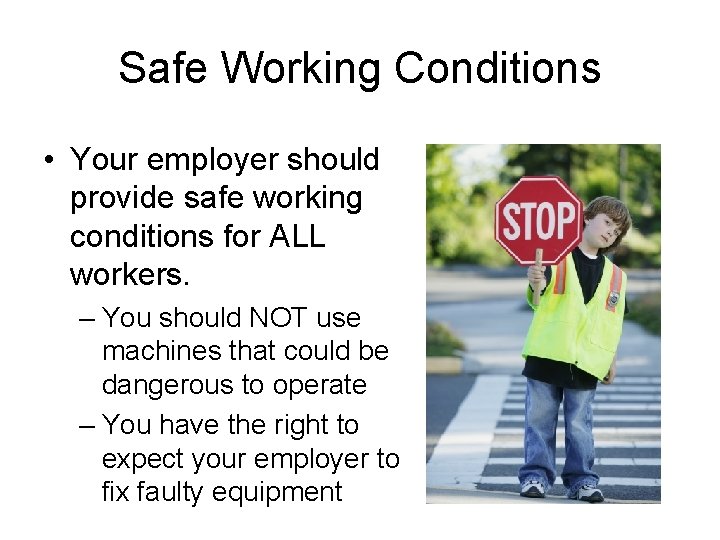
Safe Working Conditions • Your employer should provide safe working conditions for ALL workers. – You should NOT use machines that could be dangerous to operate – You have the right to expect your employer to fix faulty equipment
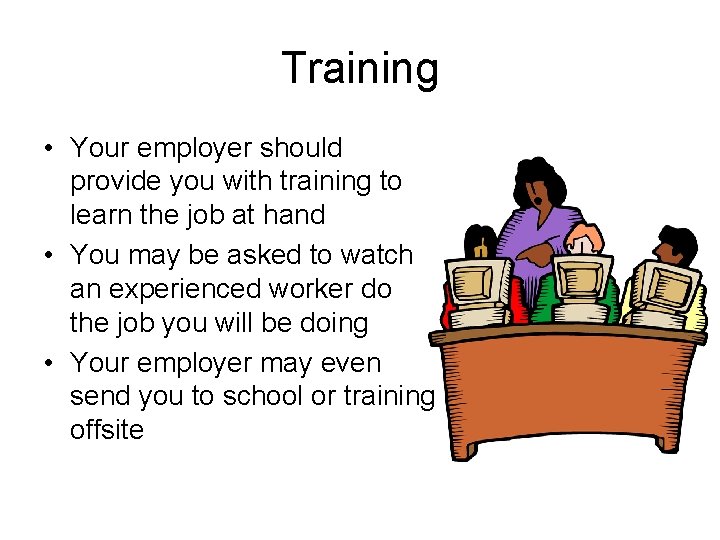
Training • Your employer should provide you with training to learn the job at hand • You may be asked to watch an experienced worker do the job you will be doing • Your employer may even send you to school or training offsite
Introductions • Your employer should introduce you to all of your co-workers!! – This common courtesy is one you can expect but is not always observed. – If not, then you will have to be brave and introduce yourself.
Explanations • Your employer should explain company policies, rules, and regulations – Ask questions for further explanations!! – Your employer should explain any changes that affect you and your work. – What could change? • Duties, working relationships, salary, and vacation schedules. • YOU HAVE A RIGHT TO KNOW WHY THINGS CHANGE!!!
Evaluations • Your employer should evaluate you and your work! – They will monitor how you get along with coworkers. – A work evaluations will be prepared, such as a written report on your job performance. • These evaluations may determine if you whether or not you are promoted, given a raise, kept in the same position or fired.
Discussing the Evaluation • Your employer may or may not discuss the evaluation. – It should be discussed in PRIVATE – The employer should discuss strengths and weaknesses – Employer’s purpose is to make you a better worker!!! – If you follow your employers suggestions, you have a better chance of receiving high pay in the future.
Honesty • Just as your employer expects YOU to be honest, you can expect YOUR employer to be honest. – They should pay you when they say they are going to pay you – They should not deny you any benefits or privileges to which you are entitled
Fairness • Freedom from Discrimination: In the workplace, discrimination means treating someone unfairly because of prejudice. – Ex: Racial, sexual, religious, or age-related discrimination are most common. • Disabled individuals fall into this category too! • Laws to protect against this discrimination include the Equal Employment Opportunity Act.
Fairness • Equal Employment Opportunity Act: – Part of the 1964 Civil Rights Act – Forbids discrimination by employers against on the basis of race, color, religion, sex, or national origin. • Age Discrimination Act of 1967: – Makes it illegal to discriminate against people over 40 in hiring or on the job
Fairness • Rehabilitation Act of 1973: – This protects people with physical or mental disabilities from discrimination as well. – Purpose of these laws is to be certain that people are judged on the basis of their ability to do the job. – Fair Labor Standards Act: sets the standards for fair treatment in three main areas – child labor, wages and hours, and equal pay.
Fringe Benefits • These are given to full time employers who have been with the company for six months or more. – Health insurance – cost is usually shared by the employer and employee – Retirement plans – Bonuses – Other insurance such as long term and short term disability – Child Care – with more than half of working women being mothers, larger companies are assisting with day care or providing day care facilities for working moms!
Standard Separation Procedures • It is bound to happen, people lose their jobs. – Termination notice: this means you have been fired! • This is a statement from your employer that says you have been terminated from your job with the company. – Don’t put all the blame on the company. – Think about what happened and how you could have prevented it!!
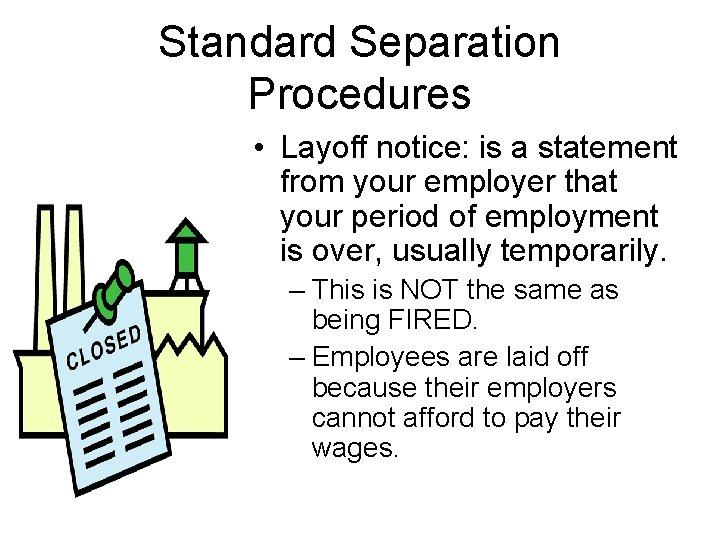
Standard Separation Procedures • Layoff notice: is a statement from your employer that your period of employment is over, usually temporarily. – This is NOT the same as being FIRED. – Employees are laid off because their employers cannot afford to pay their wages.
Standard Separation Procedures • It is customary for employers to notify you if you are to be laid off. – Some employers may give you a severance pay: • You receive a check from your job if you laid off.
Standard Separation Procedures • Unemployment Compensation: is money given to people who have recently become unemployed. – Provided for a limited time to those who are able to work and who are actively seeking jobs. – To qualify: certain amount of money earned prior to losing job. – Part time students do not usually qualify because their yearly earnings do not meet the minimum requirements.