
Employee Engagement Myths Realities Next Steps for Your

- Slides: 41
Employee Engagement: Myths, Realities, & Next Steps for Your Organization The Canadian Masters in HR Strategy and Execution February 23, 2012 NOON – 1: 00 p. m. ET Paul Fairlie, Ph. D. , Paul Fairlie Consulting
Introduction • Paul Fairlie, Ph. D. , Paul Fairlie Consulting • 20 yrs. in organizational, market, and opinion research. • People Tech Consulting, Right Management Consultants, Environics, Shepell-fgi. • Individual/organizational assessment tools, organizational behaviour, research and data analysis. • Journal and conference papers on meaningful work and employee engagement.
Purpose • Engagement: What it isn’t. • What drives it? – What to instill and track. • What are its benefits? • An evidence-based approach. – No hearsay, opinions, marketing, nor folk wisdom. • Take-aways and recommendations! Take-Away!
This May Come As a Surprise… • Engagement was a variable before it was a movement. • There is relatively little confusion about engagement in research circles. • The most powerful (and ignored) drivers have only recently been identified. • Other things may be more important than engagement. • “Engagement is whatever you want it to mean”. “Engagement is different in every organization”. “In my opinion, engagement is…” These beliefs could be costly.
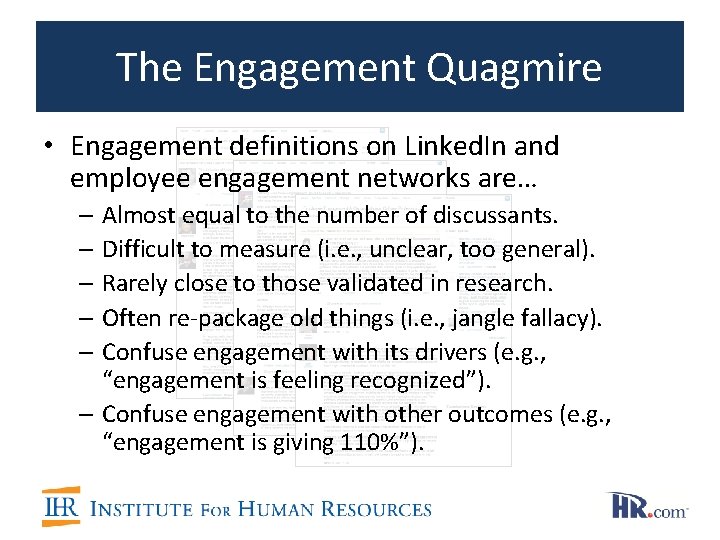
The Engagement Quagmire • Engagement definitions on Linked. In and employee engagement networks are… – Almost equal to the number of discussants. – Difficult to measure (i. e. , unclear, too general). – Rarely close to those validated in research. – Often re-package old things (i. e. , jangle fallacy). – Confuse engagement with its drivers (e. g. , “engagement is feeling recognized”). – Confuse engagement with other outcomes (e. g. , “engagement is giving 110%”).
The Engagement Quagmire • Why is this a problem? – No starting point for action. – Over-emphasis on single drivers (e. g. , recognition). – Focus on drivers with little evidence. – Confuse drivers with outcomes? Wrong starting points. – Engagement becomes anything and everything to do with managing people. ‘Real’ engagement is left behind. – Loss of time and money, missed opportunities for excellence.
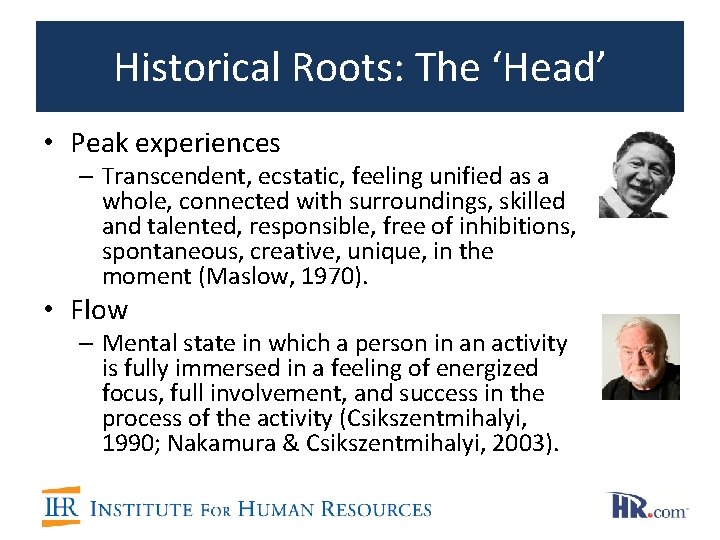
Historical Roots: The ‘Head’ • Peak experiences – Transcendent, ecstatic, feeling unified as a whole, connected with surroundings, skilled and talented, responsible, free of inhibitions, spontaneous, creative, unique, in the moment (Maslow, 1970). • Flow – Mental state in which a person in an activity is fully immersed in a feeling of energized focus, full involvement, and success in the process of the activity (Csikszentmihalyi, 1990; Nakamura & Csikszentmihalyi, 2003).
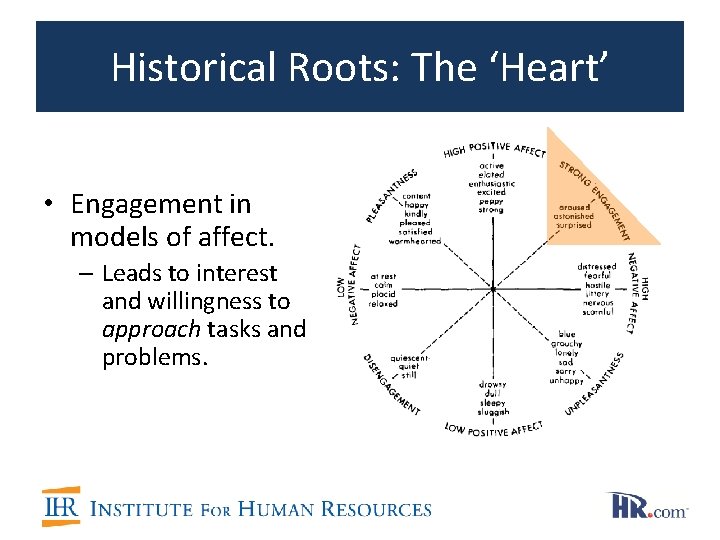
Historical Roots: The ‘Heart’ • Engagement in models of affect. – Leads to interest and willingness to approach tasks and problems.
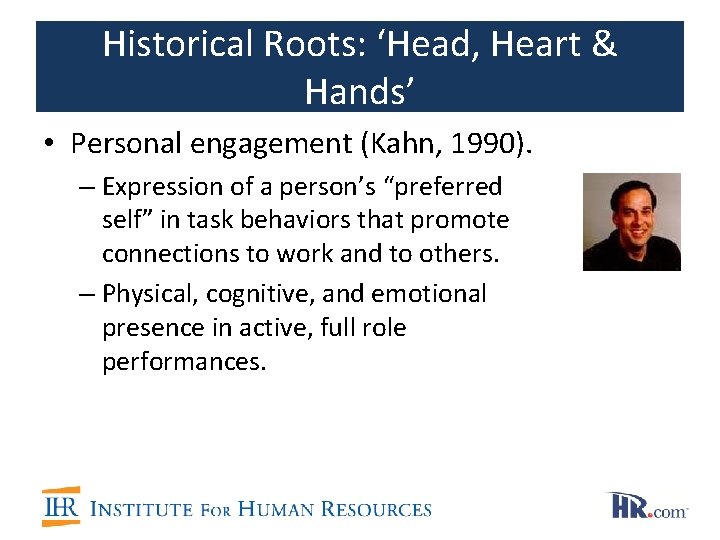
Historical Roots: ‘Head, Heart & Hands’ • Personal engagement (Kahn, 1990). – Expression of a person’s “preferred self” in task behaviors that promote connections to work and to others. – Physical, cognitive, and emotional presence in active, full role performances.
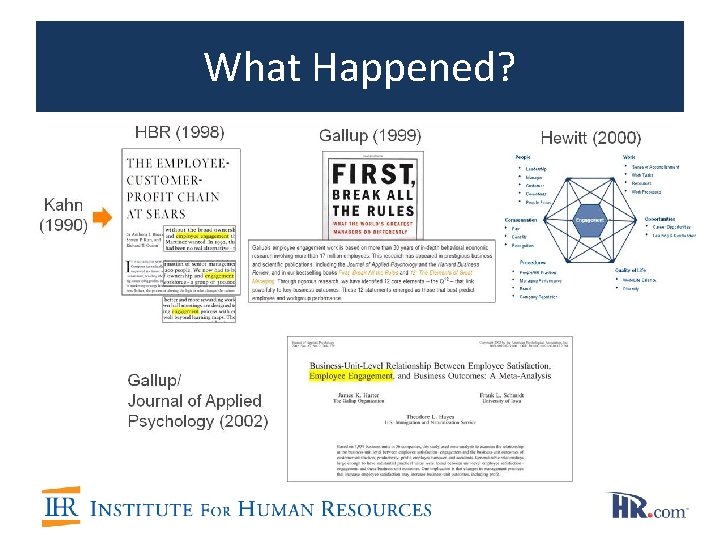
What Happened?
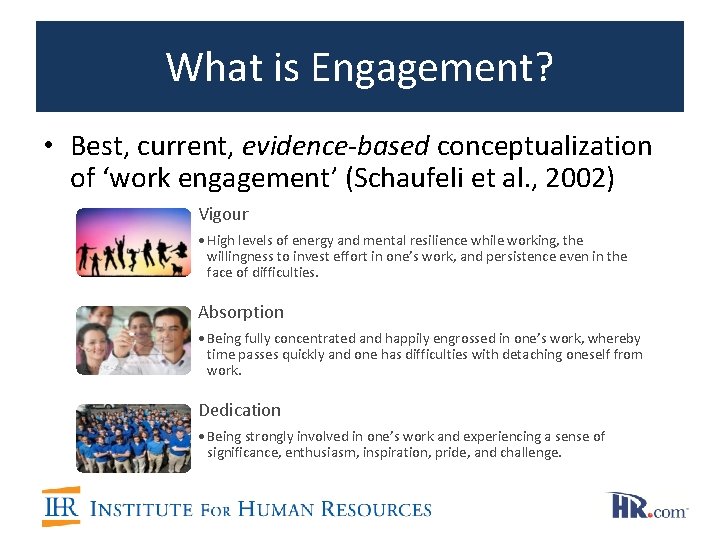
What is Engagement? • Best, current, evidence-based conceptualization of ‘work engagement’ (Schaufeli et al. , 2002) Vigour • High levels of energy and mental resilience while working, the willingness to invest effort in one’s work, and persistence even in the face of difficulties. Absorption • Being fully concentrated and happily engrossed in one’s work, whereby time passes quickly and one has difficulties with detaching oneself from work. Dedication • Being strongly involved in one’s work and experiencing a sense of significance, enthusiasm, inspiration, pride, and challenge.
What is Engagement? • Similar conceptions from research. – Time spent thinking and concentrating on a role (attention) and losing track of time and becoming engrossed in role performance (absorption) (Rothvard, 2001). – Harnessing of members’ selves to their work roles; Employ and express themselves physically, cognitively, and emotionally during role performances (May et al. , 2004). – Simultaneous investment of cognitive, affective, and physical energies into one’s role performance (Rich et al. , 2010). – Extent to which an individual is psychologically present in a particular organizational role (Saks, 2006). – The opposite of burnout: high energy, strong involvement, sense of efficacy at work (Maslach et al. , 2001).
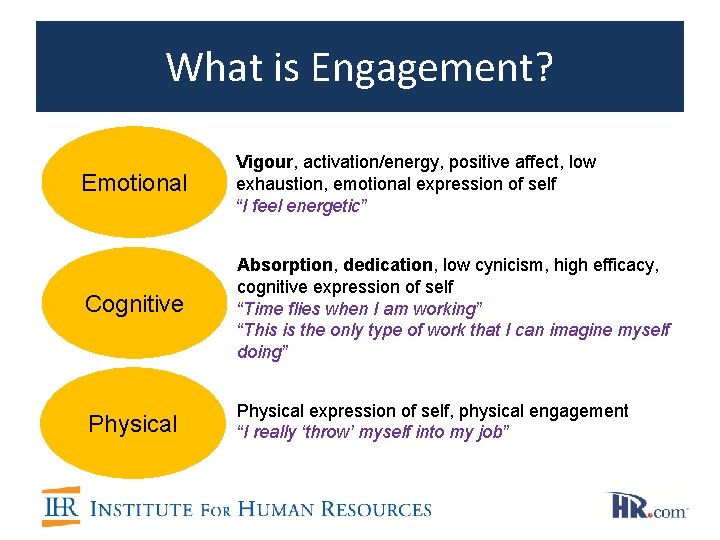
What is Engagement? Emotional Vigour, activation/energy, positive affect, low exhaustion, emotional expression of self “I feel energetic” Cognitive Absorption, dedication, low cynicism, high efficacy, cognitive expression of self “Time flies when I am working” “This is the only type of work that I can imagine myself doing” Physical expression of self, physical engagement “I really ‘throw’ myself into my job”
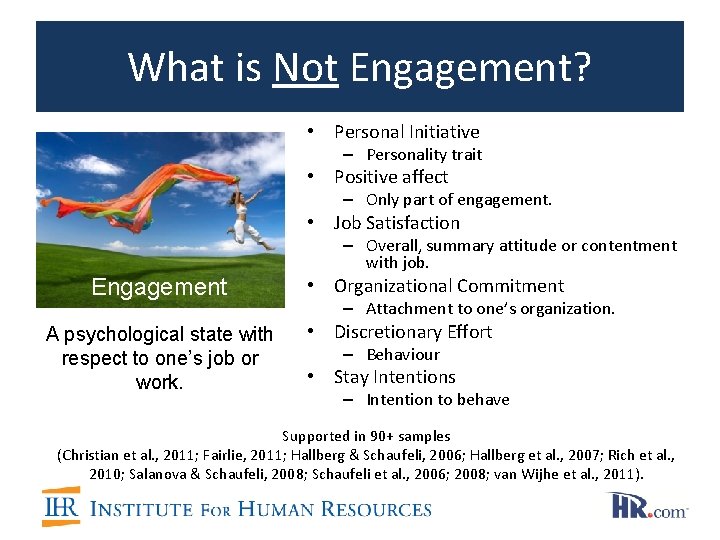
What is Not Engagement? • Personal Initiative – Personality trait • Positive affect – Only part of engagement. • Job Satisfaction Engagement A psychological state with respect to one’s job or work. – Overall, summary attitude or contentment with job. • Organizational Commitment – Attachment to one’s organization. • Discretionary Effort – Behaviour • Stay Intentions – Intention to behave Supported in 90+ samples (Christian et al. , 2011; Fairlie, 2011; Hallberg & Schaufeli, 2006; Hallberg et al. , 2007; Rich et al. , 2010; Salanova & Schaufeli, 2008; Schaufeli et al. , 2006; 2008; van Wijhe et al. , 2011).
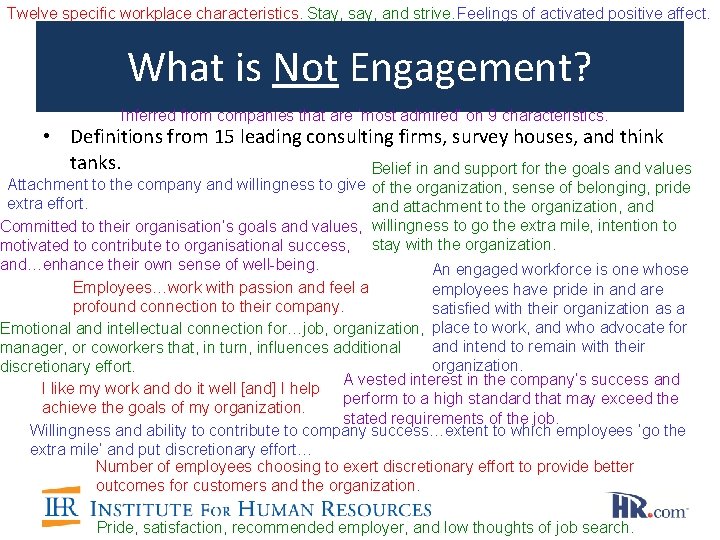
Twelve specific workplace characteristics. Stay, say, and strive. Feelings of activated positive affect. What is Not Engagement? Inferred from companies that are ‘most admired’ on 9 characteristics. • Definitions from 15 leading consulting firms, survey houses, and think tanks. Belief in and support for the goals and values Attachment to the company and willingness to give of the organization, sense of belonging, pride extra effort. and attachment to the organization, and Committed to their organisation’s goals and values, willingness to go the extra mile, intention to motivated to contribute to organisational success, stay with the organization. and…enhance their own sense of well-being. An engaged workforce is one whose Employees…work with passion and feel a employees have pride in and are profound connection to their company. satisfied with their organization as a Emotional and intellectual connection for…job, organization, place to work, and who advocate for and intend to remain with their manager, or coworkers that, in turn, influences additional organization. discretionary effort. A vested interest in the company’s success and I like my work and do it well [and] I help perform to a high standard that may exceed the achieve the goals of my organization. stated requirements of the job. Willingness and ability to contribute to company success…extent to which employees ‘go the extra mile’ and put discretionary effort… Number of employees choosing to exert discretionary effort to provide better outcomes for customers and the organization. Pride, satisfaction, recommended employer, and low thoughts of job search.
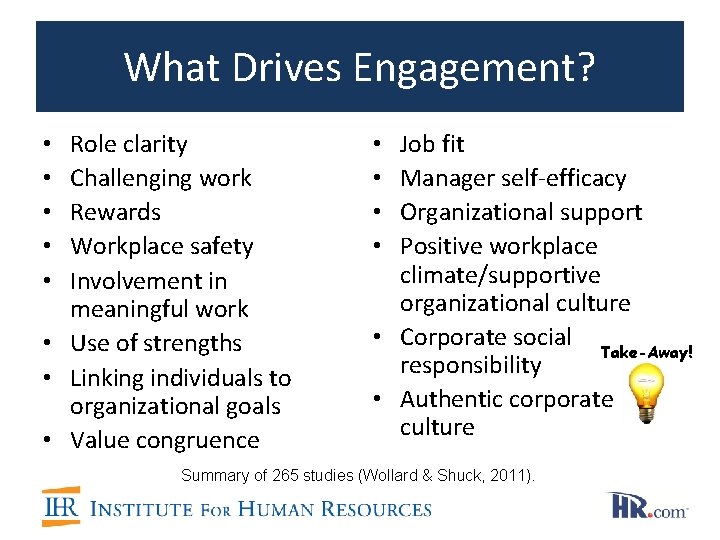
What Drives Engagement? Role clarity Challenging work Rewards Workplace safety Involvement in meaningful work • Use of strengths • Linking individuals to organizational goals • Value congruence • • • Job fit Manager self-efficacy Organizational support Positive workplace climate/supportive organizational culture • Corporate social Take-Away! responsibility • Authentic corporate culture • • Summary of 265 studies (Wollard & Shuck, 2011).
What Drives Engagement? • Job autonomy, task identity, skill variety, task significance, performance feedback. • Training and development. • Social support/positive work relationships/team climate/colleague support. Take-Away! • Supervisory coaching. • ‘Recovery’ from work. 50+ additional studies (Bakker & Bal, 2010; Christian et al. , 2011; Crawford et al. , 2010; Mauno et al. , 2007; Nahrgang et al. , 2011; Rich et al, 2010; Saks, 2006; Salanova et al. , 2005; Schaufeli et al. , 2009; Sonnentag, 2003; Weigl et al. , 2010; Xanthopoulou et al. , 2008; Xanthopoulou et al. , 2009 b).
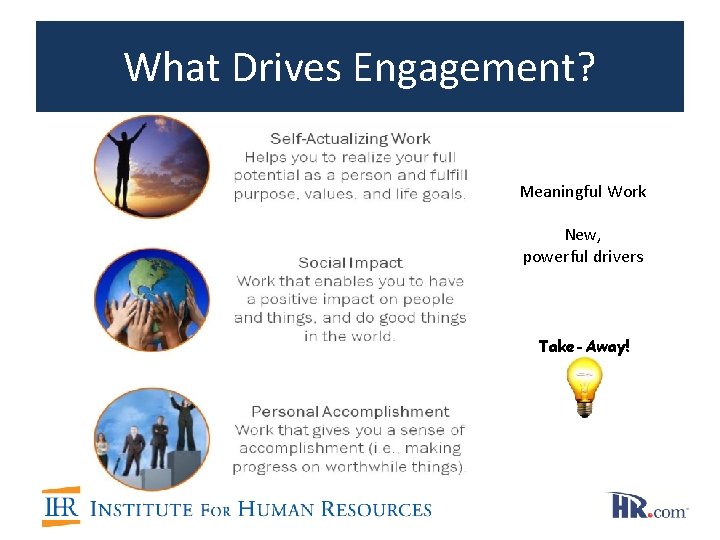
What Drives Engagement? Meaningful Work New, powerful drivers Take-Away!
What Drives Engagement?
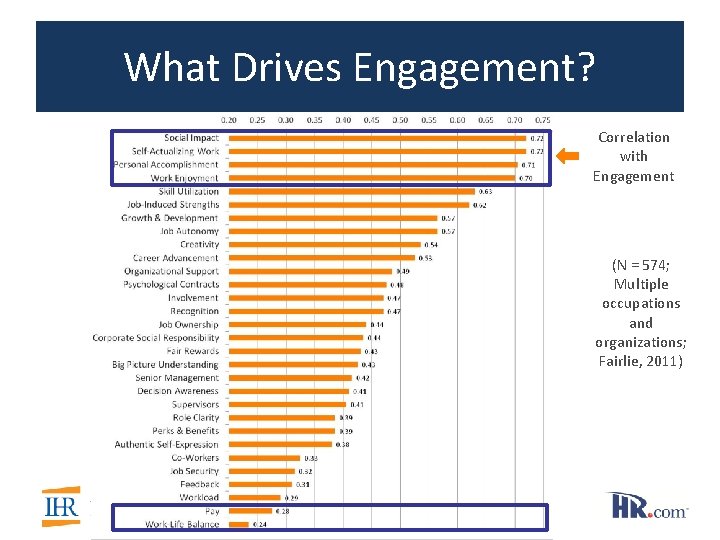
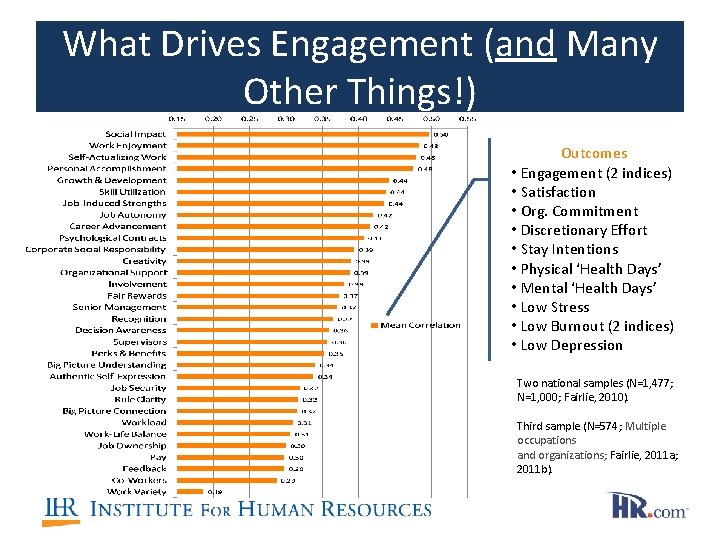
What Drives Engagement? Correlation with Engagement (N = 574; Multiple occupations and organizations; Fairlie, 2011)
What Drives Engagement?
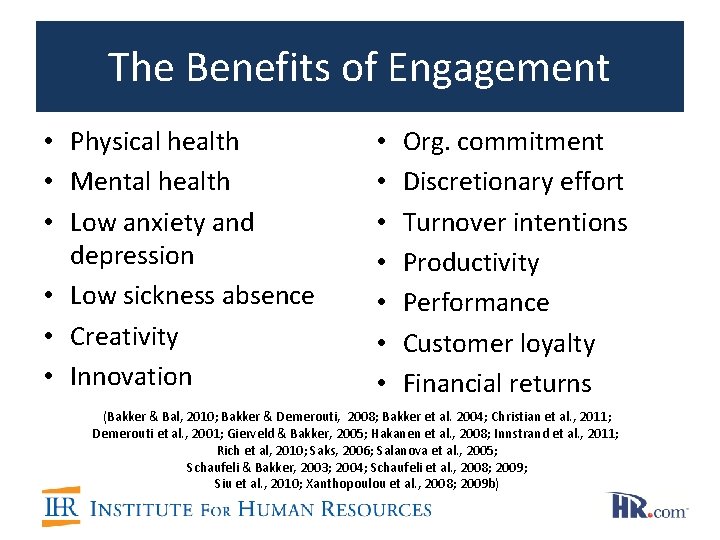
The Benefits of Engagement • Physical health • Mental health • Low anxiety and depression • Low sickness absence • Creativity • Innovation • • Org. commitment Discretionary effort Turnover intentions Productivity Performance Customer loyalty Financial returns (Bakker & Bal, 2010; Bakker & Demerouti, 2008; Bakker et al. 2004; Christian et al. , 2011; Demerouti et al. , 2001; Gierveld & Bakker, 2005; Hakanen et al. , 2008; Innstrand et al. , 2011; Rich et al, 2010; Saks, 2006; Salanova et al. , 2005; Schaufeli & Bakker, 2003; 2004; Schaufeli et al. , 2008; 2009; Siu et al. , 2010; Xanthopoulou et al. , 2008; 2009 b)
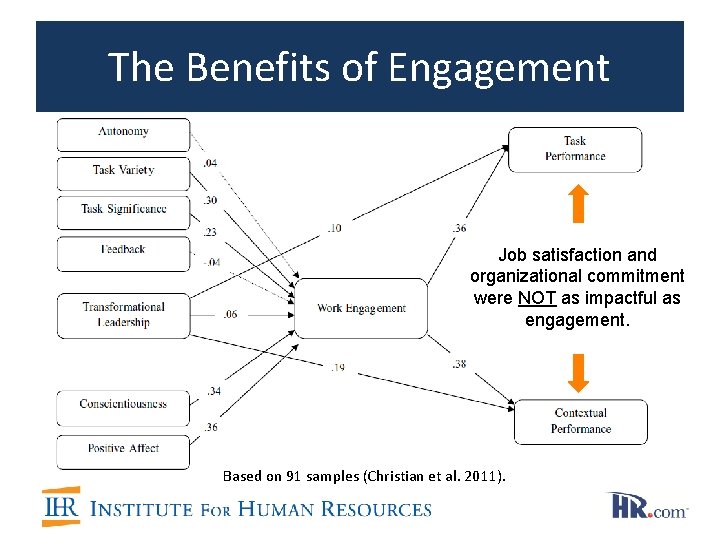
The Benefits of Engagement Job satisfaction and organizational commitment were NOT as impactful as engagement. Based on 91 samples (Christian et al. 2011).
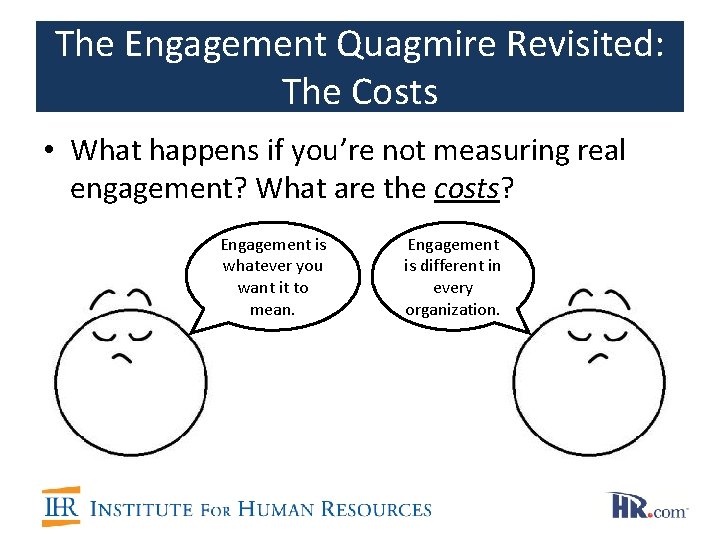
The Engagement Quagmire Revisited: The Costs • What happens if you’re not measuring real engagement? What are the costs? Engagement is whatever you want it to mean. Engagement is different in every organization.
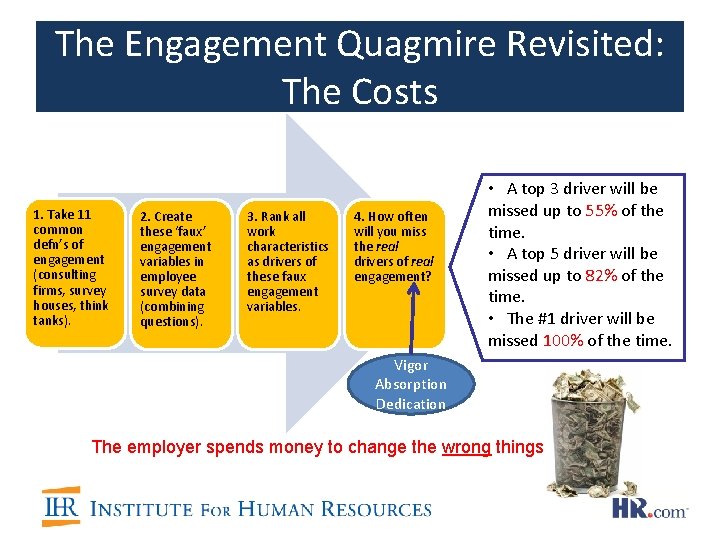
The Engagement Quagmire Revisited: The Costs 1. Take 11 common defn’s of engagement (consulting firms, survey houses, think tanks). 2. Create these ‘faux’ engagement variables in employee survey data (combining questions). 3. Rank all work characteristics as drivers of these faux engagement variables. 4. How often will you miss the real drivers of real engagement? • A top 3 driver will be missed up to 55% of the time. • A top 5 driver will be missed up to 82% of the time. • The #1 driver will be missed 100% of the time. Vigor Absorption Dedication The employer spends money to change the wrong things.
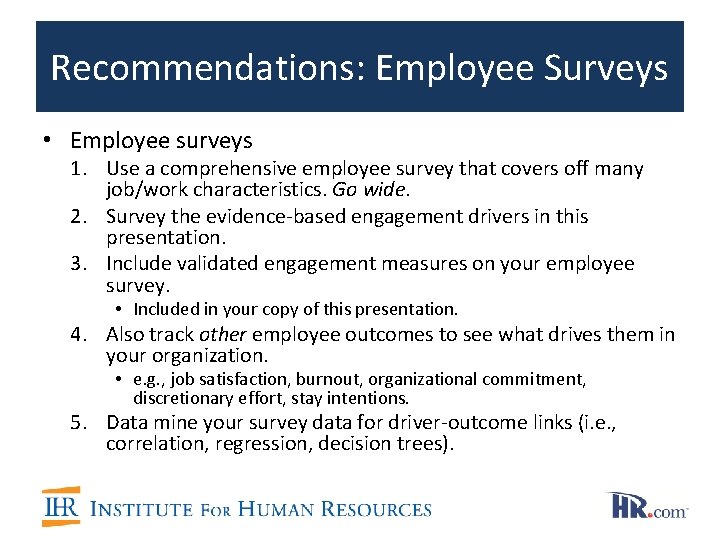
Recommendations: Employee Surveys • Employee surveys 1. Use a comprehensive employee survey that covers off many job/work characteristics. Go wide. 2. Survey the evidence-based engagement drivers in this presentation. 3. Include validated engagement measures on your employee survey. • Included in your copy of this presentation. 4. Also track other employee outcomes to see what drives them in your organization. • e. g. , job satisfaction, burnout, organizational commitment, discretionary effort, stay intentions. 5. Data mine your survey data for driver-outcome links (i. e. , correlation, regression, decision trees).
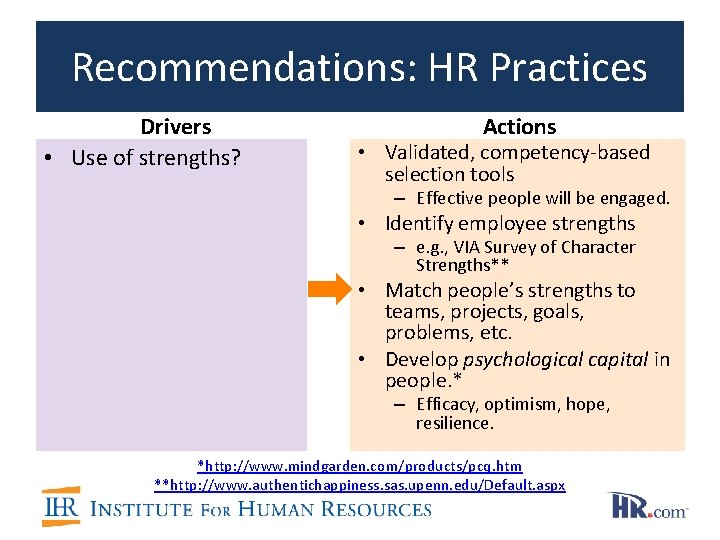
Recommendations: HR Practices Drivers • Use of strengths? Actions • Validated, competency-based selection tools – Effective people will be engaged. • Identify employee strengths – e. g. , VIA Survey of Character Strengths** • Match people’s strengths to teams, projects, goals, problems, etc. • Develop psychological capital in people. * – Efficacy, optimism, hope, resilience. *http: //www. mindgarden. com/products/pcq. htm **http: //www. authentichappiness. sas. upenn. edu/Default. aspx
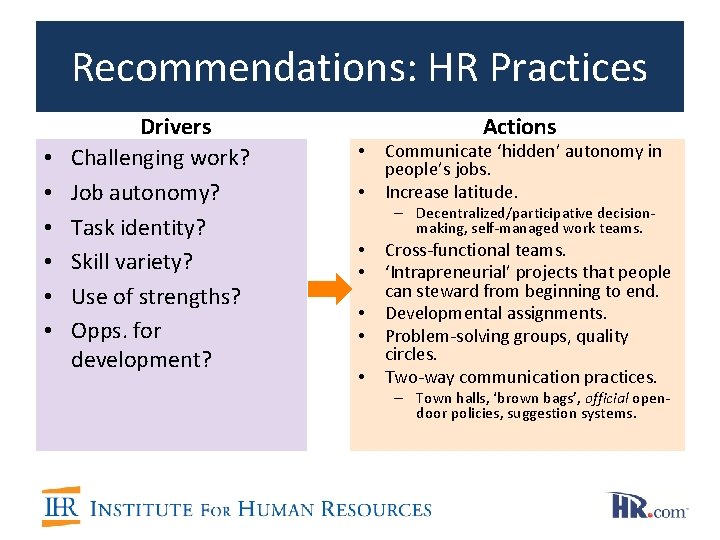
Recommendations: HR Practices • • • Drivers Challenging work? Job autonomy? Task identity? Skill variety? Use of strengths? Opps. for development? • • Actions Communicate ‘hidden’ autonomy in people’s jobs. Increase latitude. – Decentralized/participative decisionmaking, self-managed work teams. • • • Cross-functional teams. ‘Intrapreneurial’ projects that people can steward from beginning to end. Developmental assignments. Problem-solving groups, quality circles. Two-way communication practices. – Town halls, ‘brown bags’, official opendoor policies, suggestion systems.
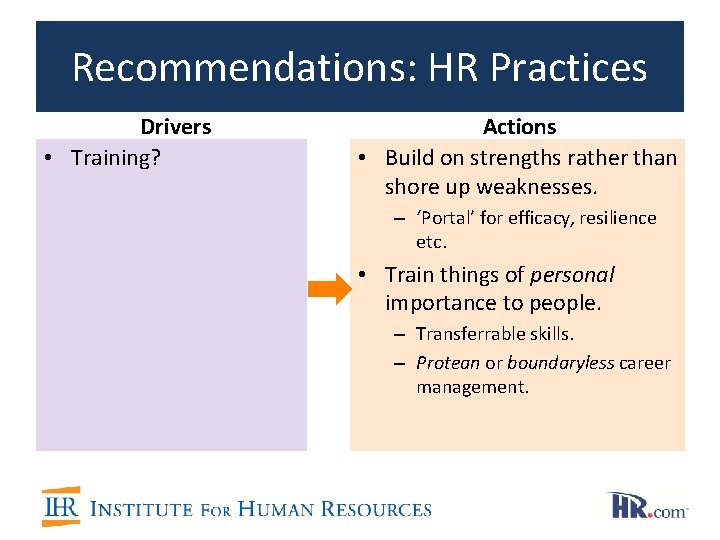
Recommendations: HR Practices Drivers • Training? Actions • Build on strengths rather than shore up weaknesses. – ‘Portal’ for efficacy, resilience etc. • Train things of personal importance to people. – Transferrable skills. – Protean or boundaryless career management.
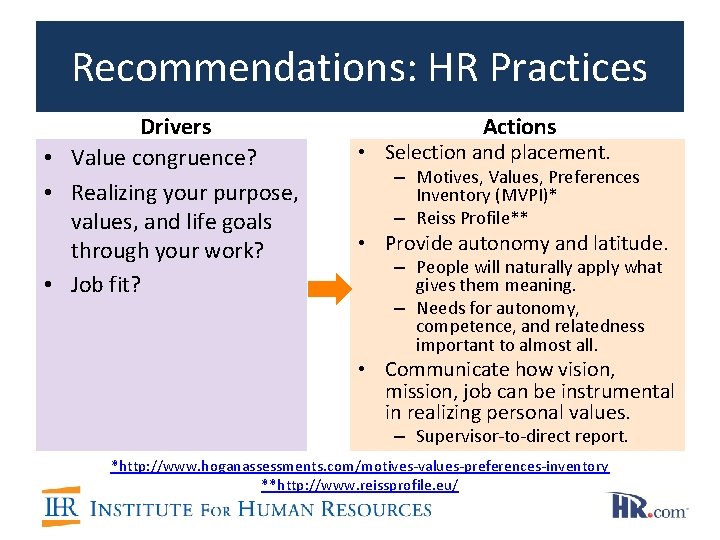
Recommendations: HR Practices Drivers • Value congruence? • Realizing your purpose, values, and life goals through your work? • Job fit? Actions • Selection and placement. – Motives, Values, Preferences Inventory (MVPI)* – Reiss Profile** • Provide autonomy and latitude. – People will naturally apply what gives them meaning. – Needs for autonomy, competence, and relatedness important to almost all. • Communicate how vision, mission, job can be instrumental in realizing personal values. – Supervisor-to-direct report. *http: //www. hoganassessments. com/motives-values-preferences-inventory **http: //www. reissprofile. eu/
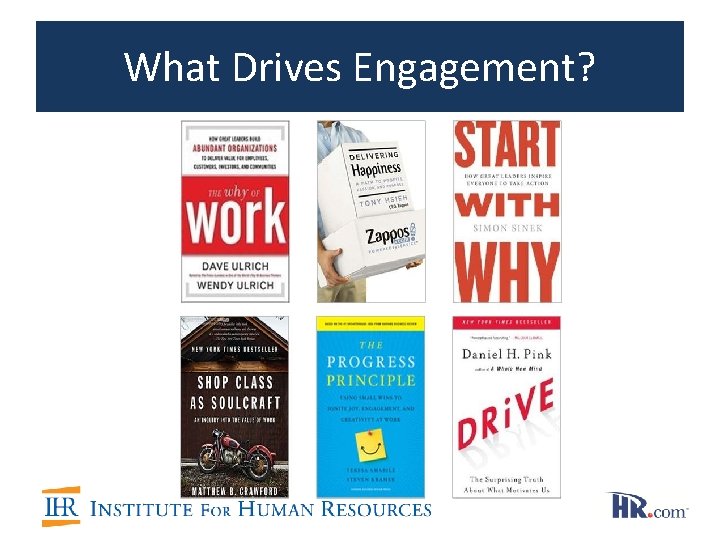
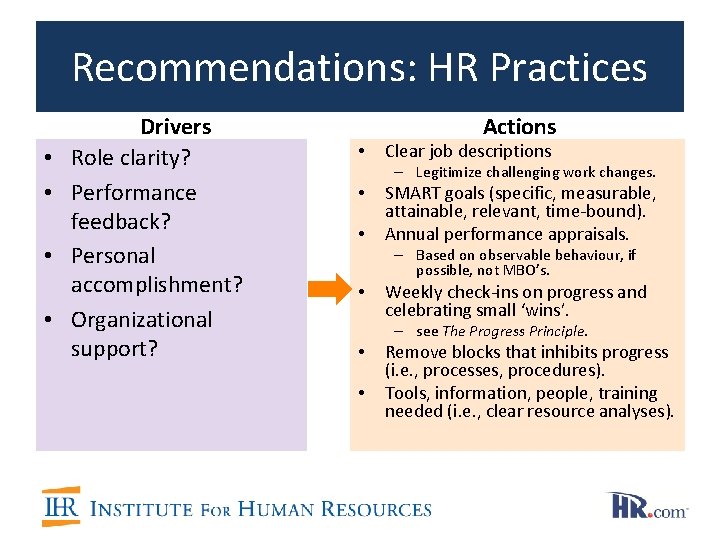
Recommendations: HR Practices • • Drivers Role clarity? Performance feedback? Personal accomplishment? Organizational support? • Actions Clear job descriptions – Legitimize challenging work changes. • • SMART goals (specific, measurable, attainable, relevant, time-bound). Annual performance appraisals. – Based on observable behaviour, if possible, not MBO’s. • Weekly check-ins on progress and celebrating small ‘wins’. – see The Progress Principle. • • Remove blocks that inhibits progress (i. e. , processes, procedures). Tools, information, people, training needed (i. e. , clear resource analyses).
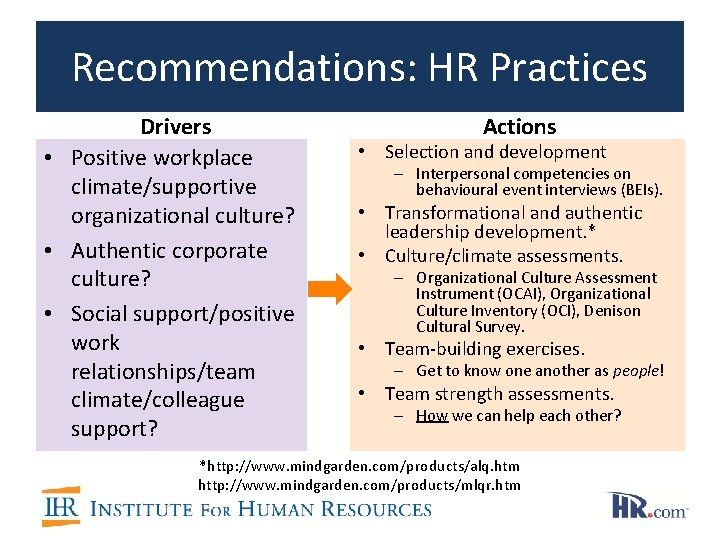
Recommendations: HR Practices Drivers • Positive workplace climate/supportive organizational culture? • Authentic corporate culture? • Social support/positive work relationships/team climate/colleague support? Actions • Selection and development – Interpersonal competencies on behavioural event interviews (BEIs). • Transformational and authentic leadership development. * • Culture/climate assessments. – Organizational Culture Assessment Instrument (OCAI), Organizational Culture Inventory (OCI), Denison Cultural Survey. • Team-building exercises. – Get to know one another as people! • Team strength assessments. – How we can help each other? *http: //www. mindgarden. com/products/alq. htm http: //www. mindgarden. com/products/mlqr. htm
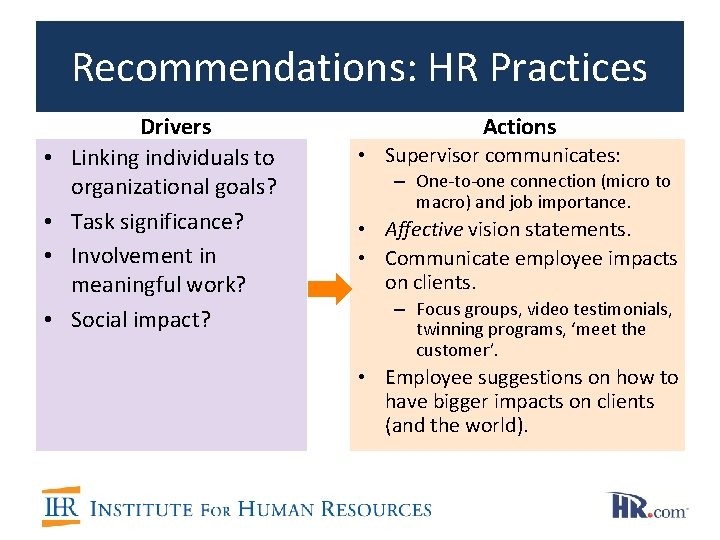
Recommendations: HR Practices • • Drivers Linking individuals to organizational goals? Task significance? Involvement in meaningful work? Social impact? Actions • Supervisor communicates: – One-to-one connection (micro to macro) and job importance. • Affective vision statements. • Communicate employee impacts on clients. – Focus groups, video testimonials, twinning programs, ‘meet the customer’. • Employee suggestions on how to have bigger impacts on clients (and the world).
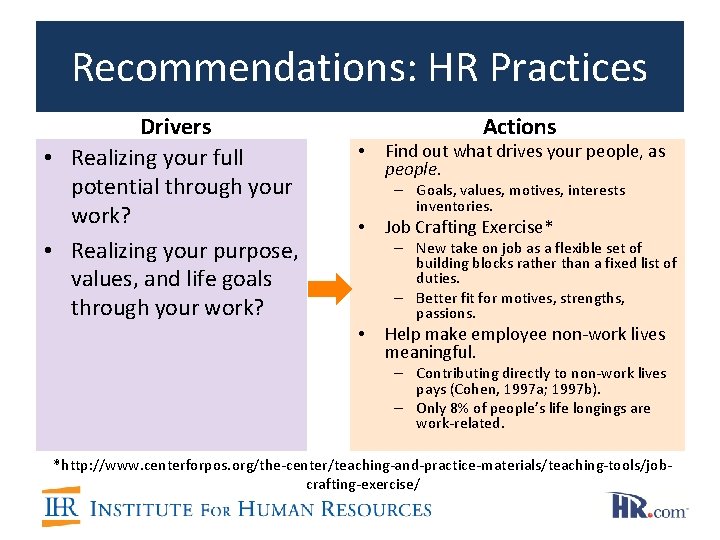
Recommendations: HR Practices Drivers • Realizing your full potential through your work? • Realizing your purpose, values, and life goals through your work? • Actions Find out what drives your people, as people. – Goals, values, motives, interests inventories. • Job Crafting Exercise* – New take on job as a flexible set of building blocks rather than a fixed list of duties. – Better fit for motives, strengths, passions. • Help make employee non-work lives meaningful. – Contributing directly to non-work lives pays (Cohen, 1997 a; 1997 b). – Only 8% of people’s life longings are work-related. *http: //www. centerforpos. org/the-center/teaching-and-practice-materials/teaching-tools/jobcrafting-exercise/
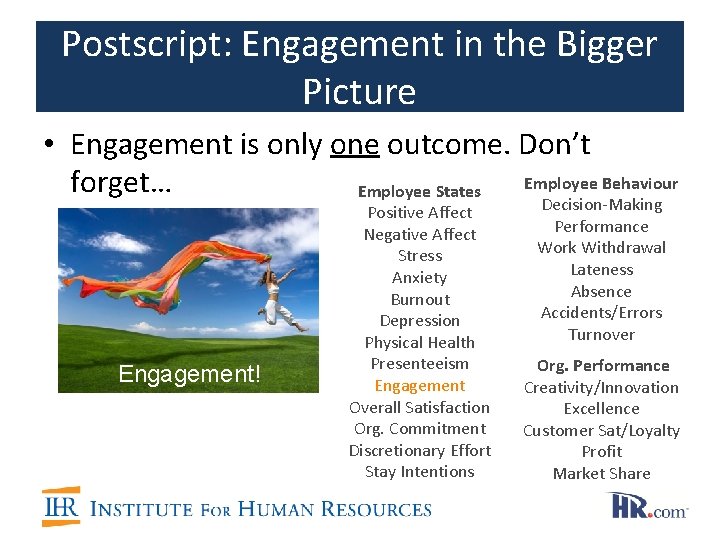
Postscript: Engagement in the Bigger Picture • Engagement is only one outcome. Don’t Employee Behaviour forget… Employee States Engagement! Positive Affect Negative Affect Stress Anxiety Burnout Depression Physical Health Presenteeism Engagement Overall Satisfaction Org. Commitment Discretionary Effort Stay Intentions Decision-Making Performance Work Withdrawal Lateness Absence Accidents/Errors Turnover Org. Performance Creativity/Innovation Excellence Customer Sat/Loyalty Profit Market Share
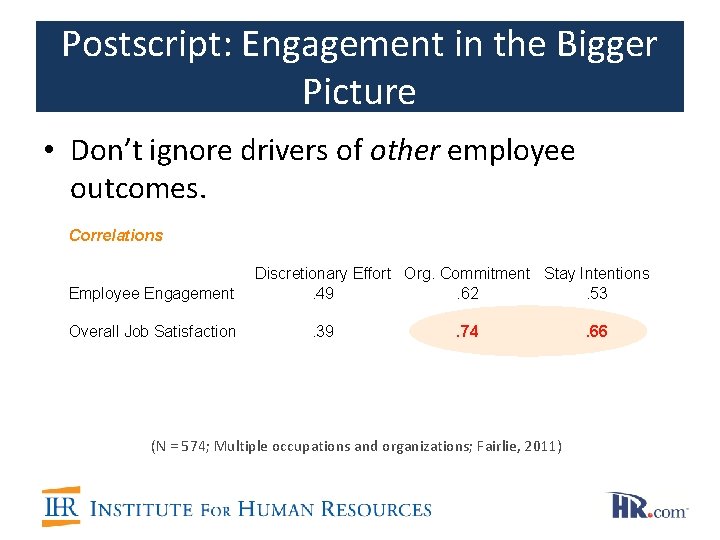
Postscript: Engagement in the Bigger Picture • Don’t ignore drivers of other employee outcomes. Correlations Employee Engagement Overall Job Satisfaction Discretionary Effort Org. Commitment Stay Intentions. 49. 62. 53. 39 . 74 (N = 574; Multiple occupations and organizations; Fairlie, 2011) . 66
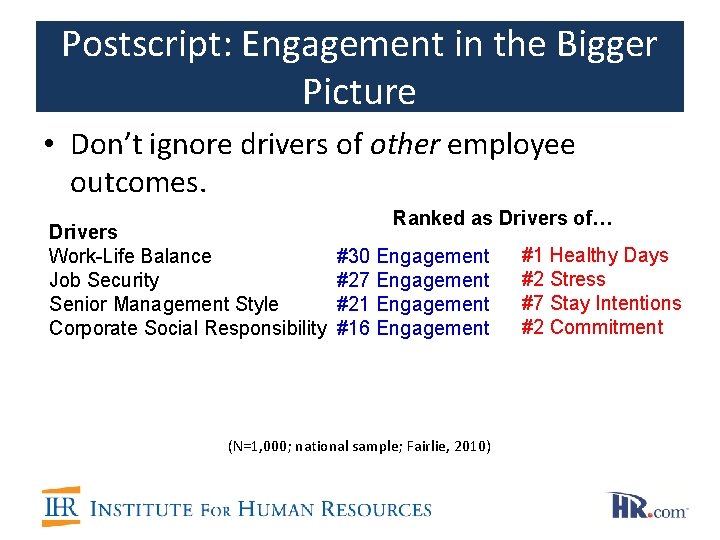
Postscript: Engagement in the Bigger Picture • Don’t ignore drivers of other employee outcomes. Drivers Work-Life Balance Job Security Senior Management Style Corporate Social Responsibility Ranked as Drivers of… #30 Engagement #27 Engagement #21 Engagement #16 Engagement (N=1, 000; national sample; Fairlie, 2010) #1 Healthy Days #2 Stress #7 Stay Intentions #2 Commitment
Polls • What are the top drivers of key employee outcomes in national studies? • One of these things is not like the other.
What Drives Engagement (and Many Other Things!) Outcomes • Engagement (2 indices) • Satisfaction • Org. Commitment • Discretionary Effort • Stay Intentions • Physical ‘Health Days’ • Mental ‘Health Days’ • Low Stress • Low Burnout (2 indices) • Low Depression Two national samples (N=1, 477; N=1, 000; Fairlie, 2010). Third sample (N=574; Multiple occupations and organizations; Fairlie, 2011 a; 2011 b).
Questions & Answers • Please send your questions. • We will try to answer all questions, time permitting.
Thank You for Joining Us! www. linkedin. com/in/paulfairlie http: //twitter. com/Paul. Fairlie Sign up to get regular facts and findings on workplace issues: http: //www. paulfairlieconsulting. com/contacts. html