
Employee Employer relationships Introduce the aims and objectives
Employee/ Employer relationships • Introduce the aims and objectives for the session. • Explain employee or employer relationships and the minimum wage. • Show a You. Tube video on minimum wage. • Explain impact of minimum wage on employees and employers. • Discuss the importance of equal opportunities. • Answer Kahoot quiz questions on employee and employer relationships. • Discuss the equal opportunities act in groups. • Recap the aims and objectives for the session.
Activity 1 Task: What are duties and rights? Time: 5 mins
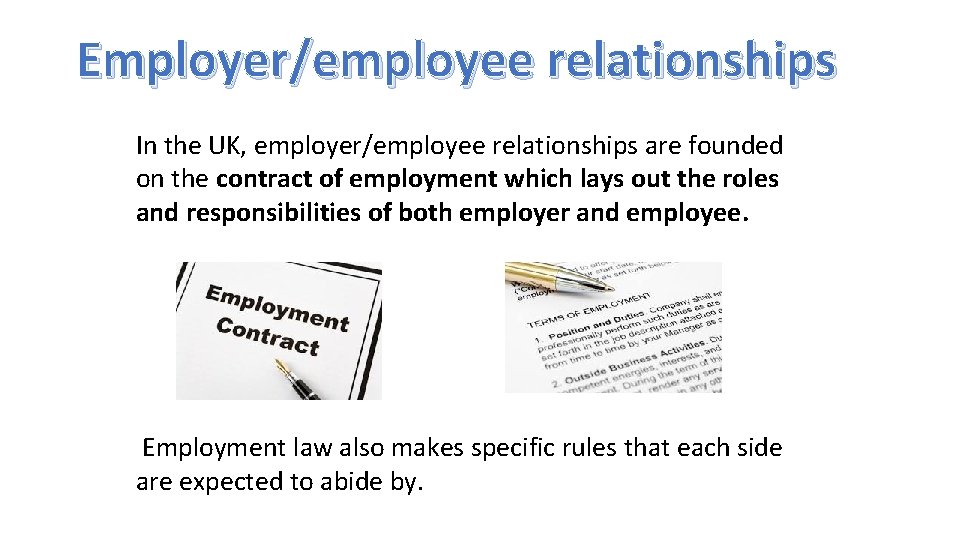
Employer/employee relationships In the UK, employer/employee relationships are founded on the contract of employment which lays out the roles and responsibilities of both employer and employee. Employment law also makes specific rules that each side are expected to abide by.
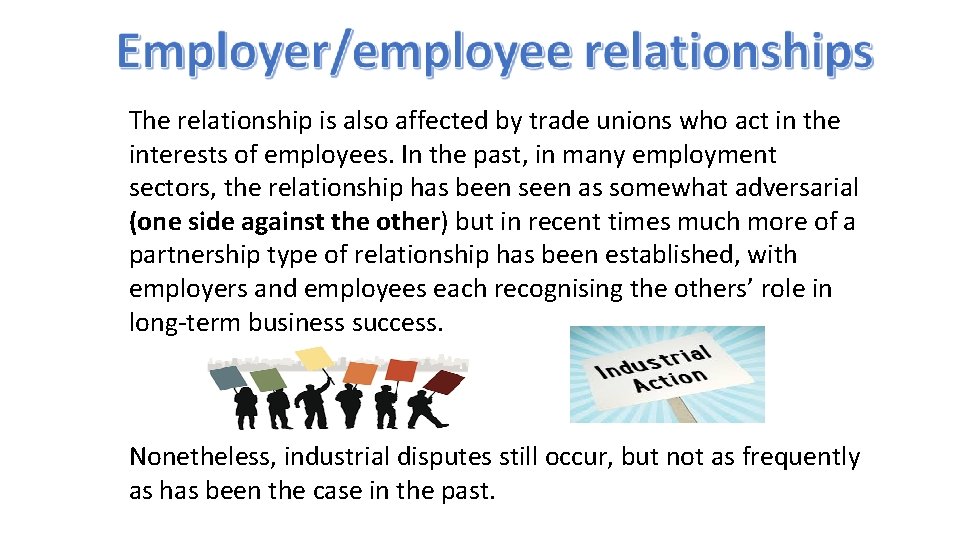
The relationship is also affected by trade unions who act in the interests of employees. In the past, in many employment sectors, the relationship has been seen as somewhat adversarial (one side against the other) but in recent times much more of a partnership type of relationship has been established, with employers and employees each recognising the others’ role in long-term business success. Nonetheless, industrial disputes still occur, but not as frequently as has been the case in the past.
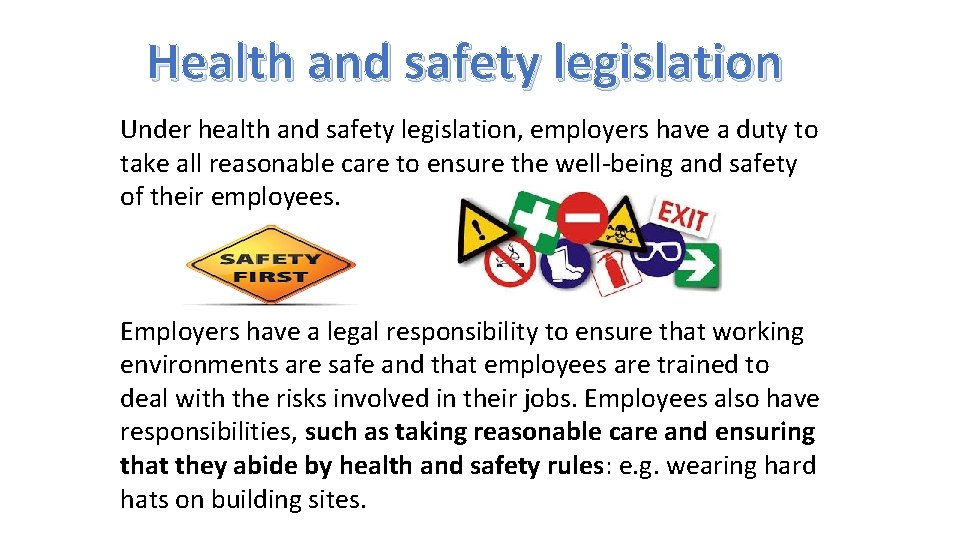
Health and safety legislation Under health and safety legislation, employers have a duty to take all reasonable care to ensure the well-being and safety of their employees. Employers have a legal responsibility to ensure that working environments are safe and that employees are trained to deal with the risks involved in their jobs. Employees also have responsibilities, such as taking reasonable care and ensuring that they abide by health and safety rules: e. g. wearing hard hats on building sites.
Workers rights Workers also have rights with regards to their terms and conditions of employment. Employees must be provided with a written contract of employment within 12 weeks of starting employment. The contract must state levels of pay, holiday entitlement, pension rights, disciplinary procedures and length of notice period.
This act also protects employees against unfair dismissal; however, this protection only comes into effect after two years of service (or even longer for some part-time workers).
European legislation also helps protect workers. The UK signing up for the Social Chapter of the Maastricht Treaty has established within UK law further rights for workers, such as a legal limit on the hours in a working week (maximum of 48 hours), and paid maternity and paternity leave. It is also illegal to discriminate on the grounds of sex, race, age or disability.
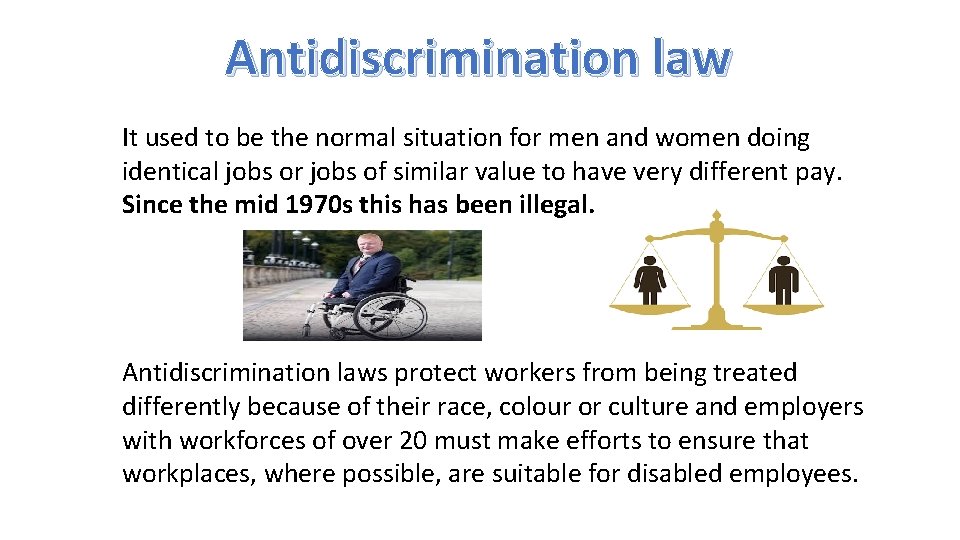
Antidiscrimination law It used to be the normal situation for men and women doing identical jobs or jobs of similar value to have very different pay. Since the mid 1970 s this has been illegal. Antidiscrimination laws protect workers from being treated differently because of their race, colour or culture and employers with workforces of over 20 must make efforts to ensure that workplaces, where possible, are suitable for disabled employees.
The minimum wage The National Minimum Wage, when first introduced in April 1999, was set cautiously low at just £ 3. 60 an hour, so as not to undermine a business’s competitiveness by pushing up costs. The change to the minimum wage was expected to benefit about two million people – more than half of them in the service sector. Some wage packets were boosted by up to a third.
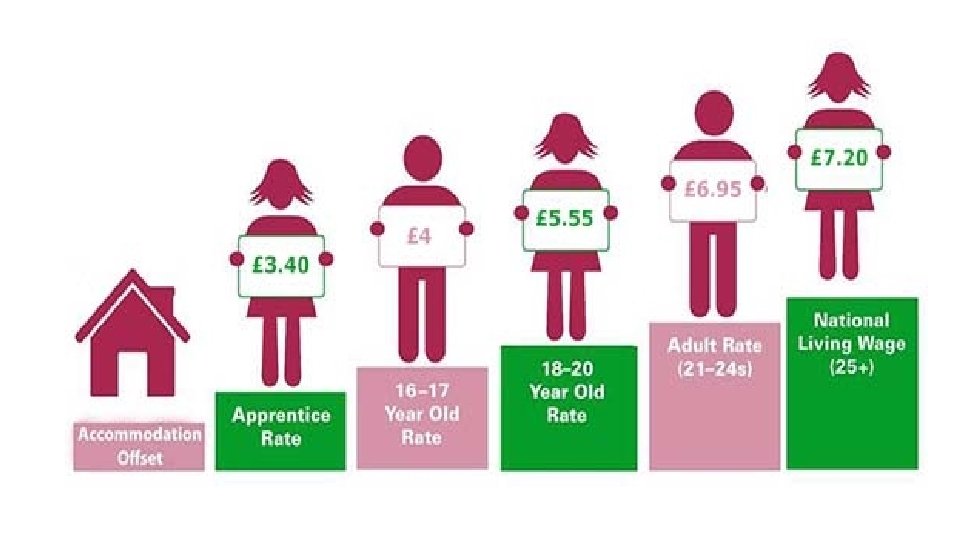
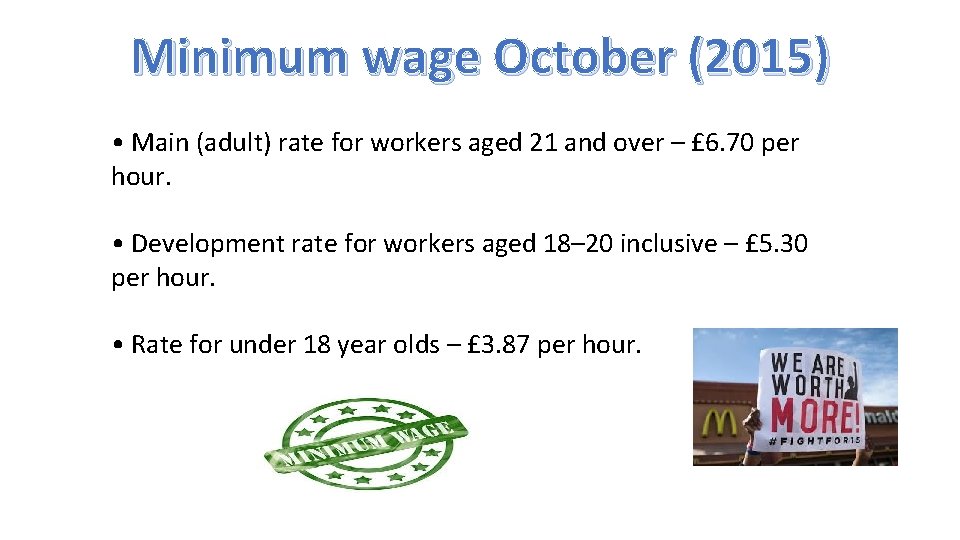
Minimum wage October (2015) • Main (adult) rate for workers aged 21 and over – £ 6. 70 per hour. • Development rate for workers aged 18– 20 inclusive – £ 5. 30 per hour. • Rate for under 18 year olds – £ 3. 87 per hour.
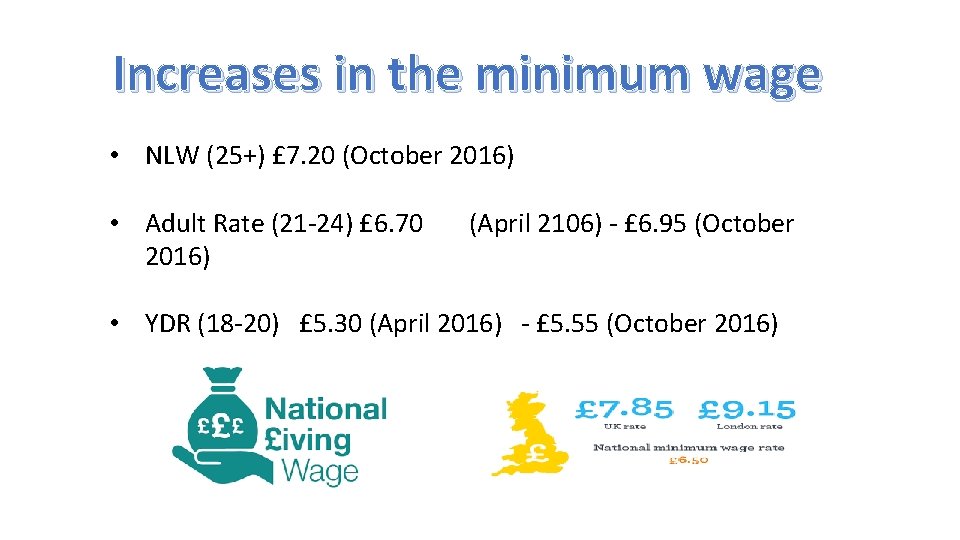
Increases in the minimum wage • NLW (25+) £ 7. 20 (October 2016) • Adult Rate (21 -24) £ 6. 70 2016) (April 2106) - £ 6. 95 (October • YDR (18 -20) £ 5. 30 (April 2016) - £ 5. 55 (October 2016)
Discussion: Task: Why should the minimum wage increase year on year? Time: 5 mins
Impact of the minimum wage on employment The introduction of the minimum wage has added only around 0. 5% to the national wage bill. In contrast to the views of many pessimists, there was no measurable impact on overall employment following introduction of the minimum wage. In fact, in the areas of the economy where the minimum wage was expected to have the greatest impact on employment levels, we saw the greatest growth in employment.
However, it could of course be argued that there would have been even greater growth in jobs without the minimum wage. The first large-scale research into the impact of the minimum wage on employment levels by Income Data Services said that the introduction of the minimum wage had not caused job losses or upset industry pay structures.
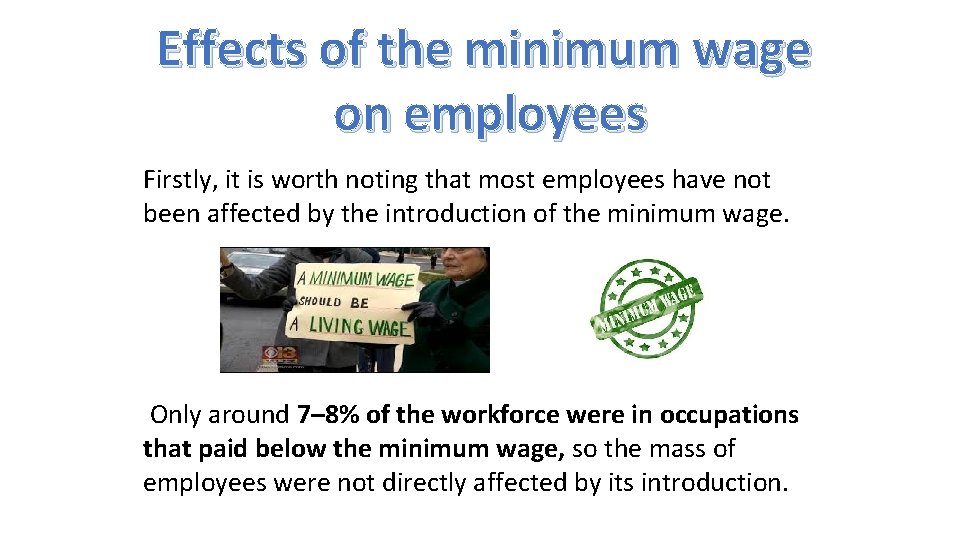
Effects of the minimum wage on employees Firstly, it is worth noting that most employees have not been affected by the introduction of the minimum wage. Only around 7– 8% of the workforce were in occupations that paid below the minimum wage, so the mass of employees were not directly affected by its introduction.
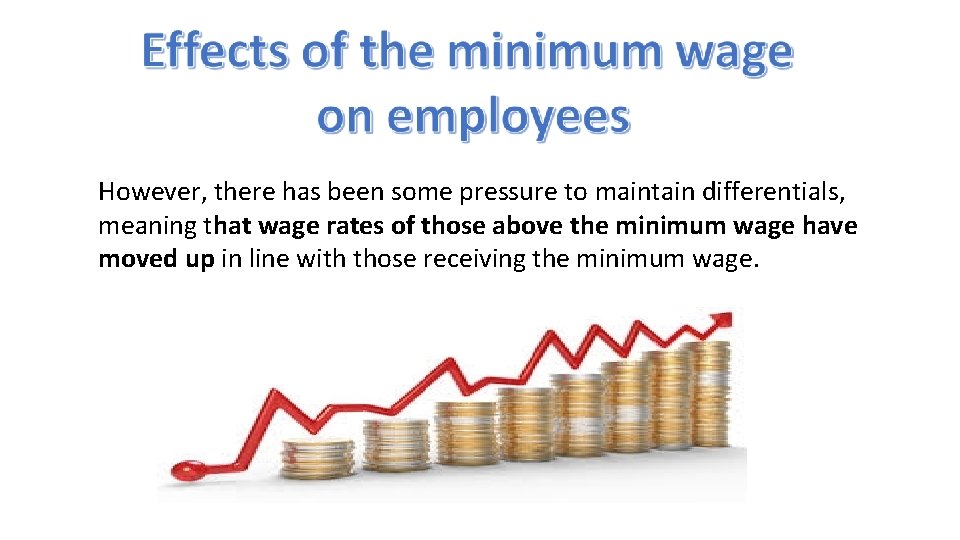
However, there has been some pressure to maintain differentials, meaning that wage rates of those above the minimum wage have moved up in line with those receiving the minimum wage.
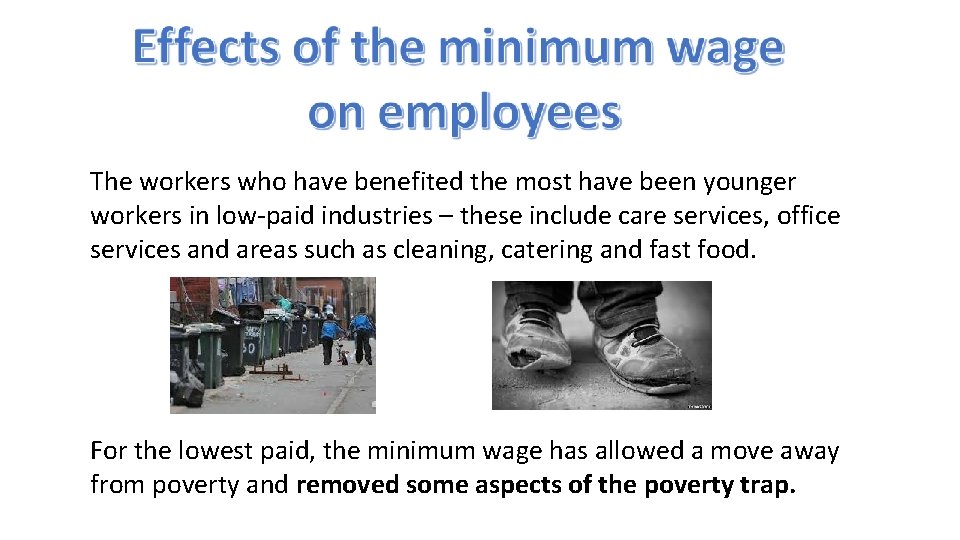
The workers who have benefited the most have been younger workers in low-paid industries – these include care services, office services and areas such as cleaning, catering and fast food. For the lowest paid, the minimum wage has allowed a move away from poverty and removed some aspects of the poverty trap.
Employment has continued to grow in low-paying sectors following the introduction of the minimum wage and there have been no signs of a significant minimum wage effect in the unemployment figures between 2000 and 2008.
In fact, in the lowest paying sectors of the economy such as the hotel industry, catering and care services, employment levels had grown strongly over the first eight years of the minimum wage. The impact of the recession seems to have been felt across most employment sectors, with those on the minimum wage not seeing any greater increase in unemployment levels. Job creation over the last two years (2013– 2015) has also been strong in minimum wage sectors.
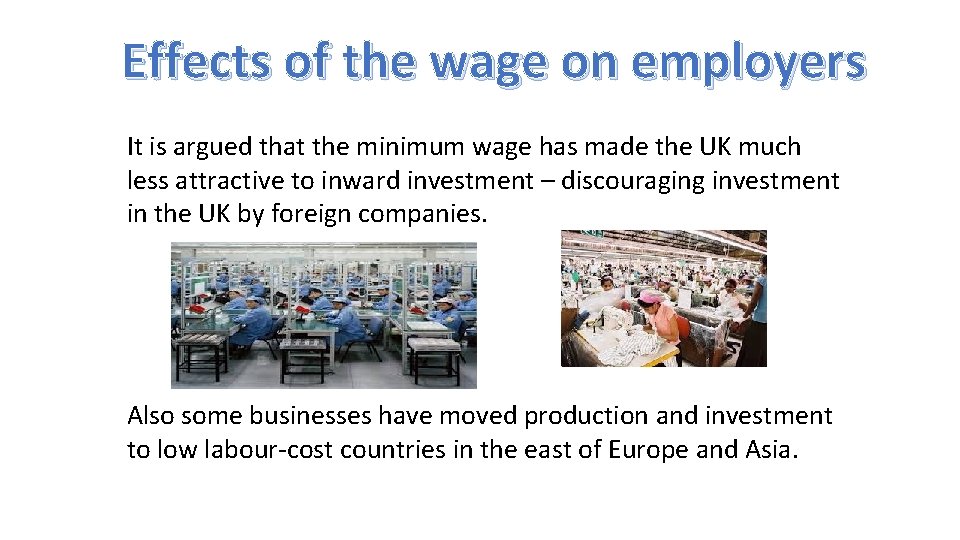
Effects of the wage on employers It is argued that the minimum wage has made the UK much less attractive to inward investment – discouraging investment in the UK by foreign companies. Also some businesses have moved production and investment to low labour-cost countries in the east of Europe and Asia.
Effects of the wage on employers Small businesses have been most affected, especially those that are labour intensive. The focus for the owners and managers of these businesses, as encouraged by the government and bodies such as the Low Pay Commission, has been to make workers more productive through training and education. When viewed from this perspective, the minimum wage could be argued to increase efficiency.
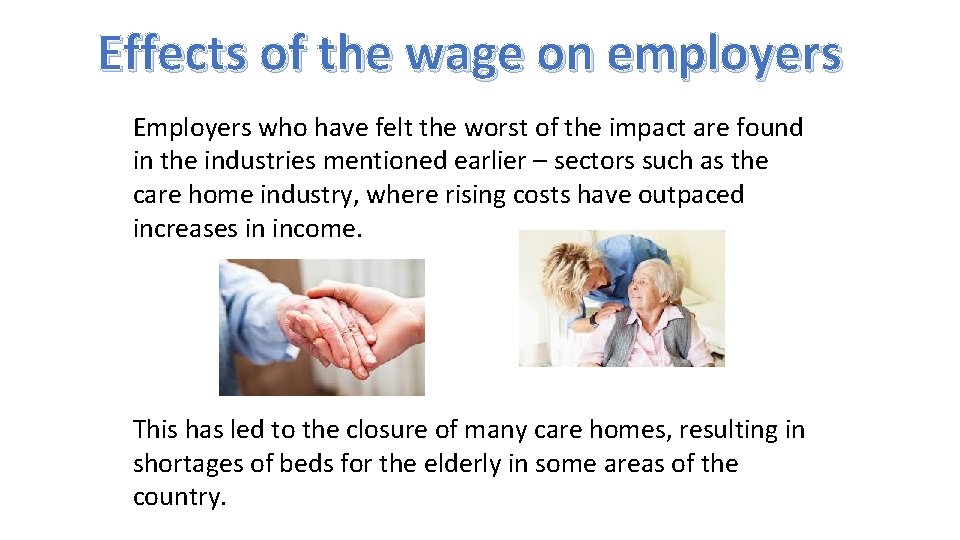
Effects of the wage on employers Employers who have felt the worst of the impact are found in the industries mentioned earlier – sectors such as the care home industry, where rising costs have outpaced increases in income. This has led to the closure of many care homes, resulting in shortages of beds for the elderly in some areas of the country.
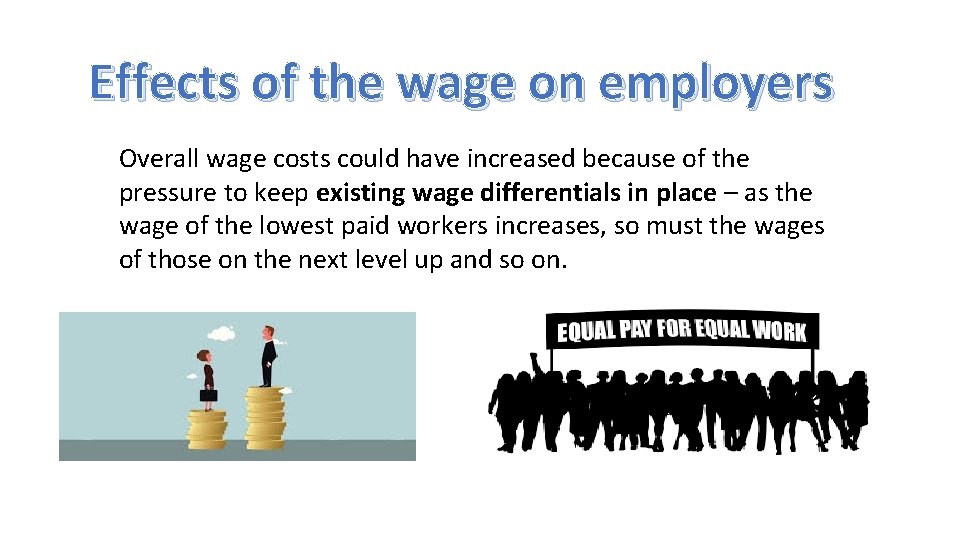
Effects of the wage on employers Overall wage costs could have increased because of the pressure to keep existing wage differentials in place – as the wage of the lowest paid workers increases, so must the wages of those on the next level up and so on.
Living wage – You. Tube video https: //www. youtube. com/watch? v=F 5 f. Psrffsck
Activity 2 Task: Explain impact of minimum wage on employees and employers. Time: 20 mins
Equality act 2010 The Equality Act 2010 legally protects people from discrimination in the workplace and in wider society. It is against the law to discriminate against anyone because of: • age; • being or becoming a transsexual person; • being married or in a civil partnership
Equality act 2010 • being pregnant or having a child; • disability; • race including colour, nationality, ethnic or national origin; • religion, belief or lack of religion/belief; • sex; or sexual orientation.
Discrimination – Equality act – 2010 These are known as ‘protected characteristics’. Any of the following is regarded as discrimination: • direct discrimination – treating someone with a protected characteristic less favourably than others; • indirect discrimination – putting rules or arrangements in place that apply to everyone, but that put someone with a protected characteristic at an unfair disadvantage;
• Harassment – unwanted behaviour linked to a protected characteristic that violates someone’s dignity or creates an offensive environment for them; • Victimisation – treating someone unfairly because they have complained about discrimination or harassment.
Workplace discrimination In the workplace the law protects people against discrimination in relation to: • dismissal; • imposition of unfair employment terms and conditions; • pay and benefits; • promotion and transfer opportunities; • opportunities for training; • recruitment; • redundancy.
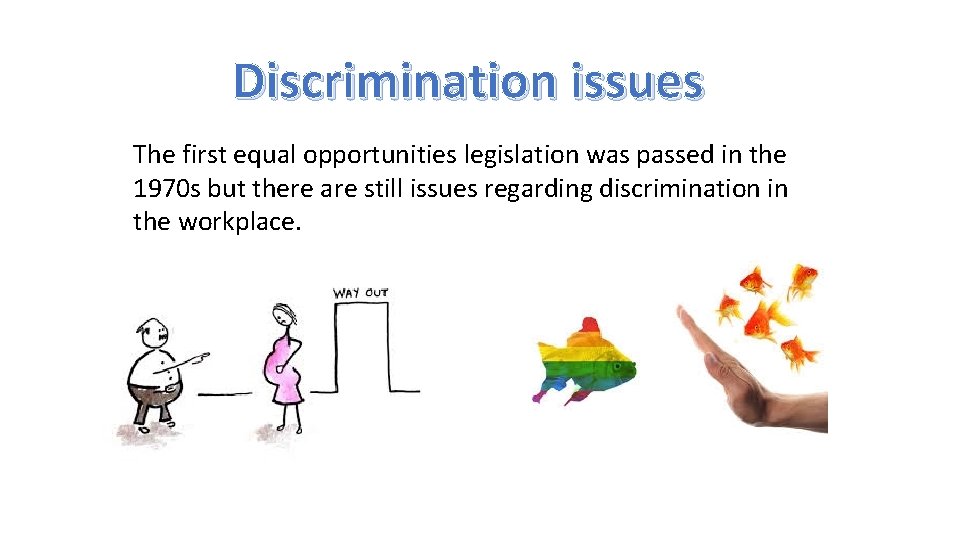
Discrimination issues The first equal opportunities legislation was passed in the 1970 s but there are still issues regarding discrimination in the workplace.
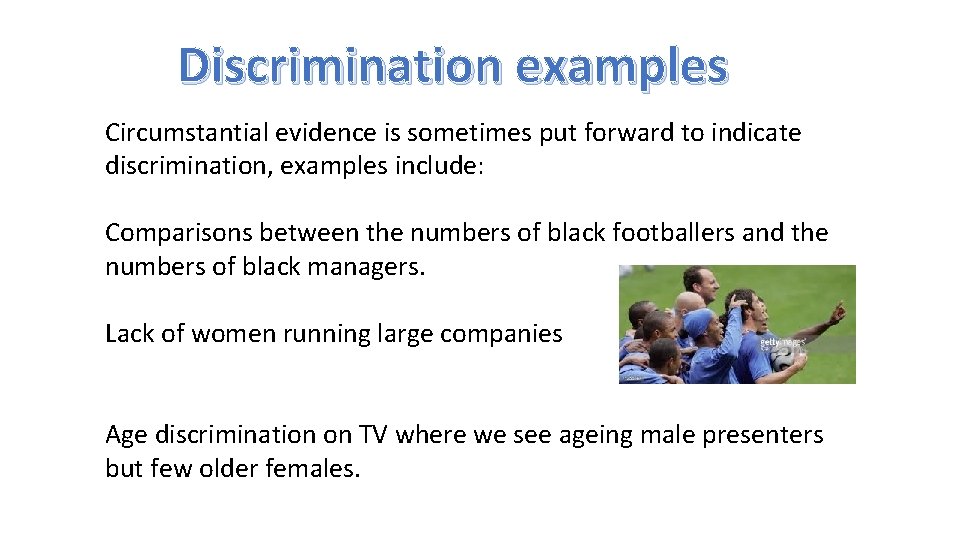
Discrimination examples Circumstantial evidence is sometimes put forward to indicate discrimination, examples include: Comparisons between the numbers of black footballers and the numbers of black managers. Lack of women running large companies Age discrimination on TV where we see ageing male presenters but few older females.
Activity 3 Task: Kahoot quiz – Minimum wage/ equal opportunities Time: 10 mins
Activity 4 Task: Equal opportunities – Written task. Time: 20 mins
Employee/ Employer relationships • Introduce the aims and objectives for the session. • Explain employee or employer relationships and the minimum wage. • Show a You. Tube video on minimum wage. • Explain impact of minimum wage on employees and employers. • Discuss the importance of equal opportunities. • Answer Kahoot quiz questions on employee and employer relationships. • Discuss the equal opportunities act in groups. • Recap the aims and objectives for the session.
- Slides: 37