
Employee Benefits and Beyond Trends Affecting your Employee

Employee Benefits and Beyond: Trends Affecting your Employee Benefit Plans Presented By: Christopher J. De. Lorey President Telamon Insurance & Financial Network cdelorey@telamonins. com 617 -614 -1215 James F. Sampson, AIF® Director of Retirement Services 617 -614 -1257 jsampson@telamonins. com
Telamon Insurance & Financial Network: Our Mission Statement We are an independent insurance agency dedicated to steady growth in niche markets, acting as a singlesource partner for a wide range of insurance solutions. Our organization provides exemplary service with innovative specialty and traditional insurance to businesses, individuals, and brokers. Telamon Insurance & Financial Network has recently been recognized by The Boston Business Journal as one of the Areas Largest Insurance Agencies for three consecutive years.
Factors and Trends
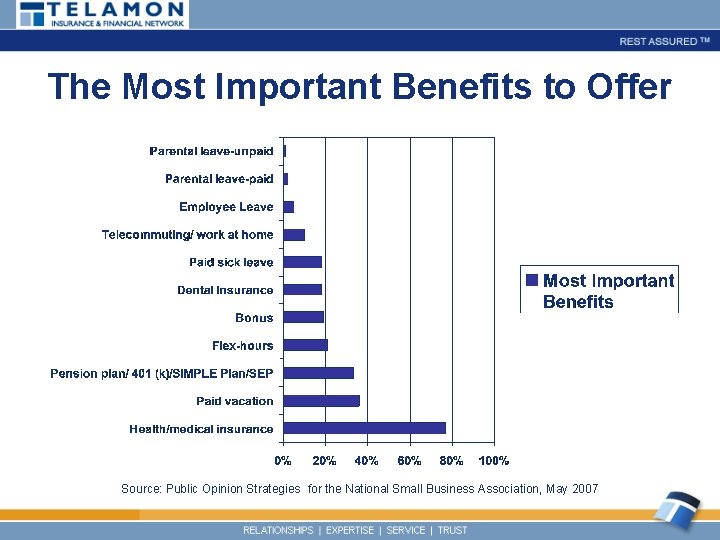
The Most Important Benefits to Offer Source: Public Opinion Strategies for the National Small Business Association, May 2007
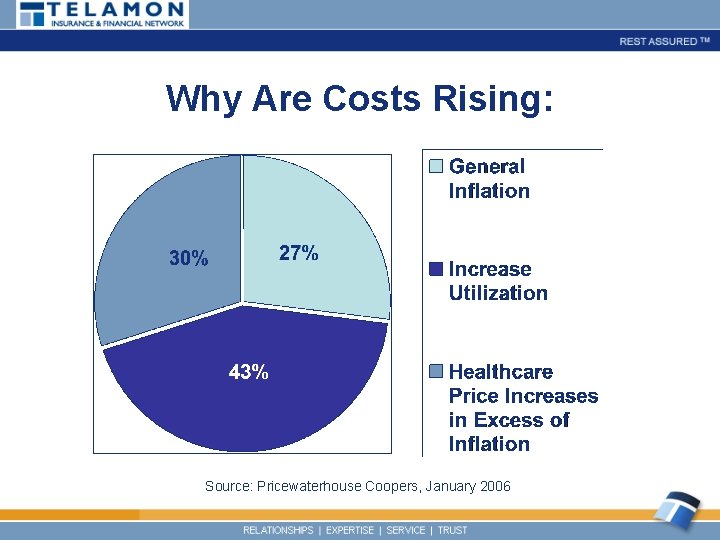
Why Are Costs Rising: Source: Pricewaterhouse Coopers, January 2006
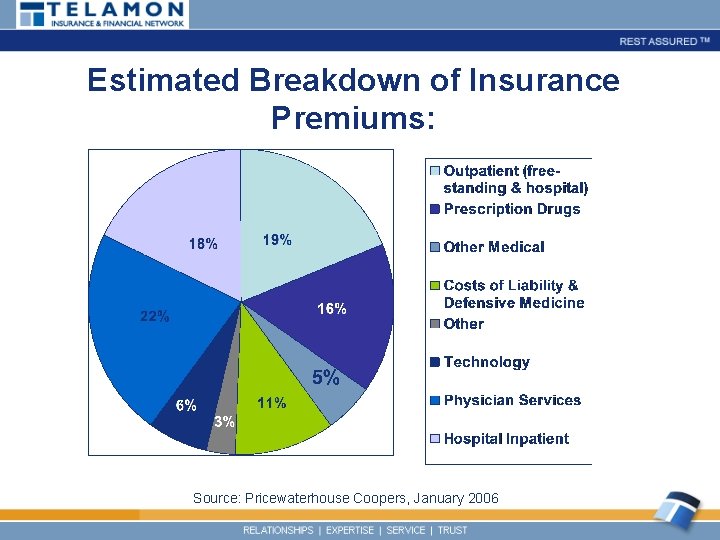
Estimated Breakdown of Insurance Premiums: Source: Pricewaterhouse Coopers, January 2006
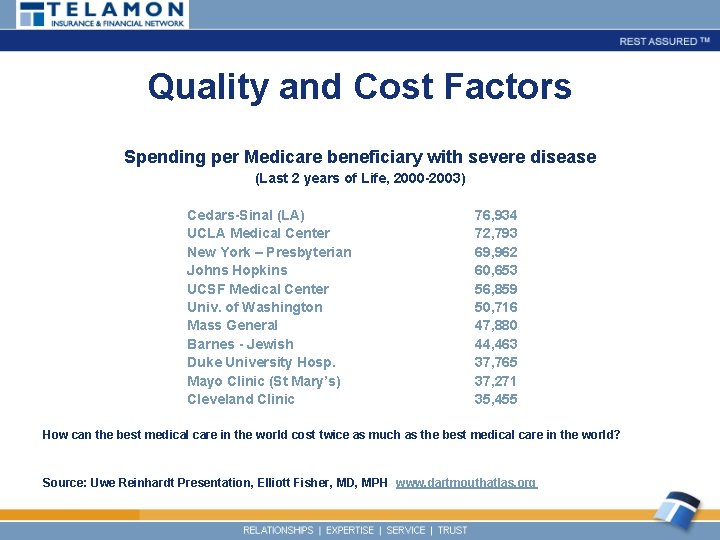
Quality and Cost Factors Spending per Medicare beneficiary with severe disease (Last 2 years of Life, 2000 -2003) Cedars-Sinal (LA) UCLA Medical Center New York – Presbyterian Johns Hopkins UCSF Medical Center Univ. of Washington Mass General Barnes - Jewish Duke University Hosp. Mayo Clinic (St Mary’s) Cleveland Clinic 76, 934 72, 793 69, 962 60, 653 56, 859 50, 716 47, 880 44, 463 37, 765 37, 271 35, 455 How can the best medical care in the world cost twice as much as the best medical care in the world? Source: Uwe Reinhardt Presentation, Elliott Fisher, MD, MPH www. dartmouthatlas. org
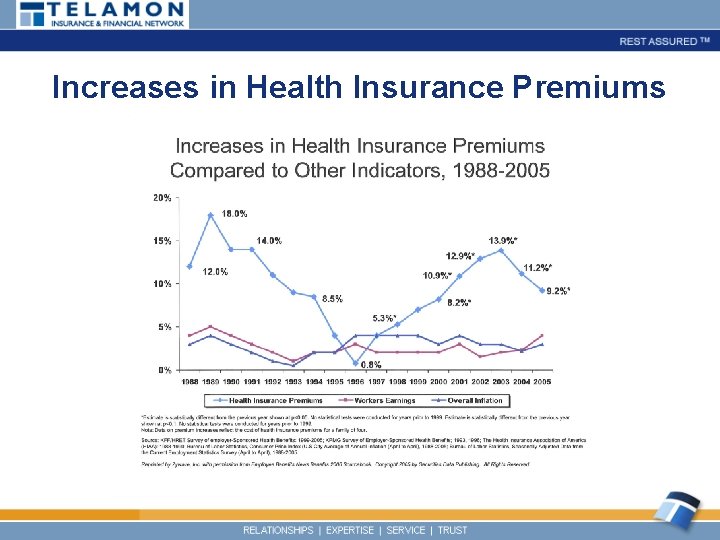
Increases in Health Insurance Premiums
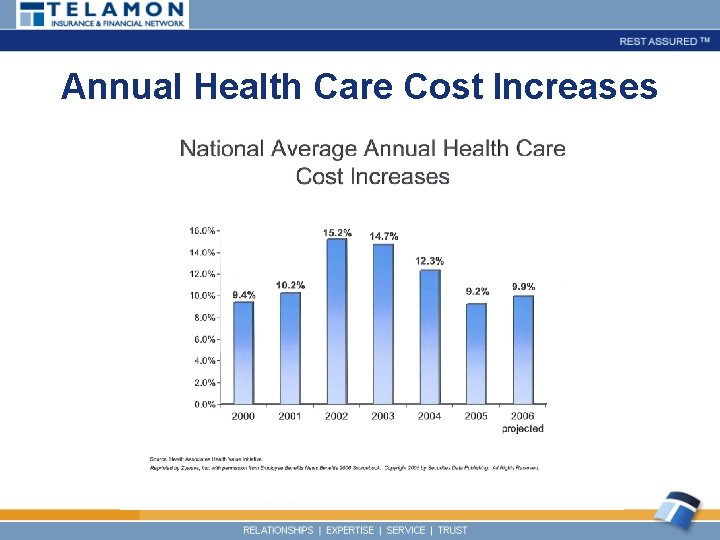
Annual Health Care Cost Increases
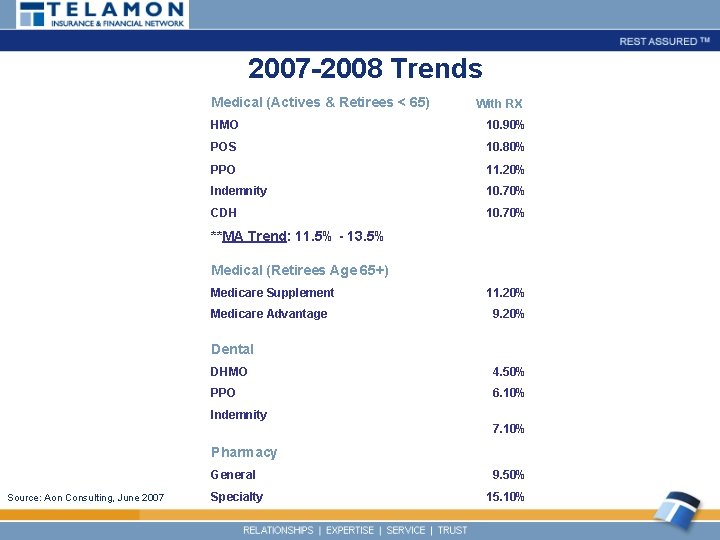
2007 -2008 Trends Medical (Actives & Retirees < 65) With RX HMO 10. 90% POS 10. 80% PPO 11. 20% Indemnity 10. 70% CDH 10. 70% **MA Trend: 11. 5% - 13. 5% Medical (Retirees Age 65+) Medicare Supplement Medicare Advantage 11. 20% 9. 20% Dental DHMO 4. 50% PPO 6. 10% Indemnity 7. 10% Pharmacy General Source: Aon Consulting, June 2007 Specialty 9. 50% 15. 10%
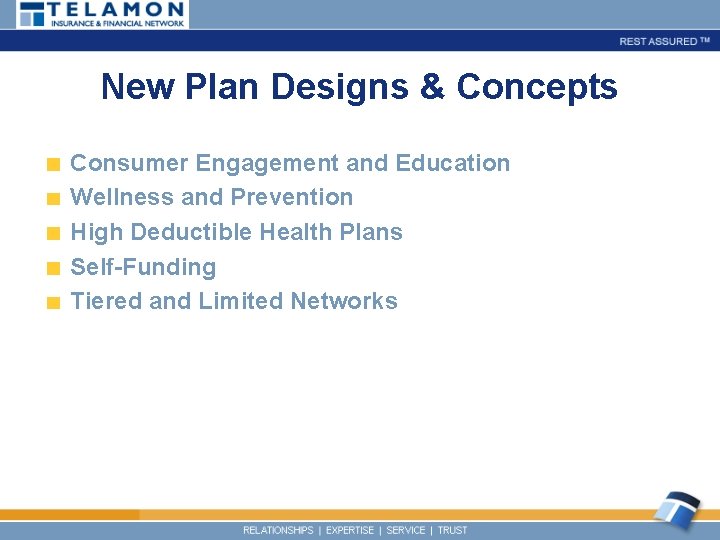
New Plan Designs & Concepts Consumer Engagement and Education Wellness and Prevention High Deductible Health Plans Self-Funding Tiered and Limited Networks
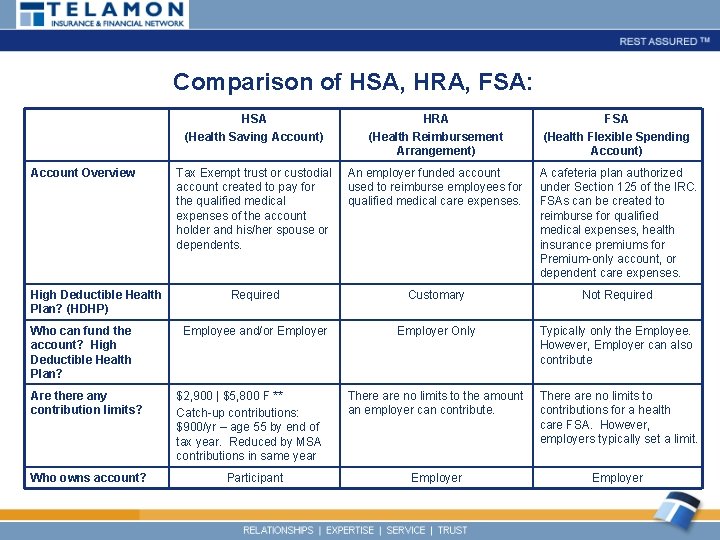
Comparison of HSA, HRA, FSA: Account Overview High Deductible Health Plan? (HDHP) Who can fund the account? High Deductible Health Plan? Are there any contribution limits? Who owns account? HSA (Health Saving Account) HRA (Health Reimbursement Arrangement) FSA (Health Flexible Spending Account) Tax Exempt trust or custodial account created to pay for the qualified medical expenses of the account holder and his/her spouse or dependents. An employer funded account used to reimburse employees for qualified medical care expenses. A cafeteria plan authorized under Section 125 of the IRC. FSAs can be created to reimburse for qualified medical expenses, health insurance premiums for Premium-only account, or dependent care expenses. Required Customary Not Required Employee and/or Employer Only Typically only the Employee. However, Employer can also contribute There are no limits to the amount an employer can contribute. There are no limits to contributions for a health care FSA. However, employers typically set a limit. Employer $2, 900 | $5, 800 F ** Catch-up contributions: $900/yr – age 55 by end of tax year. Reduced by MSA contributions in same year Participant
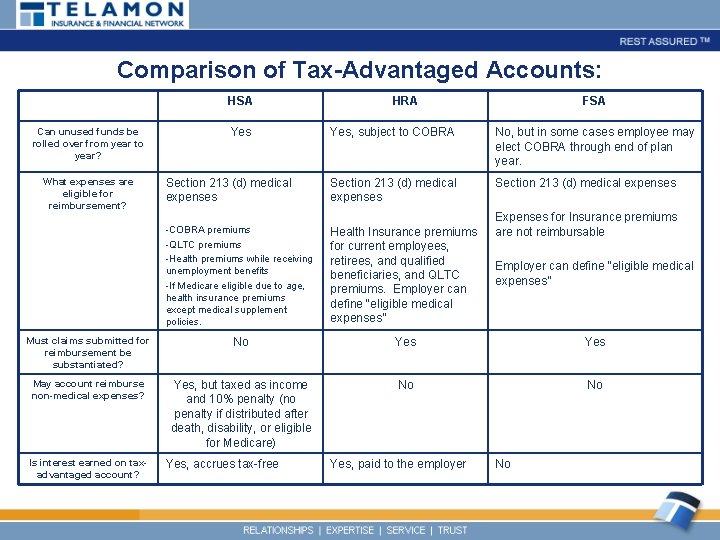
Comparison of Tax-Advantaged Accounts: HSA Can unused funds be rolled over from year to year? FSA Yes, subject to COBRA No, but in some cases employee may elect COBRA through end of plan year. Section 213 (d) medical expenses -COBRA premiums -QLTC premiums -Health premiums while receiving unemployment benefits -If Medicare eligible due to age, health insurance premiums except medical supplement policies. Health Insurance premiums for current employees, retirees, and qualified beneficiaries, and QLTC premiums. Employer can define “eligible medical expenses” Must claims submitted for reimbursement be substantiated? No Yes May account reimburse non-medical expenses? Yes, but taxed as income and 10% penalty (no penalty if distributed after death, disability, or eligible for Medicare) No No What expenses are eligible for reimbursement? Is interest earned on taxadvantaged account? Yes HRA Yes, accrues tax-free Yes, paid to the employer Expenses for Insurance premiums are not reimbursable Employer can define “eligible medical expenses” No
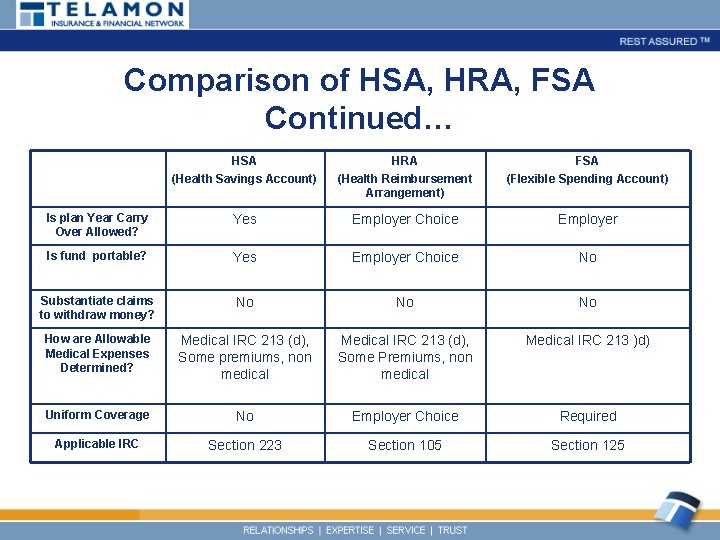
Comparison of HSA, HRA, FSA Continued… HSA (Health Savings Account) HRA (Health Reimbursement Arrangement) FSA (Flexible Spending Account) Is plan Year Carry Over Allowed? Yes Employer Choice Employer Is fund portable? Yes Employer Choice No Substantiate claims to withdraw money? No No No How are Allowable Medical Expenses Determined? Medical IRC 213 (d), Some premiums, non medical Medical IRC 213 (d), Some Premiums, non medical Medical IRC 213 )d) Uniform Coverage No Employer Choice Required Applicable IRC Section 223 Section 105 Section 125
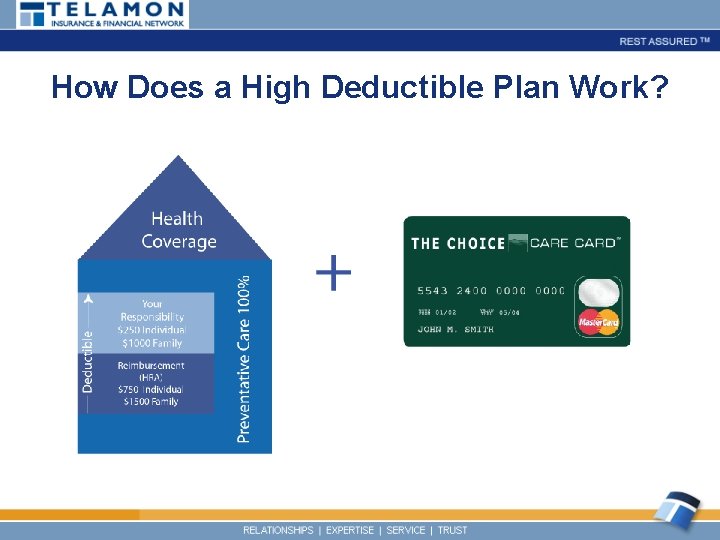
How Does a High Deductible Plan Work?
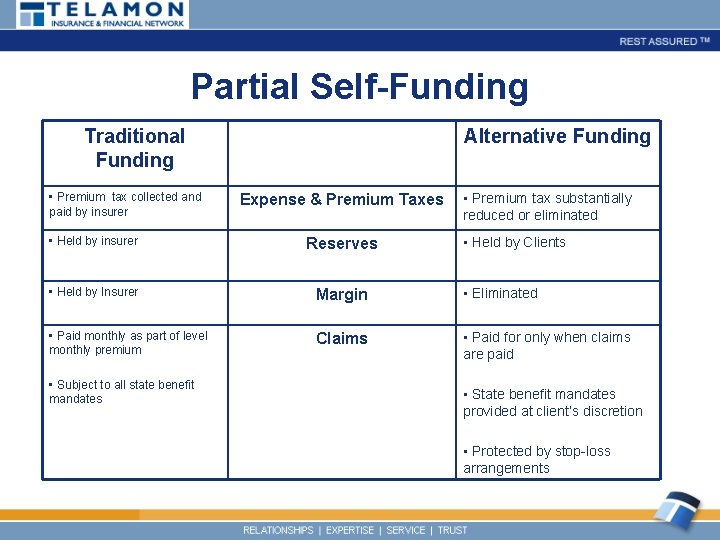
Partial Self-Funding Traditional Funding • Premium tax collected and paid by insurer Alternative Funding Expense & Premium Taxes • Premium tax substantially reduced or eliminated • Held by insurer Reserves • Held by Insurer Margin • Eliminated • Paid monthly as part of level monthly premium Claims • Paid for only when claims are paid • Subject to all state benefit mandates • Held by Clients • State benefit mandates provided at client’s discretion • Protected by stop-loss arrangements
Self-Funded Terms Administration: ◦ An administrative fee is charged for claims adjudication, billing, eligibility, customer service, plan document maintenance, Access fees, and Managed Care Fees. Set-up Fees: ◦ The set-up fee is a one-time charge for inputting eligibility and benefits so the plan can be administered. Expected Claim: ◦ Total claims the underwriter expects you to have in one policy year. This is actuarially determined from your past claims experience.
Self-Funded Terms Specific Stop Loss: ◦ Specific Stop Loss Insurance is purchased to protect you when eligible claims during the policy year on any one individual exceed the specific liability limit. If eligible claims for an individual do exceed the specific liability limit, you will be reimbursed for those claims by the insurance company. Maximum: ◦ This is 125% above your expected claims level. Claims that exceed this level are reimbursed by the Stop Loss carrier. The 125% is called the Aggregate Attachment Factor. While it can vary, 125% is most common.
Self-Funded Terms Aggregate Stop Loss: ◦ Aggregate Stop Loss Insurance protects you from eligible claims for the entire group that exceed the annual aggregate liability limit. If the eligible claims for the entire group exceed the aggregate liability limit, the insurance company will reimburse you for those claims at the end of the policy year. It is important to note that many insurance companies offer an “accommodation agreement” for a monthly fee. This special contract provision provides monthly reimbursement of aggregate claims.
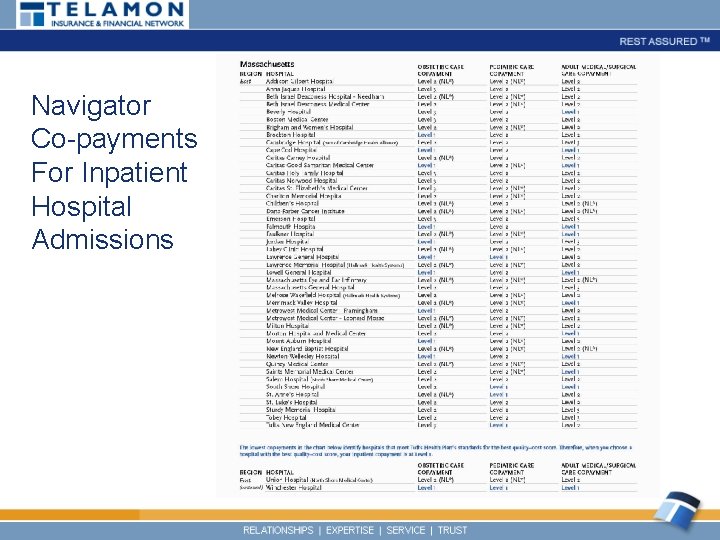
Navigator Co-payments For Inpatient Hospital Admissions
Wellness Incentive Programs Use your health plan! Create incentives for: - Personal care and assessment - Weight Loss - Smoking Cessation - Stress Management - Chronic Disease Management - Screenings
Healthcare Consumer Resources www. leapfroggroup. org www. mywebmd. com www. pharmacychecker. com www. healthsmart. org www. healthfinder. com www. mhqp. org http: //profiles. massmedboard. org www. mass. gov/healthcareqc. com www. urac. org/consumers/ www. kidshealth. org www. healthgrades. com
MA Health Care Reform Highlights Health Insurance Mandate on eligible individuals – - Effective 7/1/07 - Employee HIRD Form $295 Employer Assessment for employees not covered by health insurance - Groups of 10+ only - Fair Share Testing - New! – Proposed Employer HIRD regulation Establishment of the Commonwealth Care Health Insurance Exchange Authority - Multiple carrier options - Can be list billed to employer.
Retirement Plans Fiduciary Responsibility
Your Responsibilities as a Plan Sponsor: Evaluation and Selection of a Suitable Provider Design and Review of an Investment Portfolio Plan Design and Compliance Participant Education Programs Plan Administration Capabilities Legislative Review (Keeping Plan in Compliance) On-going Periodic Plan Review
7 Habits of Highly Successful Retirement Plans: High participation rates High average deferral percentages Appropriate asset allocation Following an Investment Policy Statement Regular monitoring of investment choices Offer investment education to employees Independent annual review of plan features and operations
How Successful Is Your Plan? What percentage of your employees contribute? What is your average deferral percentage? Are your employees properly invested? Do you have an Investment Policy Statement? How often do you review or replace your funds? How often do you offer employee education? Do you independently review your plan annually?
It’s About How You Play The Game: You cannot guarantee investment performance, but you can guarantee a process
Retirement Plans Plan Design Options
Plan Design Options: Auto-Pilot Features Automatic Enrollment ◦ Targets “procrastinators” to increase participation Automatic Deferral Increase ◦ Helps employees to save more each year in small increments Automatic Default Investment Options ◦ Better alternative than cash equivalent, ensures proper asset allocation for those who do not choose investments Employees always have the option to “opt-out” Changing the default eases administration, helps sponsor to cover fiduciary responsibility
Plan Design Options: Roth 401(k)/403(b) After-tax contributions, tax-free growth of account Tax-free distribution at retirement (10% penalty if before Age 59 ½) No income limitations (Roth IRA limits higher income earners) Employees may contribute up to $15, 500 in 2007 (Roth IRA limit - $4, 000) Roth contributions subject to discrimination testing Roth contributions not in addition to Traditional Roth must be active 5 years for tax-free withdrawal
Plan Design Options: Safe-Harbor 401(k) Allows for Average Deferral Percentage (ADP), Top. Heavy testing to be WAIVED Employees may make maximum contributions ◦ $15, 500 in 2007, $20, 500 for employees Age 50+ Mandatory Employer Contributions: ◦ ◦ 3% Non-Elective contribution to all eligible employees, OR 4% Matching contribution to contributing employees Employee Notice required 30 -60 days prior to plan year
Plan Design Options: Cross-Tested Profit -Sharing Discretionary Contribution Ability to separate employees by class/job title Allows higher contributions for Key Employees ◦ Up to $45, 000 in 2007, $50, 000 for employees Age 50+ Allows different contributions for different classes Based on contributions projected to Age 65 Requires additional year-end discrimination testing

- Slides: 35