
Employed Unemployed Not in the Labor Force Labor


Employed, Unemployed, Not in the Labor Force, Labor Force • Employed: A person is considered employed if he or she has spent most of the previous week working at a paid job. • Unemployed: A person is unemployed if he or she is on temporary layoff, is looking for a job, or is waiting for the start date of a new job. • Not in the Labor Force: A person who fits neither of these categories, such as a full-time student, homemaker, or retiree, is not in the labor force. • Labor Force – The labor force is the total number of workers and the BLS defines the it as the sum of the employed and the unemployed.
UNEMPLOYMENT AND THE LABOUR FORCE • Labour force or workforce - The number of people employed and self-employed plus those unemployed but ready and able to work. • Three factors affect the size of the labour force: – Population – Migration – Labour force participation in economic activity.
So what, if we have Unemployment? • Unemployment is a big concern for the economy, because if resources (human capital) are not being use to it's potential, then Potential GDP (productivity) cannot be reached! • This is the only way that our economy can grow over time. • If people aren't earning wages they can't purchase final goods and services (Cconsumption GDP). • If they aren't working then goods and services can't be made.
Unemployment Effects • When people are unemployed the following occurs: • Unemployment Insurance benefits increase (If they've been working) • Increase the needs for public goods and services. • Crime (if they can't find any work at all and need resources to live). • Decreases in living standards. • Emotional stress or • In fact emotional stress for a period of time can cause a worker to become discouraged: • Discouraged Worker defined is: – Workers who have left the labor force, because they have not been able to find employment.
The Labor Force • The Labor Force is defined as: – The total number of people employed or actively seeking employment. – It is calculated By: • Number Employed + Number Unemployed (but are looking for work)
Who is counted? – To even be considered in the labor force you must be 16 years of age. – You must be actively seeking work. – This data is collected by local state employment offices, through a survey known as the CPS (current population survey)
Who do we count as being in the labor force? • Who is not counted? – Workers who are under 16. – Volunteer Workers – Military Soldiers – People who are in prison – People who are in hospitals or nursing homes – Full-Time Students – Retirees • Who is counted as working: – Those who are working fulltime for pay. – Part-time workers – Temp workers – Self-Employed workers – Family workers who work at least 15 hrs a week at a family enterprise. (paid or unpaid)
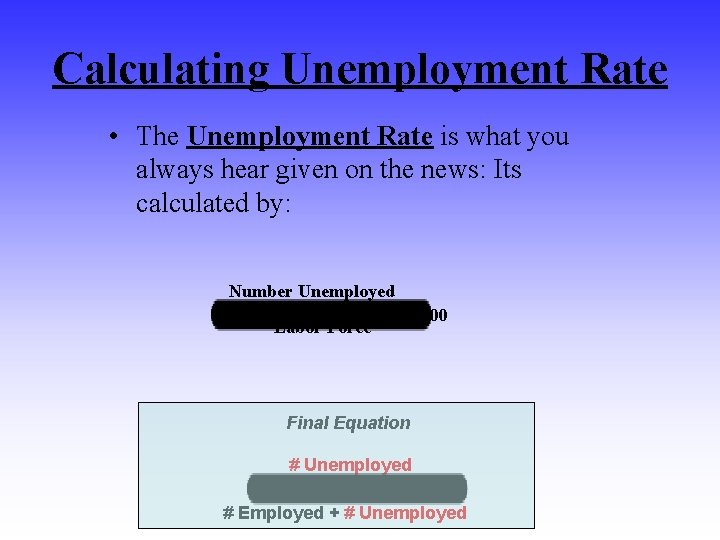
Calculating Unemployment Rate • The Unemployment Rate is what you always hear given on the news: Its calculated by: Number Unemployed Labor Force X 100 Final Equation # Unemployed # Employed + # Unemployed
Types of unemployment • Frictional : arises from normal labour turnover, ie people entering and leaving the labour force. – Generous unemployment compensation leads to high frictional unemployment. – European countries like France fall in this category. • Structural : arises due to changes in technology, international competition, etc. – Arises due to skill obsolescence or lack of competitiveness. • Cyclical : fluctuates with the business cycle. – Increases during a recession and falls during an expansion.
Economists distinguish between four types of unemployment: âFrictional âSeasonal âStructural âCyclical

ÜThis type of unemployment is the (unavoidable) product of the movement of human resources between jobs, or into the labor force. College graduates seeking employment are a good example of frictional unemployment. I’m a “techie” who is relocating to Dallas because my wife got transferred
RUnemployment arising from the seasonal nature of some economic activities. YConstruction workers in Minnesota unemployed in February. YEmployees of ski resorts unemployed in July. retail sales are higher during the holiday season therefore unemployment in this industry goes down during the months of November and December
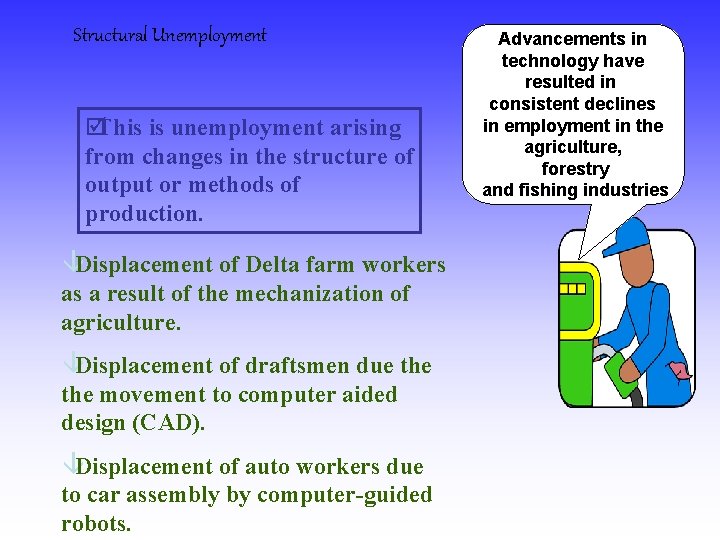
Structural Unemployment þThis is unemployment arising from changes in the structure of output or methods of production. âDisplacement of Delta farm workers as a result of the mechanization of agriculture. âDisplacement of draftsmen due the movement to computer aided design (CAD). âDisplacement of auto workers due to car assembly by computer-guided robots. Advancements in technology have resulted in consistent declines in employment in the agriculture, forestry and fishing industries
àThis is unemployment due a general contraction in the level of business activity-that is, recession related unemployment ØAuto and farm equipment workers laid off to to weak sales. ØWorkers in heavy machinery industries laid off because investment spending is soft. I couldn’t find work in 1991, because hardly anyone was building a new home
Unemployment is a drag! • Unemployment causes stress on individuals and families. • Unemployment is correlated with rising incidence of spousal and child abuse, divorce, drug and alcohol use, and crime. • The purely economic cost of unemployment is lost physical output, as measured by the GDP Gap
Unemployment and Its Costs • Natural Rate of Unemployment The level of unemployment that results when the rate of unemployment is normal, considering both frictional and structural factors. Also called the NAIRU (Nonaccelerating Inflation Rate of Unemployment) • Potential Real GDP The level of output produced when nonlabor resources are fully utilized and unemployment is at its natural rate. • GDP gap = potential real GDP – actual GDP
GDP Gap = Potential GDP - Actual GDP, where potential GDP is the level of output the economy would achieve if the unemployment rate were equal to the Natural Rate of the NAIRU is an acronym for “non-accelerating inflation rate of unemployment. ” It is the unemployment rate corresponding to zero cyclical unemployment NAIRU is the “full-employment” unemployment rate.
Actual unemployment in was 9. 6%. If you assume that the NAIRU was 6%, then we can use Okun’s law to estimate a GDP gap of $352 billion for 1983 (1987 dollars) Okun’s law: each percentage point difference between the unemployment rate and the NAIRU converts to a 2. 5 percent GDP gap.
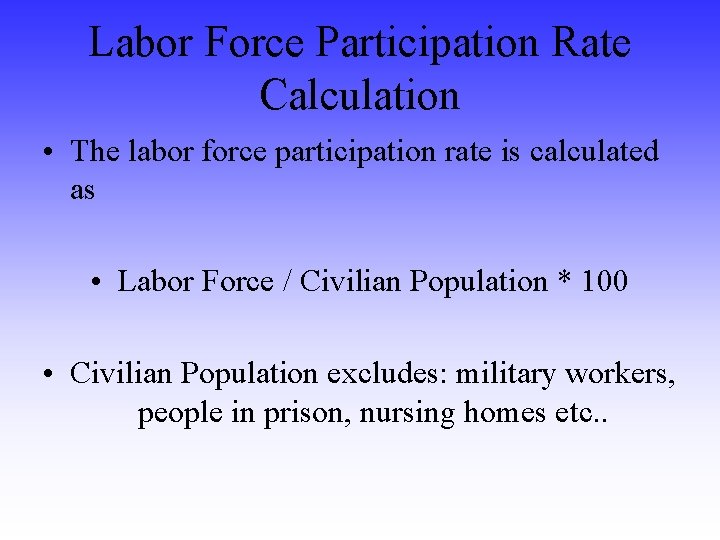
Labor Force Participation Rate Calculation • The labor force participation rate is calculated as • Labor Force / Civilian Population * 100 • Civilian Population excludes: military workers, people in prison, nursing homes etc. .
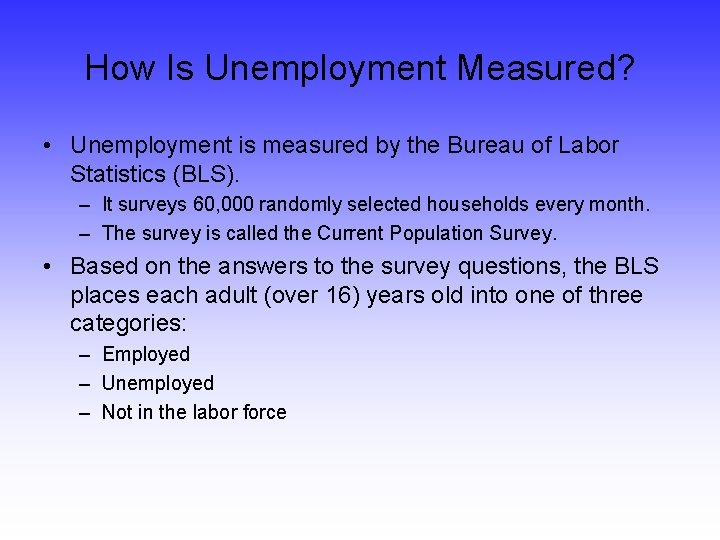
How Is Unemployment Measured? • Unemployment is measured by the Bureau of Labor Statistics (BLS). – It surveys 60, 000 randomly selected households every month. – The survey is called the Current Population Survey. • Based on the answers to the survey questions, the BLS places each adult (over 16) years old into one of three categories: – Employed – Unemployed – Not in the labor force
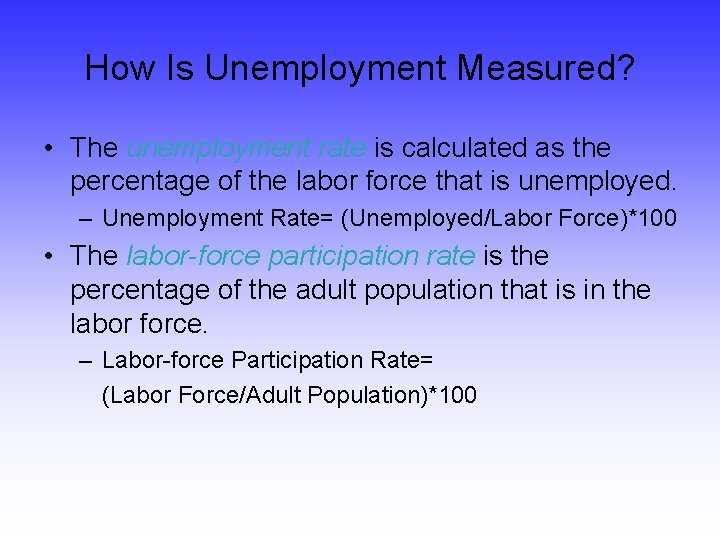
How Is Unemployment Measured? • The unemployment rate is calculated as the percentage of the labor force that is unemployed. – Unemployment Rate= (Unemployed/Labor Force)*100 • The labor-force participation rate is the percentage of the adult population that is in the labor force. – Labor-force Participation Rate= (Labor Force/Adult Population)*100
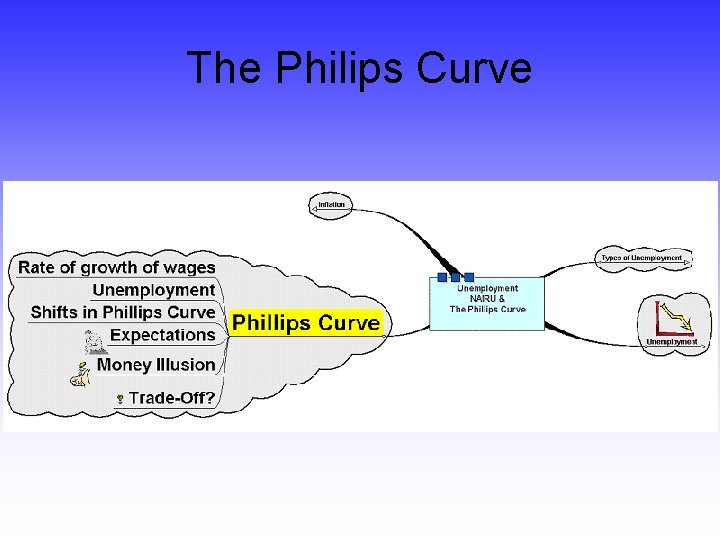
The Philips Curve
The Phillips Curve • 1958 – Professor A. W. Phillips • Expressed a statistical relationship between the rate of growth of money wages and unemployment from 1861 – 1957 • Rate of growth of money wages linked to inflationary pressure • Led to a theory expressing a trade-off between inflation and unemployment
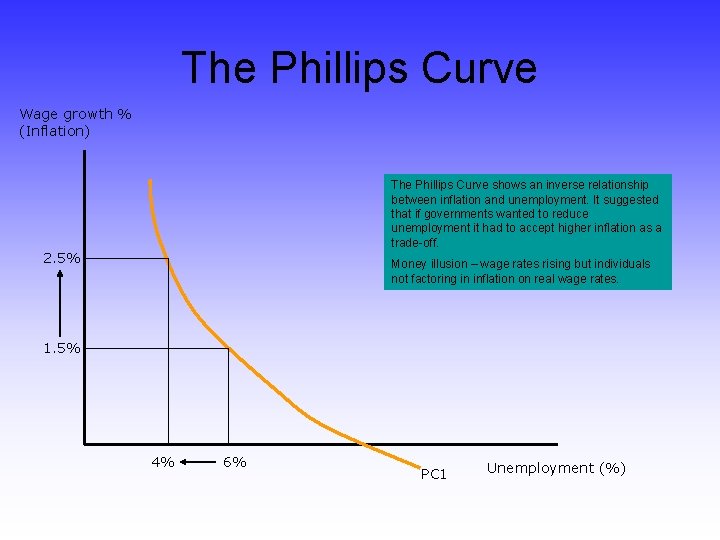
The Phillips Curve Wage growth % (Inflation) The Phillips Curve shows an inverse relationship between inflation and unemployment. It suggested that if governments wanted to reduce unemployment it had to accept higher inflation as a trade-off. 2. 5% Money illusion – wage rates rising but individuals not factoring in inflation on real wage rates. 1. 5% 4% 6% PC 1 Unemployment (%)
The Phillips Curve • Problems: • 1970 s – Inflation and unemployment rising at the same time – stagflation • Phillips Curve redundant? • Or was it moving?
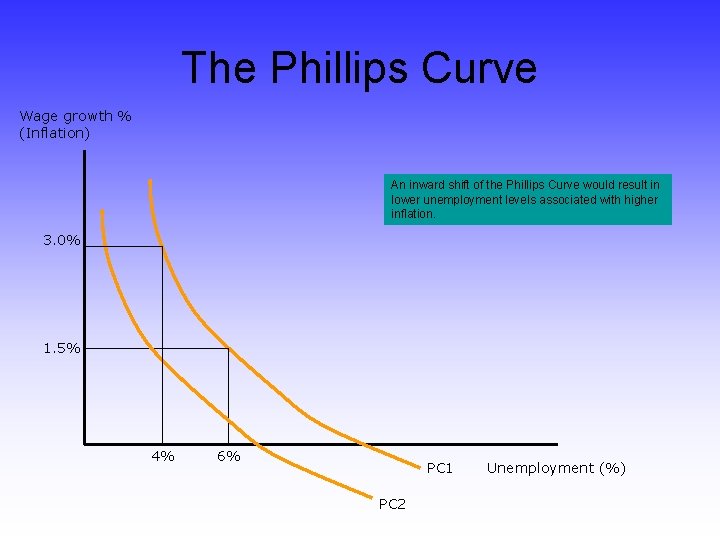
The Phillips Curve Wage growth % (Inflation) An inward shift of the Phillips Curve would result in lower unemployment levels associated with higher inflation. 3. 0% 1. 5% 4% 6% PC 1 PC 2 Unemployment (%)
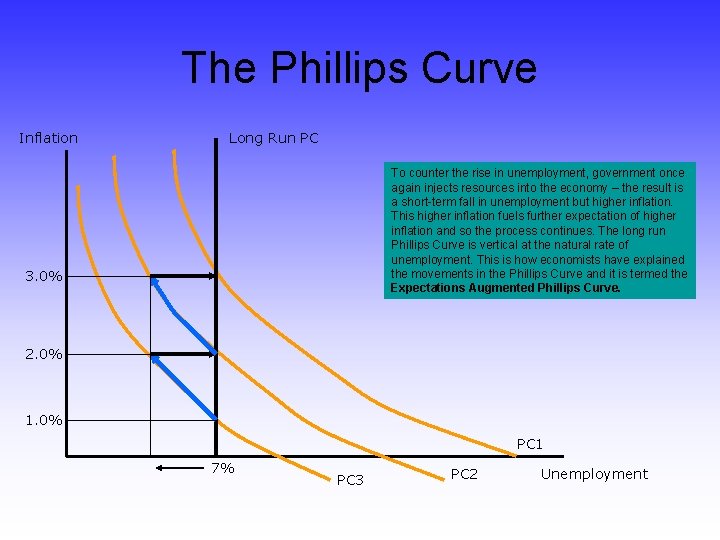
The Phillips Curve Inflation Long Run PC To There Assume counter is athe short theeconomy rise term in fall unemployment, starts in unemployment with an inflation government butrate at aof once cost of 1% again higher but injects very inflation. resources high Individuals unemployment into the now economy at base 7%. their – the wage result is negotiations a Government short-term fall on takes expectations in unemployment measuresoftohigher reduce but higher inflation. in the next This unemployment higher period. inflation If higher by an fuels wages expansionary further are granted expectation fiscal then policy of firms higher that costs inflation pushes rise and AD – they so to the start right process to (see shed continues. the labour AD/AS and The diagram long run on unemployment Phillips slide 15) Curve iscreeps verticalback at the upnatural to 7% again. rate of unemployment. This is how economists have explained the movements in the Phillips Curve and it is termed the Expectations Augmented Phillips Curve. 3. 0% 2. 0% 1. 0% PC 1 7% PC 3 PC 2 Unemployment
The Phillips Curve • Where the long run Phillips Curve cuts the horizontal axis would be the rate of unemployment at which inflation was constant – the so-called Non-Accelerating Inflation Rate of Unemployment (NAIRU)
The Phillips Curve • To reduce unemployment to below the natural rate would necessitate: 1. Influencing expectations – persuading individuals that inflation was going to fall 2. Boosting the supply side of the economy increase capacity (pushing the PC curve outwards)
The Phillips Curve • Supply side policies have been focused on: • Education: – – Boosting the number of those staying on at school Boosting numbers going to university Lifelong learning Vocational education • Welfare benefits: – The working family tax credit – Incentives to work • Labour market flexibility
The Phillips Curve • Expectations have been centred on: – Operational independence of the Bank of England – Tight control of public sector pay The independence of the Bank of England has taken away interest rate decision making from the government who may have been motivated by political ends – this had the effect of influencing expectations.
Phillips curve • In 1958, a New Zealand economist , A. W. H. Phillips proposed that there was a trade-off between inflation and unemployment. • The lower the unemployment rate, the higher was the rate of inflation. • Governments simply had to choose the right balance between the two evils. • Economies did seem to work like this in the 1950 s and 1960 s, but then the relationship broke down.
NAIRU(Non Accelerating inflation rate of unemployment) • Now economists prefer to talk about the NAIRU, the lowest rate of unemployment at which inflation does not accelerate. • The lowest rate of unemployment at which the jobs market can be in stable equilibrium. • When unemployment is above this rate, demand can potentially be increased to bring it to the natural rate, but attempting to lower it even further will only cause inflation to accelerate.
The Keynesians and the Monetarists • Keynesians, assumed that the economy would always have some slack. • The government could lower the rate of unemployment if it was willing to accept a little more inflation. • However, economists such as Milton Friedman argued that the economy of left to itself would adjust to full employment. • The supposed inflation-for-jobs trade-off was in fact a trap. • Governments that tolerated higher inflation in the hope of lowering unemployment would find that joblessness dipped only briefly before returning to its previous level, while inflation would rise and stay high. • Instead, they argued, unemployment has an equilibrium or natural rate, determined not by the amount of demand in an economy but by the structure of the labour market. • They stressed the importance of flexible labour markets.
- Slides: 35