
Empirical Molecular Formulas Percent Composition Determine the elements

- Slides: 23
Empirical & Molecular Formulas
Percent Composition • Determine the elements present in a compound and their percent by mass. • A 100 g sample of a new compound contains 55 g of element X and 45 g of element Y • Percent by mass can be calculated using Mass of element X 100 = percent by mass Mass of compound
Percent Composition • The percents of all elements in a compound must equal 100. • The percent by mass of each element in a compound is called the percent composition of a compound
Percent Composition from the Chemical Formula • If you already know the chemical formula for a compound you can calculate its percent composition 1. Calculate the molar mass of each element and compound formula unit a. Assume sample size is one mole b. Multiply the molar mass of the element by its subscript in the chemical formula 2. Divide the mass of the element by the molar mass of the compound unit and multiply by 100
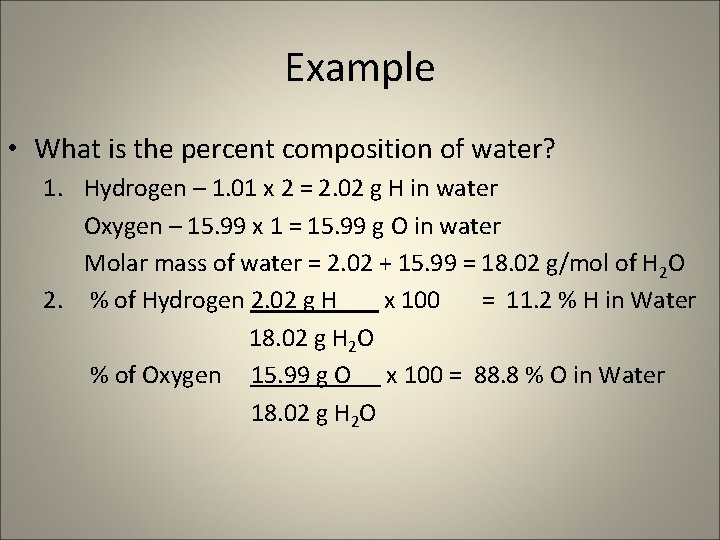
Example • What is the percent composition of water? 1. Hydrogen – 1. 01 x 2 = 2. 02 g H in water Oxygen – 15. 99 x 1 = 15. 99 g O in water Molar mass of water = 2. 02 + 15. 99 = 18. 02 g/mol of H 2 O 2. % of Hydrogen 2. 02 g H x 100 = 11. 2 % H in Water 18. 02 g H 2 O % of Oxygen 15. 99 g O x 100 = 88. 8 % O in Water 18. 02 g H 2 O
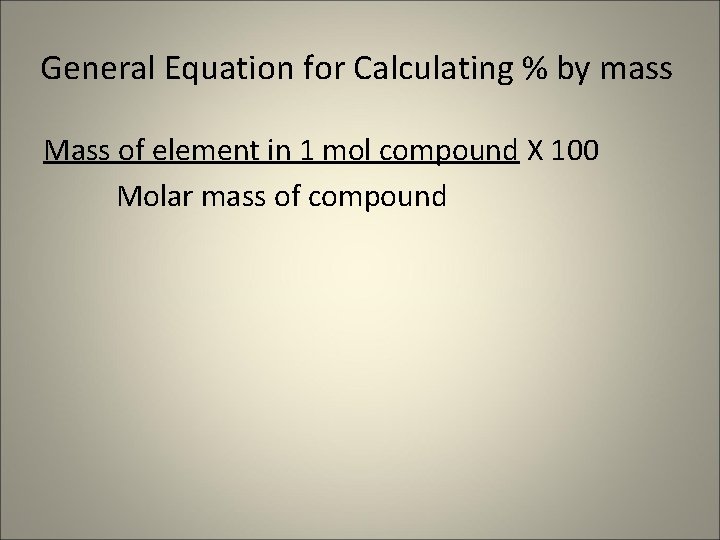
General Equation for Calculating % by mass Mass of element in 1 mol compound X 100 Molar mass of compound
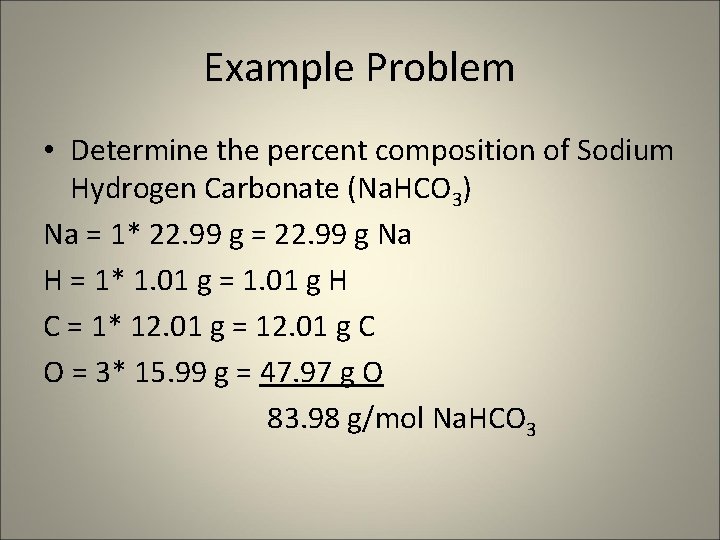
Example Problem • Determine the percent composition of Sodium Hydrogen Carbonate (Na. HCO 3) Na = 1* 22. 99 g = 22. 99 g Na H = 1* 1. 01 g = 1. 01 g H C = 1* 12. 01 g = 12. 01 g C O = 3* 15. 99 g = 47. 97 g O 83. 98 g/mol Na. HCO 3
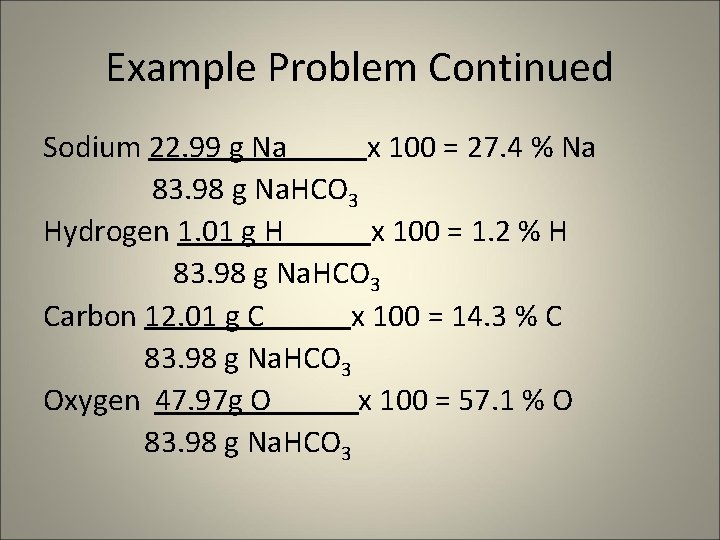
Example Problem Continued Sodium 22. 99 g Na x 100 = 27. 4 % Na 83. 98 g Na. HCO 3 Hydrogen 1. 01 g H x 100 = 1. 2 % H 83. 98 g Na. HCO 3 Carbon 12. 01 g C x 100 = 14. 3 % C 83. 98 g Na. HCO 3 Oxygen 47. 97 g O x 100 = 57. 1 % O 83. 98 g Na. HCO 3
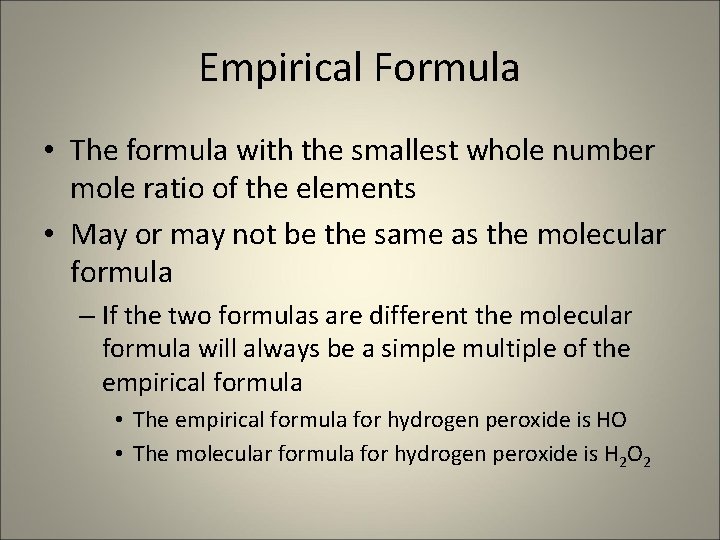
Empirical Formula • The formula with the smallest whole number mole ratio of the elements • May or may not be the same as the molecular formula – If the two formulas are different the molecular formula will always be a simple multiple of the empirical formula • The empirical formula for hydrogen peroxide is HO • The molecular formula for hydrogen peroxide is H 2 O 2
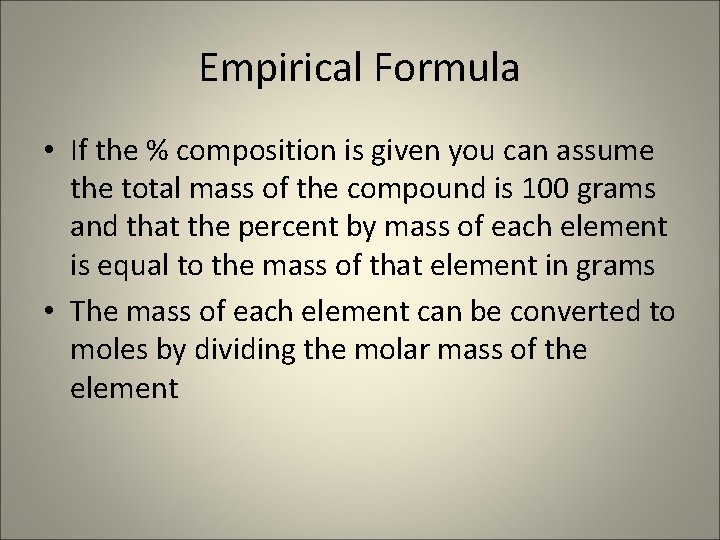
Empirical Formula • If the % composition is given you can assume the total mass of the compound is 100 grams and that the percent by mass of each element is equal to the mass of that element in grams • The mass of each element can be converted to moles by dividing the molar mass of the element
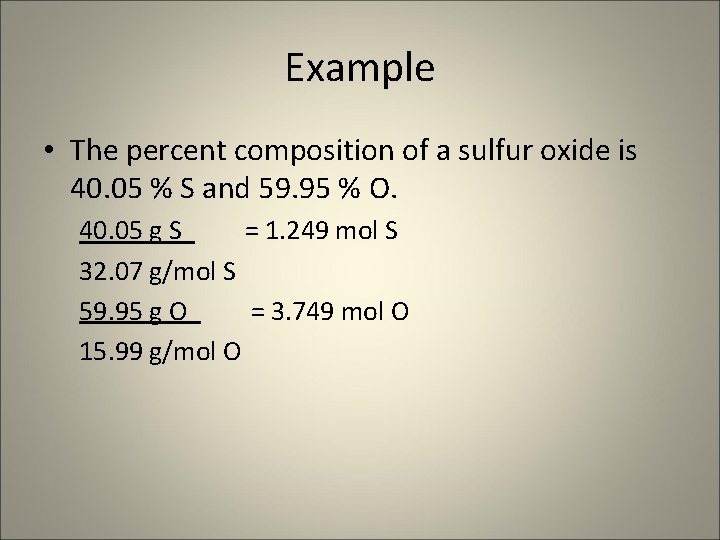
Example • The percent composition of a sulfur oxide is 40. 05 % S and 59. 95 % O. 40. 05 g S = 1. 249 mol S 32. 07 g/mol S 59. 95 g O = 3. 749 mol O 15. 99 g/mol O
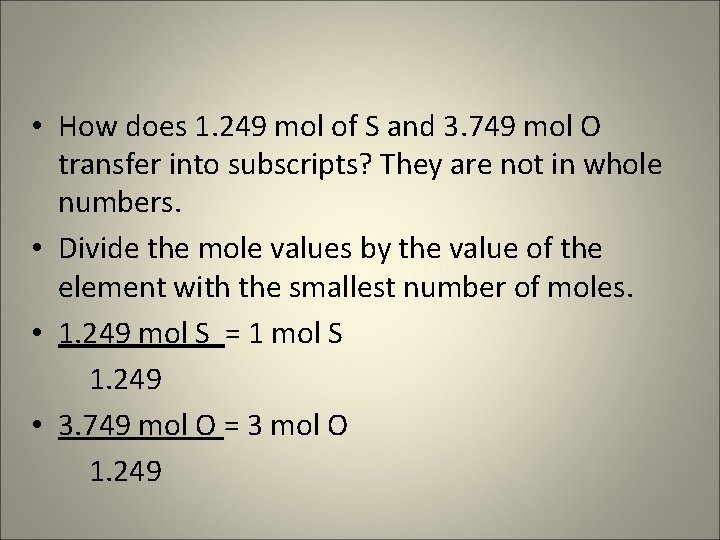
• How does 1. 249 mol of S and 3. 749 mol O transfer into subscripts? They are not in whole numbers. • Divide the mole values by the value of the element with the smallest number of moles. • 1. 249 mol S = 1 mol S 1. 249 • 3. 749 mol O = 3 mol O 1. 249
• The simplest whole number mole ratio of S atoms to O atoms is 1: 3. • The empirical formula for the oxide of sulfur is SO 3 • The calculated mole values may not always be whole numbers – In these cases all the mole values must be multiplied by the smallest factor that will make them whole numbers
• % to Mass • Mass to Mole • Divide by smallest • Multiply until whole
Practice Problems 48. Propane is hydrocarbon, a compound composed only of carbon and hydrogen. It is 81. 82% carbon and 18. 18% hydrogen. What is the empirical formula?
• The chemical analysis of aspirin indicates that the molecule is 60. 00% carbon, 4. 44% hydrogen, and 35. 56% oxygen. Determine the empirical formula for aspirin.
Molecular Formulas • Two or more substances with distinctly different properties can have the same percent composition and the same empirical formula • The subscripts in an empirical formula indicate the simplest whole-number ratio of moles of the elements in a compound • The simplest ratio does not always indicate the actual number of moles in the compound
Determining Molecular Formulas • A molecular formula specifies the actual number of atoms of each element in one molecule or formula unit of the substance • The molar mass must be determined through experimentation and compared with the mass represented by the empirical formula
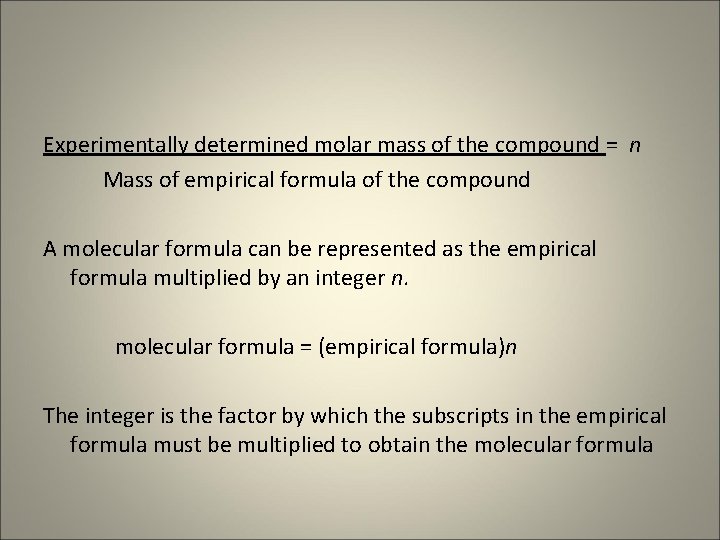
Experimentally determined molar mass of the compound = n Mass of empirical formula of the compound A molecular formula can be represented as the empirical formula multiplied by an integer n. molecular formula = (empirical formula)n The integer is the factor by which the subscripts in the empirical formula must be multiplied to obtain the molecular formula
Practice Problems 51. Analysis of a chemical used in photographic developing fluid indicates a chemical composition of 65. 45% C, 5. 45%H, and 29. 09% O. The molar mass is found to be 110. 0 g/mol. Determine the molecular formula. 52. A compound was found to contain 49. 98 g carbon and 10. 47 g hydrogen. The molar mass of the compound is 58. 12 g/mol. Determine the molecular formula. 53. A colorless liquid composed of 46. 68% nitrogen and 53. 32% oxygen has a molar mass of 60. 01 g/mol. What is the molecular formula?
Answers
Calculating an Empirical Formula from Mass Data