
Empirical Methods in Accounting and Finance Reading Research

- Slides: 32
Empirical Methods in Accounting and Finance Reading: Research methods for business students, SLT, Pearson. 1
S 4 Literature review 2
If you have read previous papers that I provide in earlier weeks, then you may have already had a quick impression regarding reading literature. It could be boring, time-consuming, and difficult. But reviewing could be even worse than reading. 3
As part of your research, you will be asked to ‘review the literature’, ‘write a literature review’ or ‘critically review the literature’ on a given topic. Some students fear the literature review, not because of the associated reading but because of the requirement (i) to make reasoned judgements about the value of each piece of work and (ii) to organise ideas and findings of value into a review. 4
Three ways in which you are likely to use literature (Creswell, 2012), 1. Preliminary search helps you to generate and refine your research ideas (we discussed this). 2. Often referred to as the critical review or critical literature review, provides the context and theoretical framework for your research. 3. Place your research findings within the wider body of knowledge and forms part of your discussion chapter (we will see this later). 5
Three ways in which you are likely to use literature (Creswell, 2012), 1. Preliminary search helps you to generate and refine your research ideas (we discussed this). 2. Often referred to as the critical review or critical literature review, provides the context and theoretical framework for your research. 3. Place your research findings within the wider body of knowledge and forms part of your discussion chapter (we will see this later). 6
Simply, it should help to define ‘where you are’. 7
Following the 2 nd tutorial, ‘asset pricing’… though you have obtained prior knowledge from other modules, but mainly centres on CAPM and APT. 8
CAPM and APT What you know, e. g. , what the model is, what beta is/implies, what the factor is, etc. But do you know, e. g. , 1. How beta is obtained from an empirical way? 2. What proxies for market return? 3. What proxies for risk-free rate? 4. Which country/market it fits? 5. More recent development in this area? 9
While all these questions are answered in the literature, this session mainly focuses on the last one. ‘A study on the CAPM in Country ABC’ CAPM, Fama and French (1993), Carhart (1997), Amihud (2002), Fama and French (2015), Hou et al. (2015, 2020), Fama and French (2020). These papers form the mainstream, and more are on applications. 10
Some similar cases are seen in last year. Many were working on corporate governance, banking industry, and Islamic finance, but normally these works show zero awareness of the current status of knowledge. 1. Do something that is quite outdated 2. Do something that has been extensively done Perhaps okay for a report, but not for research. 11
Although you may feel that you already have a reasonable knowledge of your research area, reviewing the literature critically is essential. You need to demonstrate awareness of the current state of knowledge in your subject, its limitations, and how your research fits in this wider context (Gill and Johnson, 2010). 12
Bonus: If you are not able to find any papers published in good journals over the past five years (i. e. , 2016 onwards), you may need to change your topic. We will define ‘good’ later. ‘Five’ comes from practice. Last year, a student came to me, arguing that the topic was not outdated as there were several 21 st century papers… The logic follows topic selection when you find nobody has ever done this before… (medical example? ) 13
Although the literature will enhance your subject knowledge and help you to clarify your research question(s) further, only those relevant to your research will be included in your review. 14
It is like sharing your on-campus location. You could simply say I am in ABC building. Or, if you want to know theory of relativity, should I start from a detailed introduction to Albert Einstein? If too much less relevant information is provided, it would be misleading. Always bear your research question in mind! 15
E. g. , You are about to propose one new pricing factor based on prior pricing models: size effects? momentum effects and contrarian effects? B-CAPM? You are about to examine gender-performance relation: education? age? a brief history of corporate governance? However, that is not to say you should even not read those studies. They are still helpful in providing more insights into your selected topic. 16
Your literature review should be a constructively critical analysis that develops a clear argument about what the published literature indicates is known and not known about your research question (Wallace and Wray 2011). It is NOT just a basket of book and journal article reviews describing and summarising what each is about. Rather, you will need to assess what is significant to your research and, on this basis, decide whether or not to include it (stay focused). If you think the concepts, theories, arguments or empirical research findings reported and discussed in an article are unclear, biased or inconsistent with other work and need to be researched further, you will need to justify why (think about tutorial 1). 17
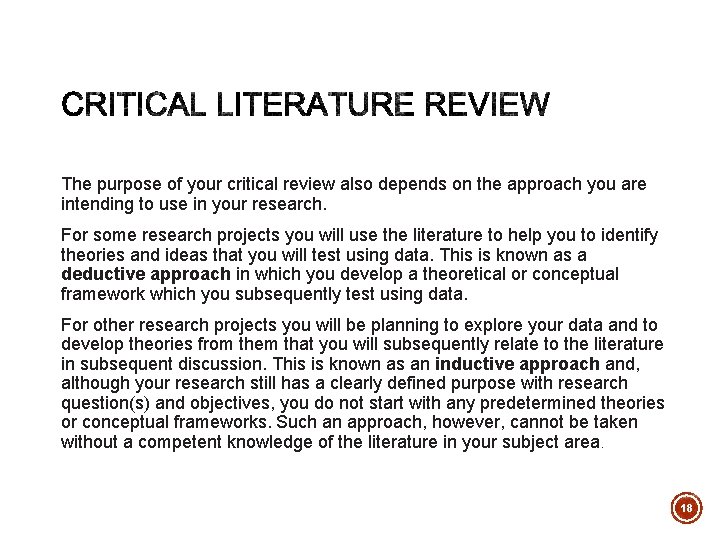
The purpose of your critical review also depends on the approach you are intending to use in your research. For some research projects you will use the literature to help you to identify theories and ideas that you will test using data. This is known as a deductive approach in which you develop a theoretical or conceptual framework which you subsequently test using data. For other research projects you will be planning to explore your data and to develop theories from them that you will subsequently relate to the literature in subsequent discussion. This is known as an inductive approach and, although your research still has a clearly defined purpose with research question(s) and objectives, you do not start with any predetermined theories or conceptual frameworks. Such an approach, however, cannot be taken without a competent knowledge of the literature in your subject area. 18
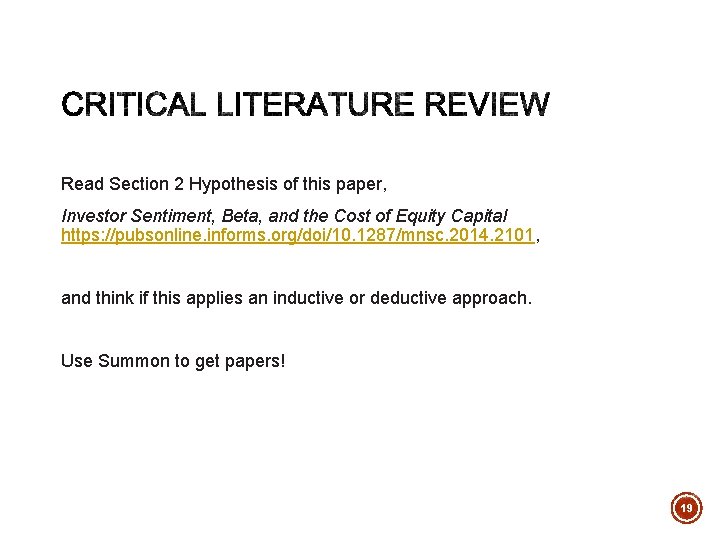
Read Section 2 Hypothesis of this paper, Investor Sentiment, Beta, and the Cost of Equity Capital https: //pubsonline. informs. org/doi/10. 1287/mnsc. 2014. 2101, and think if this applies an inductive or deductive approach. Use Summon to get papers! 19
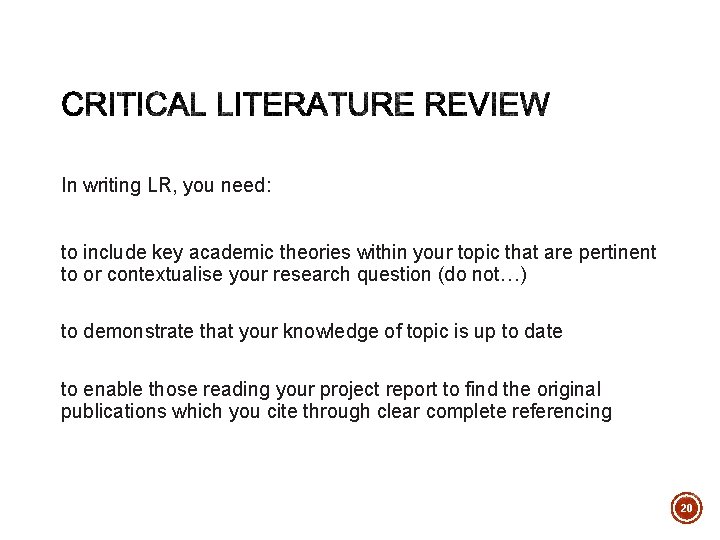
In writing LR, you need: to include key academic theories within your topic that are pertinent to or contextualise your research question (do not…) to demonstrate that your knowledge of topic is up to date to enable those reading your project report to find the original publications which you cite through clear complete referencing 20
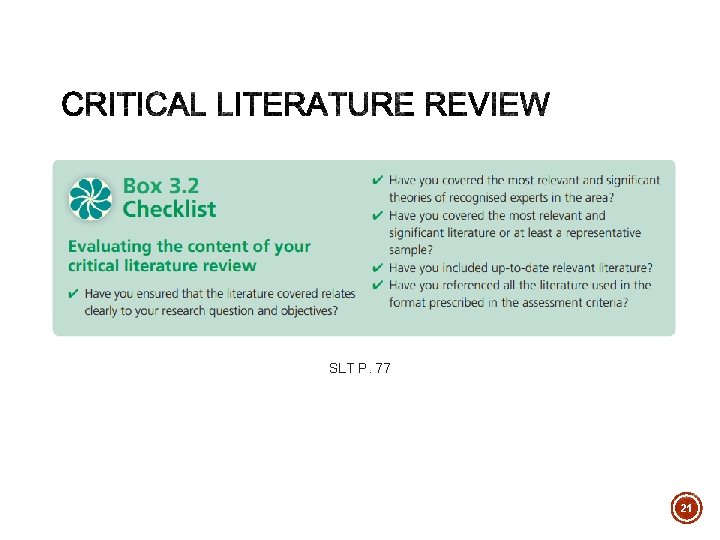
SLT P. 77 21
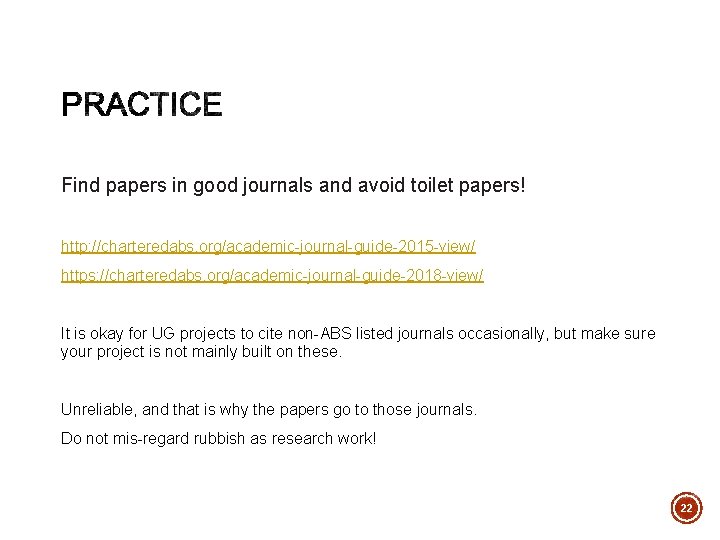
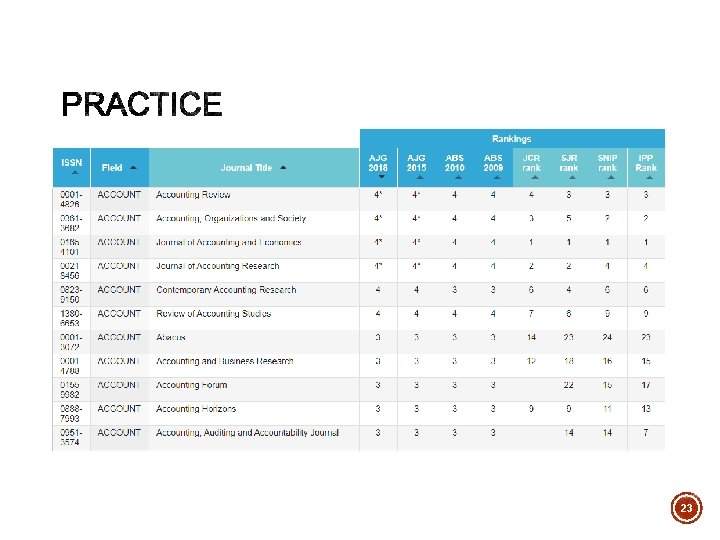
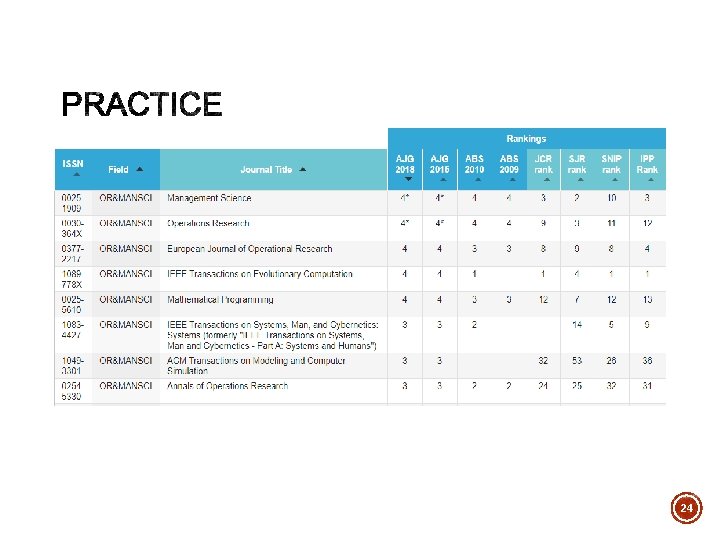
Find papers in good journals and avoid toilet papers! http: //charteredabs. org/academic-journal-guide-2015 -view/ https: //charteredabs. org/academic-journal-guide-2018 -view/ It is okay for UG projects to cite non-ABS listed journals occasionally, but make sure your project is not mainly built on these. Unreliable, and that is why the papers go to those journals. Do not mis-regard rubbish as research work! 22
23
24
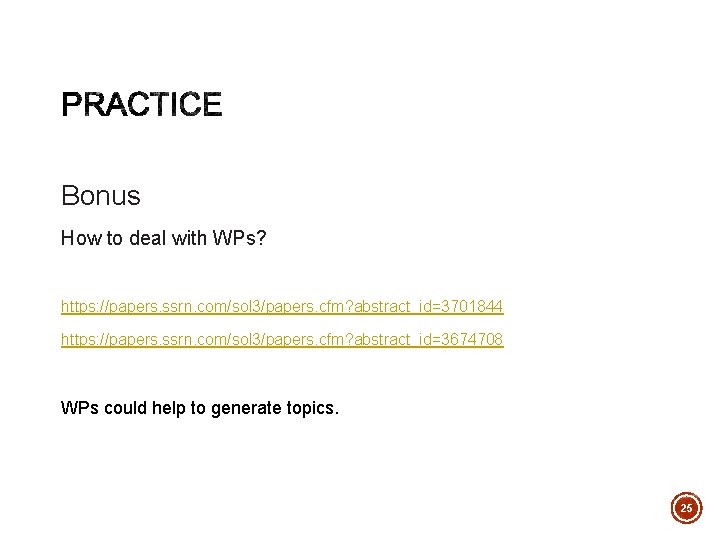
Bonus How to deal with WPs? https: //papers. ssrn. com/sol 3/papers. cfm? abstract_id=3701844 https: //papers. ssrn. com/sol 3/papers. cfm? abstract_id=3674708 WPs could help to generate topics. 25
Being critical in reviewing the literature is a combination of your skills and the attitude with which you read. In critically reviewing the literature, you need to read the literature about your research topic with some scepticism and be willing to question what you read. This means you need to be constantly considering and justifying your own critical stance with clear arguments and references to the literature rather than just giving your own opinion. 26
You will have to read widely on your research topic and have a good understanding of the literature. Critically reviewing the literature for your research project, therefore, requires you to have gained topicbased background knowledge, understanding, the ability to reflect upon and to analyse the literature and, based on this, to make reasoned judgements that are argued effectively. When you use these skills to review the literature, the term ‘critical’ refers to the judgement you exercise. 27
It therefore describes the process of providing a detailed and justified analysis of, and commentary on, the merits and faults of the key literature within your chosen area. This means that, for your review to be critical, you will need to have shown critical judgement. Part of this judgement will inevitably mean being able to identify the most relevant and significant theories. For some research topics there will be a pre-existing, clearly developed theoretical base. For others you will need to integrate a number of different theoretical strands to develop your understanding. Do not make a huge step! 28
The LR that you write for your project should be a description and critical analysis of what other authors have written. When drafting your review you therefore need to focus on your research question(s) and objectives. One way of helping you to focus is to think of your literature review as discussing how far existing published research goes in answering your research question(s). The shortfall in the literature will be addressed, at least partially, in the remainder of your project report. (where you are and where the gap is) Another way of helping you to focus is to ask yourself how your review relates to your objectives. If it does not, or does so only partially, there is a need for a clearer focus on your objectives. Normally you need an independent chapter for LR. 29
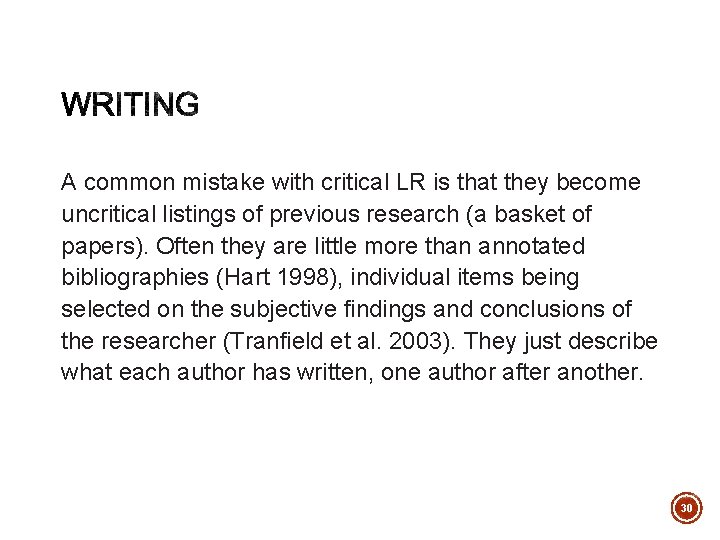
A common mistake with critical LR is that they become uncritical listings of previous research (a basket of papers). Often they are little more than annotated bibliographies (Hart 1998), individual items being selected on the subjective findings and conclusions of the researcher (Tranfield et al. 2003). They just describe what each author has written, one author after another. 30
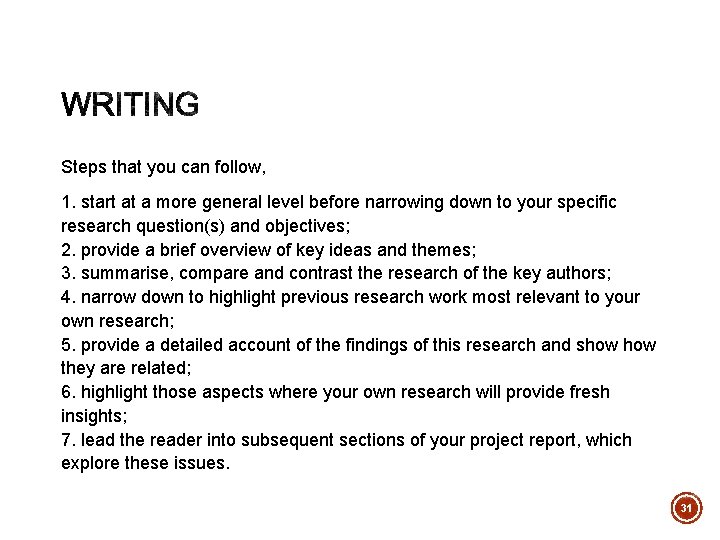
Steps that you can follow, 1. start at a more general level before narrowing down to your specific research question(s) and objectives; 2. provide a brief overview of key ideas and themes; 3. summarise, compare and contrast the research of the key authors; 4. narrow down to highlight previous research work most relevant to your own research; 5. provide a detailed account of the findings of this research and show they are related; 6. highlight those aspects where your own research will provide fresh insights; 7. lead the reader into subsequent sections of your project report, which explore these issues. 31
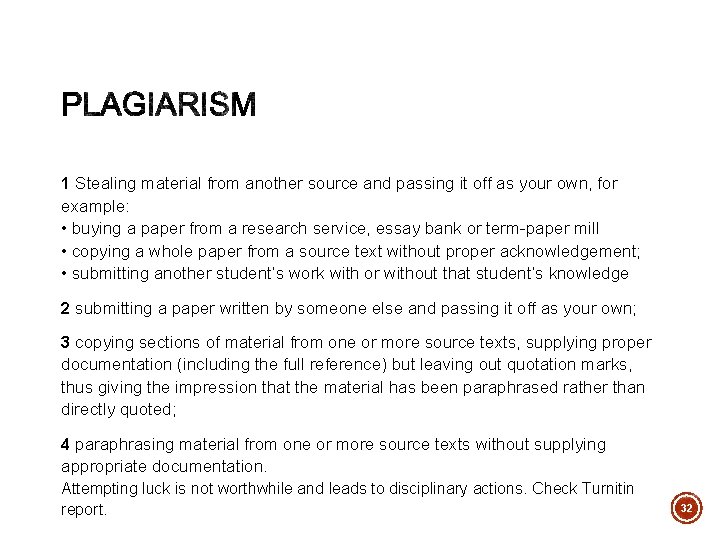
1 Stealing material from another source and passing it off as your own, for example: • buying a paper from a research service, essay bank or term-paper mill • copying a whole paper from a source text without proper acknowledgement; • submitting another student’s work with or without that student’s knowledge 2 submitting a paper written by someone else and passing it off as your own; 3 copying sections of material from one or more source texts, supplying proper documentation (including the full reference) but leaving out quotation marks, thus giving the impression that the material has been paraphrased rather than directly quoted; 4 paraphrasing material from one or more source texts without supplying appropriate documentation. Attempting luck is not worthwhile and leads to disciplinary actions. Check Turnitin report. 32