
Empirical Formula Chemistry Chapter Ten Mrs Luckett Empirical
- Slides: 10
Empirical Formula Chemistry Chapter Ten Mrs Luckett
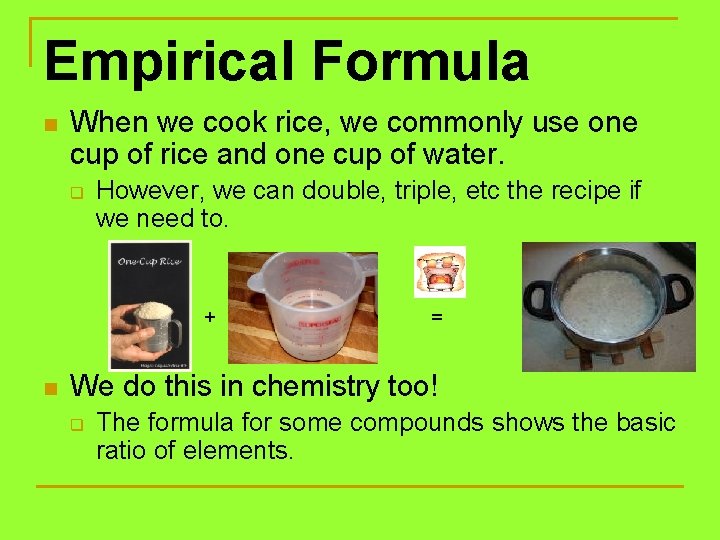
Empirical Formula n When we cook rice, we commonly use one cup of rice and one cup of water. q However, we can double, triple, etc the recipe if we need to. + n = We do this in chemistry too! q The formula for some compounds shows the basic ratio of elements.
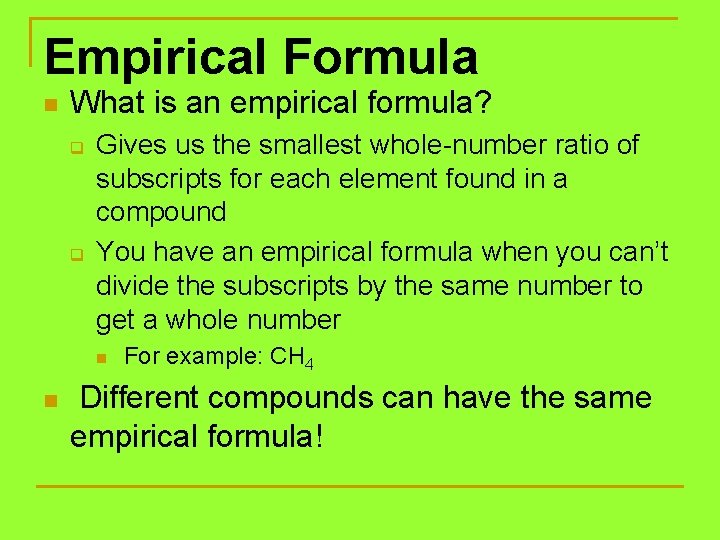
Empirical Formula n What is an empirical formula? q q Gives us the smallest whole-number ratio of subscripts for each element found in a compound You have an empirical formula when you can’t divide the subscripts by the same number to get a whole number n n For example: CH 4 Different compounds can have the same empirical formula!
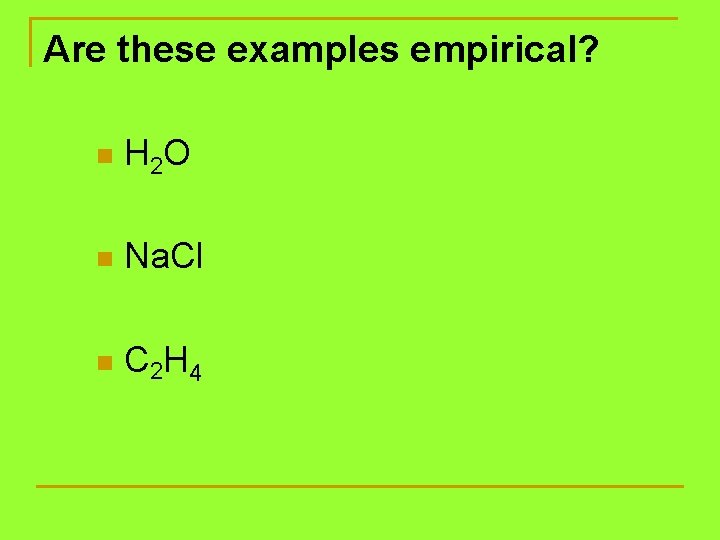
Are these examples empirical? n H 2 O n Na. Cl n C 2 H 4
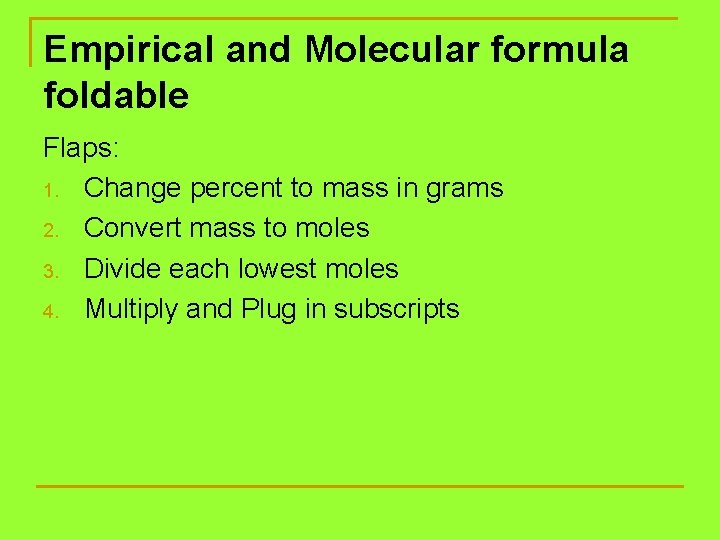
Empirical and Molecular formula foldable Flaps: 1. Change percent to mass in grams 2. Convert mass to moles 3. Divide each lowest moles 4. Multiply and Plug in subscripts
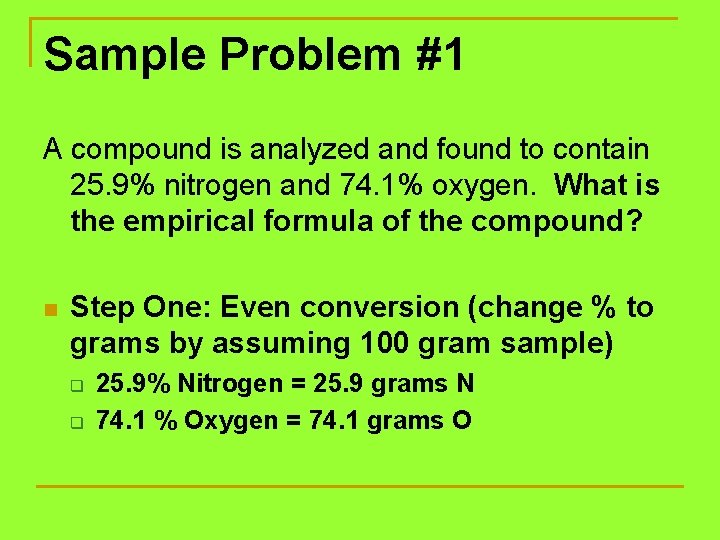
Sample Problem #1 A compound is analyzed and found to contain 25. 9% nitrogen and 74. 1% oxygen. What is the empirical formula of the compound? n Step One: Even conversion (change % to grams by assuming 100 gram sample) q q 25. 9% Nitrogen = 25. 9 grams N 74. 1 % Oxygen = 74. 1 grams O
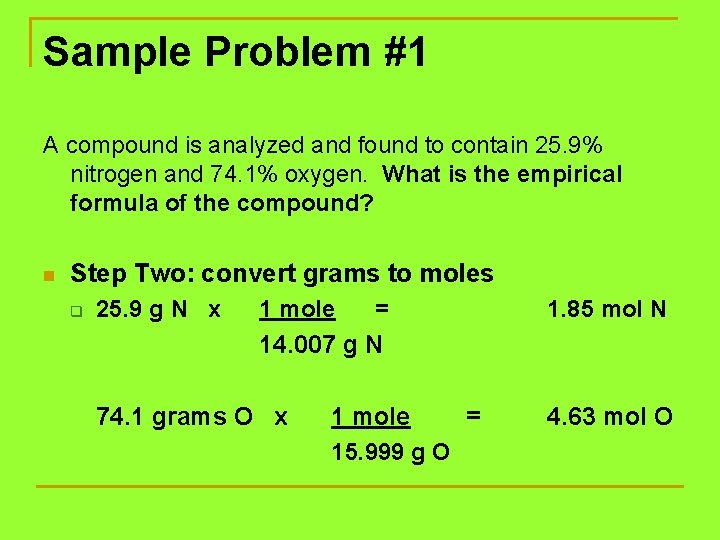
Sample Problem #1 A compound is analyzed and found to contain 25. 9% nitrogen and 74. 1% oxygen. What is the empirical formula of the compound? n Step Two: convert grams to moles q 25. 9 g N x 1 mole = 14. 007 g N 74. 1 grams O x 1 mole = 15. 999 g O 1. 85 mol N 4. 63 mol O
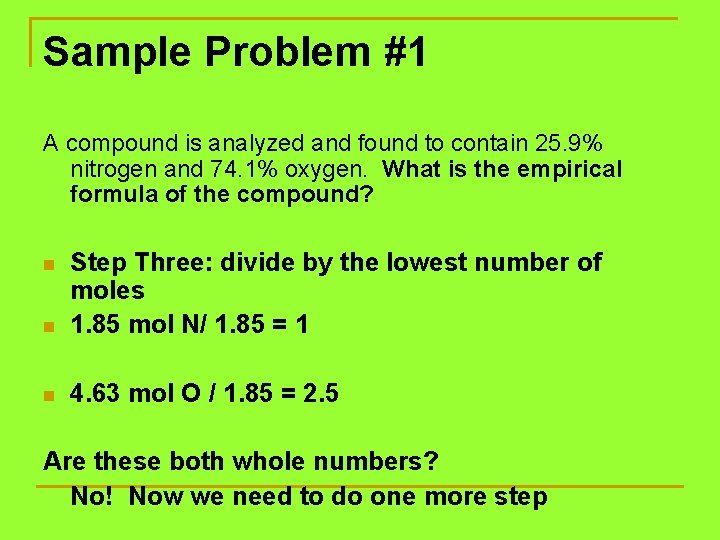
Sample Problem #1 A compound is analyzed and found to contain 25. 9% nitrogen and 74. 1% oxygen. What is the empirical formula of the compound? n Step Three: divide by the lowest number of moles 1. 85 mol N/ 1. 85 = 1 n 4. 63 mol O / 1. 85 = 2. 5 n Are these both whole numbers? No! Now we need to do one more step
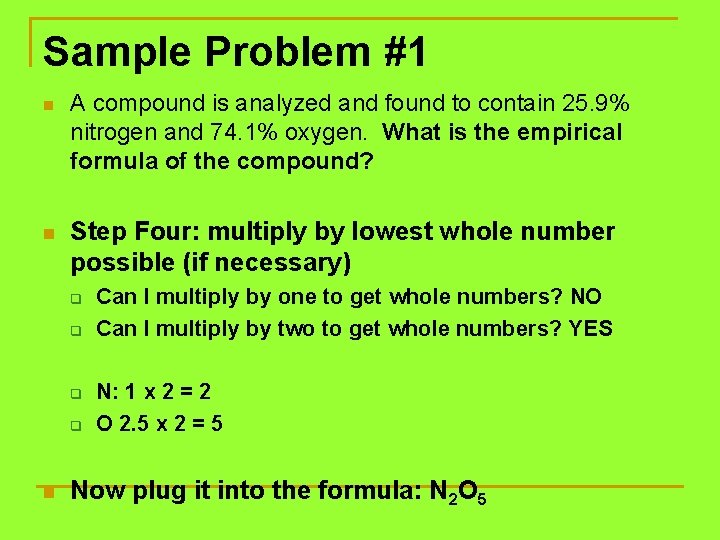
Sample Problem #1 n A compound is analyzed and found to contain 25. 9% nitrogen and 74. 1% oxygen. What is the empirical formula of the compound? n Step Four: multiply by lowest whole number possible (if necessary) q q n Can I multiply by one to get whole numbers? NO Can I multiply by two to get whole numbers? YES N: 1 x 2 = 2 O 2. 5 x 2 = 5 Now plug it into the formula: N 2 O 5
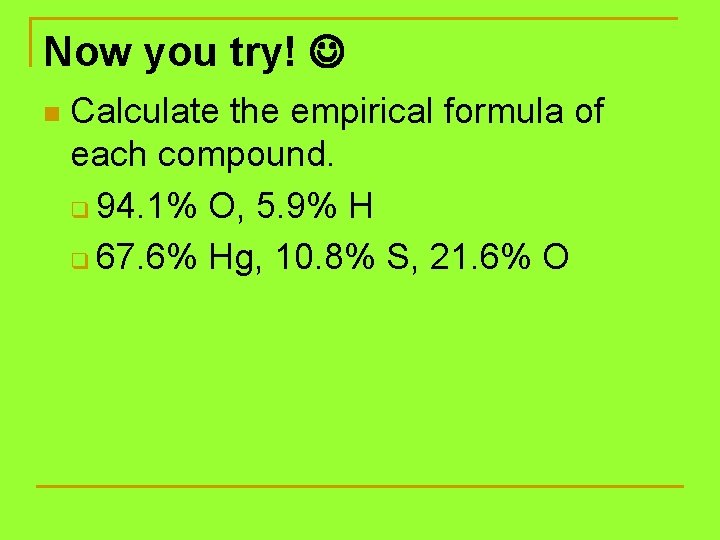
Now you try! n Calculate the empirical formula of each compound. q 94. 1% O, 5. 9% H q 67. 6% Hg, 10. 8% S, 21. 6% O