
Empirical and Molecular Formulas Caffeine is 49 48
- Slides: 8
Empirical and Molecular Formulas
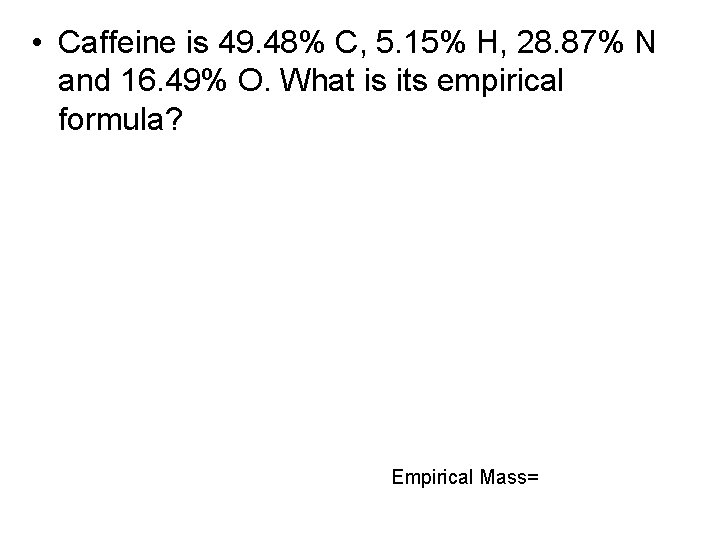
• Caffeine is 49. 48% C, 5. 15% H, 28. 87% N and 16. 49% O. What is its empirical formula? Empirical Mass=
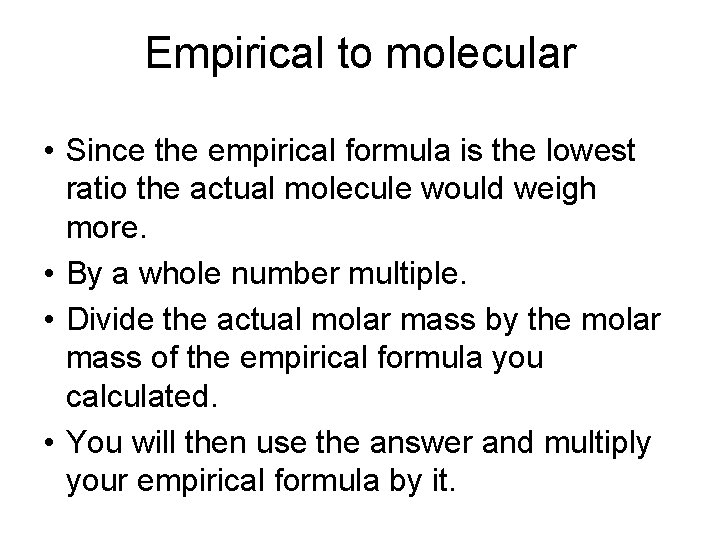
Empirical to molecular • Since the empirical formula is the lowest ratio the actual molecule would weigh more. • By a whole number multiple. • Divide the actual molar mass by the molar mass of the empirical formula you calculated. • You will then use the answer and multiply your empirical formula by it.
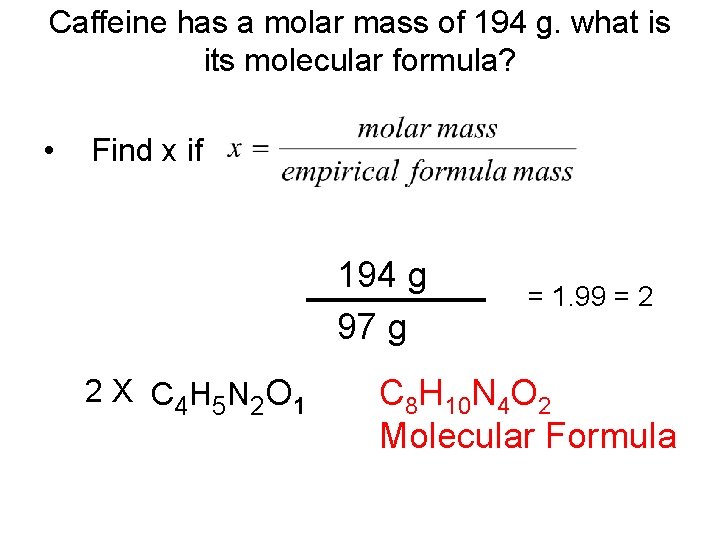
Caffeine has a molar mass of 194 g. what is its molecular formula? • Find x if 194 g 97 g 2 X C 4 H 5 N 2 O 1 = 1. 99 = 2 C 8 H 10 N 4 O 2 Molecular Formula
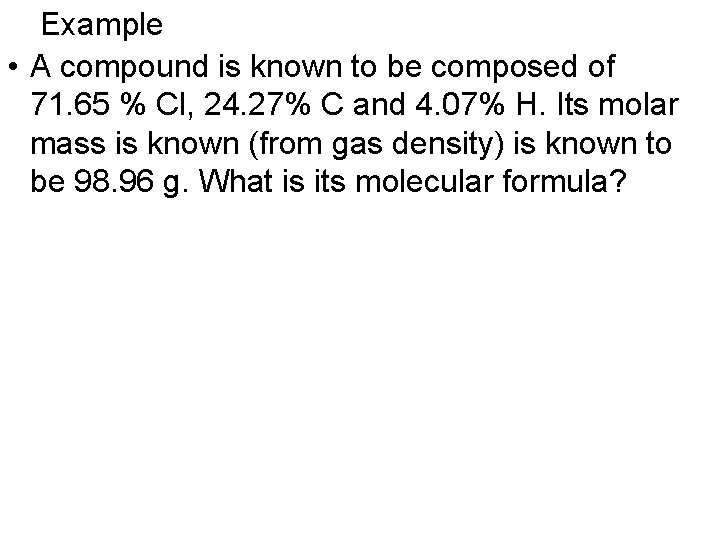
Example • A compound is known to be composed of 71. 65 % Cl, 24. 27% C and 4. 07% H. Its molar mass is known (from gas density) is known to be 98. 96 g. What is its molecular formula?
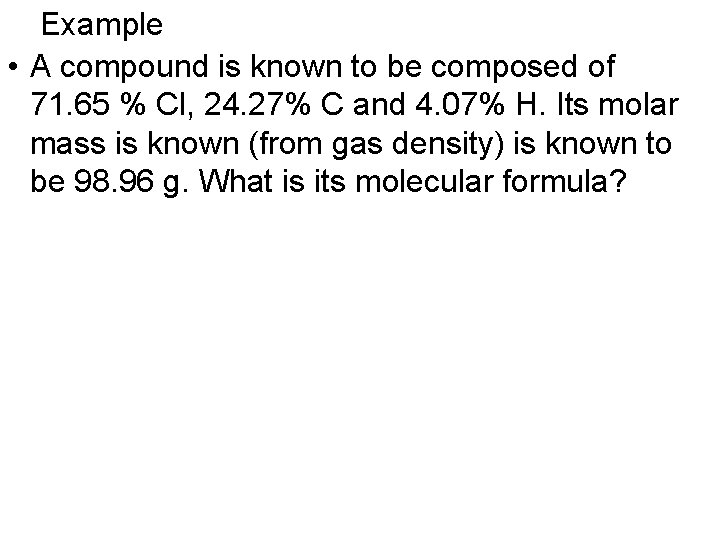
Example • A compound is known to be composed of 71. 65 % Cl, 24. 27% C and 4. 07% H. Its molar mass is known (from gas density) is known to be 98. 96 g. What is its molecular formula?
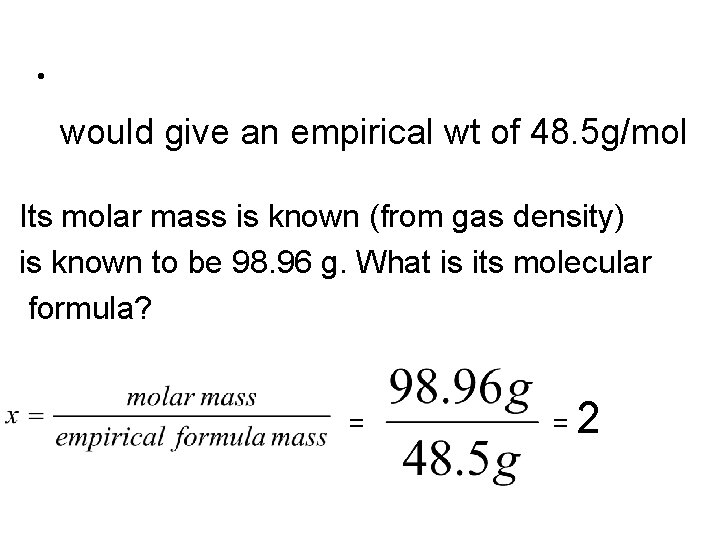
• would give an empirical wt of 48. 5 g/mol Its molar mass is known (from gas density) is known to be 98. 96 g. What is its molecular formula? = =2
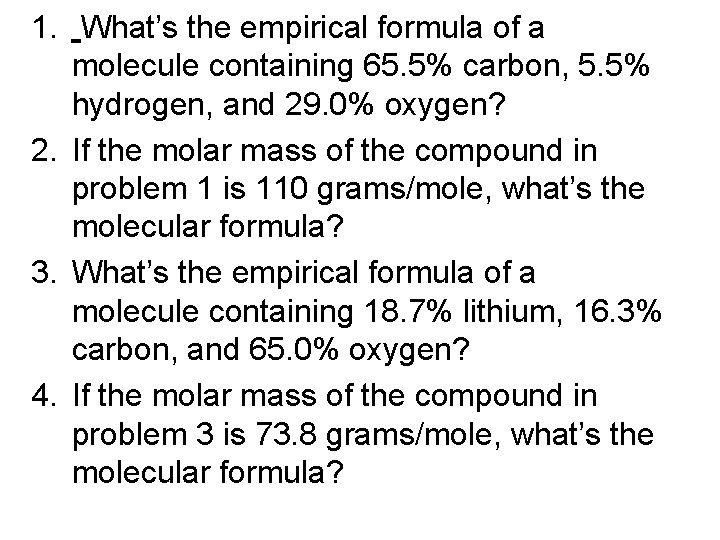
1. What’s the empirical formula of a molecule containing 65. 5% carbon, 5. 5% hydrogen, and 29. 0% oxygen? 2. If the molar mass of the compound in problem 1 is 110 grams/mole, what’s the molecular formula? 3. What’s the empirical formula of a molecule containing 18. 7% lithium, 16. 3% carbon, and 65. 0% oxygen? 4. If the molar mass of the compound in problem 3 is 73. 8 grams/mole, what’s the molecular formula?