
EMPATHIC RESPONSEDRAMATI C PERFORMANCE Year 9 Empathic response


- Slides: 36
EMPATHIC RESPONSE/DRAMATI C PERFORMANCE Year 9
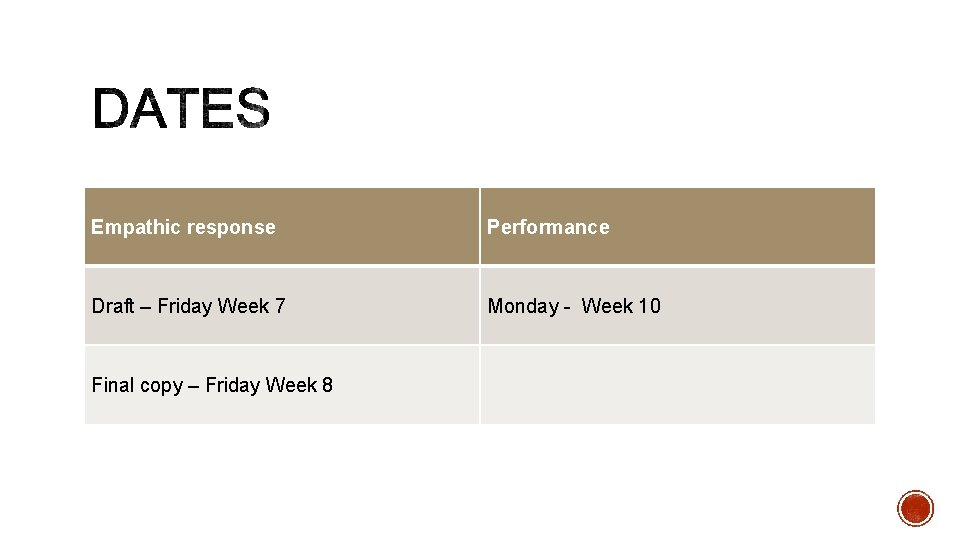
Empathic response Performance Draft – Friday Week 7 Monday - Week 10 Final copy – Friday Week 8
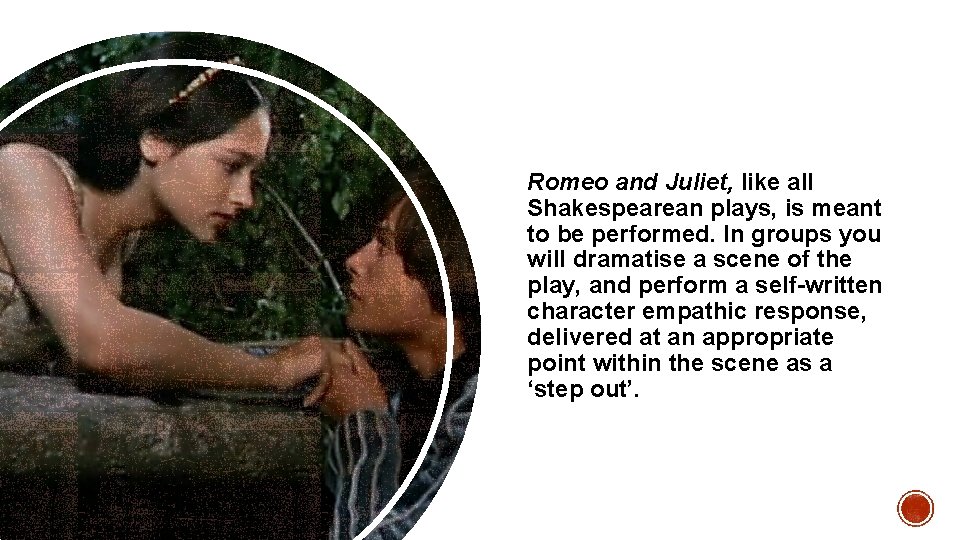
Romeo and Juliet, like all Shakespearean plays, is meant to be performed. In groups you will dramatise a scene of the play, and perform a self-written character empathic response, delivered at an appropriate point within the scene as a ‘step out’.
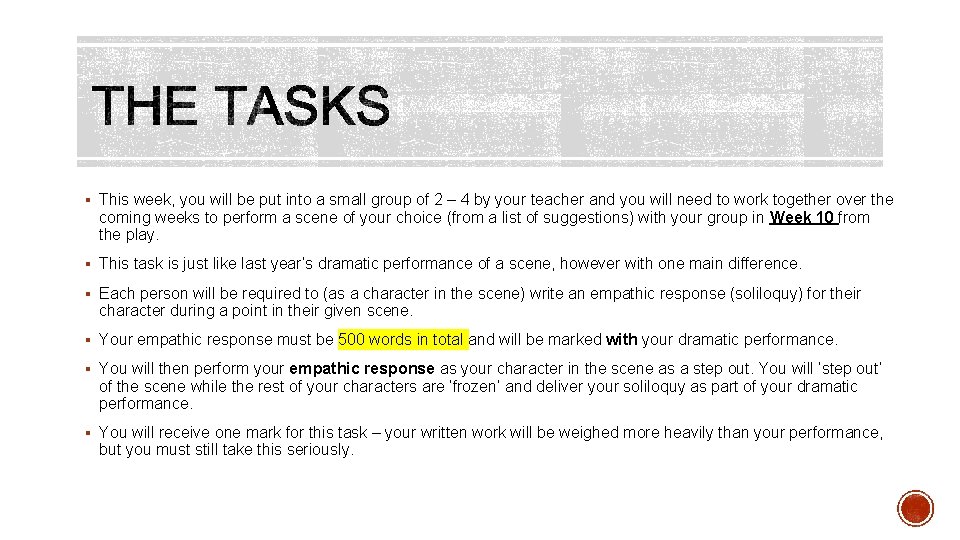
§ This week, you will be put into a small group of 2 – 4 by your teacher and you will need to work together over the coming weeks to perform a scene of your choice (from a list of suggestions) with your group in Week 10 from the play. § This task is just like last year’s dramatic performance of a scene, however with one main difference. § Each person will be required to (as a character in the scene) write an empathic response (soliloquy) for their character during a point in their given scene. § Your empathic response must be 500 words in total and will be marked with your dramatic performance. § You will then perform your empathic response as your character in the scene as a step out. You will ‘step out’ of the scene while the rest of your characters are ‘frozen’ and deliver your soliloquy as part of your dramatic performance. § You will receive one mark for this task – your written work will be weighed more heavily than your performance, but you must still take this seriously.
CHECKLIST today 1. Decide on your Act and Scene for your performance. Choose which characters you will embody. 2. Copy and paste your chosen scene into a word document (from Spark Notes) and edit out any unnecessary lines (show this to me for final approval in week 7). 3. Assign someone to print the scripts for each group member this week. 4. Decide on where you would like to place your step out/empathic response. Ensure there is ‘balance’ in your scene. For 2 characters For 3 characters For 4 characters -Benvolio and Romeo discuss Rosaline (Act 1, Scene 1 – lines 130 onwards) -The Balcony scene (Act 2, Scene 2) -Friar Lawrence and Romeo (Act 2, Scene 3) -Juliet and nurse discuss her new love (Act 2, Scene 5) -Juliet and nurse discuss Romeo’s banishment (Act 3, Scene 2) -Lady Capulet, Juliet and nurse discuss Paris (Act 1, Scene 3) -Paris, Juliet and Friar Lawrence (Act 4, Scene 1) -Capulet party (Act 1, Scene 5) -Fight scene (Act 3, Scene 1)
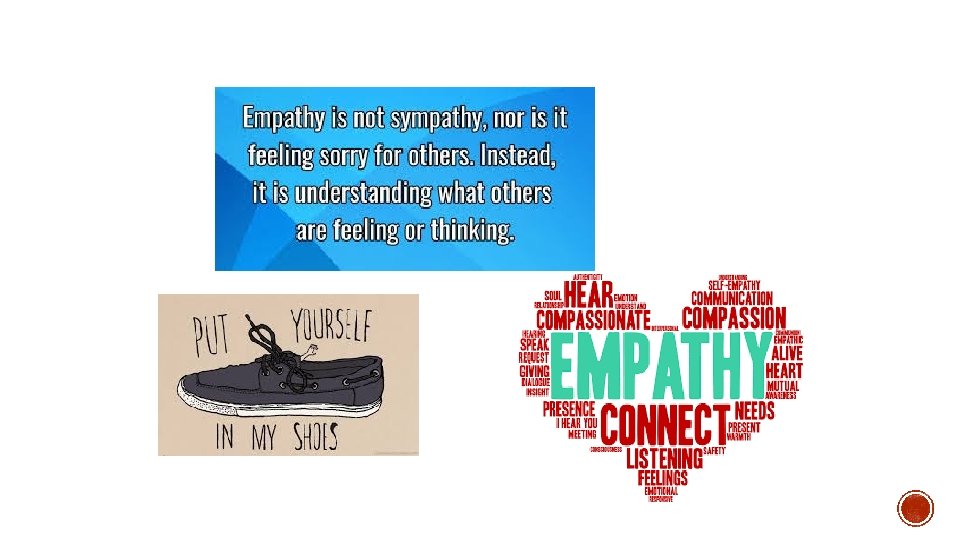
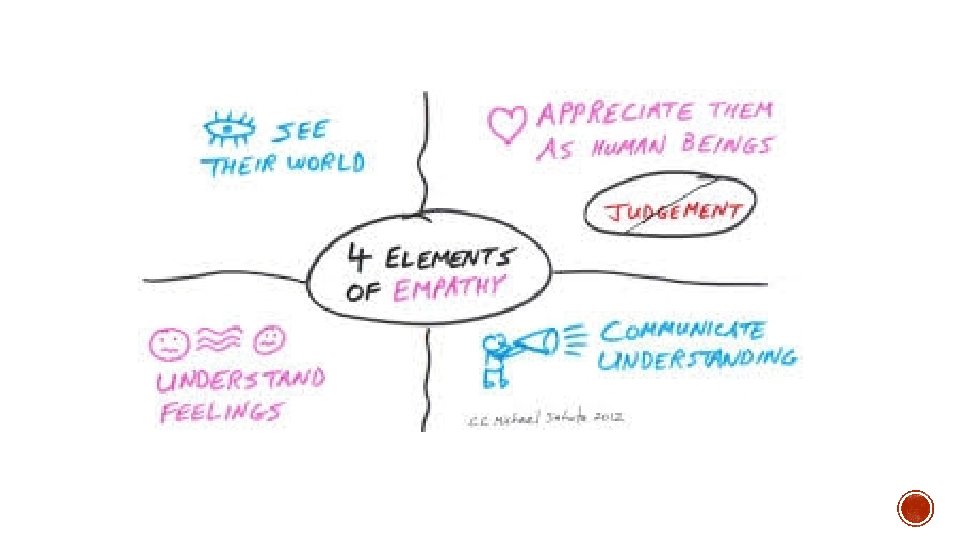
EMPATHIC MEANS EMPATHY § Empathy means being able ‘to put yourself in someone else’s shoes. ’ To be able to understand what they are thinking, feeling and experiencing. § In a sense, empathic writing asks you to ‘be them’, to write as though you are that character/person. § Empathic writing means that you have to put yourself in the position of a character and write in their voice, while showcasing your knowledge of the text in your own words.
§ Involves one solitary speaker § Definition: A speech that one gives to oneself – in a play, a character delivering a soliloquy talks to herself/himself – thinking out loud, so the audience better understands what is happening to the character internally. § It simply means a character speaking all by himself/herself, to himself/herself. § E. g. THE BALCONY SCENE (ACT 2, SCENE 2): Romeo’s soliloquy when he is watching Juliet on the balcony – he is expressing his thoughts of Juliet, though Juliet cannot hear him/is unaware.
§ They are creative or empathetic pieces of writing that explore a specific moment/s through the eyes of a particular character. § They share knowledge of the incident or awareness of the situation. § You do not retell the story. § Present tense - write your current thoughts (Immediately after the event). § Refer to previous events that have contributed to your current state of mind. § You share your personal thoughts as you interpret them for the character.
§ You must write an Empathic Response (soliloquy) that reflects your characters thoughts and feelings in the specific moment that the scene freezes as your character. § It is a moment of reflection for the character, YOUR EMPATHIC RESPONSE in which they reveal their doubts, desires, fears, regrets, reactions to what is currently happening etc. They can also refer to any part of the play which precedes this moment. § Be specific in your word choices and use the type of language that is authentic to your character (e. g. Romeo’s religious imagery, Mercutio’s bawdy language) § This is to be written and performed in modern English. § 500 words.
Get into the mind of the character. You must place yourself in their frame of reference and see the action through their eyes – at that moment are they fearful, anxious, excited, a combination of feelings? It is a moment of reflection for the character, in which they reveal their doubts, desires, fears, regrets, reactions to what is currently happening etc. They can also refer to any part of the play which precedes this moment. What you deliver must be clearly motivated and the emotional energy must seem apt and logical in terms of what has preceded it as well as what follows It should advance the story along, by clarifying the speaker’s intentions or beliefs
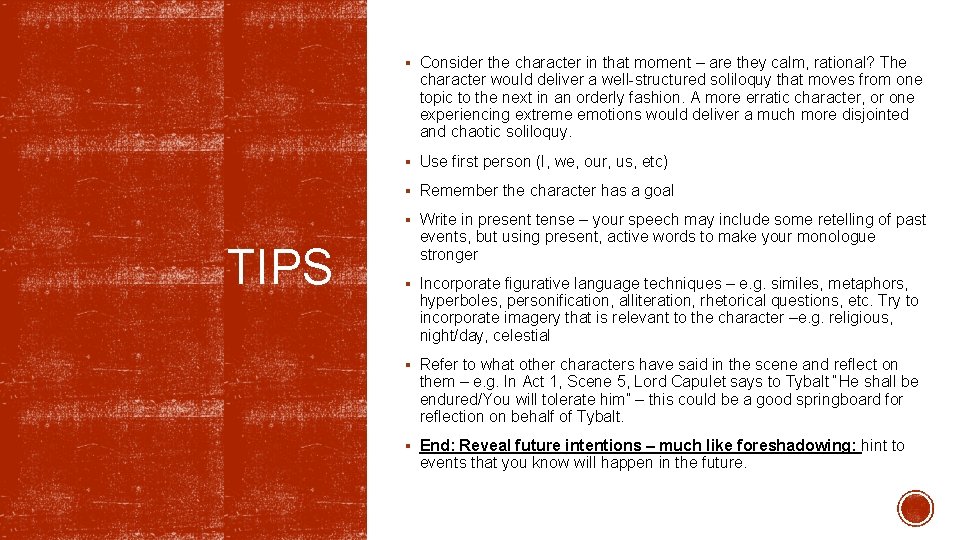
§ Consider the character in that moment – are they calm, rational? The character would deliver a well-structured soliloquy that moves from one topic to the next in an orderly fashion. A more erratic character, or one experiencing extreme emotions would deliver a much more disjointed and chaotic soliloquy. § Use first person (I, we, our, us, etc) § Remember the character has a goal § Write in present tense – your speech may include some retelling of past TIPS events, but using present, active words to make your monologue stronger § Incorporate figurative language techniques – e. g. similes, metaphors, hyperboles, personification, alliteration, rhetorical questions, etc. Try to incorporate imagery that is relevant to the character –e. g. religious, night/day, celestial § Refer to what other characters have said in the scene and reflect on them – e. g. In Act 1, Scene 5, Lord Capulet says to Tybalt “He shall be endured/You will tolerate him” – this could be a good springboard for reflection on behalf of Tybalt. § End: Reveal future intentions – much like foreshadowing: hint to events that you know will happen in the future.
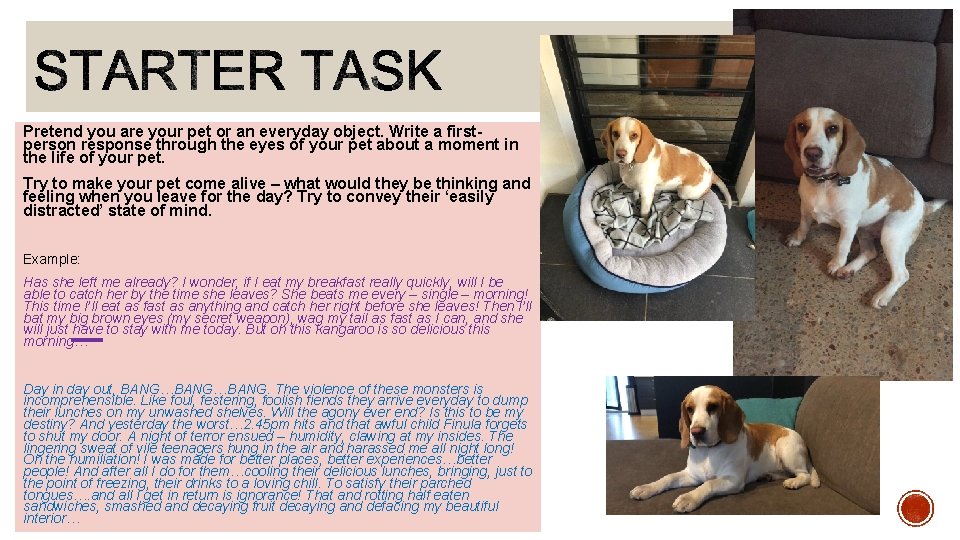
Pretend you are your pet or an everyday object. Write a firstperson response through the eyes of your pet about a moment in the life of your pet. Try to make your pet come alive – what would they be thinking and feeling when you leave for the day? Try to convey their ‘easily distracted’ state of mind. Example: Has she left me already? I wonder, if I eat my breakfast really quickly, will I be able to catch her by the time she leaves? She beats me every – single – morning! This time I’ll eat as fast as anything and catch her right before she leaves! Then I’ll bat my big brown eyes (my secret weapon), wag my tail as fast as I can, and she will just have to stay with me today. But oh this kangaroo is so delicious this morning… Day in day out, BANG…BANG. The violence of these monsters is incomprehensible. Like foul, festering, foolish fiends they arrive everyday to dump their lunches on my unwashed shelves. Will the agony ever end? Is this to be my destiny? And yesterday the worst… 2. 45 pm hits and that awful child Finula forgets to shut my door. A night of terror ensued – humidity, clawing at my insides. The lingering sweat of vile teenagers hung in the air and harassed me all night long! Oh the humiliation! I was made for better places, better experiences…better people! And after all I do for them…cooling their delicious lunches, bringing, just to the point of freezing, their drinks to a loving chill. To satisfy their parched tongues…. and all I get in return is ignorance! That and rotting half eaten sandwiches, smashed and decaying fruit decaying and defacing my beautiful interior…
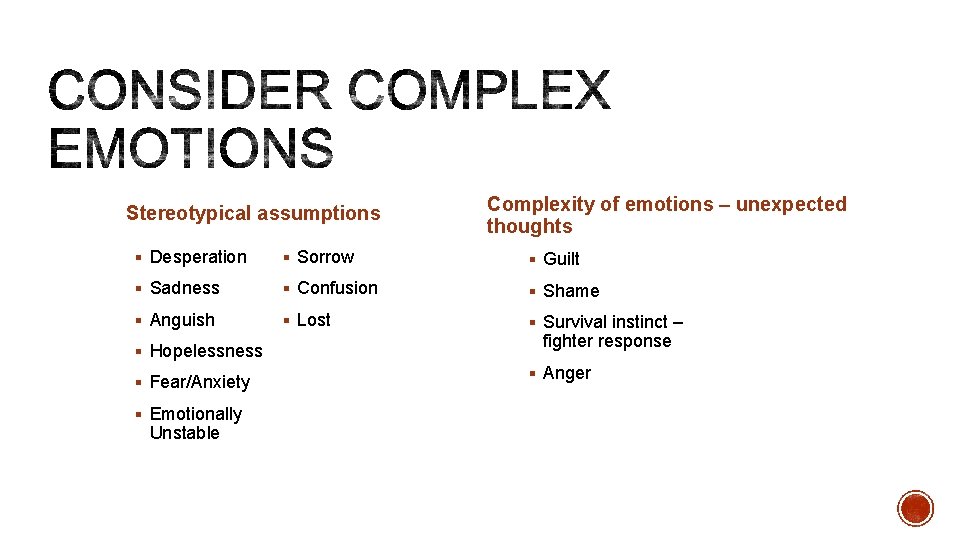
Stereotypical assumptions Complexity of emotions – unexpected thoughts § Desperation § Sorrow § Guilt § Sadness § Confusion § Shame § Anguish § Lost § Survival instinct – § Hopelessness § Fear/Anxiety § Emotionally Unstable fighter response § Anger
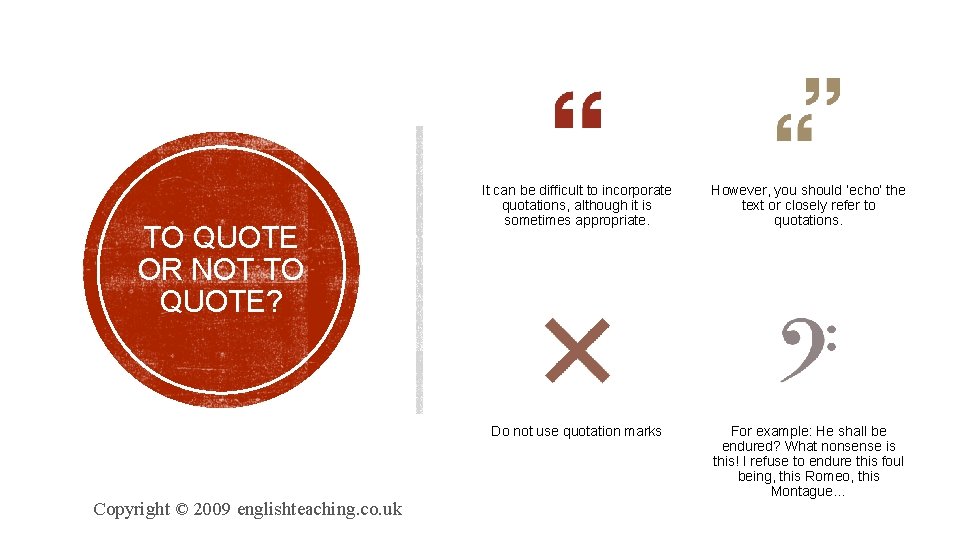
TO QUOTE OR NOT TO QUOTE? Copyright © 2009 englishteaching. co. uk It can be difficult to incorporate quotations, although it is sometimes appropriate. However, you should ‘echo’ the text or closely refer to quotations. Do not use quotation marks For example: He shall be endured? What nonsense is this! I refuse to endure this foul being, this Romeo, this Montague…
This lesson we will do the following: § Read an A grade example § Look at how to plan for an Empathic Response (Wheel of Emotion) § Create a Quote Search on A 3 paper § Any time remaining: Drafting
Consider: § Does the writer stay in first person? LET’S READ A RESPONS E Highlight where the person has tried to paraphrase quotes from the play itself – to show their writing is ‘rooted in the text’/accurate. § Is it written in present tense? § Are they trying to mirror the linguistic § § § style of the character? Have they used a WIDE RANGE of figurative language devices? Have they paragraphed their response? Do they stay frozen in the moment? Have they recounted the story/plot retell? Is the response accurate to the character’s emotions and feelings (in order)?
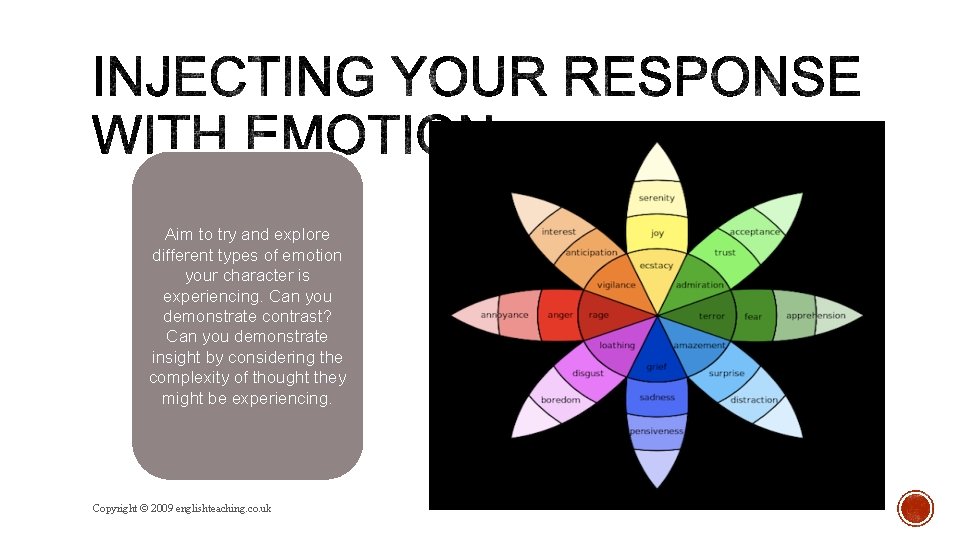
Aim to try and explore different types of emotion your character is experiencing. Can you demonstrate contrast? Can you demonstrate insight by considering the complexity of thought they might be experiencing. Copyright © 2009 englishteaching. co. uk
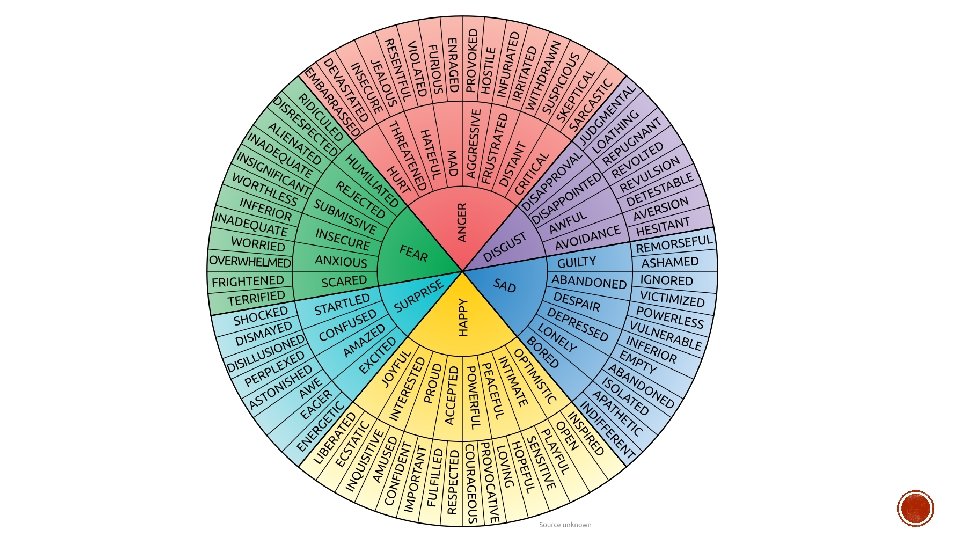
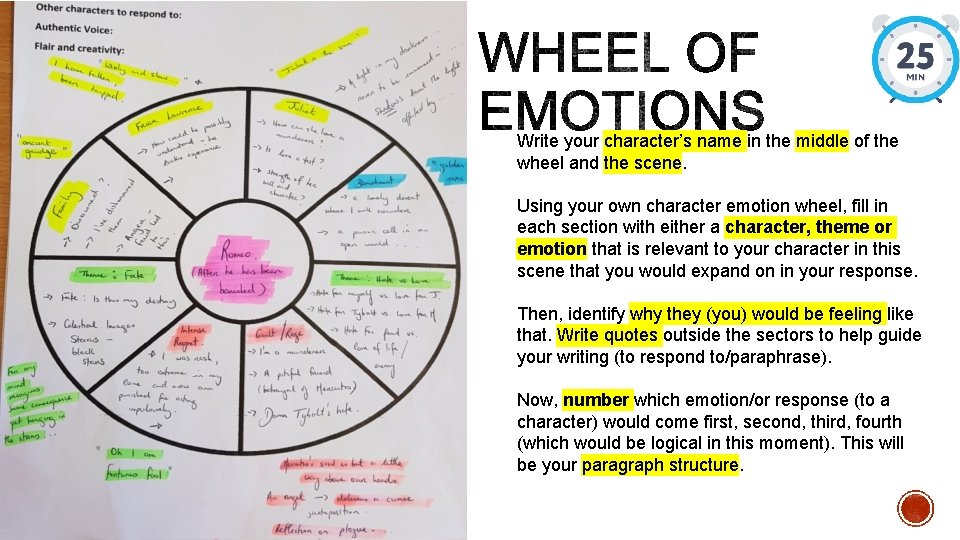
Write your character’s name in the middle of the wheel and the scene. Using your own character emotion wheel, fill in each section with either a character, theme or emotion that is relevant to your character in this scene that you would expand on in your response. Then, identify why they (you) would be feeling like that. Write quotes outside the sectors to help guide your writing (to respond to/paraphrase). Now, number which emotion/or response (to a character) would come first, second, third, fourth (which would be logical in this moment). This will be your paragraph structure.
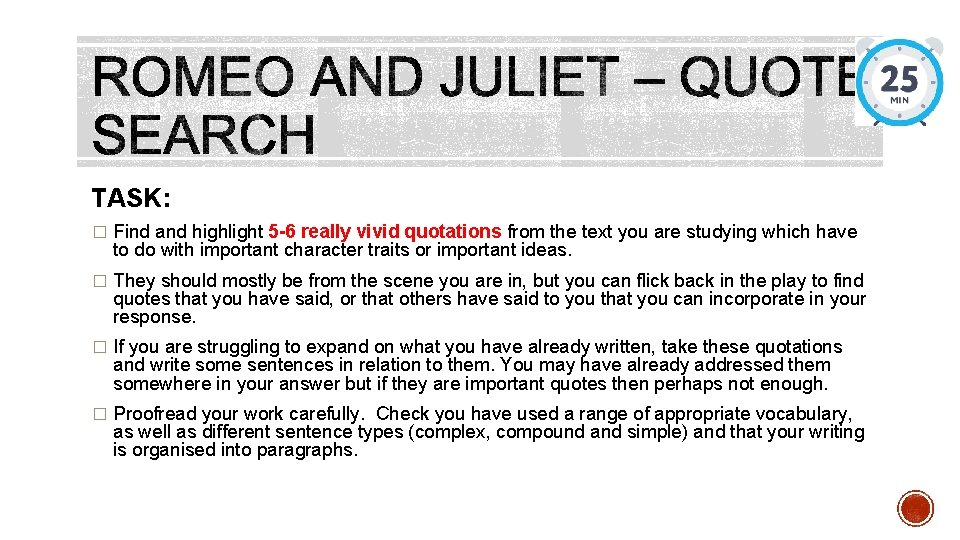
TASK: � Find and highlight 5 -6 really vivid quotations from the text you are studying which have to do with important character traits or important ideas. � They should mostly be from the scene you are in, but you can flick back in the play to find quotes that you have said, or that others have said to you that you can incorporate in your response. � If you are struggling to expand on what you have already written, take these quotations and write some sentences in relation to them. You may have already addressed them somewhere in your answer but if they are important quotes then perhaps not enough. � Proofread your work carefully. Check you have used a range of appropriate vocabulary, as well as different sentence types (complex, compound and simple) and that your writing is organised into paragraphs.
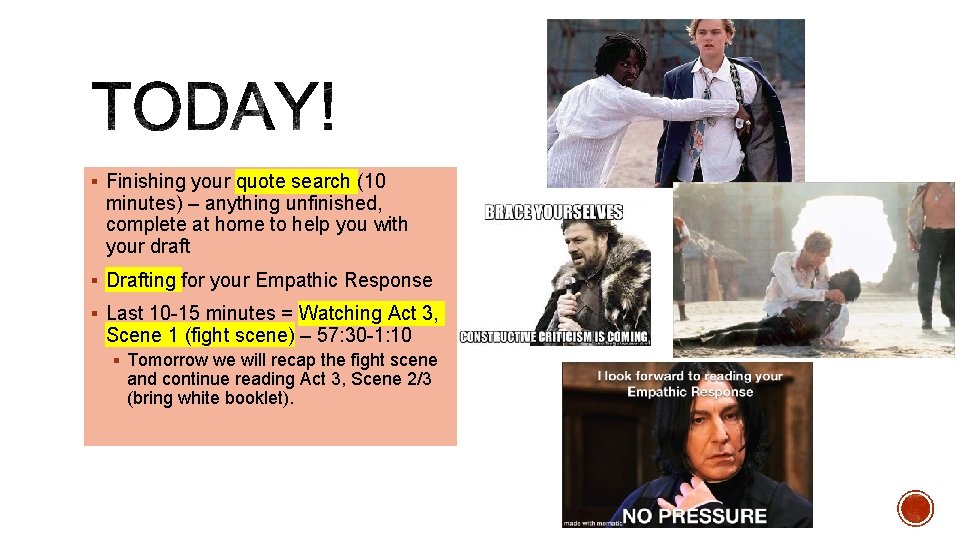
§ Finishing your quote search (10 minutes) – anything unfinished, complete at home to help you with your draft § Drafting for your Empathic Response § Last 10 -15 minutes = Watching Act 3, Scene 1 (fight scene) – 57: 30 -1: 10 § Tomorrow we will recap the fight scene and continue reading Act 3, Scene 2/3 (bring white booklet).
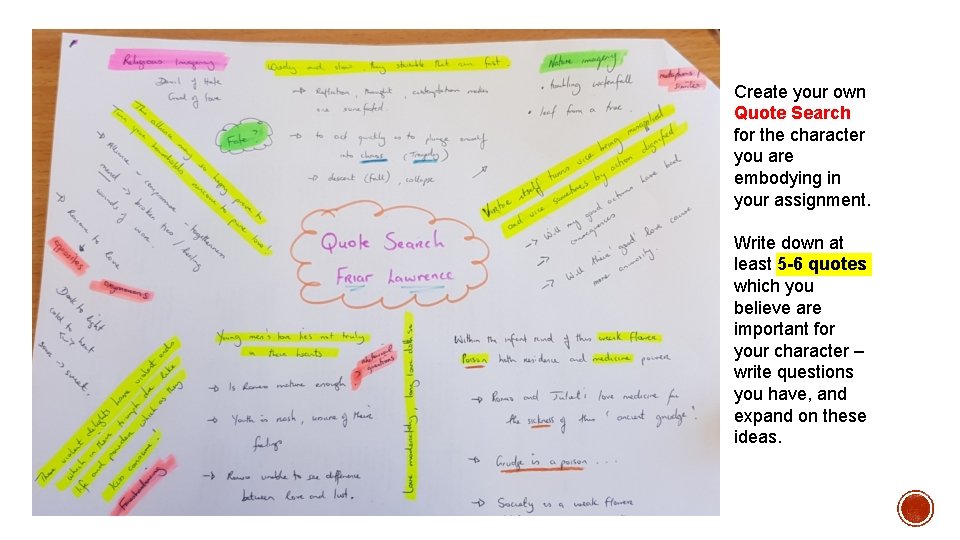
Create your own Quote Search for the character you are embodying in your assignment. Write down at least 5 -6 quotes which you believe are important for your character – write questions you have, and expand on these ideas.
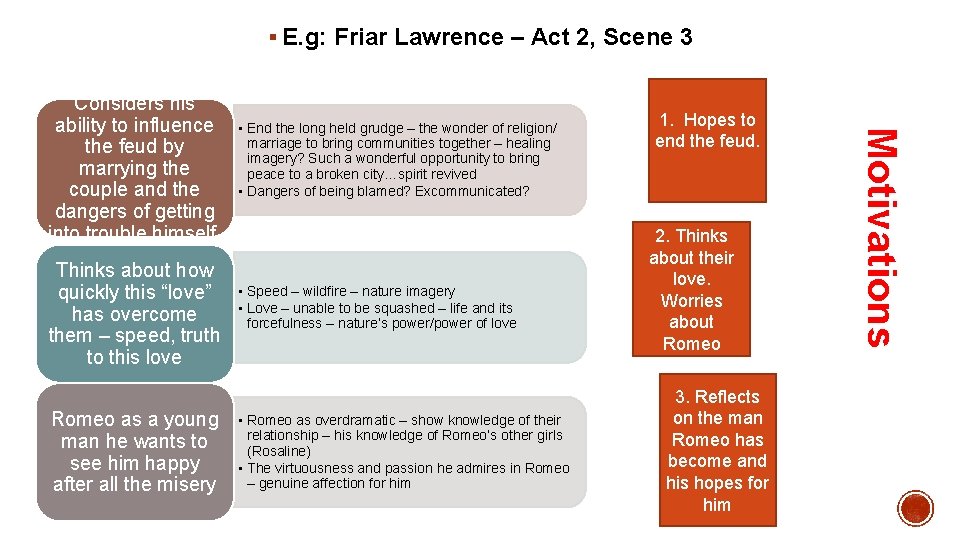
§ E. g: Friar Lawrence – Act 2, Scene 3 Thinks about how quickly this “love” has overcome them – speed, truth to this love Romeo as a young man he wants to see him happy after all the misery • End the long held grudge – the wonder of religion/ marriage to bring communities together – healing imagery? Such a wonderful opportunity to bring peace to a broken city…spirit revived • Dangers of being blamed? Excommunicated? • Speed – wildfire – nature imagery • Love – unable to be squashed – life and its forcefulness – nature’s power/power of love • Romeo as overdramatic – show knowledge of their relationship – his knowledge of Romeo’s other girls (Rosaline) • The virtuousness and passion he admires in Romeo – genuine affection for him 1. Hopes to end the feud. 2. Thinks about their love. Worries about Romeo 3. Reflects on the man Romeo has become and his hopes for him Motivations Considers his ability to influence the feud by marrying the couple and the dangers of getting into trouble himself.
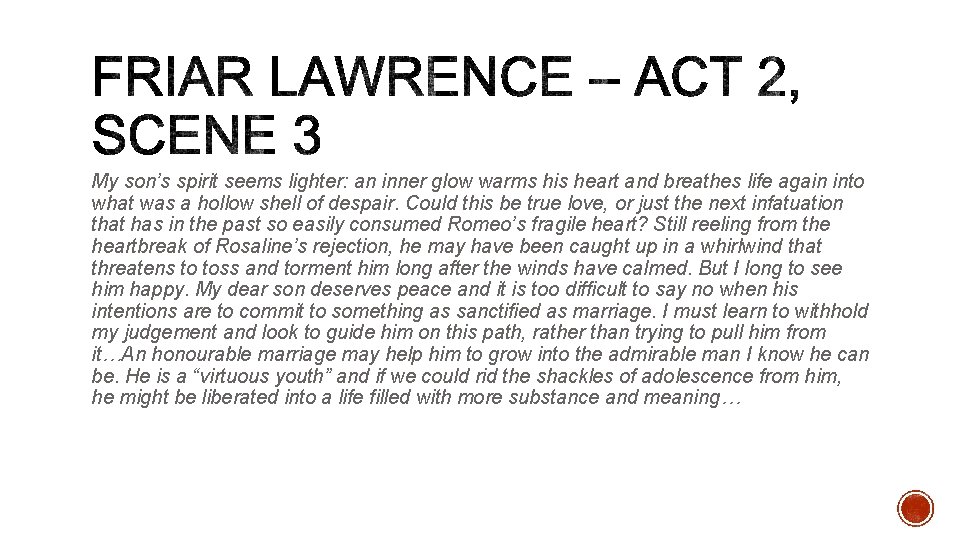
My son’s spirit seems lighter: an inner glow warms his heart and breathes life again into what was a hollow shell of despair. Could this be true love, or just the next infatuation that has in the past so easily consumed Romeo’s fragile heart? Still reeling from the heartbreak of Rosaline’s rejection, he may have been caught up in a whirlwind that threatens to toss and torment him long after the winds have calmed. But I long to see him happy. My dear son deserves peace and it is too difficult to say no when his intentions are to commit to something as sanctified as marriage. I must learn to withhold my judgement and look to guide him on this path, rather than trying to pull him from it…An honourable marriage may help him to grow into the admirable man I know he can be. He is a “virtuous youth” and if we could rid the shackles of adolescence from him, he might be liberated into a life filled with more substance and meaning…
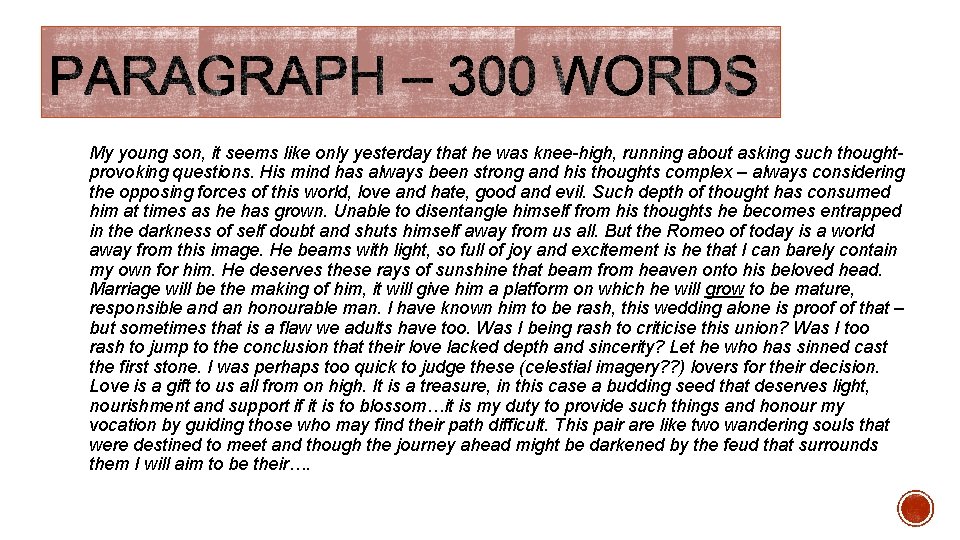
My young son, it seems like only yesterday that he was knee-high, running about asking such thoughtprovoking questions. His mind has always been strong and his thoughts complex – always considering the opposing forces of this world, love and hate, good and evil. Such depth of thought has consumed him at times as he has grown. Unable to disentangle himself from his thoughts he becomes entrapped in the darkness of self doubt and shuts himself away from us all. But the Romeo of today is a world away from this image. He beams with light, so full of joy and excitement is he that I can barely contain my own for him. He deserves these rays of sunshine that beam from heaven onto his beloved head. Marriage will be the making of him, it will give him a platform on which he will grow to be mature, responsible and an honourable man. I have known him to be rash, this wedding alone is proof of that – but sometimes that is a flaw we adults have too. Was I being rash to criticise this union? Was I too rash to jump to the conclusion that their love lacked depth and sincerity? Let he who has sinned cast the first stone. I was perhaps too quick to judge these (celestial imagery? ? ) lovers for their decision. Love is a gift to us all from on high. It is a treasure, in this case a budding seed that deserves light, nourishment and support if it is to blossom…it is my duty to provide such things and honour my vocation by guiding those who may find their path difficult. This pair are like two wandering souls that were destined to meet and though the journey ahead might be darkened by the feud that surrounds them I will aim to be their….
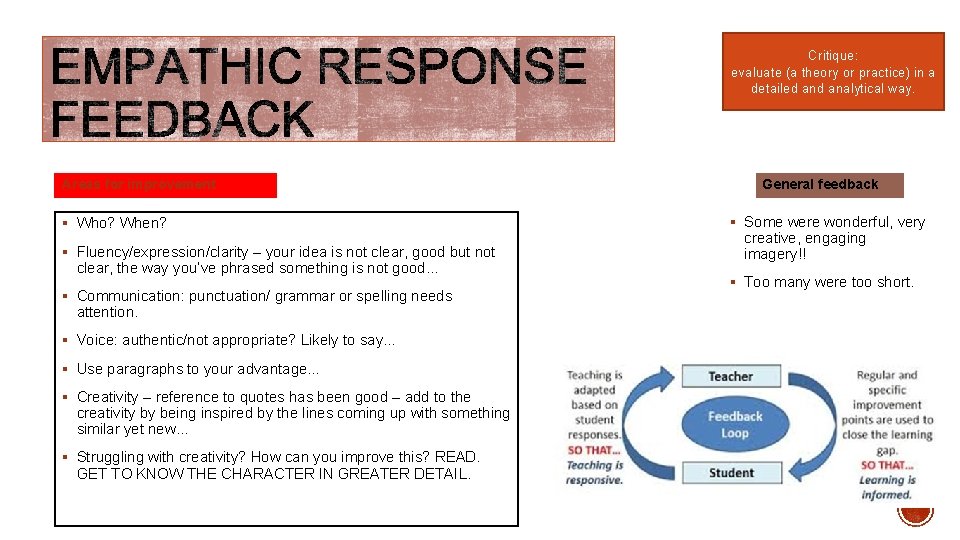
Critique: evaluate (a theory or practice) in a detailed analytical way. Areas for improvement § Who? When? § Fluency/expression/clarity – your idea is not clear, good but not clear, the way you’ve phrased something is not good… § Communication: punctuation/ grammar or spelling needs attention. § Voice: authentic/not appropriate? Likely to say… § Use paragraphs to your advantage… § Creativity – reference to quotes has been good – add to the creativity by being inspired by the lines coming up with something similar yet new… § Struggling with creativity? How can you improve this? READ. GET TO KNOW THE CHARACTER IN GREATER DETAIL. General feedback § Some were wonderful, very creative, engaging imagery!! § Too many were too short.
(and step out)
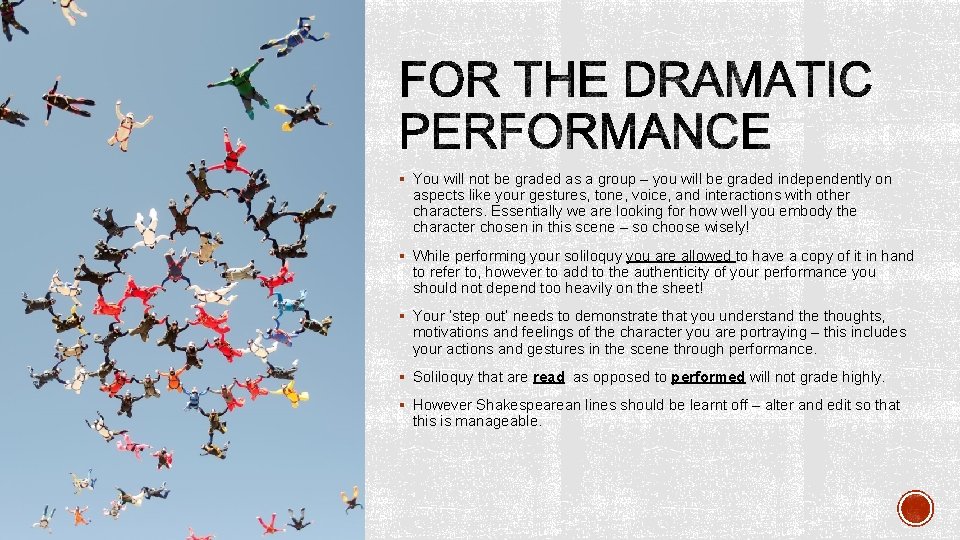
§ You will not be graded as a group – you will be graded independently on aspects like your gestures, tone, voice, and interactions with other characters. Essentially we are looking for how well you embody the character chosen in this scene – so choose wisely! § While performing your soliloquy you are allowed to have a copy of it in hand to refer to, however to add to the authenticity of your performance you should not depend too heavily on the sheet! § Your ‘step out’ needs to demonstrate that you understand the thoughts, motivations and feelings of the character you are portraying – this includes your actions and gestures in the scene through performance. § Soliloquy that are read as opposed to performed will not grade highly. § However Shakespearean lines should be learnt off – alter and edit so that this is manageable.
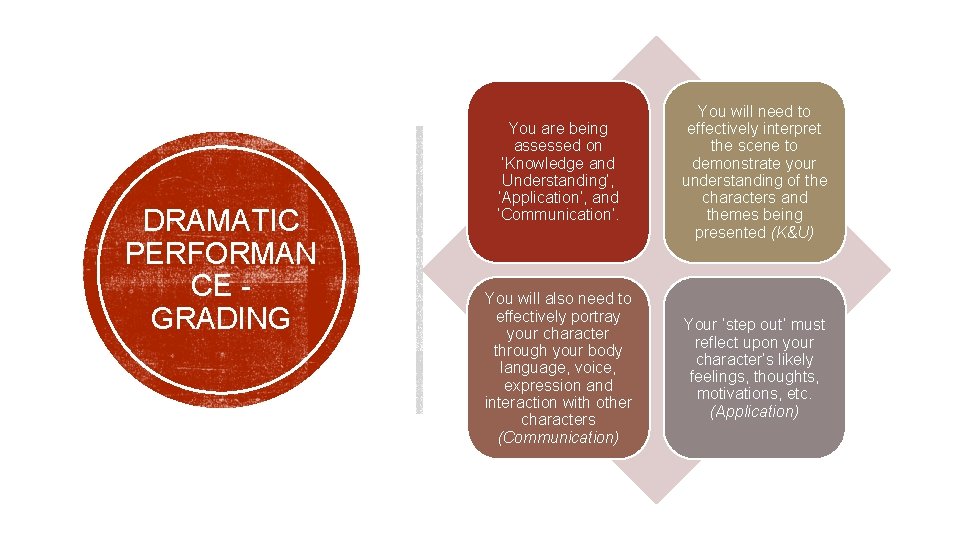
DRAMATIC PERFORMAN CE GRADING You are being assessed on ‘Knowledge and Understanding’, ‘Application’, and ‘Communication’. You will need to effectively interpret the scene to demonstrate your understanding of the characters and themes being presented (K&U) You will also need to effectively portray your character through your body language, voice, expression and interaction with other characters (Communication) Your ‘step out’ must reflect upon your character’s likely feelings, thoughts, motivations, etc. (Application)
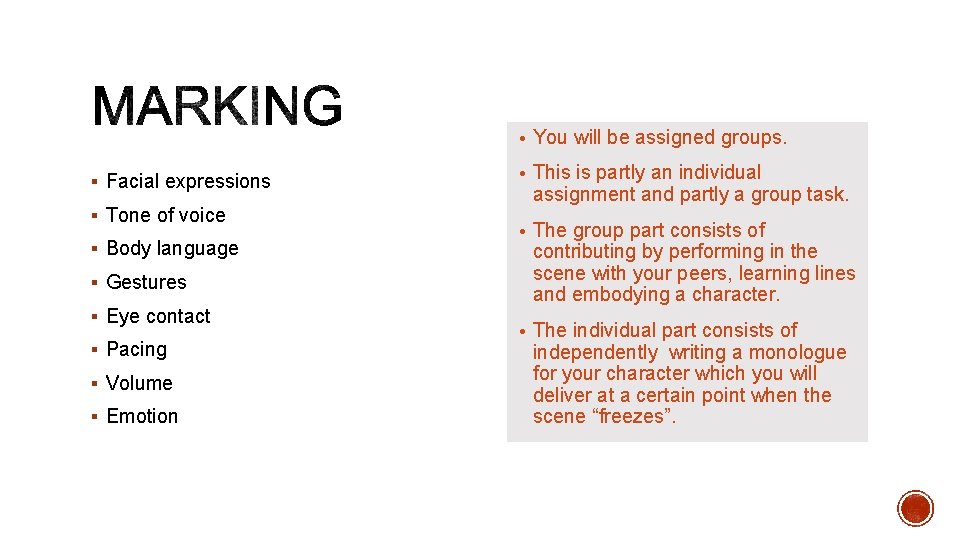
§ Facial expressions § Tone of voice § Body language • You will be assigned groups. • This is partly an individual assignment and partly a group task. • The group part consists of contributing by performing in the scene with your peers, learning lines and embodying a character. • The individual part consists of independently writing a monologue for your character which you will deliver at a certain point when the scene “freezes”. § Gestures § Eye contact § Pacing § Volume § Emotion
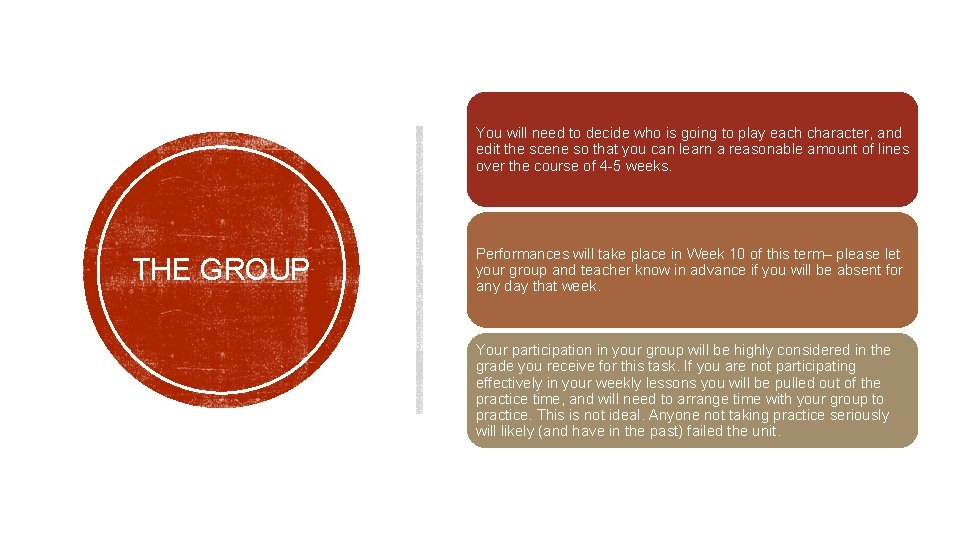
You will need to decide who is going to play each character, and edit the scene so that you can learn a reasonable amount of lines over the course of 4 -5 weeks. THE GROUP Performances will take place in Week 10 of this term– please let your group and teacher know in advance if you will be absent for any day that week. Your participation in your group will be highly considered in the grade you receive for this task. If you are not participating effectively in your weekly lessons you will be pulled out of the practice time, and will need to arrange time with your group to practice. This is not ideal. Anyone not taking practice seriously will likely (and have in the past) failed the unit.
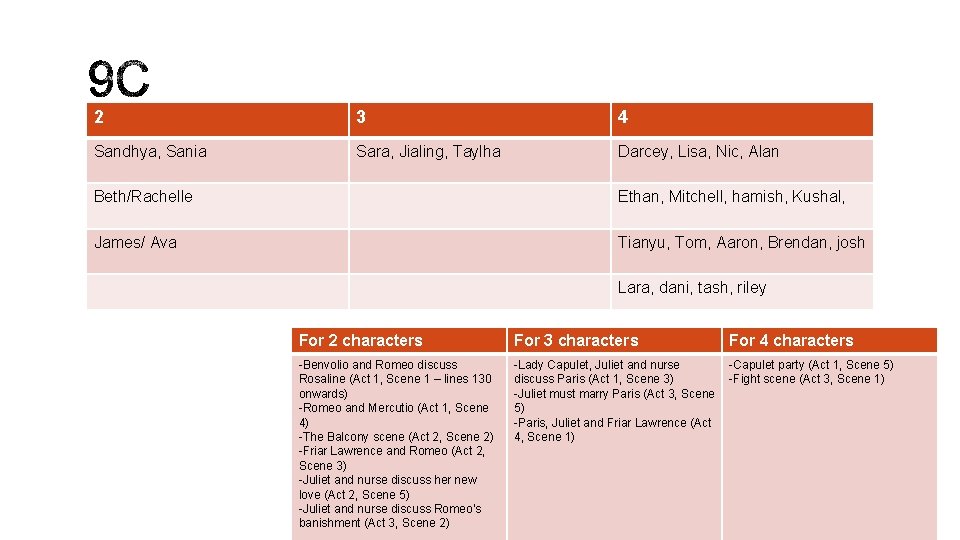
2 3 4 Sandhya, Sania Sara, Jialing, Taylha Darcey, Lisa, Nic, Alan Beth/Rachelle Ethan, Mitchell, hamish, Kushal, James/ Ava Tianyu, Tom, Aaron, Brendan, josh Lara, dani, tash, riley For 2 characters For 3 characters For 4 characters -Benvolio and Romeo discuss Rosaline (Act 1, Scene 1 – lines 130 onwards) -Romeo and Mercutio (Act 1, Scene 4) -The Balcony scene (Act 2, Scene 2) -Friar Lawrence and Romeo (Act 2, Scene 3) -Juliet and nurse discuss her new love (Act 2, Scene 5) -Juliet and nurse discuss Romeo’s banishment (Act 3, Scene 2) -Lady Capulet, Juliet and nurse discuss Paris (Act 1, Scene 3) -Juliet must marry Paris (Act 3, Scene 5) -Paris, Juliet and Friar Lawrence (Act 4, Scene 1) -Capulet party (Act 1, Scene 5) -Fight scene (Act 3, Scene 1)
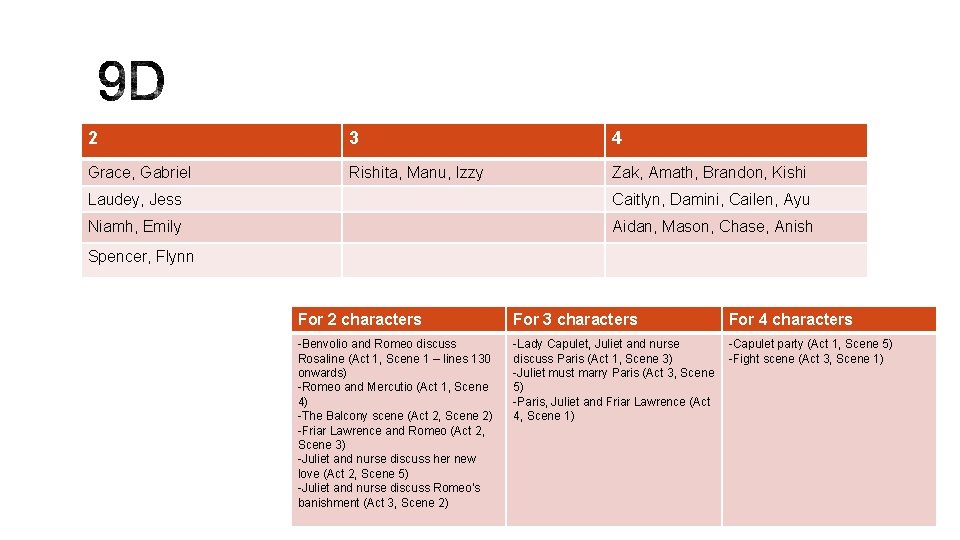
2 3 4 Grace, Gabriel Rishita, Manu, Izzy Zak, Amath, Brandon, Kishi Laudey, Jess Caitlyn, Damini, Cailen, Ayu Niamh, Emily Aidan, Mason, Chase, Anish Spencer, Flynn For 2 characters For 3 characters For 4 characters -Benvolio and Romeo discuss Rosaline (Act 1, Scene 1 – lines 130 onwards) -Romeo and Mercutio (Act 1, Scene 4) -The Balcony scene (Act 2, Scene 2) -Friar Lawrence and Romeo (Act 2, Scene 3) -Juliet and nurse discuss her new love (Act 2, Scene 5) -Juliet and nurse discuss Romeo’s banishment (Act 3, Scene 2) -Lady Capulet, Juliet and nurse discuss Paris (Act 1, Scene 3) -Juliet must marry Paris (Act 3, Scene 5) -Paris, Juliet and Friar Lawrence (Act 4, Scene 1) -Capulet party (Act 1, Scene 5) -Fight scene (Act 3, Scene 1)