
Emotions Motivation and Emotion Learning Intention Give examples
- Slides: 16
Emotions Motivation and Emotion
Learning Intention • Give examples of the physiological theories of emotion • Explain the cognitive theorists’ approach to the study of emotion
Motives and emotions are clearly intertwined • When we want to emphasis the needs, desires, and mental calculations that lead to goal-oriented behavior • Motivation/drive • When we want to stress the feelings associated with these decisions and activities • Emotion/affect • Frequently explain our motives in terms of emotions • Sometimes emotions function like biological drives – feelings can energize us
Emotional intelligence • ability to perceive, imagine, and understand emotions and to use that emotion in decision making • Decisions at work, school, family, friends • Wrong decision can get you in trouble – emotional intelligence helps you to gauge the situation to determine an accurate action
Expressing emotions • Emotion: subjective feeling provoked by real or imagined objects or events that have a high significance to an individual • Three parts: • Physical – how the emotion affects the physical arousal of an individual – directs the body how to respond to the experienced emotion • Behavioural – outward expression of the e motion, such as body language, hand gestures, tone of voice • Cognitive – concerns how we think or interpret a situation, which affects our emotions • Someone says hello – we think they are being friendly, hostile, or mocking
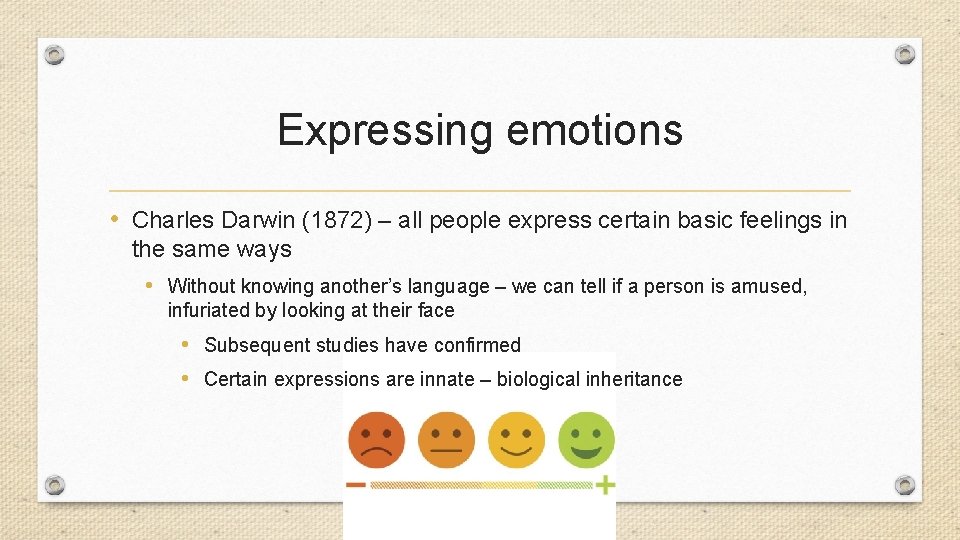
Expressing emotions • Charles Darwin (1872) – all people express certain basic feelings in the same ways • Without knowing another’s language – we can tell if a person is amused, infuriated by looking at their face • Subsequent studies have confirmed • Certain expressions are innate – biological inheritance
Expressing emotions • Carroll Izard (1983) – developed a coding system for assessing emotional states in people • Noticing changes in different parts of the face (eyebrows, eyes, mouth) – able to identify 10 different emotional states • Anger: eyebrows sharply down, drawn together, eyes narrowed or squinted • Cross-cultural studies show there are 11 universally recognizes facial expressions of emotion
Expressing emotions • Other emotions learned from social expectations and consequence • Parents regulate children’s emotions from angry outbursts, being sympathetic, occasionally ignoring • Children learn which emotions are appropriate or not
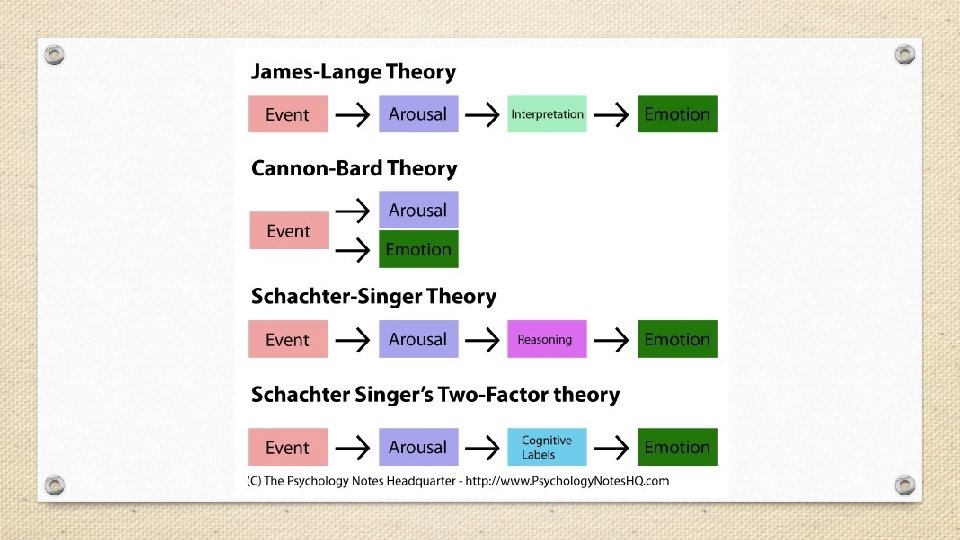
Physiological Theories • William James (1890) – thought there were too many emotions to catalogue because of subtle variations – but interested in the sudden increases/decreases in energy, muscle tension, etc • James-Lange Theory – we use the word emotion to describe our visceral reactions to the things that happen around us
Physiological Theories • Cannon-Bard Theory (1929) – argues the thalamus is the seat of emotion – certain experiences activate thalamus, and it in turn sends messages to the cortex and other body organs • Emotion refers to the simultaneous burst of activity in the brain and the visceral reaction • Late studies show it’s not the thalamus, but the hypothalamus that is involved in emotional experiences • First to describe the flight or fight response – physiological arousal
Cognitive Theories • Body changes and thinking work together to produce emotions • What you feel determines in how you interpret the emotions
Schachter-Singer Experiment • Told participants they were testing the effects of a vitamin on eyesight • In reality – most given an adrenaline injections • Informed group was told that the injection would make their heart race, bodies tremble • Misinformed group told them the injection would make them numb • Uninformed group not told anything about how their bodies would react • Control group received a neutral injection that produced no symptoms, not given info on symptoms
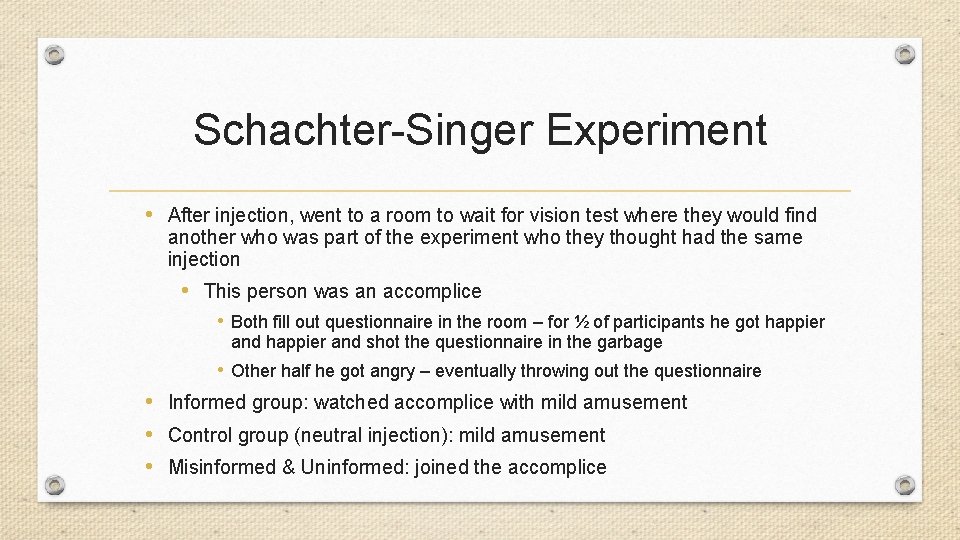
Schachter-Singer Experiment • After injection, went to a room to wait for vision test where they would find another who was part of the experiment who they thought had the same injection • This person was an accomplice • Both fill out questionnaire in the room – for ½ of participants he got happier and shot the questionnaire in the garbage • Other half he got angry – eventually throwing out the questionnaire • Informed group: watched accomplice with mild amusement • Control group (neutral injection): mild amusement • Misinformed & Uninformed: joined the accomplice
Schachter-Singer Experiment • Internal components of emotion affect people differently depending on their interpretation of the social situation • When people cannot explain their physical reactions, they take cues from the environment – the accomplice provided the cues
Opponent-Process Theory • Emotions can be disabling – why wouldn’t your body have a regulator to return to homeostasis? • Sympathetic and parasympathetic nervous systems to calm and relax the body • Theory states that these two systems act in concert to regulate and manipulate our emotions • Based on classical conditioning • Removal of the stimulus that excites one emotion causes a swing to the opposite emotion