
Emotions Definition Emotions its complex physiological reaction of

- Slides: 17
Emotions
Definition • Emotions - it’s complex physiological reaction of the organism to external and internal irritations which is directed on intesification or loosening (weakening) of condition induced these irritations. Emotions reflect individual relation of person to the environment.
Theories of emotions 1. Biological (Anokhin, 1949) Emotions are developing on the correlation between: - actual necessity (needs) – desire, wish and - possibility (probability) of it’s satisfaction
Necessities There are three groups of necessities: • - vital (somato-visceral) • - social (communication) • - creative (art, science, religion)
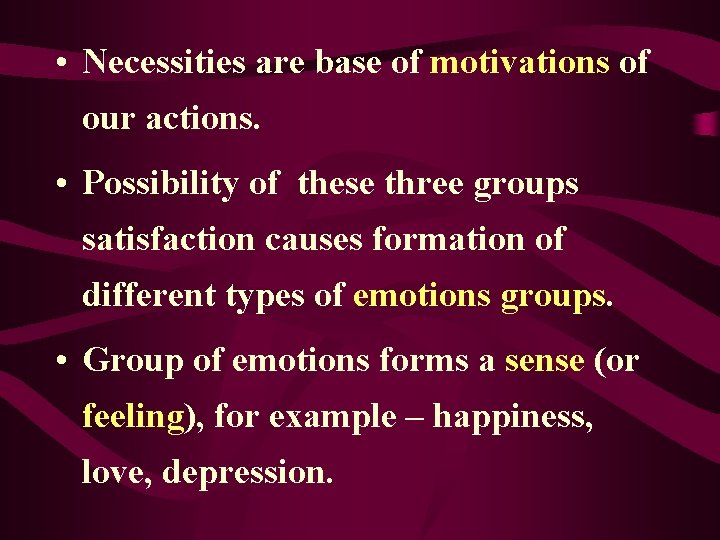
• Necessities are base of motivations of our actions. • Possibility of these three groups satisfaction causes formation of different types of emotions groups. • Group of emotions forms a sense (or feeling), for example – happiness, love, depression.
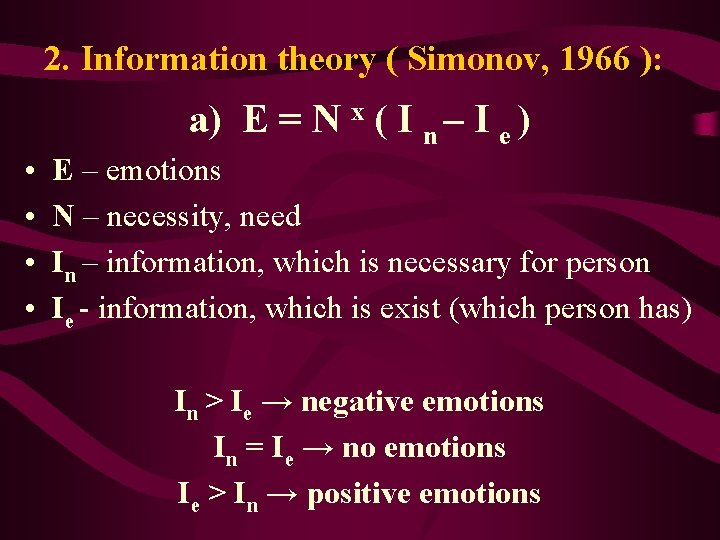
2. Information theory ( Simonov, 1966 ): a) E = N x ( I n – I e ) • • E – emotions N – necessity, need In – information, which is necessary for person Ie - information, which is exist (which person has) In > Ie → negative emotions In = Ie → no emotions Ie > In → positive emotions
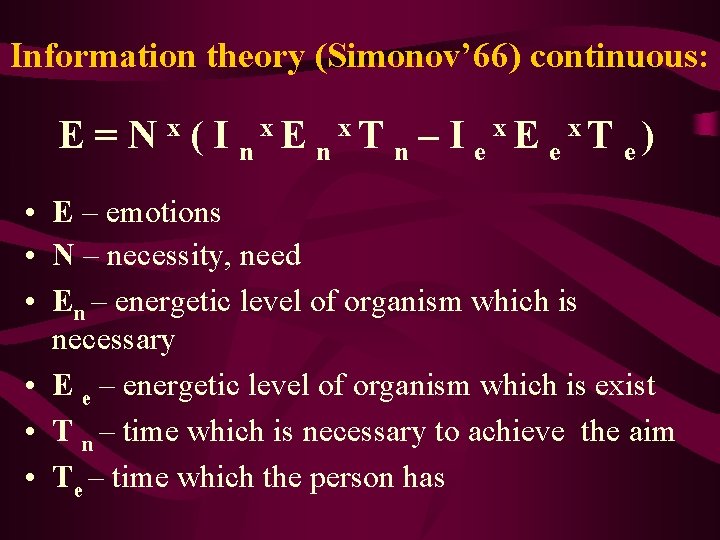
Information theory (Simonov’ 66) continuous: E = N x ( I nx. E nx. T n – I ex. E ex. T e) • E – emotions • N – necessity, need • En – energetic level of organism which is necessary • E e – energetic level of organism which is exist • T n – time which is necessary to achieve the aim • Te – time which the person has
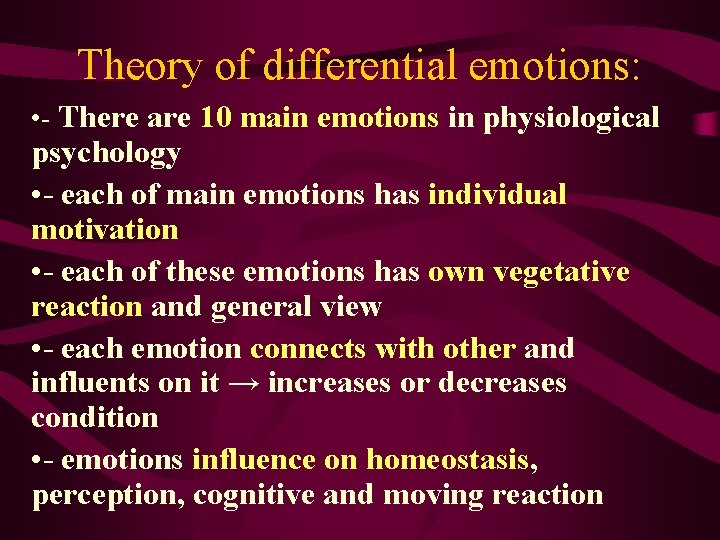
Theory of differential emotions: • - There are 10 main emotions in physiological psychology • - each of main emotions has individual motivation • - each of these emotions has own vegetative reaction and general view • - each emotion connects with other and influents on it → increases or decreases condition • - emotions influence on homeostasis, perception, cognitive and moving reaction
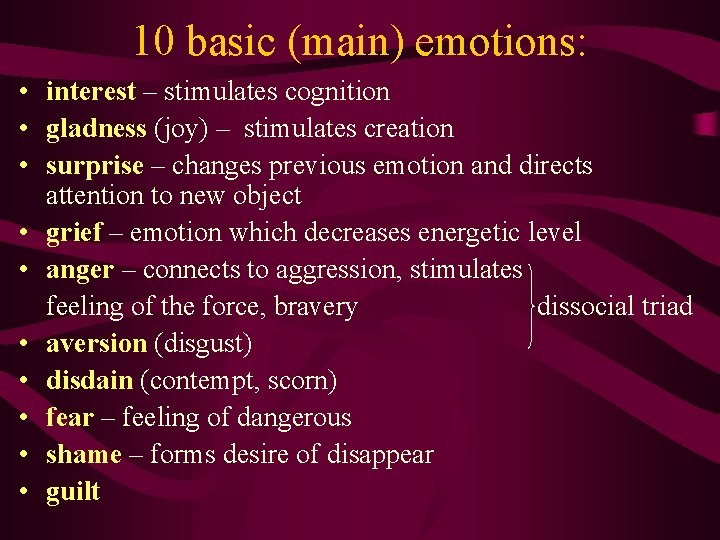
10 basic (main) emotions: • interest – stimulates cognition • gladness (joy) – stimulates creation • surprise – changes previous emotion and directs attention to new object • grief – emotion which decreases energetic level • anger – connects to aggression, stimulates feeling of the force, bravery dissocial triad • aversion (disgust) • disdain (contempt, scorn) • fear – feeling of dangerous • shame – forms desire of disappear • guilt
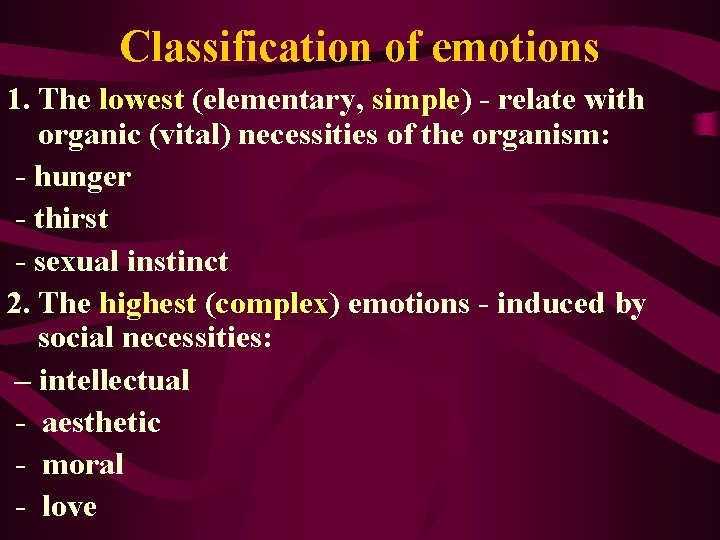
Classification of emotions 1. The lowest (elementary, simple) - relate with organic (vital) necessities of the organism: - hunger - thirst - sexual instinct 2. The highest (complex) emotions - induced by social necessities: – intellectual - aesthetic - moral - love
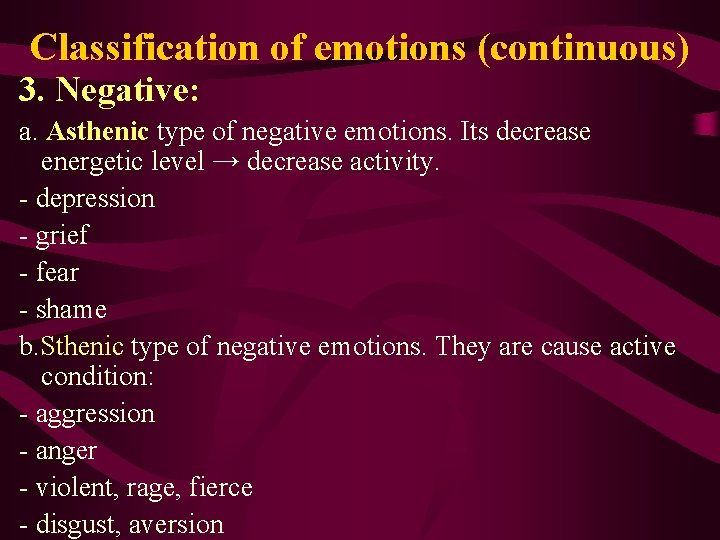
Classification of emotions (continuous) 3. Negative: a. Asthenic type of negative emotions. Its decrease energetic level → decrease activity. - depression - grief - fear - shame b. Sthenic type of negative emotions. They are cause active condition: - aggression - anger - violent, rage, fierce - disgust, aversion
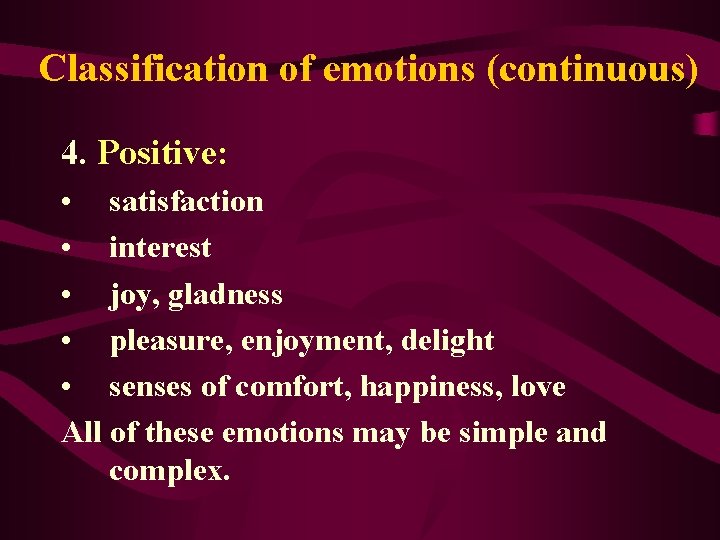
Classification of emotions (continuous) 4. Positive: • satisfaction • interest • joy, gladness • pleasure, enjoyment, delight • senses of comfort, happiness, love All of these emotions may be simple and complex.
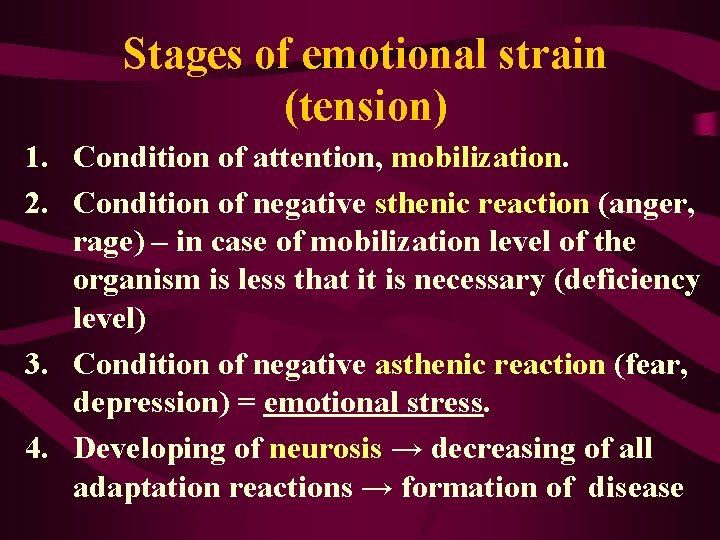
Stages of emotional strain (tension) 1. Condition of attention, mobilization. 2. Condition of negative sthenic reaction (anger, rage) – in case of mobilization level of the organism is less that it is necessary (deficiency level) 3. Condition of negative asthenic reaction (fear, depression) = emotional stress. 4. Developing of neurosis → decreasing of all adaptation reactions → formation of disease
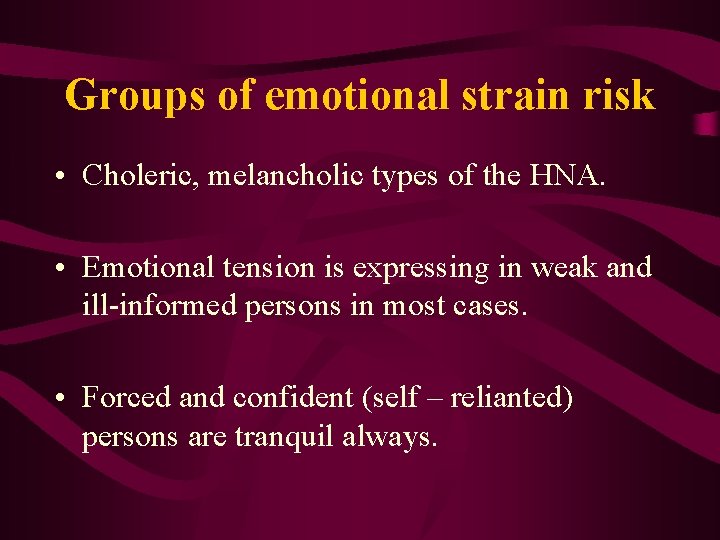
Groups of emotional strain risk • Choleric, melancholic types of the HNA. • Emotional tension is expressing in weak and ill-informed persons in most cases. • Forced and confident (self – relianted) persons are tranquil always.
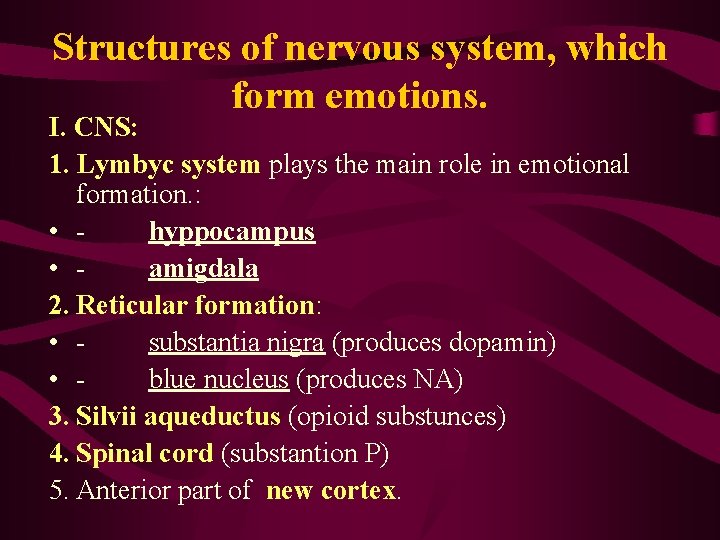
Structures of nervous system, which form emotions. I. CNS: 1. Lymbyc system plays the main role in emotional formation. : • hyppocampus • amigdala 2. Reticular formation: • substantia nigra (produces dopamin) • blue nucleus (produces NA) 3. Silvii aqueductus (opioid substunces) 4. Spinal cord (substantion P) 5. Anterior part of new cortex.
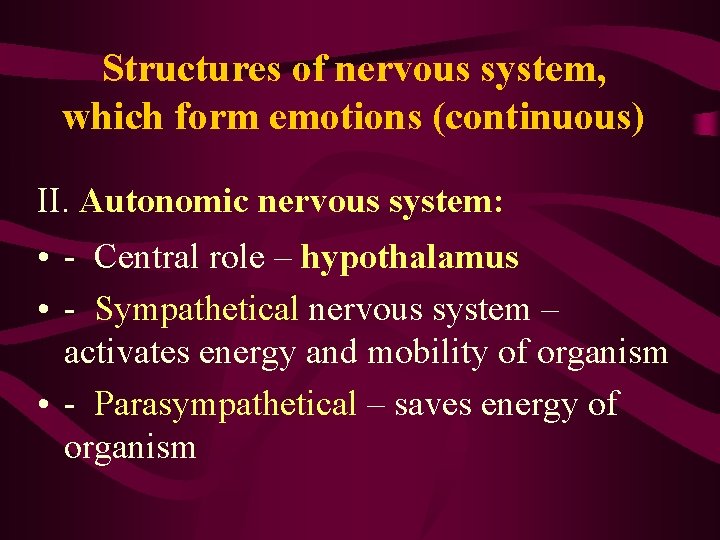
Structures of nervous system, which form emotions (continuous) II. Autonomic nervous system: • - Central role – hypothalamus • - Sympathetical nervous system – activates energy and mobility of organism • - Parasympathetical – saves energy of organism
Functions of emotions 1. Adaptation function to environment changes – all types of emotions. 2. Activation of behaviour – reflex formation, processes of thinking – “+” emotion. 3. Protection, compensation function – “-” emotions.