
Emotions and Personalit y Section 040907 What are
- Slides: 81
Emotions and Personalit y Section 04/09/07
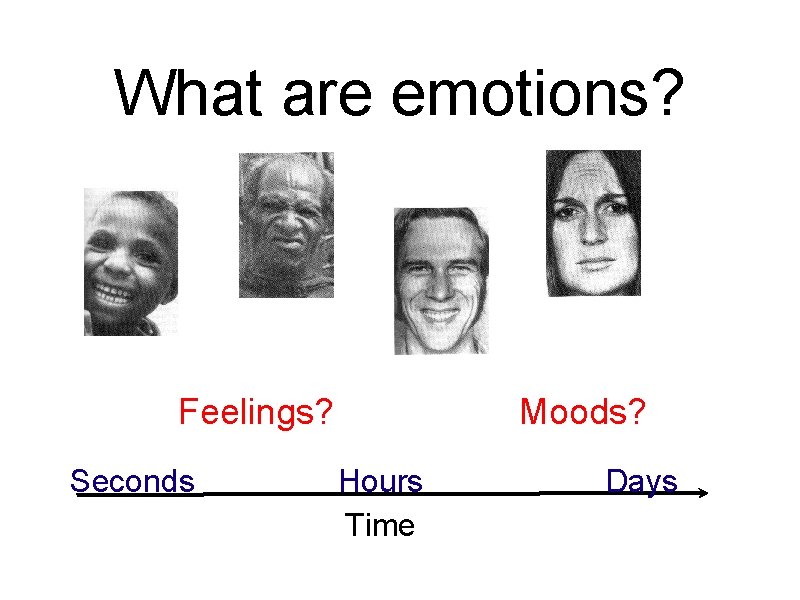
What are emotions? Feelings? Seconds Moods? Hours Time Days
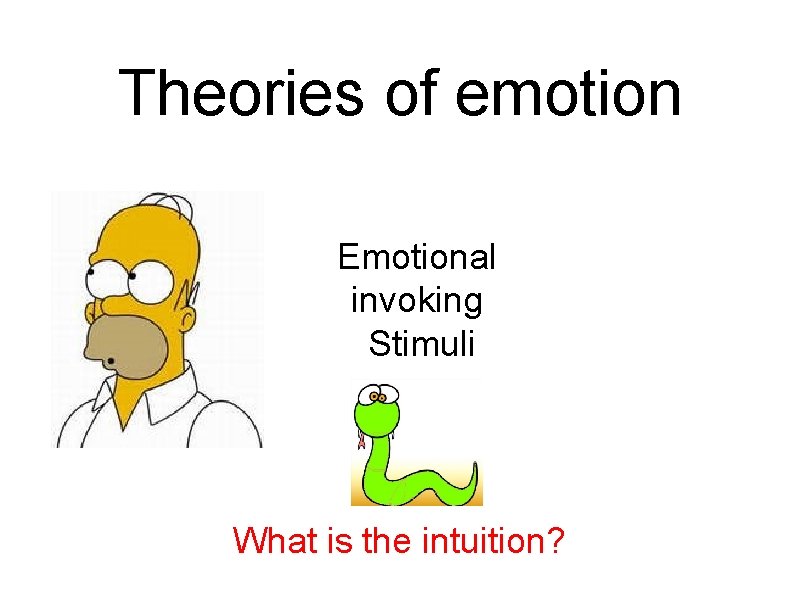
Theories of emotion What is the intuition?
Theories of emotion What is the intuition?
Theories of emotion Emotional invoking Stimuli What is the intuition?
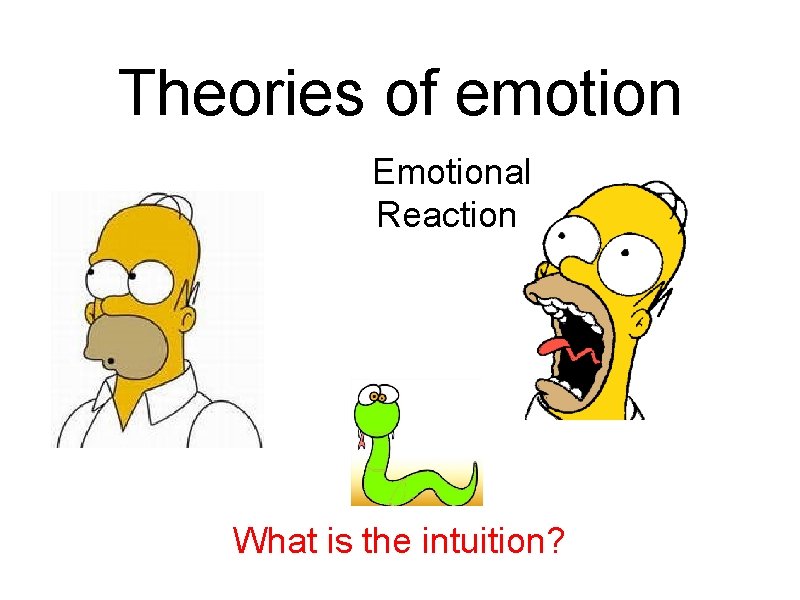
Theories of emotion Emotional Reaction What is the intuition?
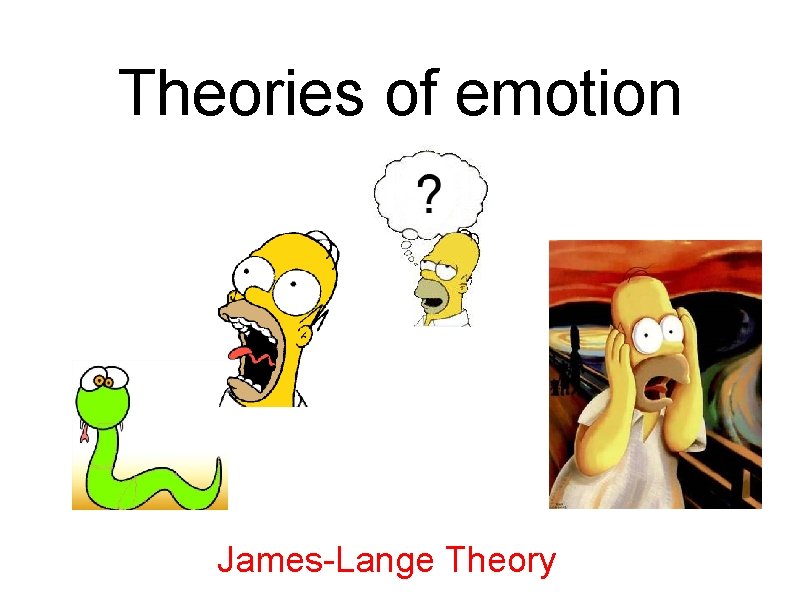
Theories of emotion James-Lange Theory
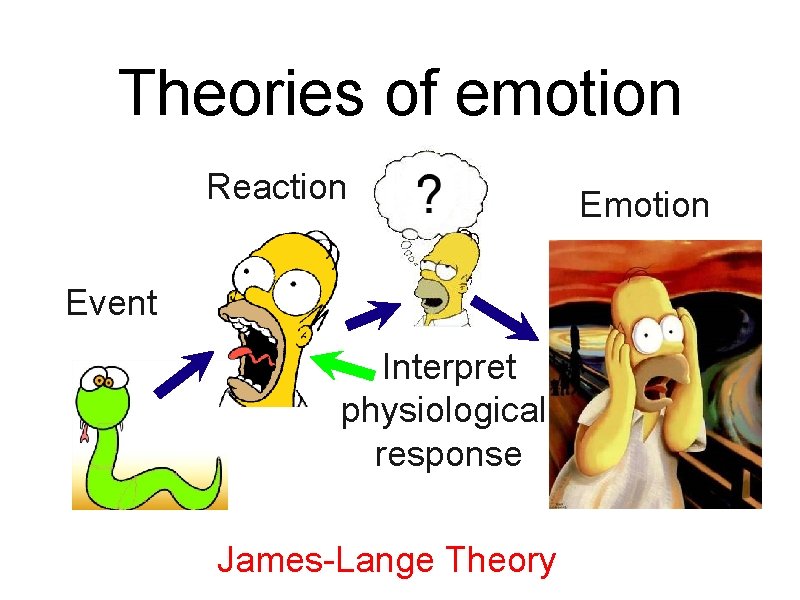
Theories of emotion Reaction Event Interpret physiological response James-Lange Theory Emotion
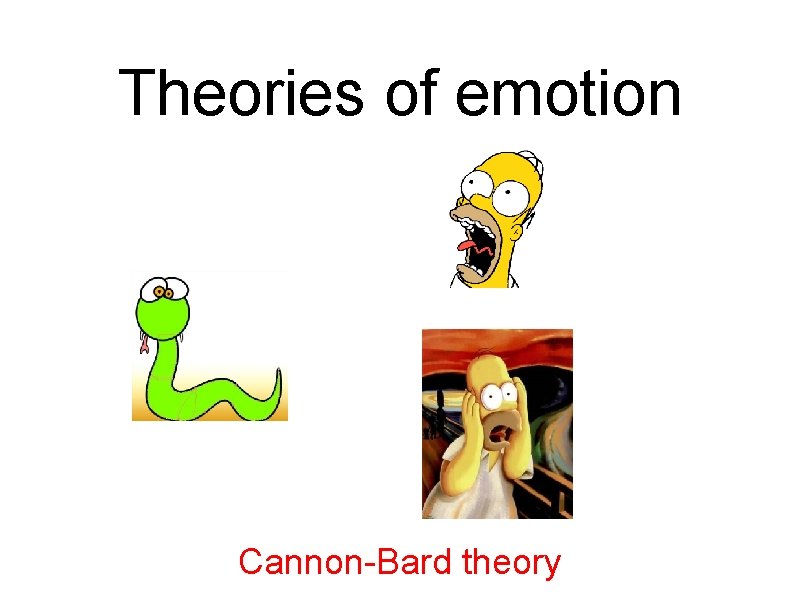
Theories of emotion Cannon-Bard theory
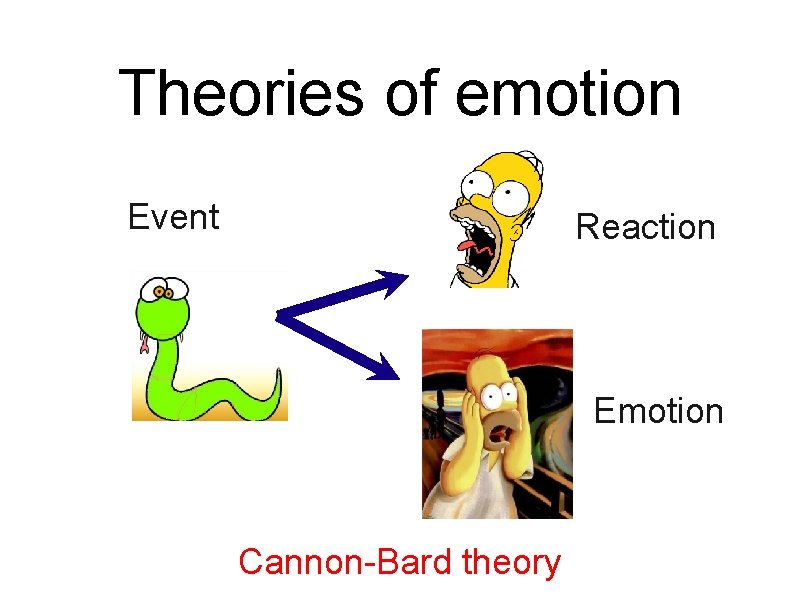
Theories of emotion Event Reaction Emotion Cannon-Bard theory
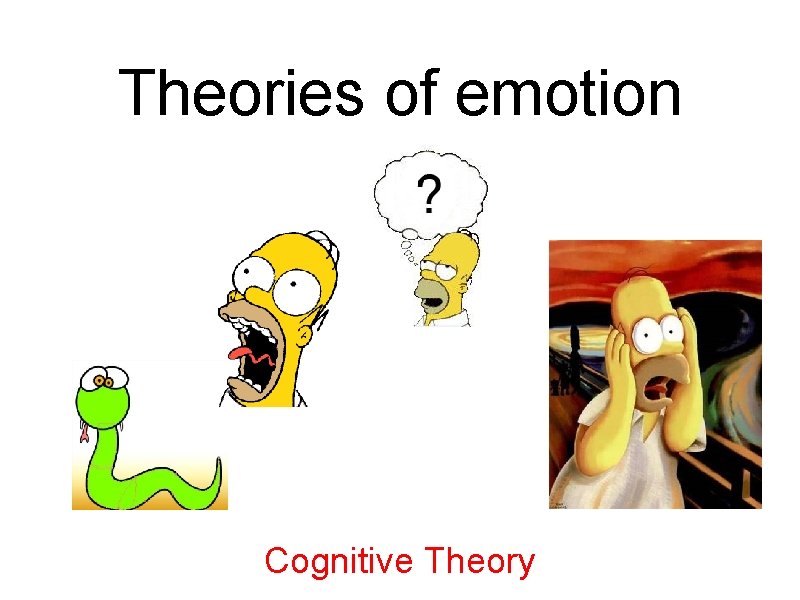
Theories of emotion Cognitive Theory
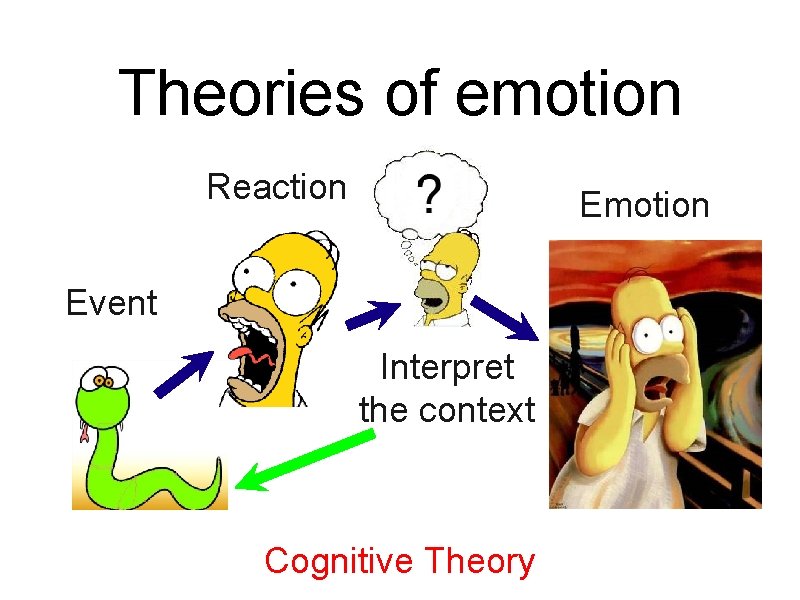
Theories of emotion Reaction Emotion Event Interpret the context Cognitive Theory
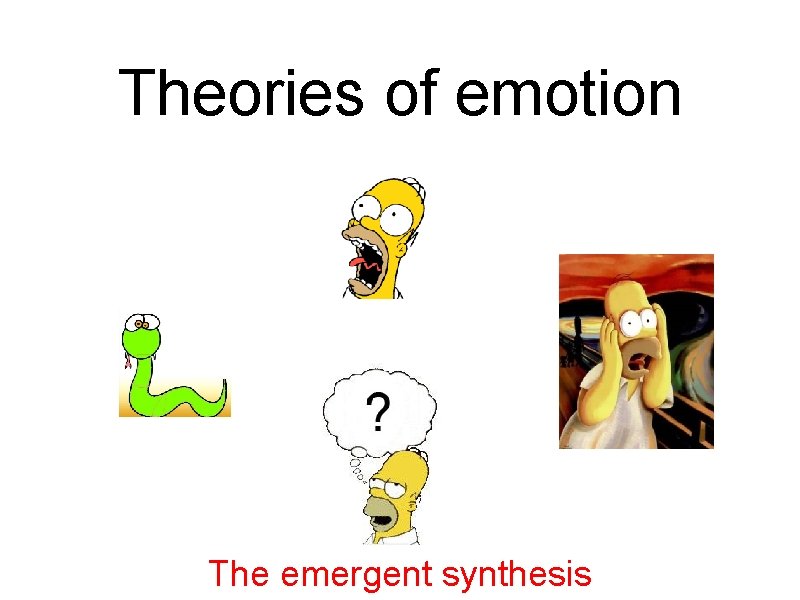
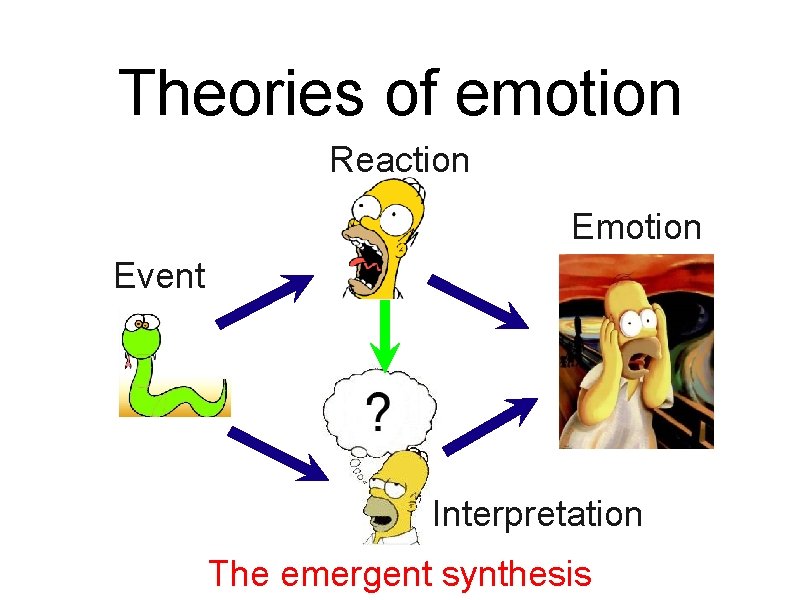
Theories of emotion The emergent synthesis
Theories of emotion Reaction Emotion Event Interpretation The emergent synthesis
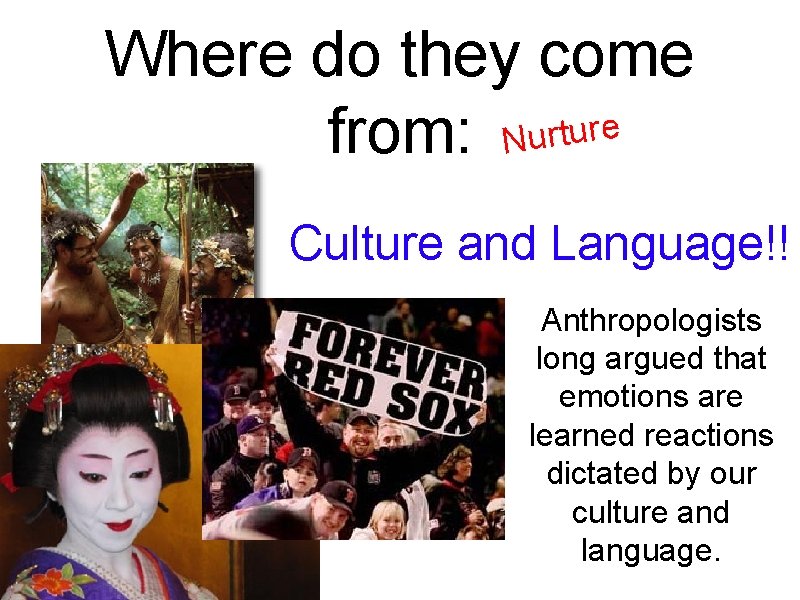
Where do they come e r u t r u from: N Culture and Language!! Anthropologists long argued that emotions are learned reactions dictated by our culture and language.
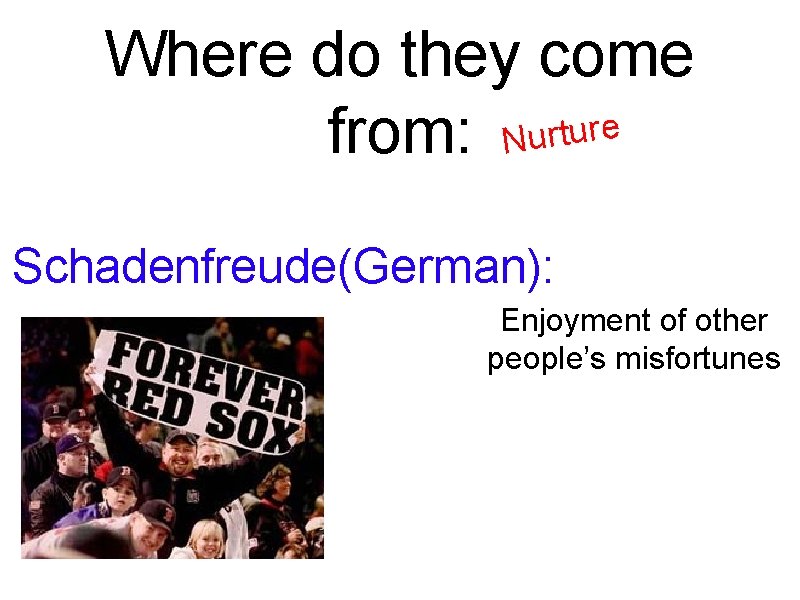
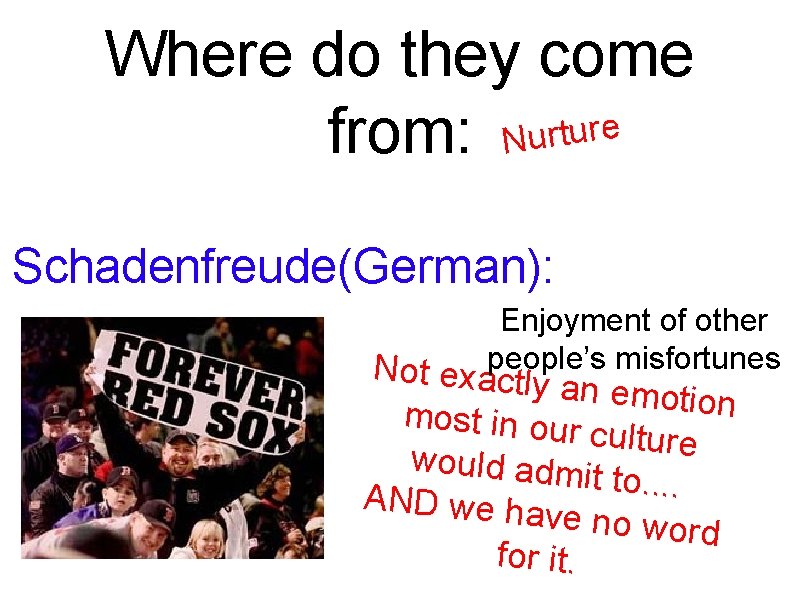
Where do they come e r u t r u from: N Schadenfreude(German): Enjoyment of other people’s misfortunes
Where do they come e r u t r u from: N Schadenfreude(German): Enjoyment of other people’s misfortunes Not exactly an emotion most in our culture would adm it to. . AND we ha ve no word for it.
Where do they come e r u t r u from: N Others Schadenfreude: Enjoyment of other people’s misfortunes Dependence, Amae(Japanese): immature/simple, spoiled Jung(Korean): Attachment, affection
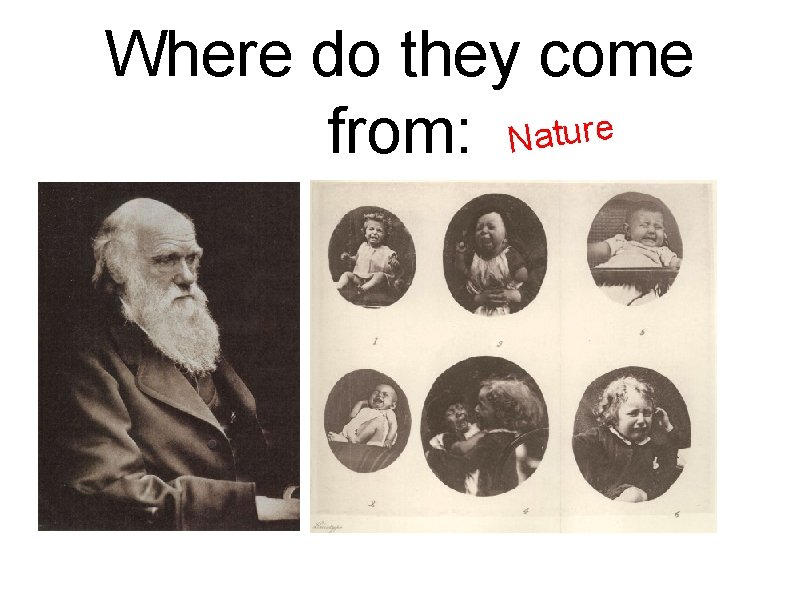
Where do they come from: Nature
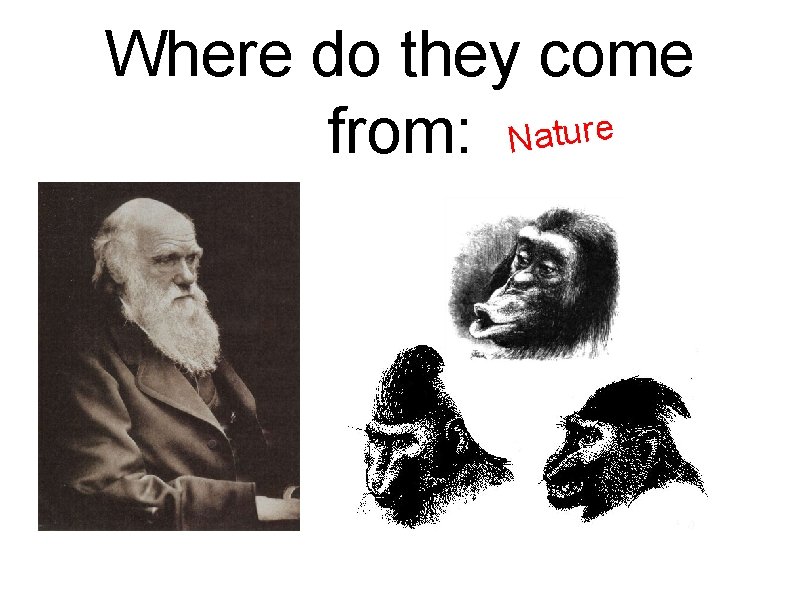
Where do they come from: Nature
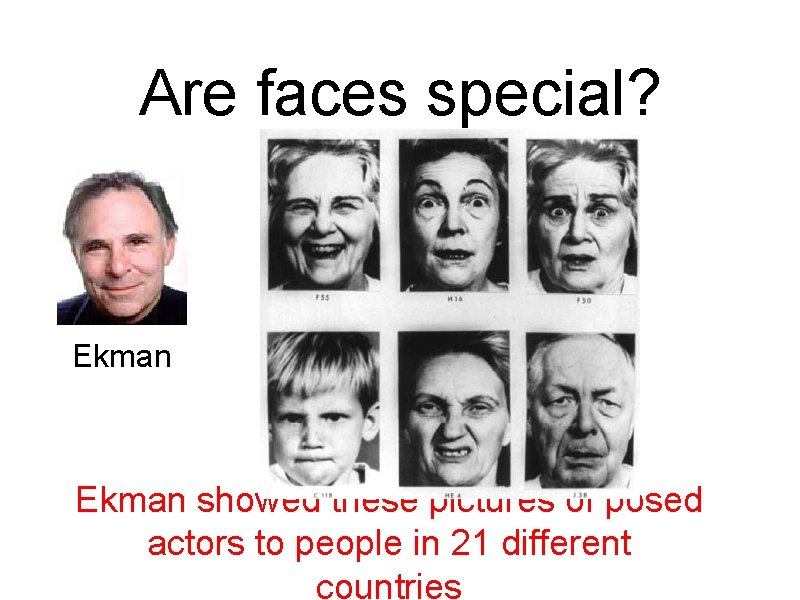
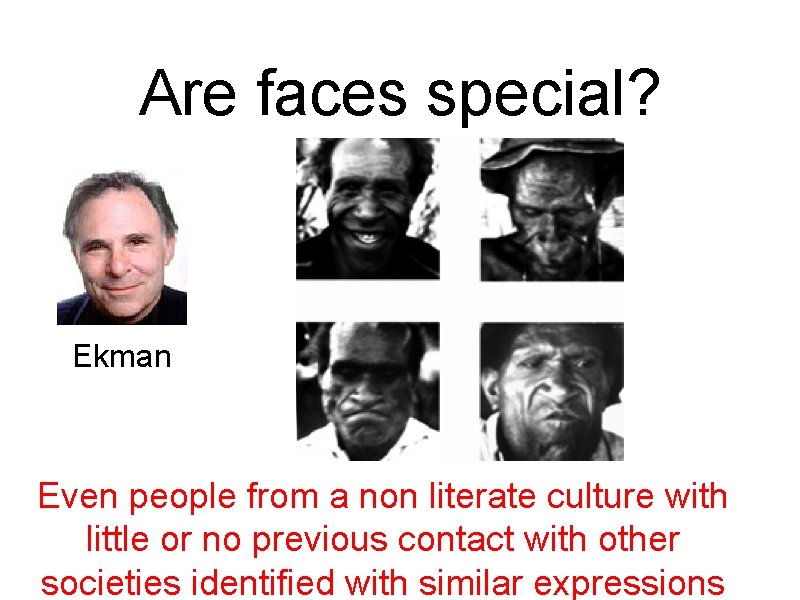
Are faces special? Ekman showed these pictures of posed actors to people in 21 different countries
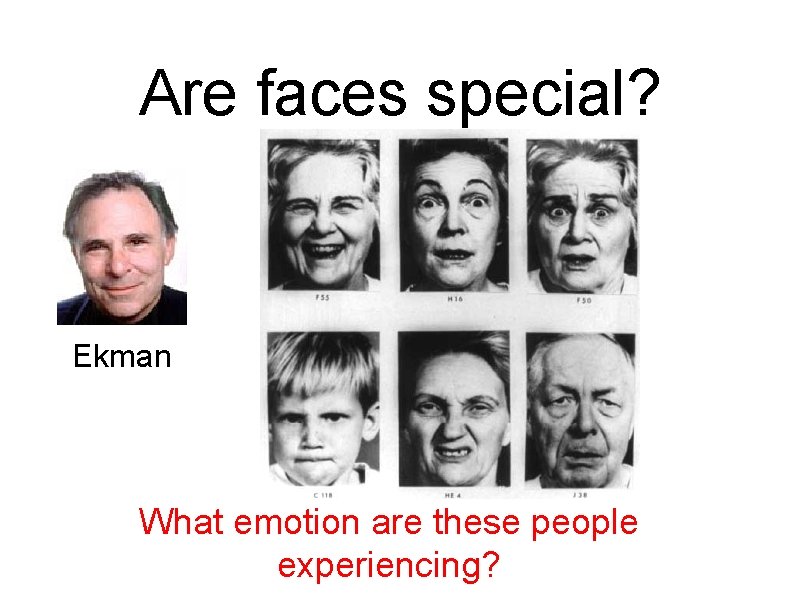
Are faces special? Ekman What emotion are these people experiencing?
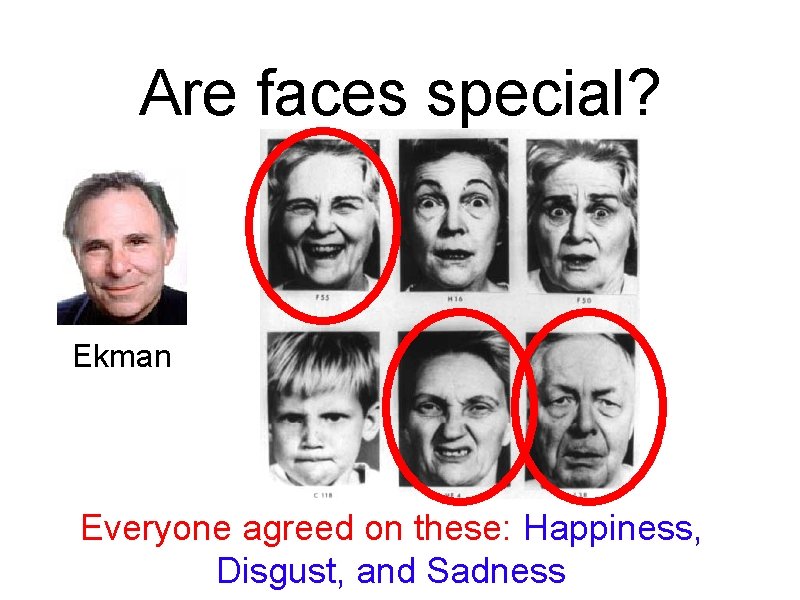
Are faces special? Ekman Everyone agreed on these: Happiness, Disgust, and Sadness
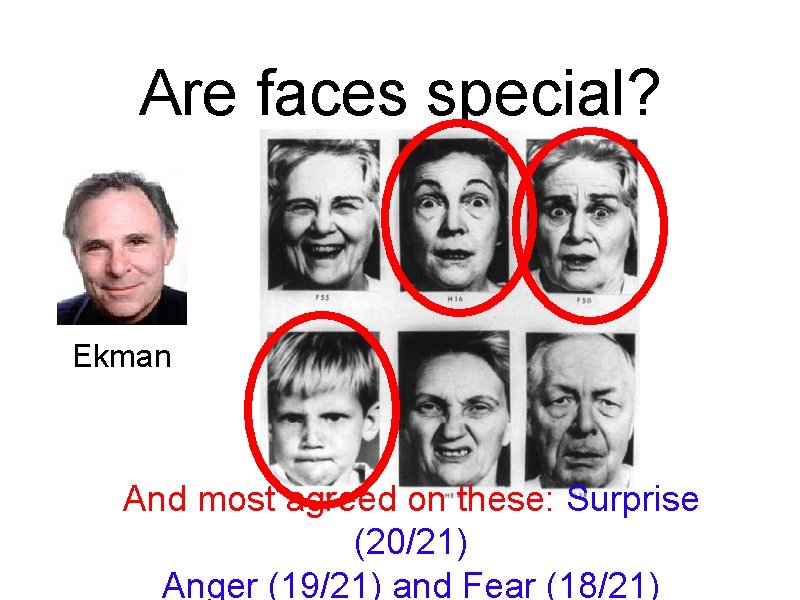
Are faces special? Ekman And most agreed on these: Surprise (20/21) Anger (19/21) and Fear (18/21)
Are faces special? Ekman Even people from a non literate culture with little or no previous contact with other societies identified with similar expressions
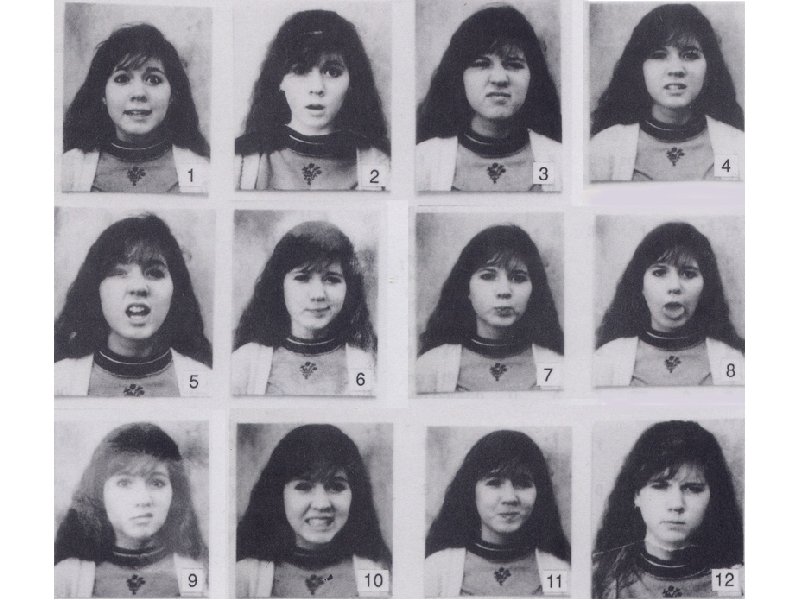
Are faces special? • Demo: Emotions from facial expressions • You will see a number of faces, for each statement on your handout, pick the face that most clearly depicts the reaction you would expect in the situation described. You can choose the same face more than once.
Are faces special?
Are faces special? • Results: Discussion • Did specific faces tend to be associated with the basic emotions? • Which had less agreement? Why? • Were the other situations associated with particular faces?
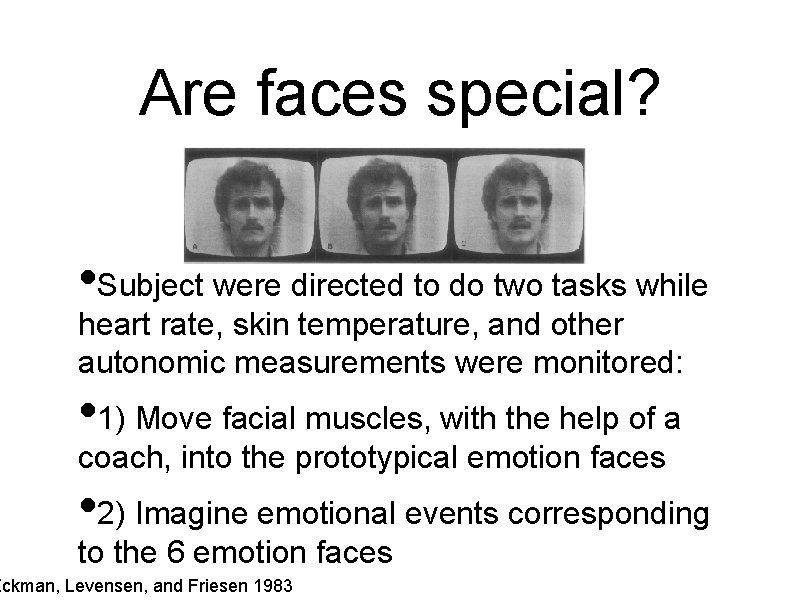
Are faces special? • Subject were directed to do two tasks while heart rate, skin temperature, and other autonomic measurements were monitored: • 1) Move facial muscles, with the help of a coach, into the prototypical emotion faces • 2) Imagine emotional events corresponding to the 6 emotion faces Eckman, Levensen, and Friesen 1983
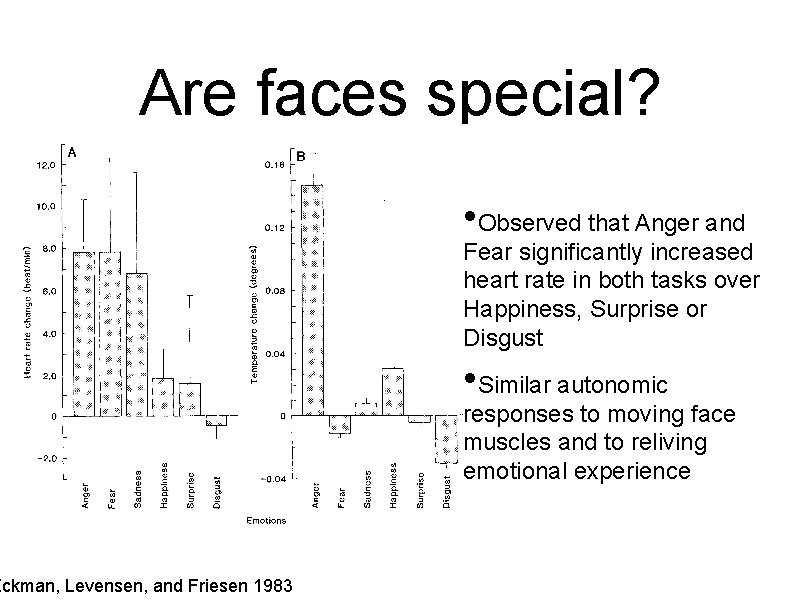
Are faces special? Eckman, Levensen, and Friesen 1983 • Observed that Anger and Fear significantly increased heart rate in both tasks over Happiness, Surprise or Disgust • Similar autonomic responses to moving face muscles and to reliving emotional experience
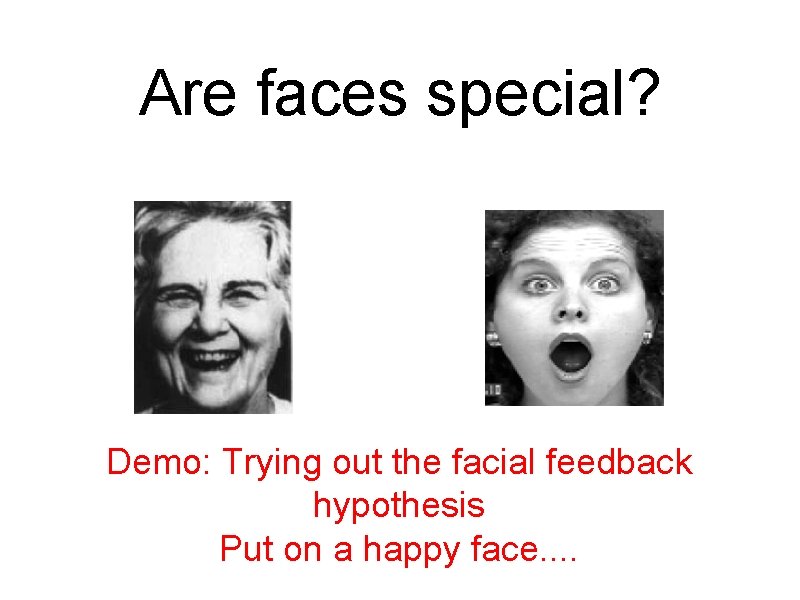
Are faces special? Demo: Trying out the facial feedback hypothesis Put on a happy face. .
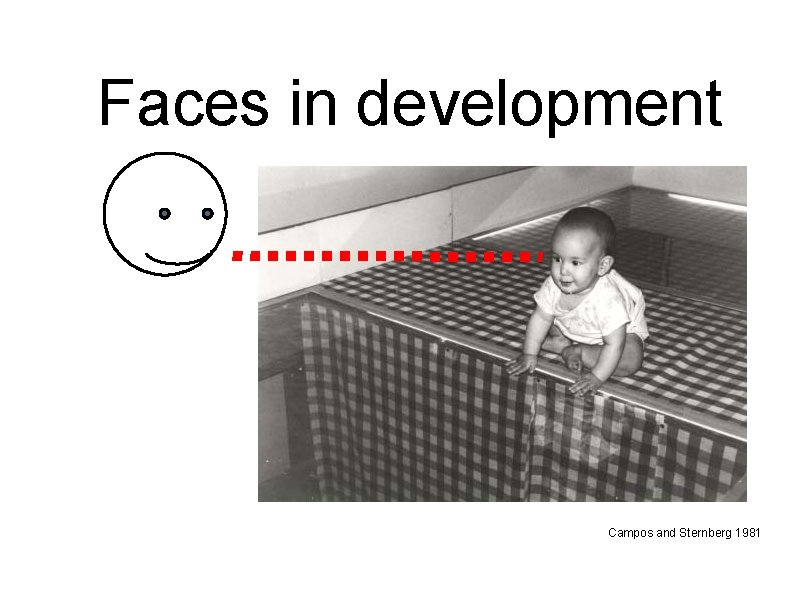
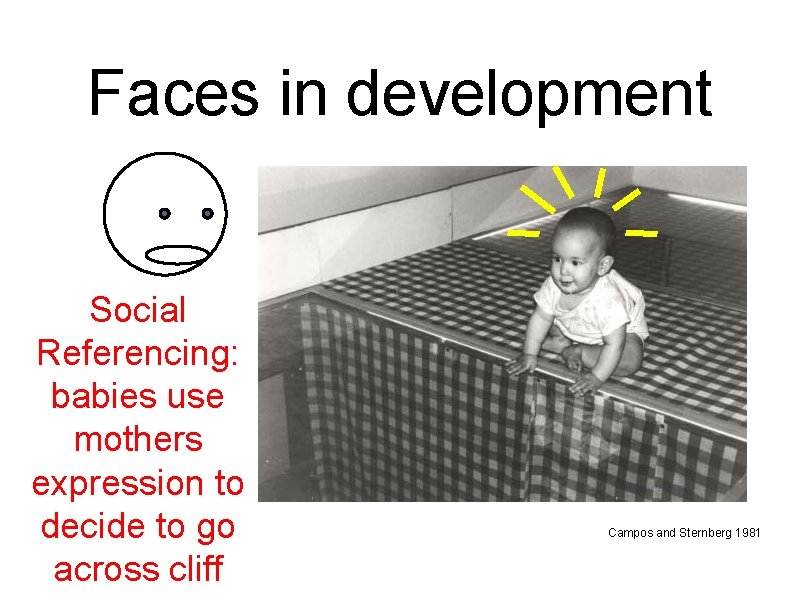
Faces in development Campos and Sternberg 1981
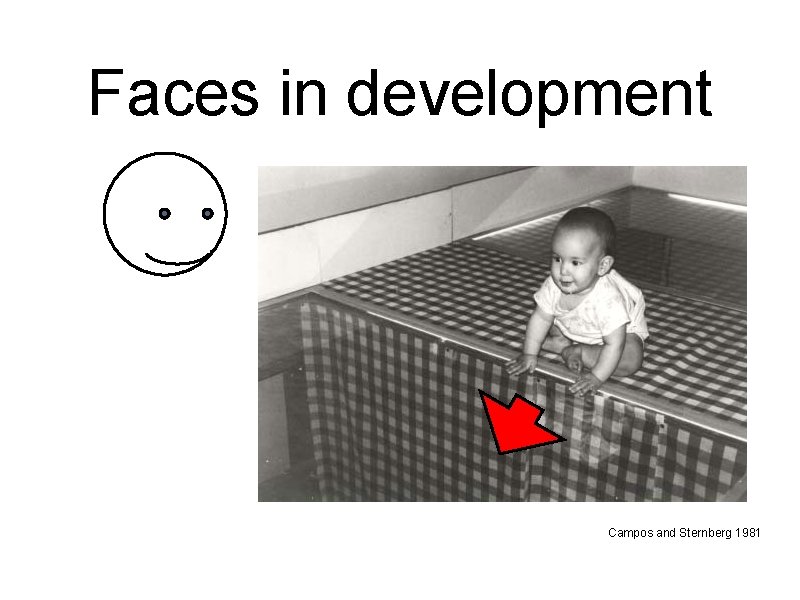
Faces in development Campos and Sternberg 1981
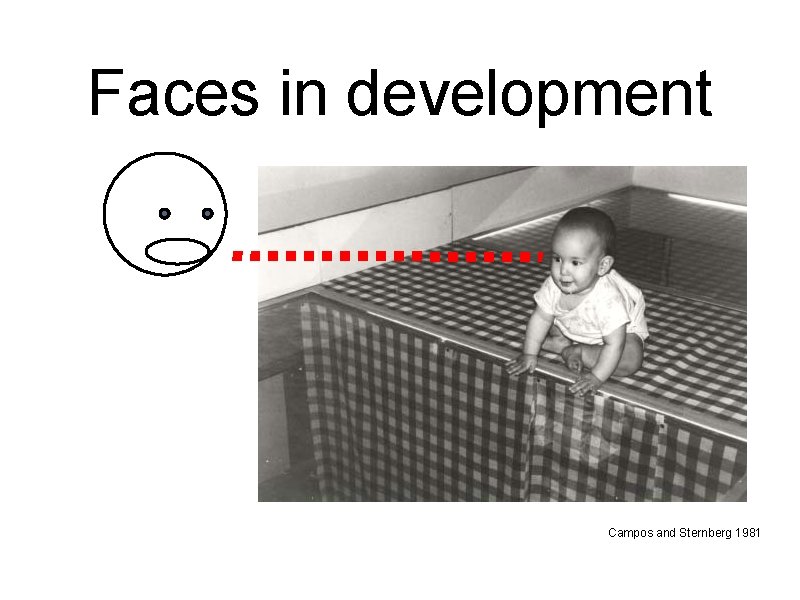
Faces in development Campos and Sternberg 1981
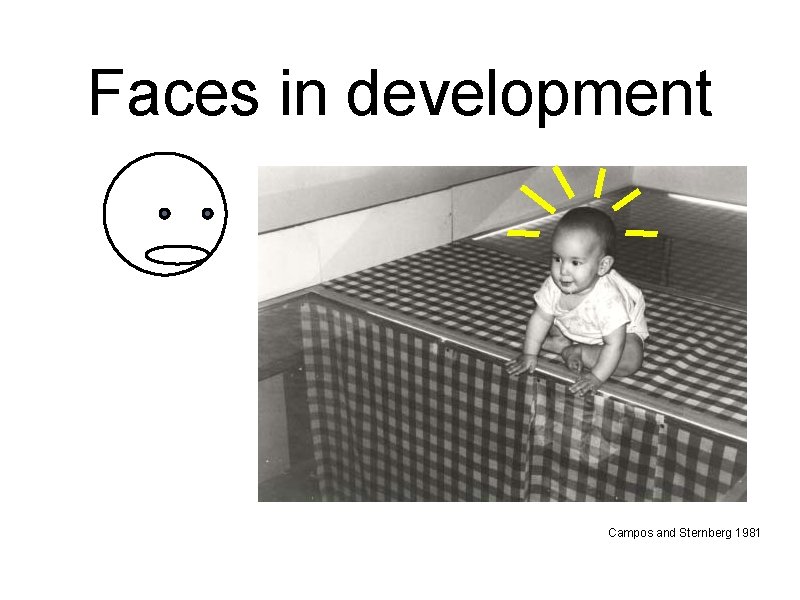
Faces in development Campos and Sternberg 1981
Faces in development Campos and Sternberg 1981
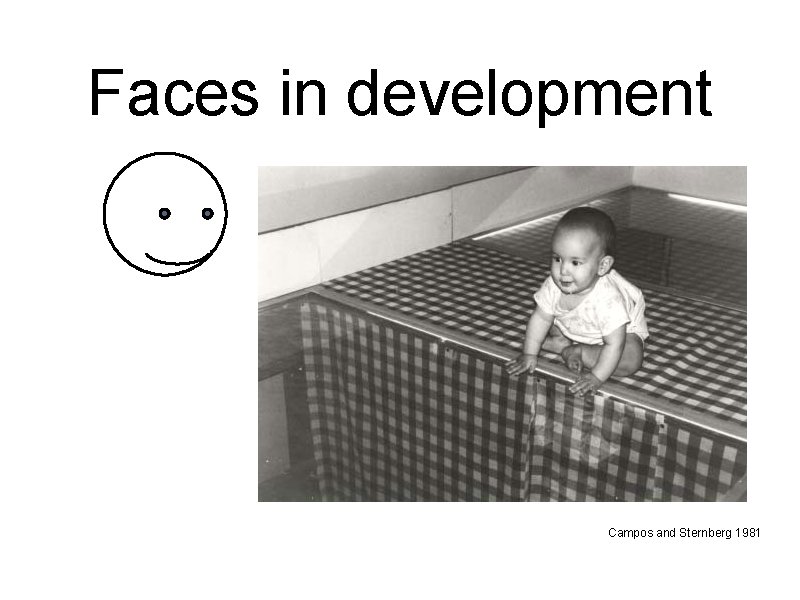
Faces in development Social Referencing: babies use mothers expression to decide to go across cliff Campos and Sternberg 1981
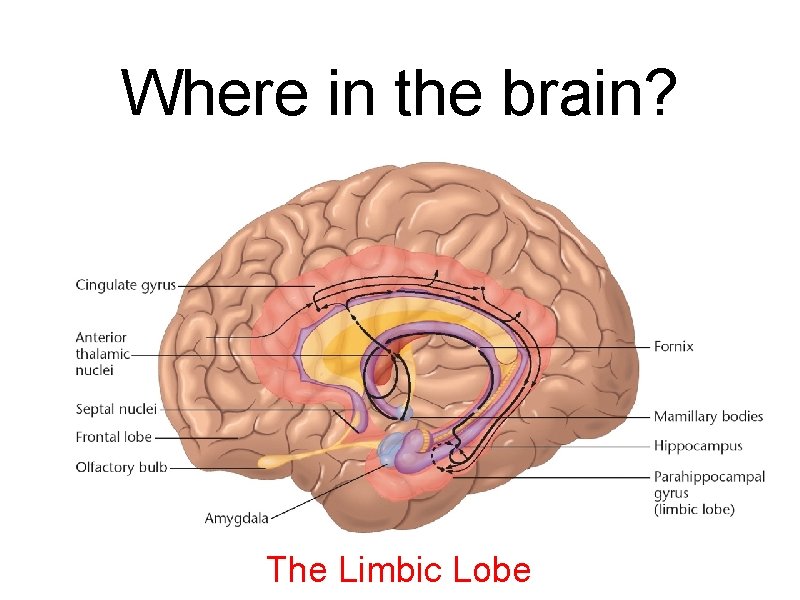
Where in the brain? The Limbic Lobe
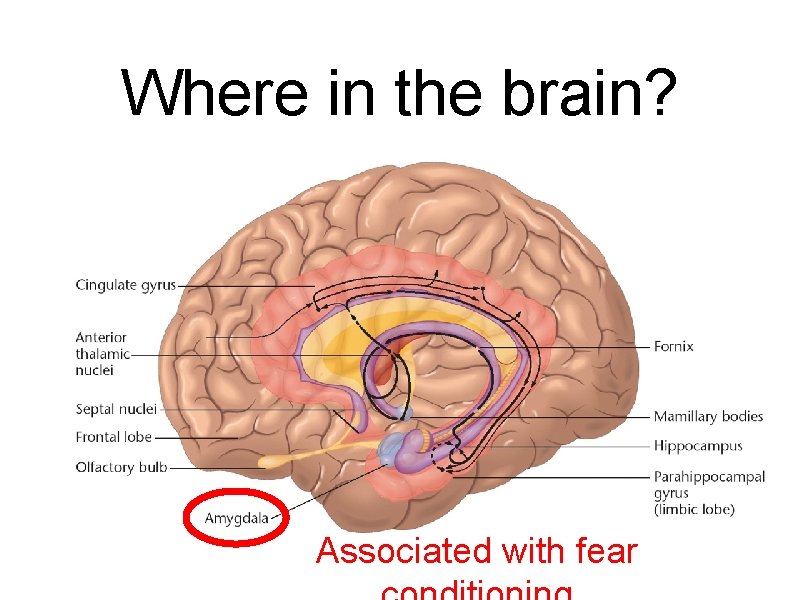
Where in the brain? Associated with fear
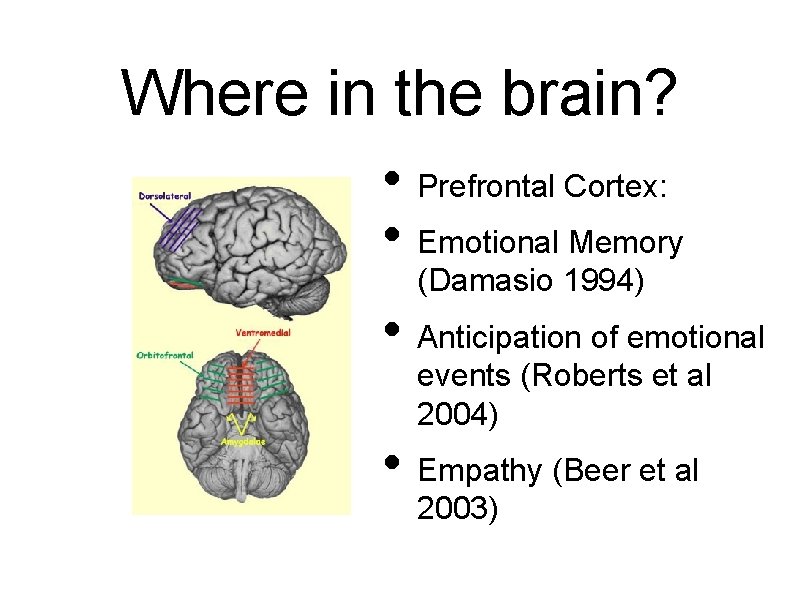
Where in the brain? • Prefrontal Cortex: • Emotional Memory (Damasio 1994) • Anticipation of emotional events (Roberts et al 2004) • Empathy (Beer et al 2003)
Personality What is it?
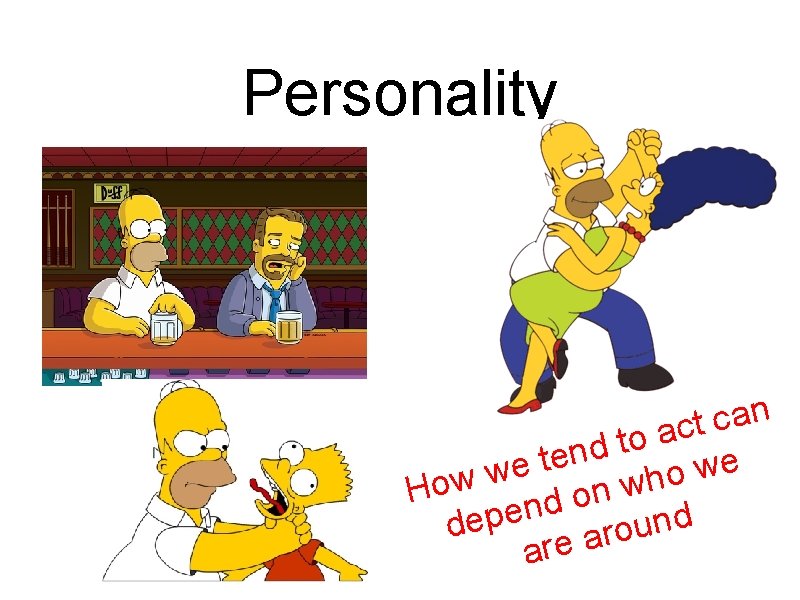
Personality n a c t c a o t d n e t e e w w o How nd on wh d n depe u o r a e ar
Personality y t i l a n o s r Pe tates s Per son a trait lity s
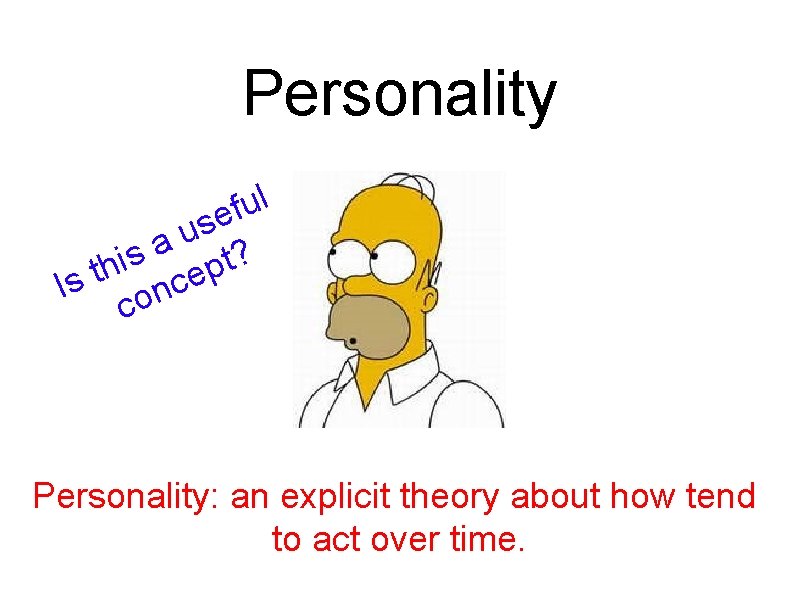
Personality: an explicit theory about how tend to act over time.
Personality l u f e s u a is ept? h t Is onc c Personality: an explicit theory about how tend to act over time.
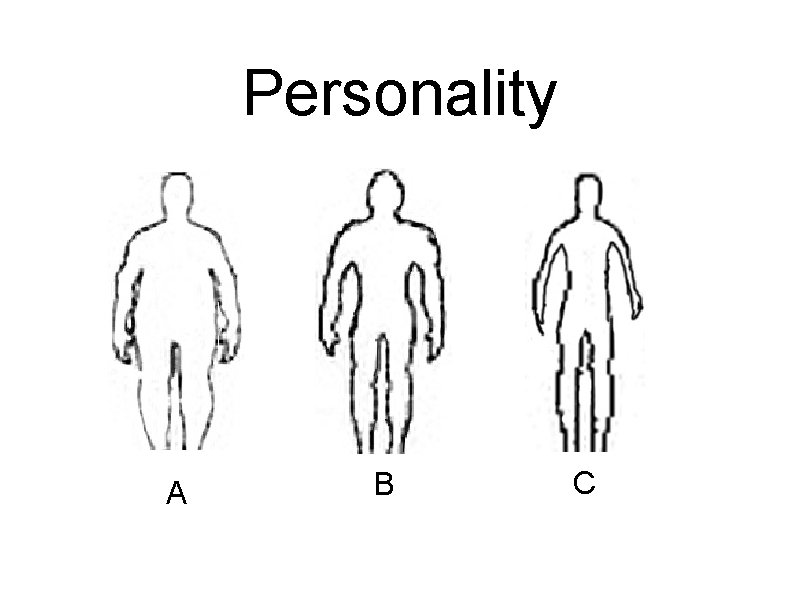
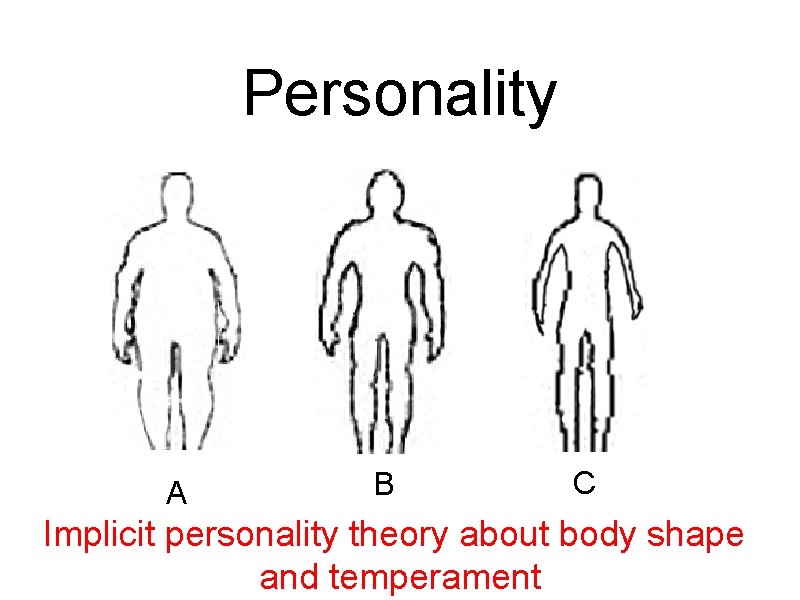
Personality !! ! ! O M E D • You will see 3 figures (A, B, C). I will read you statements about these three men • Decide which of three men the statement most likely applies to.
Personality A B C
Personality A B C Implicit personality theory about body shape and temperament
Personality • If you wanted to describe personality, or create a taxonomy, where would you begin?
Personality Language! • The idea was that the most salient and important personality characteristics have been encoded in language.
Personality • Initial work by Allport and Odburt(1936)compiled all of the English terms in the dictionary as a basis set. • Subsequent work focused on factoring these down to a meaningful and universal set of personality descriptors
Personality • One of the most prominent models is the “Big 5” which measures 5 dimensions: • • • Openness (orginality, openmindedness) Conscientiousness (control, constraint) Extraversion(energy, enthusiasm). Agreeableness (affection, altruism) Neuroticism (easily upset, stress)
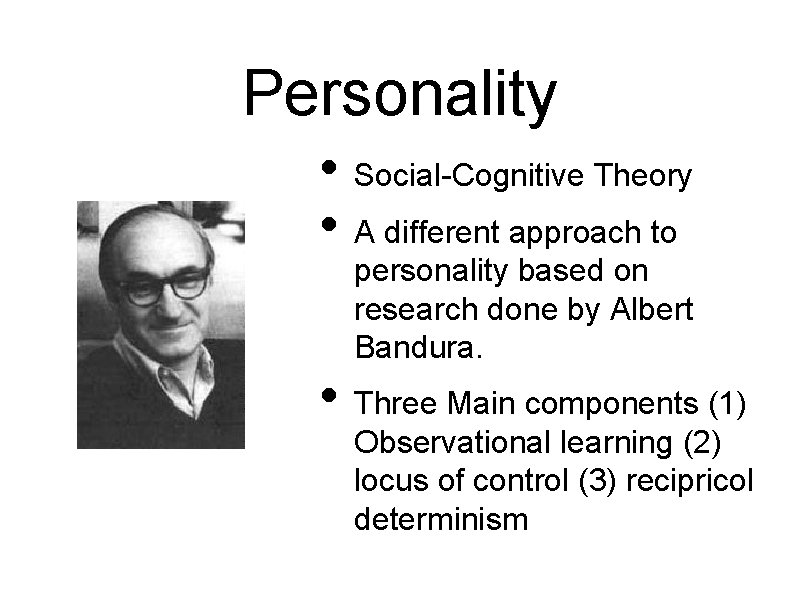
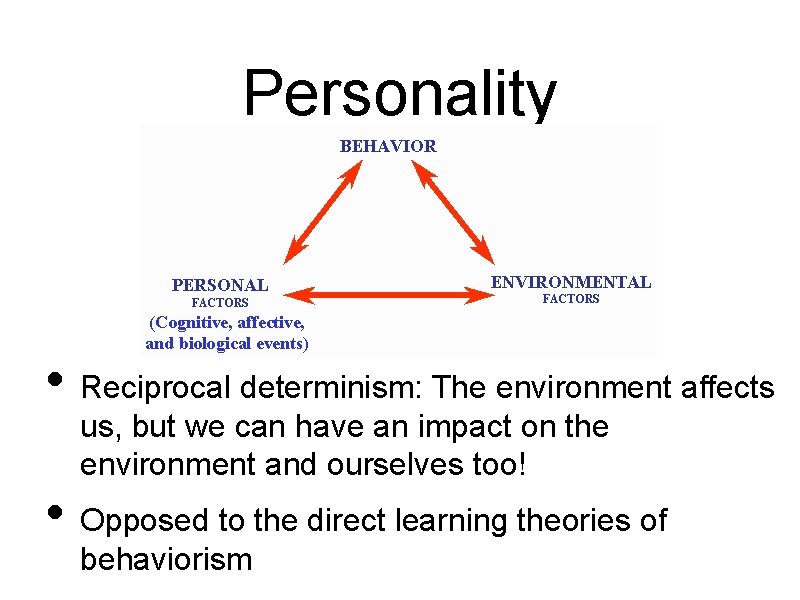
Personality • Social-Cognitive Theory • A different approach to personality based on research done by Albert Bandura. • Three Main components (1) Observational learning (2) locus of control (3) recipricol determinism
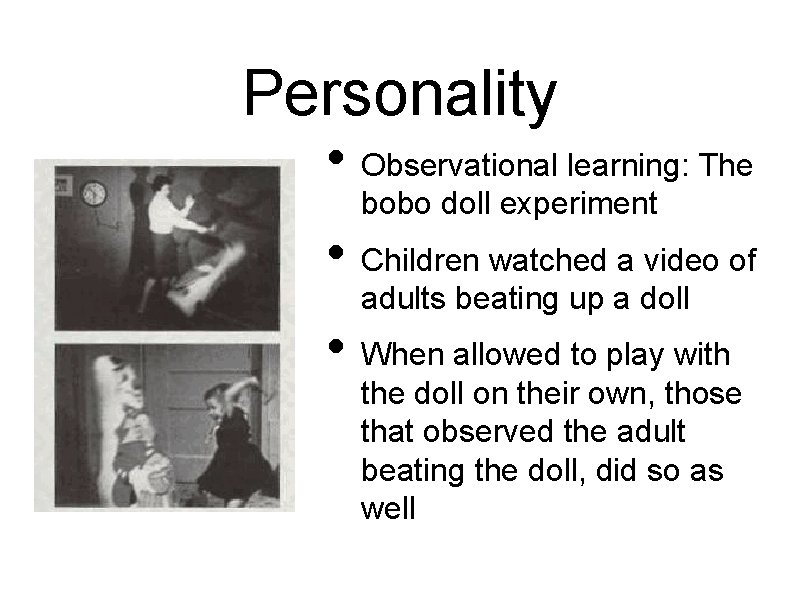
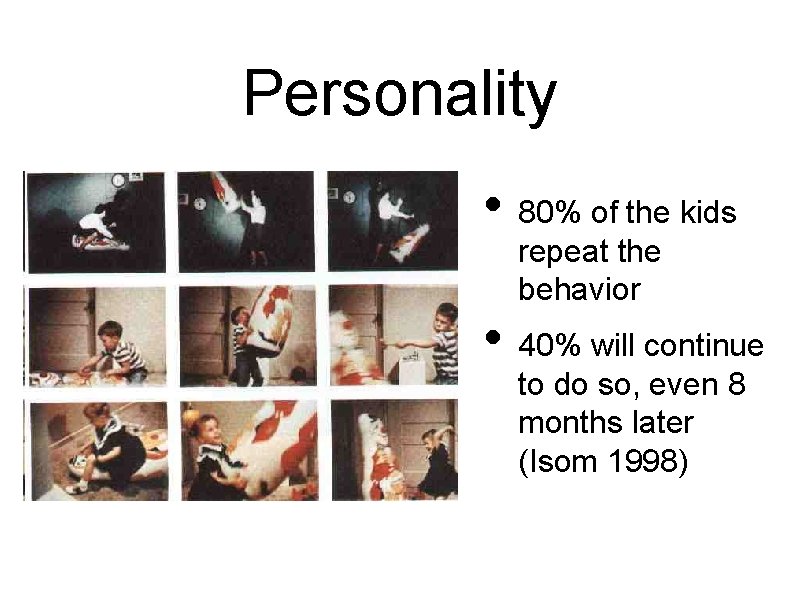
Personality • Observational learning: The bobo doll experiment • Children watched a video of adults beating up a doll • When allowed to play with the doll on their own, those that observed the adult beating the doll, did so as well
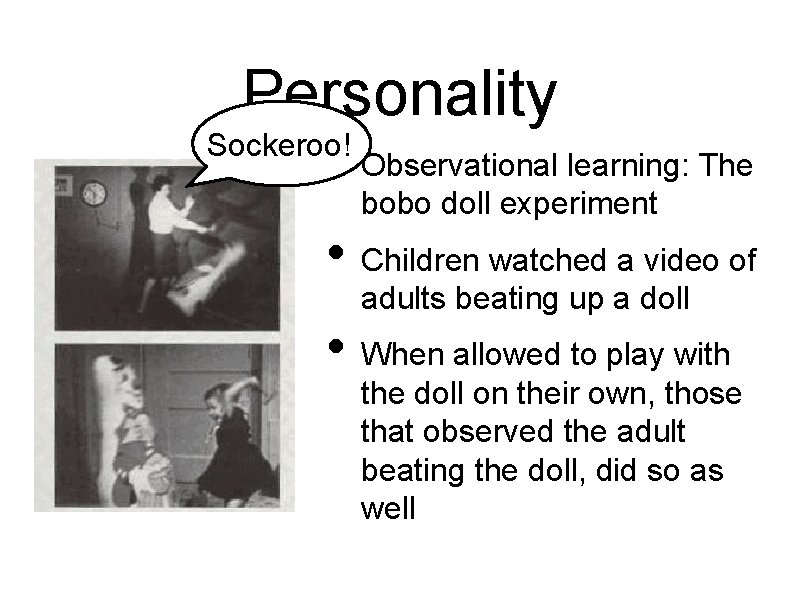
Personality • Observational learning: The Sockeroo! bobo doll experiment • Children watched a video of adults beating up a doll • When allowed to play with the doll on their own, those that observed the adult beating the doll, did so as well
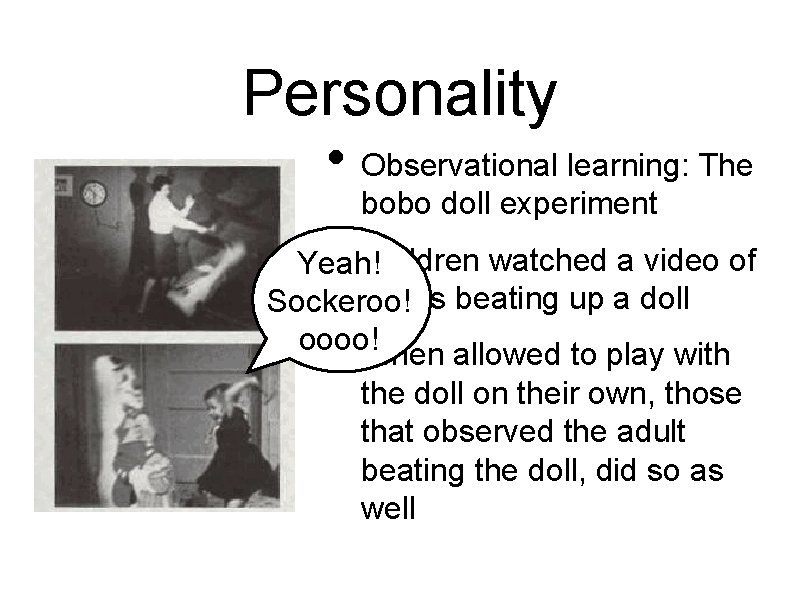
Personality • Observational learning: The • bobo doll experiment Children watched a video of Yeah! adults beating up a doll Sockeroo! oooo! When allowed to play with • the doll on their own, those that observed the adult beating the doll, did so as well
Personality • 80% of the kids repeat the behavior • 40% will continue to do so, even 8 months later (Isom 1998)
Personality • Reciprocal determinism: The environment affects us, but we can have an impact on the environment and ourselves too! • Opposed to the direct learning theories of behaviorism
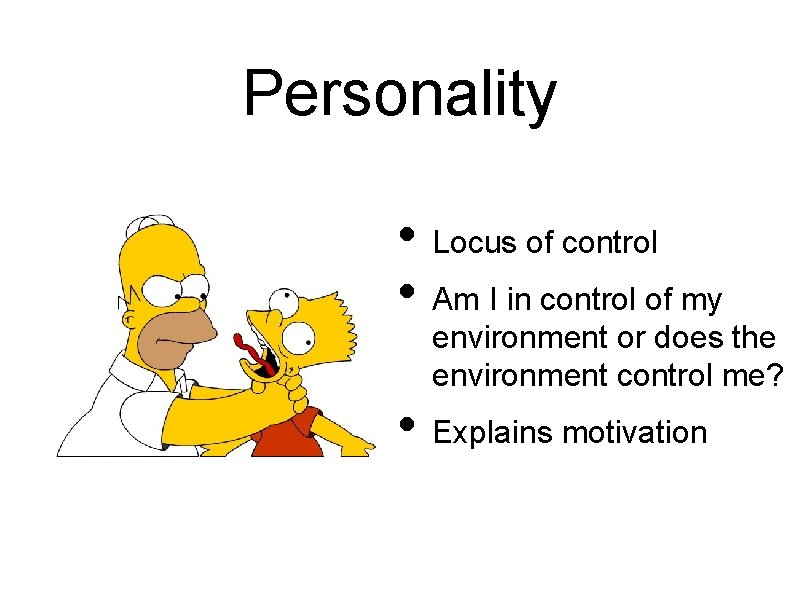
Personality • Locus of control • Am I in control of my environment or does the environment control me? • Explains motivation
Personality • !! ! ! O M E D On the handout are a series of situations that can happen to people. There are two alternative explanations for why each situation occurred. • Imagine each situation happening to you (even if it would never happen). • Decide which alternative, A or B, you prefer.
Personality • Score 1 point for answer A on items 1, 4, 7, 13, 15, and 17, and 0 for answer B. • Score 1 point for answer B on each item 2, 5, 8, 9, 12 and 18. Score a 0 for answer A on these items. • 3, 6, 10, 11, 14, and 16 were items used to evaluate social desirability: answer A in items 3, 11, 14, 16 were associated with a need to be perceived positively by others, and used to camouflage the other questions
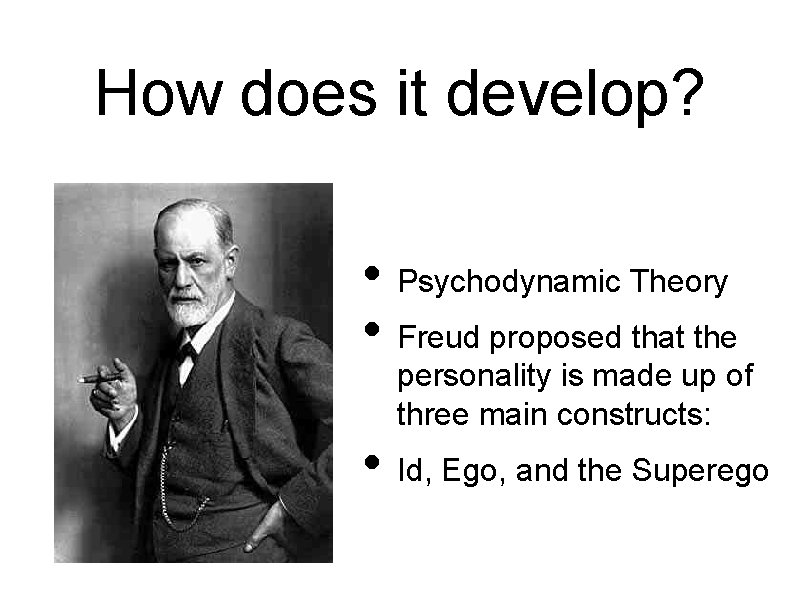
How does it develop? • Psychodynamic Theory • Freud proposed that the personality is made up of three main constructs: • Id, Ego, and the Superego
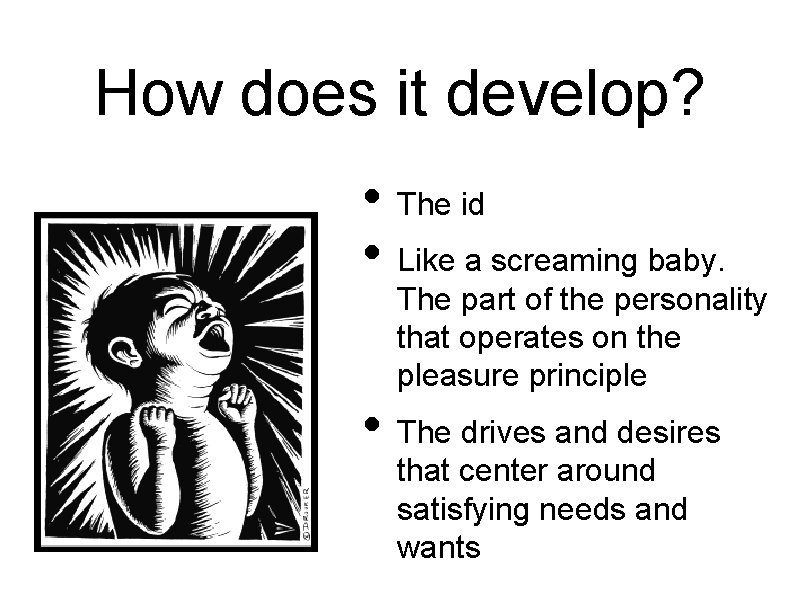
How does it develop? • The id • Like a screaming baby. The part of the personality that operates on the pleasure principle • The drives and desires that center around satisfying needs and wants
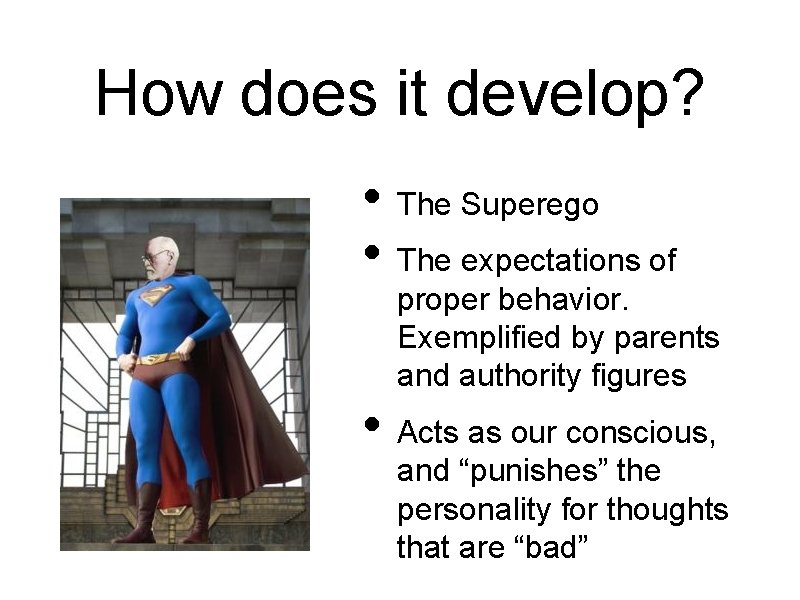
How does it develop? • The Superego • The expectations of proper behavior. Exemplified by parents and authority figures • Acts as our conscious, and “punishes” the personality for thoughts that are “bad”
How does it develop? • The Ego • The conscious self • Operates on the reality principle
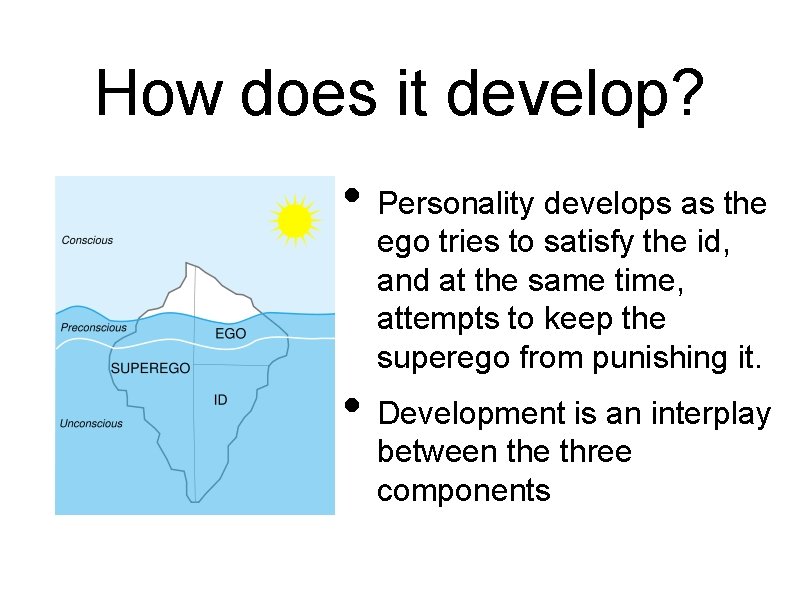
How does it develop? • Personality develops as the ego tries to satisfy the id, and at the same time, attempts to keep the superego from punishing it. • Development is an interplay between the three components
How does it develop? • The id has two main drives: The Sex and Death instincts • For Freud, these were implicit, buried deep in the personality, and NOT consciously knowable. Like a seething, bubbling cauldron wanting to explode! • The Ego’s job was to keep the lid on!
How does it develop? • What is wrong with Freud’s theory? • Testability • Reliability of the data theory is based on.
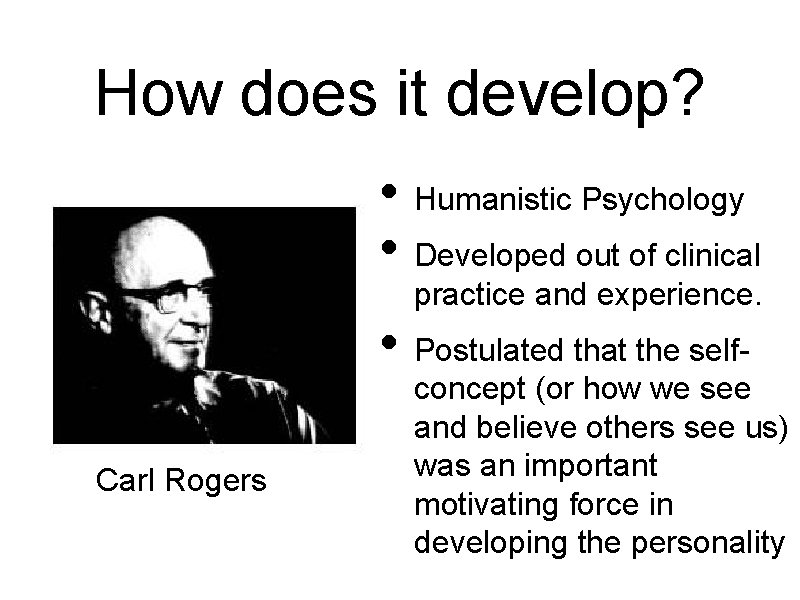
How does it develop? • Humanistic Psychology • Developed out of clinical practice and experience. • Postulated that the self. Carl Rogers concept (or how we see and believe others see us) was an important motivating force in developing the personality
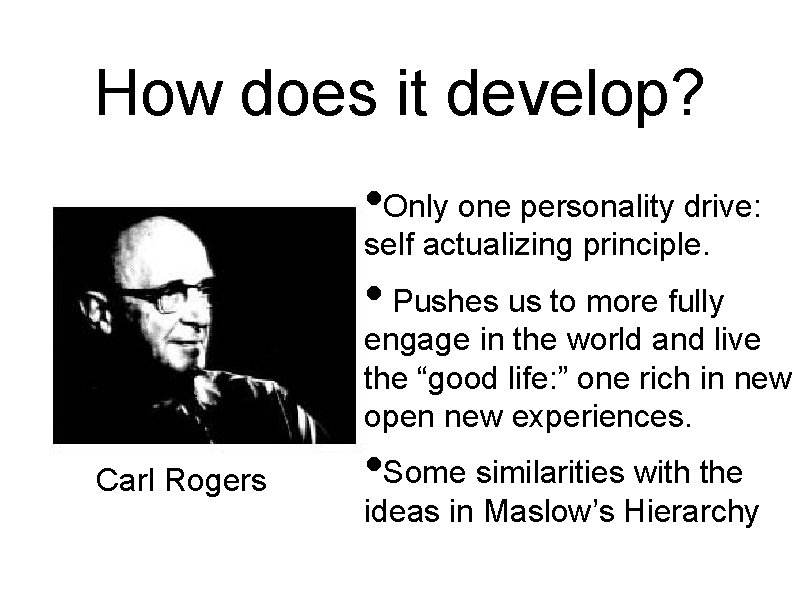
How does it develop? • Only one personality drive: self actualizing principle. • Pushes us to more fully engage in the world and live the “good life: ” one rich in new open new experiences. Carl Rogers • Some similarities with the ideas in Maslow’s Hierarchy
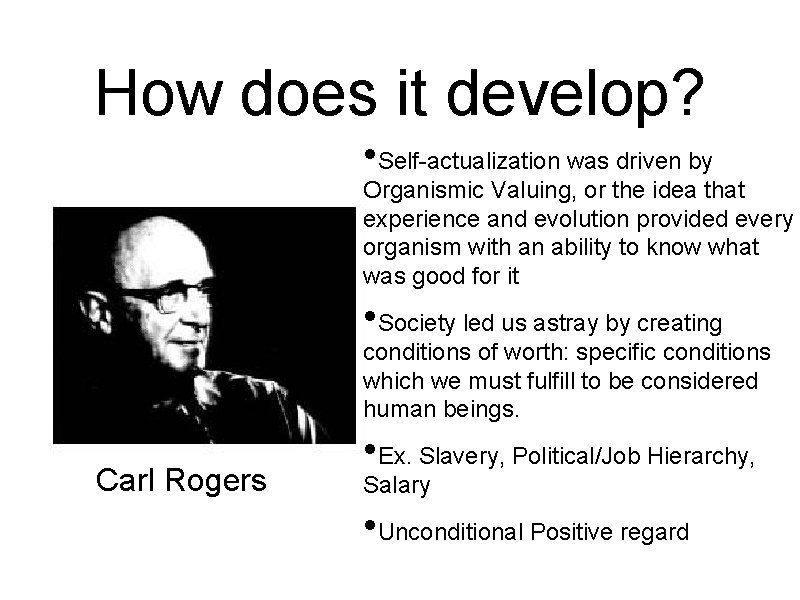
How does it develop? • Self-actualization was driven by Organismic Valuing, or the idea that experience and evolution provided every organism with an ability to know what was good for it • Society led us astray by creating conditions of worth: specific conditions which we must fulfill to be considered human beings. Carl Rogers • Ex. Slavery, Political/Job Hierarchy, Salary • Unconditional Positive regard
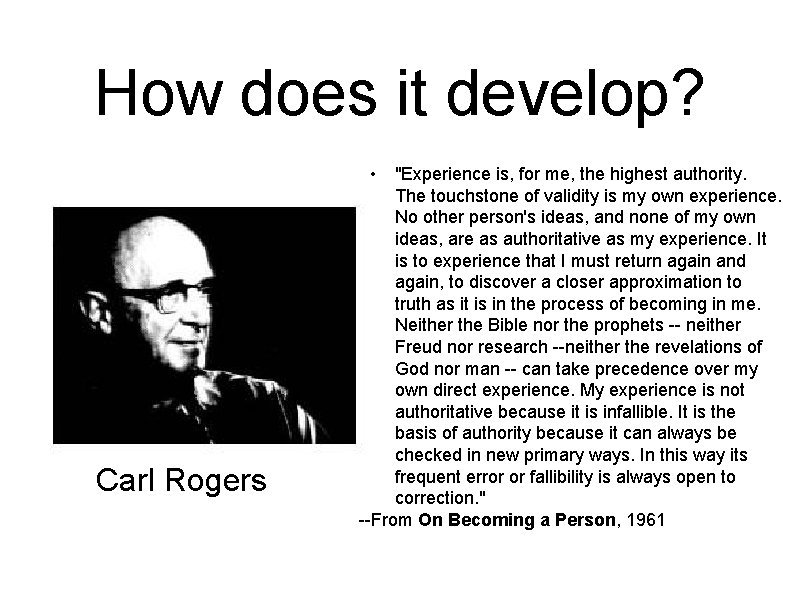
How does it develop? • Carl Rogers "Experience is, for me, the highest authority. The touchstone of validity is my own experience. No other person's ideas, and none of my own ideas, are as authoritative as my experience. It is to experience that I must return again and again, to discover a closer approximation to truth as it is in the process of becoming in me. Neither the Bible nor the prophets -- neither Freud nor research --neither the revelations of God nor man -- can take precedence over my own direct experience. My experience is not authoritative because it is infallible. It is the basis of authority because it can always be checked in new primary ways. In this way its frequent error or fallibility is always open to correction. " --From On Becoming a Person, 1961
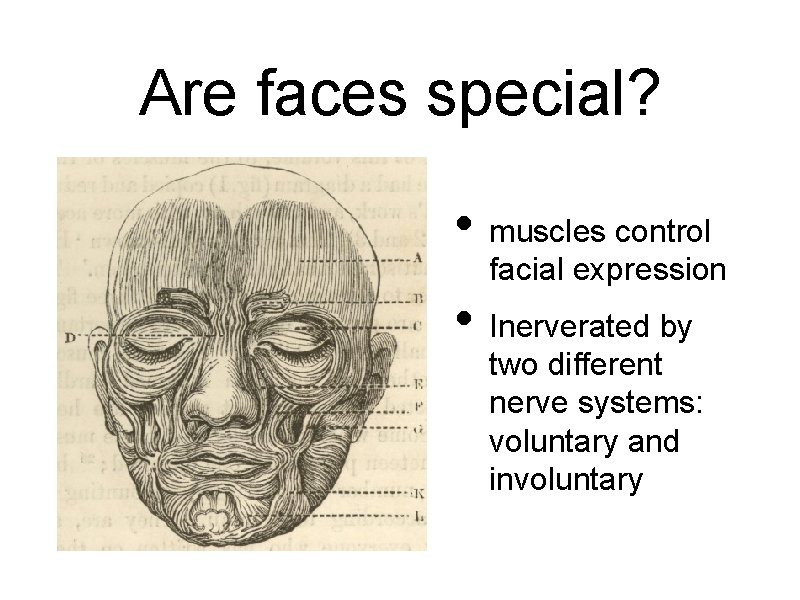
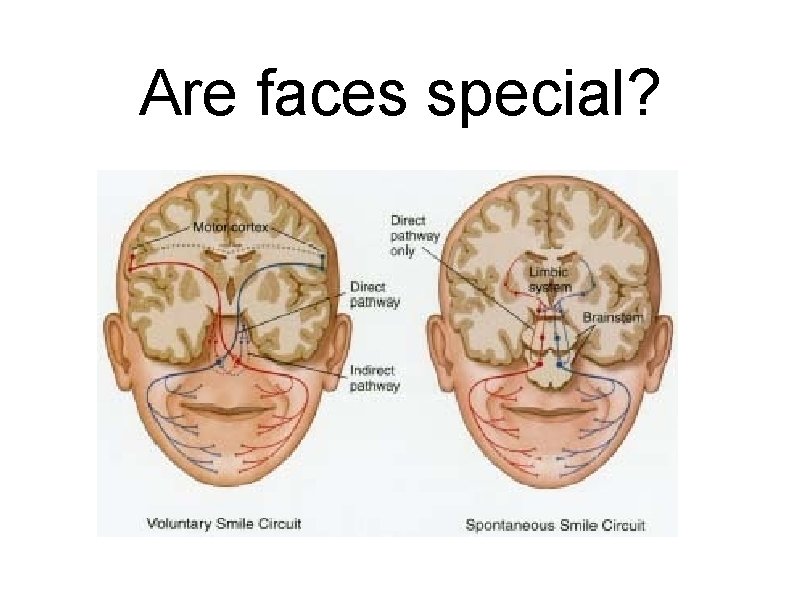
Are faces special? • muscles control facial expression • Inerverated by two different nerve systems: voluntary and involuntary
Are faces special?
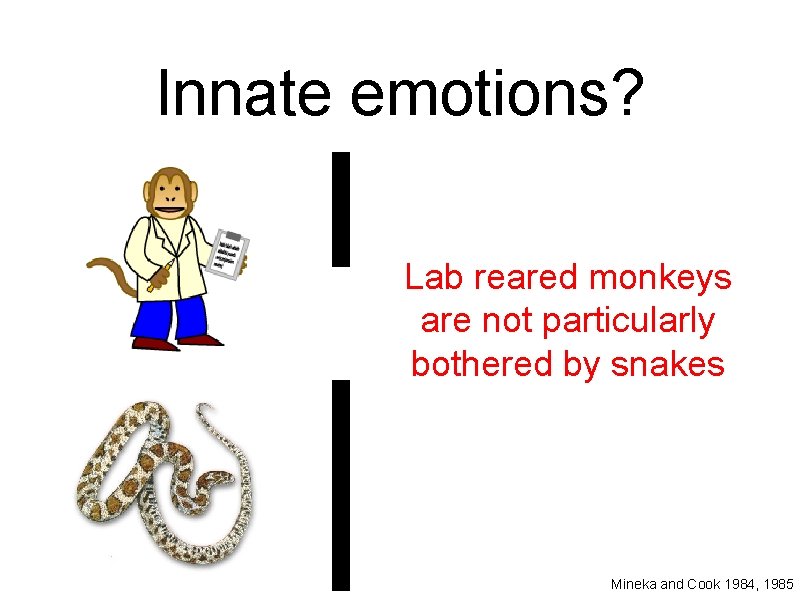
Innate emotions? Lab reared monkeys are not particularly bothered by snakes Mineka and Cook 1984, 1985
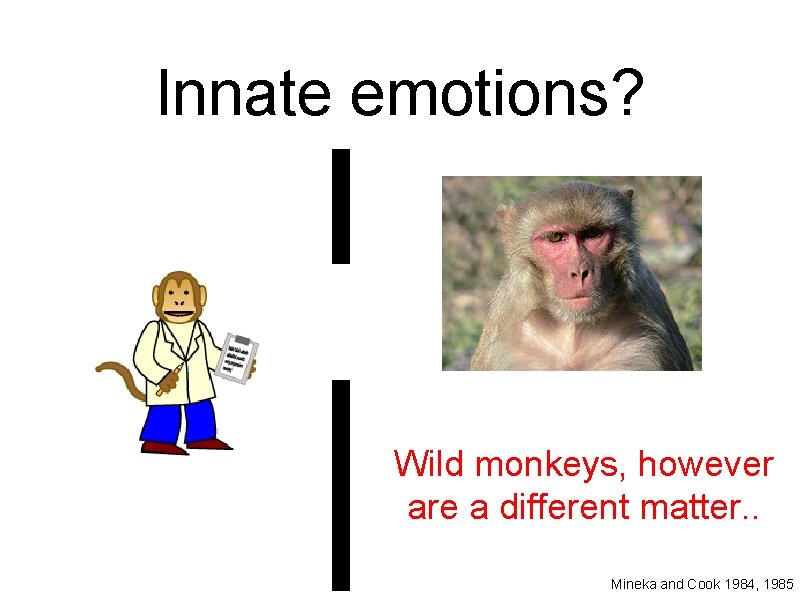
Innate emotions? Wild monkeys, however are a different matter. . Mineka and Cook 1984, 1985
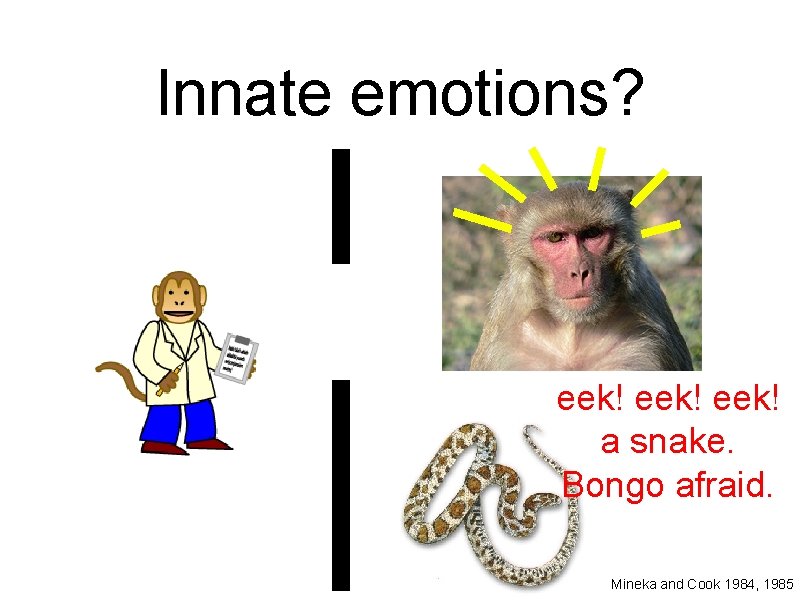
Innate emotions? eek! a snake. Bongo afraid. Mineka and Cook 1984, 1985
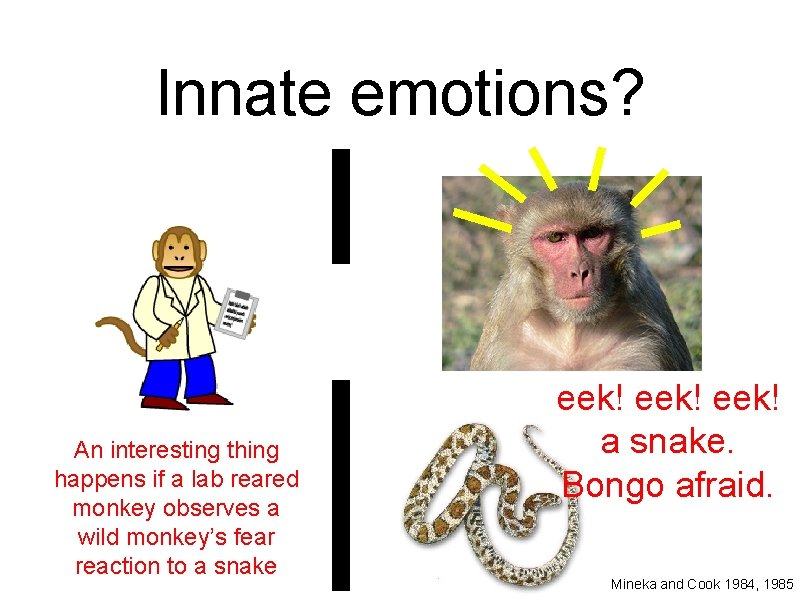
Innate emotions? An interesting thing happens if a lab reared monkey observes a wild monkey’s fear reaction to a snake eek! a snake. Bongo afraid. Mineka and Cook 1984, 1985
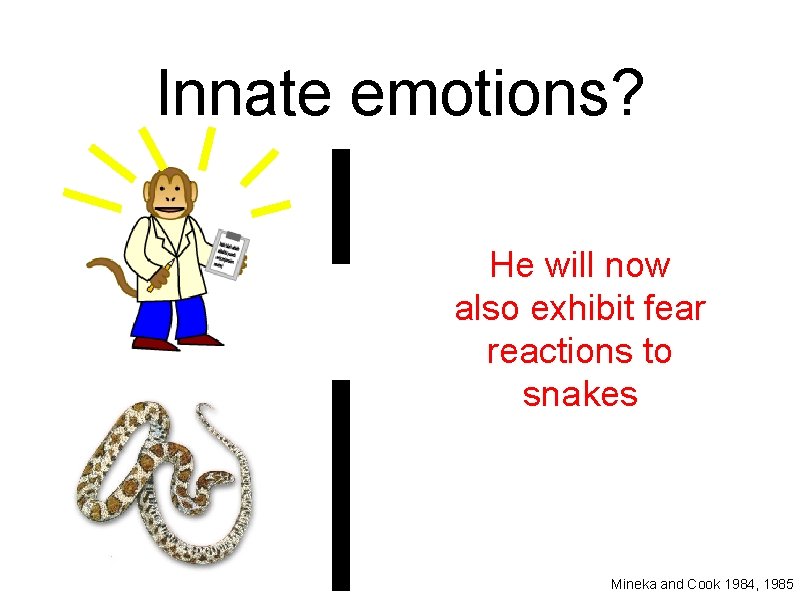
Innate emotions? He will now also exhibit fear reactions to snakes Mineka and Cook 1984, 1985
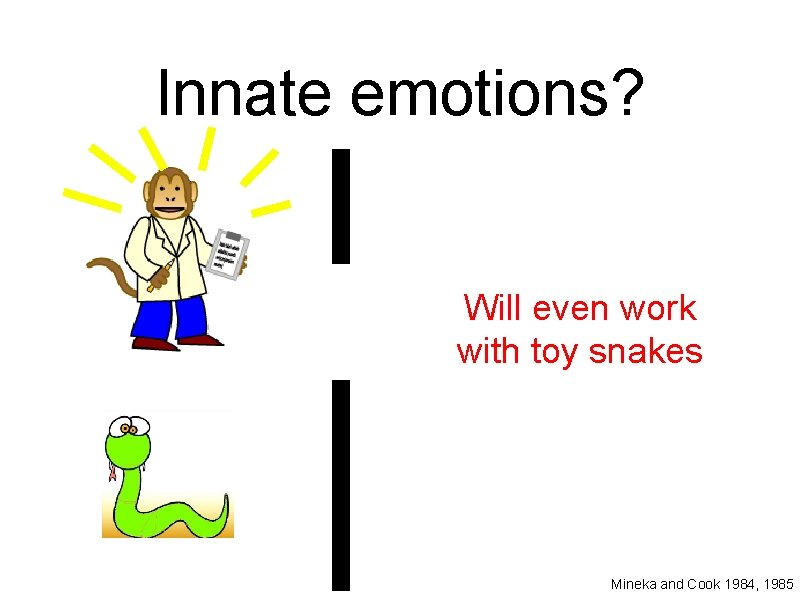
Innate emotions? Will even work with toy snakes Mineka and Cook 1984, 1985
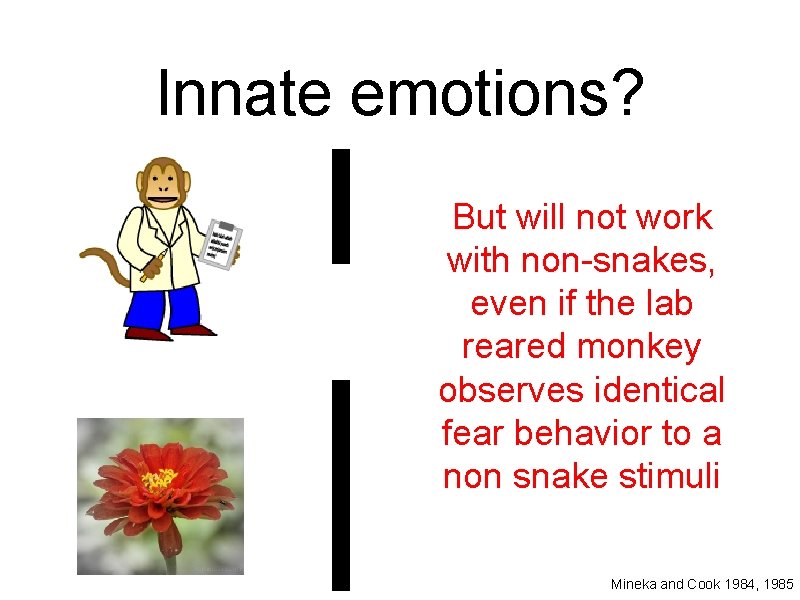
Innate emotions? But will not work with non-snakes, even if the lab reared monkey observes identical fear behavior to a non snake stimuli Mineka and Cook 1984, 1985