
EmotionalBehavioral Disorders Definition Emotional disturbance is defined in
Emotional/Behavioral Disorders

Definition • Emotional disturbance is defined in the Individuals with Disabilities Education Act (IDEA) as • (I)A condition exhibiting one or more of the following characteristics over a long period of time and to a marked degree, which adversely affects educational performance: • (A)An inability to learn which cannot be explained by intellectual, sensory, or health factors; • (B)An inability to build or maintain satisfactory relationships with peers and teachers; • (C)Inappropriate types of behavior or feelings under normal circumstances; • (D)A general pervasive mood of unhappiness or depression; or • (E)A tendency to develop physical symptoms or fears associated with personal or school problems. • (II)The term does not include children who are socially maladjusted, unless it is determined that they are seriously emotionally disturbed.
Emotional disturbance is defined in the Individuals with Disabilities Education Act (IDEA) as (I)A condition exhibiting one or more of the following characteristics over a long period of time and to a marked degree, which adversely affects educational performance: (A)An inability to learn which cannot be explained by intellectual, sensory, or health factors; (B)An inability to build or maintain satisfactory relationships with peers and teachers; (C)Inappropriate types of behavior or feelings under normal circumstances; (D)A general pervasive mood of unhappiness or depression; or (E)A tendency to develop physical symptoms or fears associated with personal or school problems. (II)The term does not include children who are socially maladjusted, unless it is determined that they are seriously emotionally disturbed.
Emotional disturbance is defined in the Individuals with Disabilities Education Act (IDEA) as (I)A condition exhibiting one or more of the following characteristics over a long period of time and to a marked degree, which adversely affects educational performance: (A)An inability to learn which cannot be explained by intellectual, sensory, or health factors; (B)An inability to build or maintain satisfactory relationships with peers and teachers; (C)Inappropriate types of behavior or feelings under normal circumstances; (D)A general pervasive mood of unhappiness or depression; or (E)A tendency to develop physical symptoms or fears associated with personal or school problems. (II)The term does not include children who are socially maladjusted, unless it is determined that they are seriously emotionally disturbed.
Deeper in to the Definition • Has been criticized because of its lack of clarity, incompleteness, and exclusion of socially maladjusted (juvenile delinquent) • What is normal behavior? • A child identified in one state may not qualify in another • Research indicates that the greatest number is Conduct disorder • Co-morbidity with other disabilities is high • Creates spiral and complicates • In Utah, most in the regular classroom for 70% of the day
Prevalence • Estimates vary from 2 -20% • Sensible estimate 3 -6% • Estimated ¾ male • In comparison with other students, both with and without disabilities, children with emotional disturbance are more likely to be • Male • African American • Economically disadvantaged. • They are also more likely to • Live with one parent • Live in foster care, or in another alternative living arrangement • Females are more likely to exhibit internalizing problems such as anxiety and depression that do not usually interfere with classroom management • Males are more likely to demonstrate the externalizing behaviors that do disrupt the classroom.
Causation • Inappropriate learning and complex interactions • Native temperament • Family environment • • Economic stress Drugs and alcohol Abuse and neglect Malnutrition Dysfunctional family Family discord Poor parenting • • • Parents who are extremely passive Parents who are overly strict Parents who use aggressive discipline Homes that have inconsistent rules or no rules Homes that have inconsistent consequences • Poverty • Health care • Biochemical abnormalities • genetics
Characteristics • Intelligence • Tend to have average to below average IQ • 2 different research studies found average IQ of 86 and 92 • Questions is whether their IQ is truly lower or a reflection of the testing • Most performing one or more years below academically • Often have reading difficulties • Social and adaptive behavior • Difficulty making and keeping friends • The students with behavioral disorders reported lower levels of empathy toward others, participation in fewer curricular activities, less frequent contacts with friends, and lower-quality relationships • Difficulty sharing, playing games • Problem solving difficulty • Accepting consequences • Expressing affection • 3 out of 4 have significant language deficits
Characteristics Continued…. • Academic • • • Of high incidence disabilities – EBD tend to have the poorest academic outcomes Higher incidence of incarceration, drug abuse later Dropout rates: 51 -70% most before 10 th grade Only 1 in 5 go on to postsecondary Employment: • Of all disabled – 69% employed, only 42 -70% EBD • Common Behaviors in the Classroom • • • Hyperactivity (short attention span, impulsiveness); Aggression or self-injurious behavior (acting out, fighting); Withdrawal (not interacting socially with others, excessive fear or anxiety); Immaturity (inappropriate crying, temper tantrums, poor coping skills); and Learning difficulties (academically performing below grade level).
Externalizing Classroom Behaviors • • • • Get out of their seats Yell, talk out, and curse Disturb peers Hit or fight Ignore the teacher Complain Argue excessively Steal Lie Destroy property Do not comply with directions Have temper tantrums Are excluded from peer-controlled activities Do not respond to teacher corrections Do not complete assignments
Internalizing Classroom Behaviors • • These children seldom play with others their own age. Do not have the social skills needed to make friends and have fun, Often retreat into daydreams and fantasies. Some are fearful of things without reason, frequently complain of being sick or hurt, and go into deep bouts of depression.
Anxiety Disorders • anxiety can be excessive, persistent, seemingly uncontrollable, and overwhelming • Includes generalized anxiety disorder (GAD), obsessivecompulsive disorder (OCD), panic disorder, posttraumatic stress disorder (PTSD), social anxiety disorder (also called social phobia), and specific phobias. Elimination disorders (encopresis or enuresis). • Most common psychiatric illnesses affecting children and adults. • Highly treatable. Unfortunately, only about 1/3 of those affected receive treatment
Bipolar Disorder • Also known as manic-depressive illness, bipolar disorder is a serious medical condition that causes dramatic mood swings from overly “high” and/or irritable to sad and hopeless, and then back again, often with periods of normal mood in between. • Severe changes in energy and behavior go along with these changes in mood. • For most people with bipolar disorder, these mood swings and related symptoms can be stabilized over time using an approach that combines medication and psychosocial treatment.
Conduct Disorder • Conduct disorder refers to a group of behavioral and emotional problems in youngsters. Children and adolescents with this disorder have great difficulty following rules and behaving in a socially acceptable way. • This may include some of the following behaviors: • aggression to people and animals; • destruction of property; • deceitfulness, lying, or stealing; or • truancy or other serious violations of rules. • This is one of the most difficult behavior disorders to treat
Eating Disorders • Characterized by extremes in eating behavior—either too much or too little—or feelings of extreme distress or concern about body weight or shape • Females are much more likely to develop an eating disorder • Anorexia nervosa is characterized by self-starvation and dramatic loss of weight. • Bulimia nervosa involves a cycle of binge eating, then self-induced vomiting or purging. • Both of these disorders are potentially life-threatening. • Binge eating is also considered an eating disorder. It’s characterized by eating excessive amounts of food, while feeling unable to control how much or what is eaten. Unlike with bulimia, people who binge eat usually do not purge afterward by vomiting or using laxatives
Psychotic Disorders • umbrella term used to refer to severe mental disorders that cause abnormal thinking and perceptions • Delusions are false beliefs, such as thinking that someone is plotting against you. • Hallucinations are false perceptions, such as hearing, seeing, or feeling something that is not there. • Schizophrenia is one type of psychotic disorder.
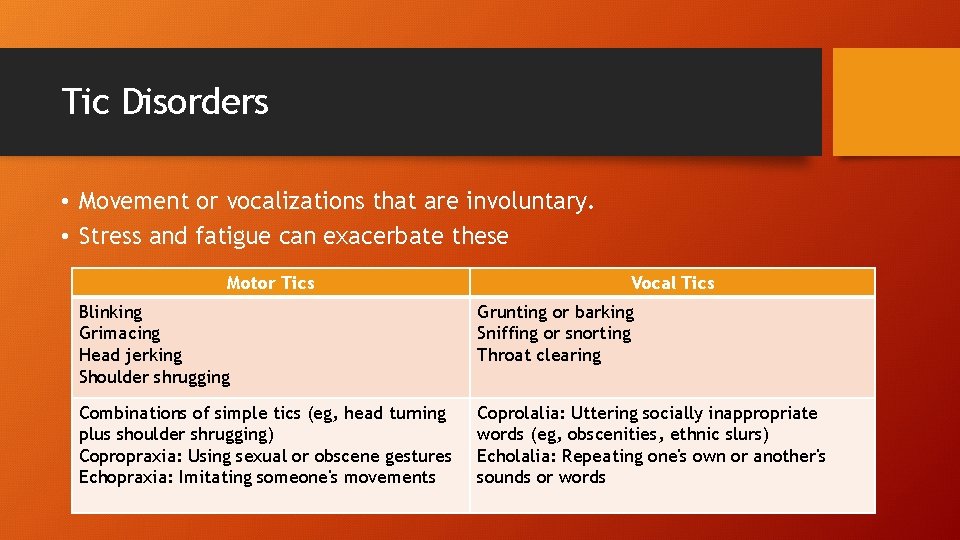
Tic Disorders • Movement or vocalizations that are involuntary. • Stress and fatigue can exacerbate these Motor Tics Vocal Tics Blinking Grimacing Head jerking Shoulder shrugging Grunting or barking Sniffing or snorting Throat clearing Combinations of simple tics (eg, head turning plus shoulder shrugging) Copropraxia: Using sexual or obscene gestures Echopraxia: Imitating someone's movements Coprolalia: Uttering socially inappropriate words (eg, obscenities, ethnic slurs) Echolalia: Repeating one's own or another's sounds or words
- Slides: 17