
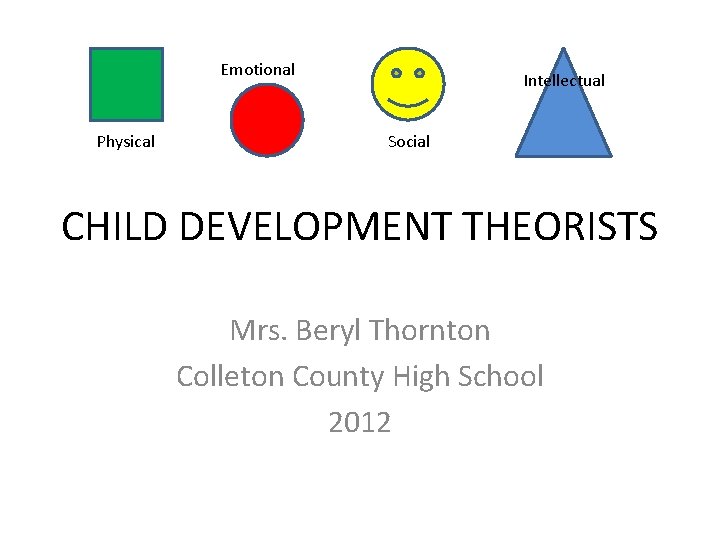
Emotional Physical Intellectual Social CHILD DEVELOPMENT THEORISTS Mrs

- Slides: 13
Emotional Physical Intellectual Social CHILD DEVELOPMENT THEORISTS Mrs. Beryl Thornton Colleton County High School 2012
Sigmund Freud (1856 -1939) • Series of Stages • Emotional Experiences of Childhood affect Adult Life • http: //allpsych. com/psychology 101/ego. html
Maria Montessori (1870 -1952) • Learn by using their senses • Learn best when pursuing their interests • Give children objects to Manipulate to exercise senses. • http: //www. michaelolaf. net/1 CW 312 MI. html http: //www. bgmontessori. com/montessori/101
Arnold Gesell (1880 -1961) • Developed a Typical Order of Mastery • Typical Rate of Development • http: //www. education. com/reference/article/arnold-gesell-child-learning-development -theory/
Jean Piaget (1896 -1980) • First Scientific Study of Children • Four Stages of Thinking that Shape how they see and learn about the world. – Sensorimotor (0 -2 years) – Preoperational (2 -7 years) – Concrete Operations (7 -11) – Formal Operations (11 -adult) • Provide activities and materials suitable to each stage. http: //psychohawks. wordpress. com/2010/09/05/theories-ofcognitive-development-jean-piaget/
Lev Vygotsky (1898 -1934) • Biological & Cultural experiences influence ability to think & learn. • Social contact is essential for intellectual development. • Provide many opportunities for social interaction to develop intellectually. http: //www. learning-theories. com/vygotskys-social-learning-theory. html
Erikson (1902 -1994) • Each Stage includes a Unique Psychological Crisis which affects future development. • Needs should be met with positive care at each stage. • Example: Separation http: //psychology. about. com/od/psychosocialtheories/a/psychosocial. htm
B. F. Skinner (1904 -1990) • Child’s actions bring positive effects--action will be repeated. • Negative results occur, child will eventually stop the action. • Rewards and punishments can influence a child’s behavior. • http: //www. kidsdevelopment. co. uk/bfskinnersbehaviouraltheory. html
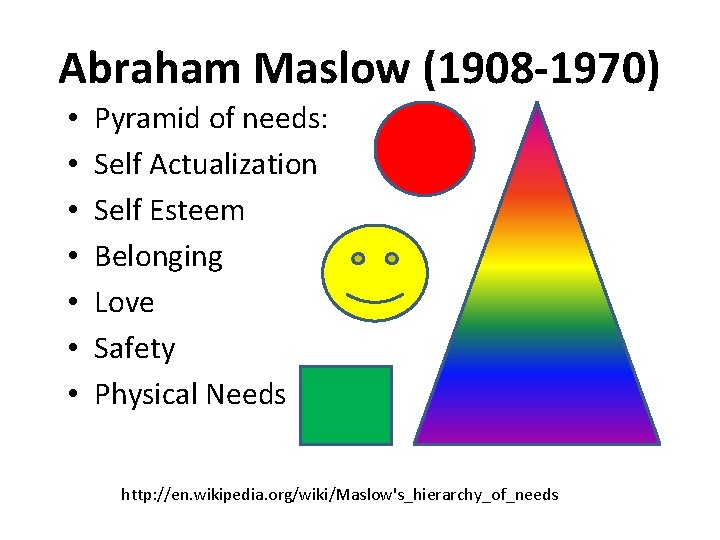
Abraham Maslow (1908 -1970) • • Pyramid of needs: Self Actualization Self Esteem Belonging Love Safety Physical Needs http: //en. wikipedia. org/wiki/Maslow's_hierarchy_of_needs
Albert Bandura (1925 • Learn by Modeling • Behavior also affects environment • Children need good examples of behavior. • http: //www. learning-theories. com/social-learning-theory-bandura. html
Robert Coles (1929 • Moral Development is learned. • Adult Moral Behavior Examples are important. • http: //www. pbs. org/newshour/gergen/february 97/coles_2 -21. html
Howard Gardner (1943 - ) • • Multiple Intelligences Theory of Learning Linguistic Logical-mathematical Spatial Bodily-kinesthetic Musical Interpersonal Intrapersonal • http: //www. indiana. edu/~intell/gardner. shtml
WORKS CITED Brisbane, Holly. “Understanding Childhood. ” The Developing Child. Glencoe, New York: 2004. “Sigmund Freud, ” All about Psychology. http: //allpsych. com/psychology 101/ego. html September 23, 2012. “Arnold Gesell” Education. www. education. com/reference/article/arnold-gesell-child-learning-developmenttheory. September 23, 2012. “Abraham Maslow. ” Wikipedia in England. http: //en. wikipedia. org/wiki/Maslow's_hierarchy_of_needs. Sept. 23, 2012. “Howard Gardner. ” Indiana University. http: //www. indiana. edu/~intell/gardner. shtml , Sept. 23, 2012. “Albert Bandura. ” Learning Theories. http: //www. learning-theories. com/social-learning-theory-bandura. html “Maria Montessori. ” Michael OLAF http: //www. michaelolaf. net/1 CW 312 MI. html Sept. 23, 2012. “Montessori 101. ” Montessori Children’s House. www. montessori. com/montessori/101 September 29, 2012. “Robert Coles. ” Public Broadcasting Station. http: //www. pbs. org/newshour/gergen/february 97/coles_221. html Sept. 23, 2012. “Jean Piaget. ” Psychology Hawks. http: //psychohawks. wordpress. com/2010/09/05/theorieof-cognitivedevelopment-jean-piaget/ September 23, 2012.