
Emotional Focused Coping Styles in relation to Stress

- Slides: 12
Emotional -Focused Coping Styles in relation to Stress, Emotional Intelligence and Mental Health among Aged M. Varalakshmi Research Scholar & Dr. B. S KUMAR REDDY, Ph. D Professor, Dept Of Psychology S. V University Tirupati
Introduction The interest in the field of Gerontology is growing very rapidly not only in the developed countries of the world but also in the developing countries, particularly in India, where the aging population is in the frontline. In India the lives of many persons are mostly hand to mouth which only adds fuel to fire in the accentuation of the normal problems of old age. However, there any investigation on the impact of stress, emotional intelligence and mental health on emotional focused coping styles among the Indian rural elderly; it was decided to carry out an investigation
Hypotheses 1. Stress would significantly influence the use of emotional-focused coping styles. 2. Emotional intelligence would significantly influence the use of emotional- focused coping styles. 3. Mental health would significantly influence the use of emotional- focused coping styles
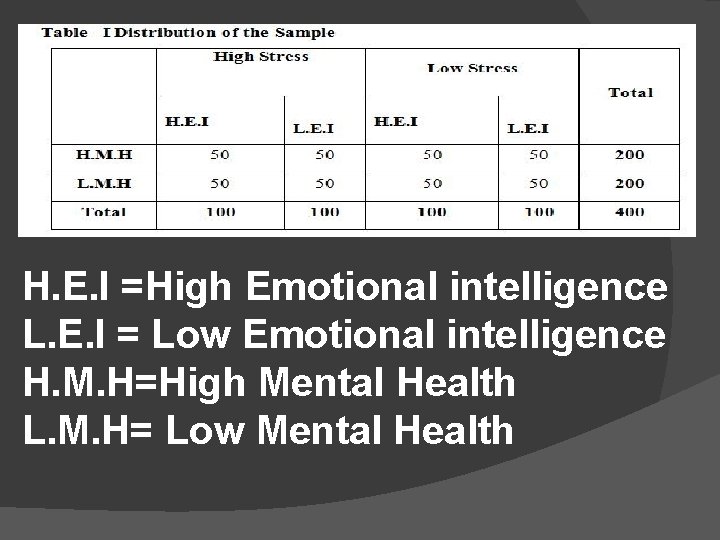
METHOD Sample of the study consisted of 400 aged men and women in the age group of 60 -70 years, living in rural areas of A. P. Technique of simple randomization was employed for the selection of the subjects and the details of the sample are given in table-1
H. E. I =High Emotional intelligence L. E. I = Low Emotional intelligence H. M. H=High Mental Health L. M. H= Low Mental Health
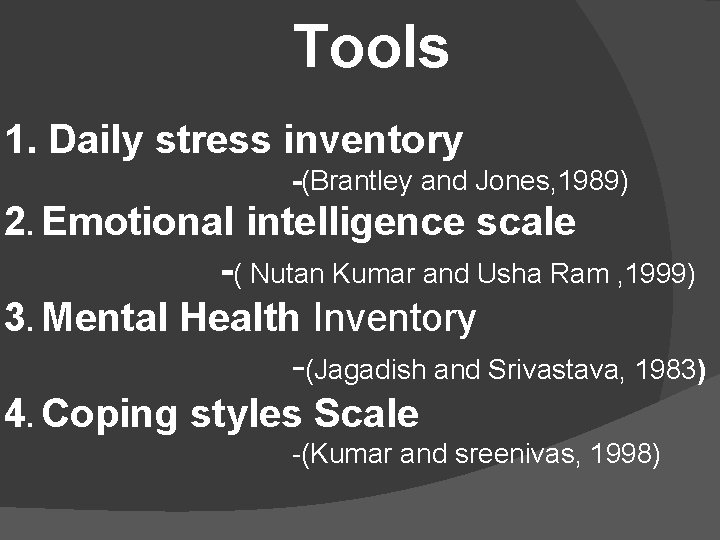
Tools 1. Daily stress inventory -(Brantley and Jones, 1989) 2. Emotional intelligence scale -( Nutan Kumar and Usha Ram , 1999) 3. Mental Health Inventory -(Jagadish and Srivastava, 1983) 4. Coping styles Scale -(Kumar and sreenivas, 1998)
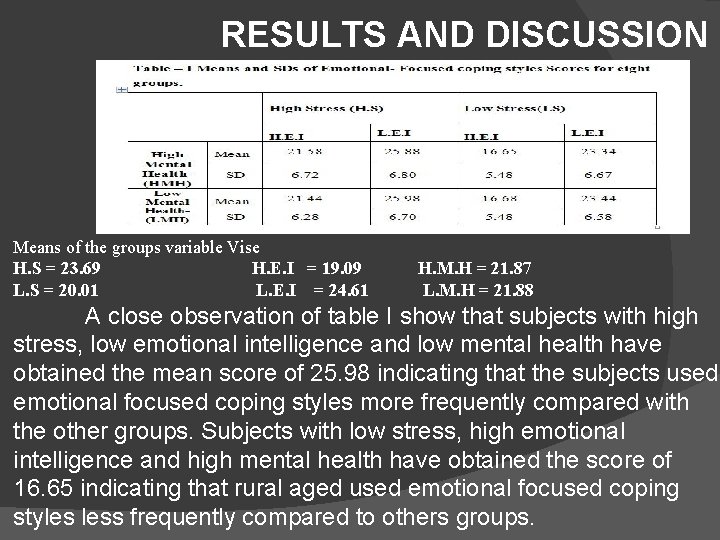
RESULTS AND DISCUSSION Means of the groups variable Vise H. S = 23. 69 H. E. I = 19. 09 L. S = 20. 01 L. E. I = 24. 61 H. M. H = 21. 87 L. M. H = 21. 88 A close observation of table I show that subjects with high stress, low emotional intelligence and low mental health have obtained the mean score of 25. 98 indicating that the subjects used emotional focused coping styles more frequently compared with the other groups. Subjects with low stress, high emotional intelligence and high mental health have obtained the score of 16. 65 indicating that rural aged used emotional focused coping styles less frequently compared to others groups.
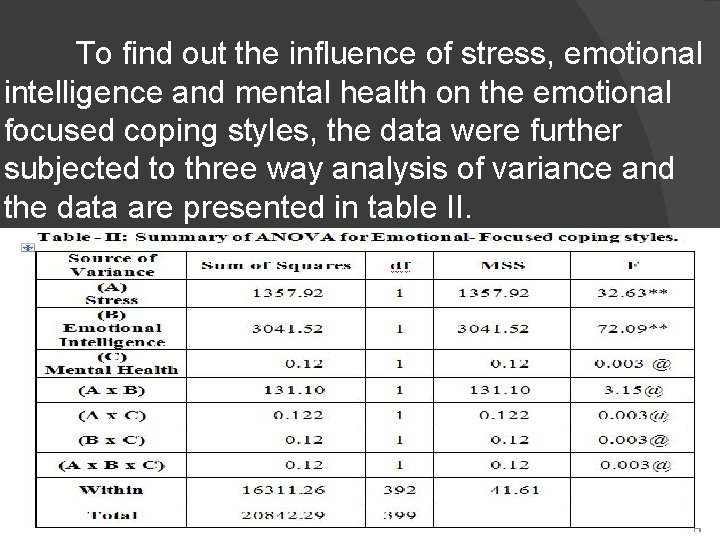
To find out the influence of stress, emotional intelligence and mental health on the emotional focused coping styles, the data were further subjected to three way analysis of variance and the data are presented in table II.
CONCLUSIONS In summary, the present investigation reveals that stress and emotional intelligence have significant influence on emotional focused coping styles. Rural folk with high stress and low emotional intelligence have been using emotional focused coping styles more frequently.
IMPLICATIONS The present investigation has brought out the impact of stress and emotional intelligence on emotional focused coping styles. The present finding implies that rural aged with high stress and low emotional intelligence has been using emotional focused coping styles more frequently. Lack of education, lack of exposure and guidance might have left the rural folk unaware of several other resources of coping and effective coping styles. Not merely because of these reasons, but owing to illiteracy and ignorance majority of the elderly not aware of stress management techniques and the importance of emotional intelligence for happy living.
There appears to be urgent need for sort of counseling for the rural aged that would be meaningful and helpful in overcoming their stresses and to improve emotional intelligence. Psychologists, Social workers and N. G. Os need to extend their expertise to the services of the rural aged by giving training programes. They need to have information on what are the better ways of coping to over come their stresses and strains.
THANK YOU