
EMOTIONAL DISTURBANCE JADE JENNINGS 17 EMOTIONAL DISTURBANCE DEFINITION
EMOTIONAL DISTURBANCE JADE JENNINGS #17
EMOTIONAL DISTURBANCE DEFINITION • IDEA defines emotional disturbance as follows: “a condition exhibiting one or more of the following characteristics over a long period of time and to a marked degree that adversely affects a child’s educational performance: (A) An inability to learn that cannot be explained by intellectual, sensory, or health factors. (B) An inability to build or maintain satisfactory interpersonal relationships with peers and teachers. (C) Inappropriate types of behavior or feelings under normal circumstances. (D) A general pervasive mood of unhappiness or depression. (E) A tendency to develop physical symptoms or fears associated with personal or school problems. ” -Emotional disturbance includes, disorders, conduct disorders, eating disorders, and many more, all of them are considered emotional disturbances.
EMOTIONS SONG: HOW ARE YOU FEELING TODAY? How are you feeling today? Oh how are you feeling today? I’m happy and glad, That’s how I’m feeling today. * How are you feeling today? Oh how are you feeling today? I’m grumpy and cross, That’s how I’m feeling today. * (repeat the verse with ‘sleepy and tired’, ‘frightened and scared’ or any other feelings that you might want to add) (sing to the tune of Hickory Dock)
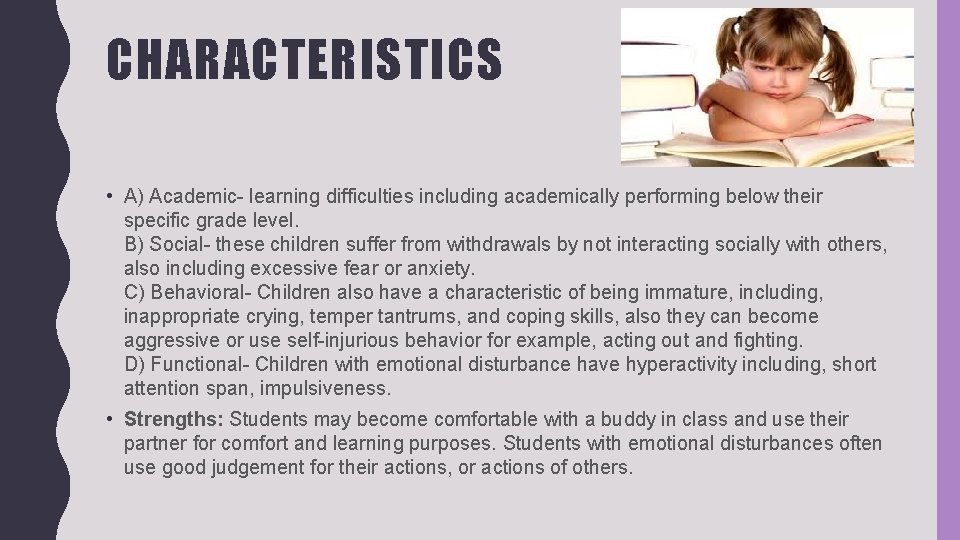
CHARACTERISTICS • A) Academic- learning difficulties including academically performing below their specific grade level. B) Social- these children suffer from withdrawals by not interacting socially with others, also including excessive fear or anxiety. C) Behavioral- Children also have a characteristic of being immature, including, inappropriate crying, temper tantrums, and coping skills, also they can become aggressive or use self-injurious behavior for example, acting out and fighting. D) Functional- Children with emotional disturbance have hyperactivity including, short attention span, impulsiveness. • Strengths: Students may become comfortable with a buddy in class and use their partner for comfort and learning purposes. Students with emotional disturbances often use good judgement for their actions, or actions of others.

STRATEGIES BENEFICIAL TO STUDENTS WITH EMOTIONAL DISTURBANCE IN SCHOOL • Programs provided in schools to help students with this disability. These services are designed to address the child’s individual needs. The support of the school counselor is helpful, as well as developing that of school-based therapists who are involved with the child. • It is important to implement strategies that address the needs of the individual. • Provide time for the student’s needs: Missed work, late work, extra time for assignments they are struggling with, etc. • Give clear examples as to what the student should expect with an activity, homework assignment, or project. • Teacher needs to be sensitive and patient to the needs of these students
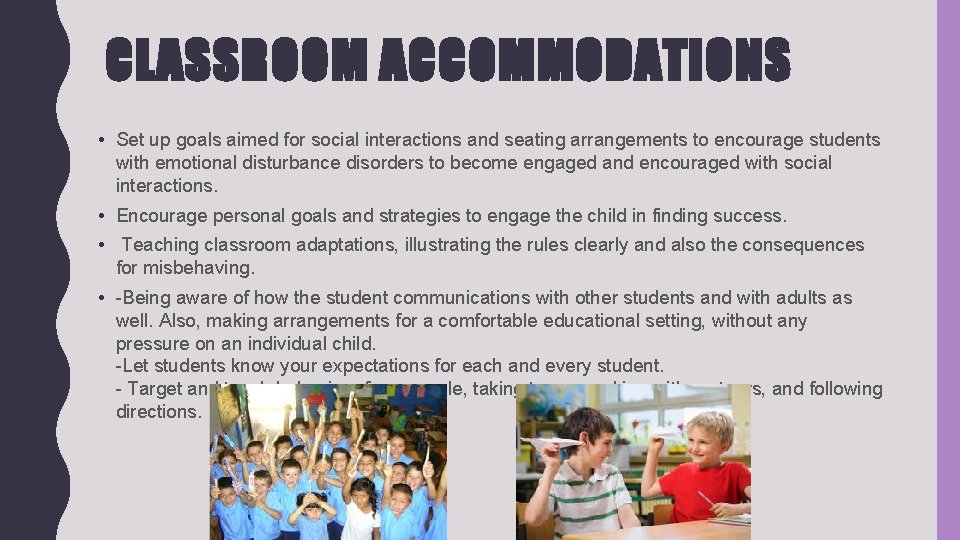
CLASSROOM ACCOMMODATIONS • Set up goals aimed for social interactions and seating arrangements to encourage students with emotional disturbance disorders to become engaged and encouraged with social interactions. • Encourage personal goals and strategies to engage the child in finding success. • Teaching classroom adaptations, illustrating the rules clearly and also the consequences for misbehaving. • -Being aware of how the student communications with other students and with adults as well. Also, making arrangements for a comfortable educational setting, without any pressure on an individual child. -Let students know your expectations for each and every student. - Target and teach behaviors for example, taking turns, working with partners, and following directions.
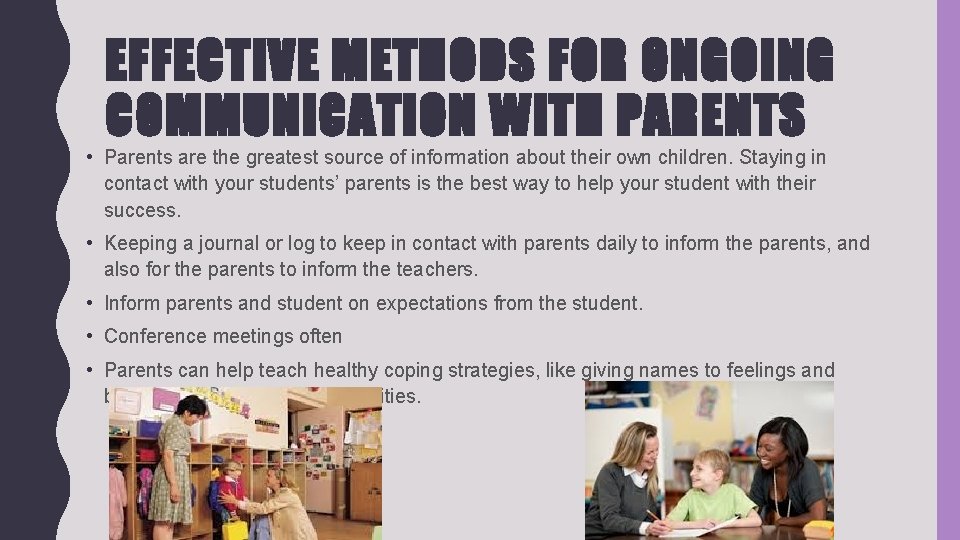
EFFECTIVE METHODS FOR ONGOING COMMUNICATION WITH PARENTS • Parents are the greatest source of information about their own children. Staying in contact with your students’ parents is the best way to help your student with their success. • Keeping a journal or log to keep in contact with parents daily to inform the parents, and also for the parents to inform the teachers. • Inform parents and student on expectations from the student. • Conference meetings often • Parents can help teach healthy coping strategies, like giving names to feelings and brainstorming stress-relief activities.
REFERENCE • Data Accountability Center. (2012). Number of students ages 6 through 2 1 served under IDEA Excerpt from The Inclusive Classroom: Strategies for Effective Instruction, by M. A. Mastropieri, T. E. Scruggs, 2007 edition, p. 64 -69. • Code of Federal Regulations, Title 34, § 300. 8(c)(4)(i) • Ideal. edu. gov • Lets Play Music. 2012. Larson.
WORK CITED • Data. Accountability. Center. (2012). Numberofstudentsages 6 through 21 servedunder. IDEA, Part. B, bydisabilitycategoryandstate: Fall 2011[Table. B 13]. Onlineat: http: //www. ideadata. org/TABLES 35 TH/B 1 -3. xls • Ideal. edu. gov Lets Play Music. 2012. Larson. • http: //www. letsplaykidsmusic. com/emotions-song/
- Slides: 9