
Emotional Behavioral Disorders Courtney Wall Valerie Kozora Nicole
Emotional & Behavioral Disorders Courtney Wall, Valerie Kozora & Nicole Kosanovich 08 July 2015

What is an emotional/behavioral disorder? ● ● An emotional/behavioral disorder is a persisting condition that is often characterized by behaviors that are significantly different from the age norm and community standard to such an extent that educational performance is negatively affected. Emotional Disturbance: A term that is used when referring to individuals with emotional or behavioral disorders.
Knowing the Definitions ● ● Socially Maladjusted: Individuals whose social behaviors are atypical; often regarded as chronic social offenders. *What does it mean to be atypical? ● Someone who exhibits unusual, or qualitatively different behaviors for ANY age. Examples include: uncontrollable motor movements (tics) or inappropriate comments.
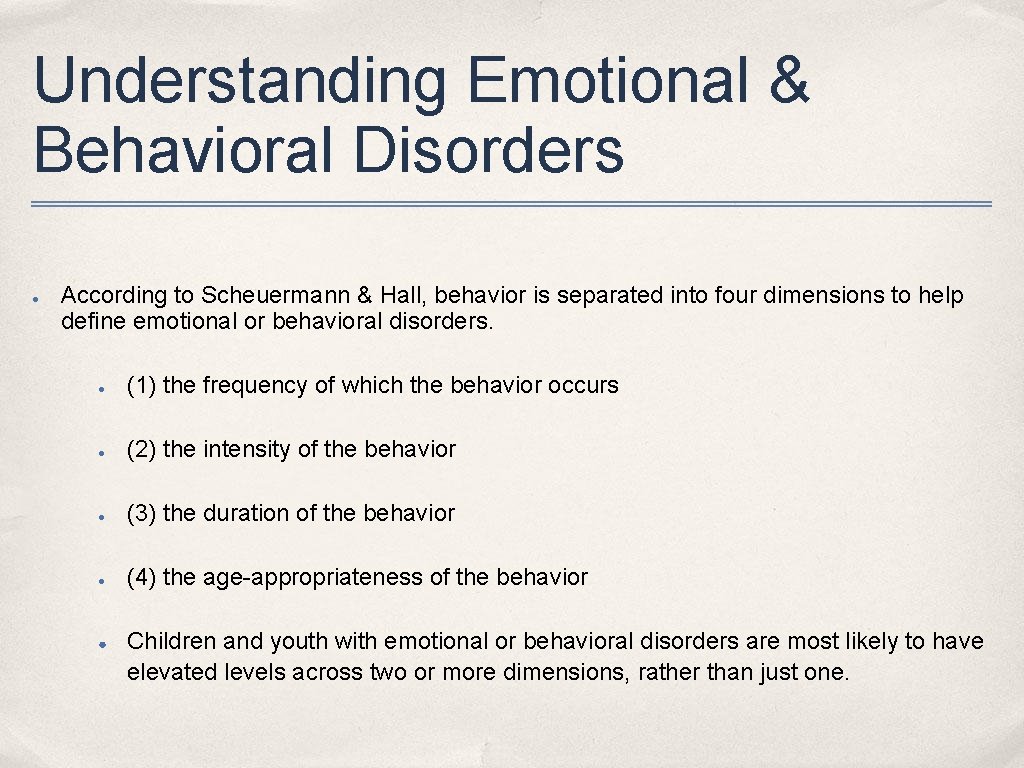
Understanding Emotional & Behavioral Disorders ● According to Scheuermann & Hall, behavior is separated into four dimensions to help define emotional or behavioral disorders. ● (1) the frequency of which the behavior occurs ● (2) the intensity of the behavior ● (3) the duration of the behavior ● (4) the age-appropriateness of the behavior ● Children and youth with emotional or behavioral disorders are most likely to have elevated levels across two or more dimensions, rather than just one.
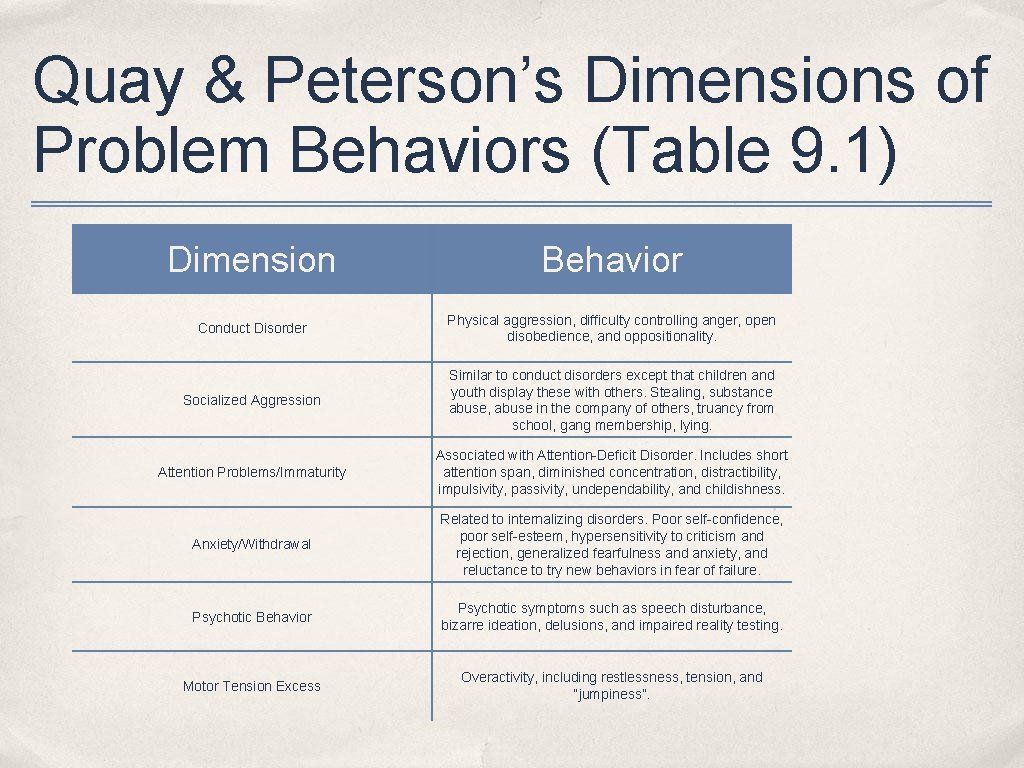
Quay & Peterson’s Dimensions of Problem Behaviors (Table 9. 1) Dimension Behavior Conduct Disorder Physical aggression, difficulty controlling anger, open disobedience, and oppositionality. Socialized Aggression Similar to conduct disorders except that children and youth display these with others. Stealing, substance abuse, abuse in the company of others, truancy from school, gang membership, lying. Attention Problems/Immaturity Associated with Attention-Deficit Disorder. Includes short attention span, diminished concentration, distractibility, impulsivity, passivity, undependability, and childishness. Anxiety/Withdrawal Related to internalizing disorders. Poor self-confidence, poor self-esteem, hypersensitivity to criticism and rejection, generalized fearfulness and anxiety, and reluctance to try new behaviors in fear of failure. Psychotic Behavior Psychotic symptoms such as speech disturbance, bizarre ideation, delusions, and impaired reality testing. Motor Tension Excess Overactivity, including restlessness, tension, and “jumpiness”.

Disturbing vs. Disturbed ● ● While some behaviors may be deemed inappropriate, there is a very important difference between disturbing and disturbed. This is highly due to the environment you are in. Disturbing behaviors occur in a certain place and time and in the presence of certain individuals. Disturbed behaviors occur in many settings, are habitual, and are part of the individual’s behavior pattern. Let’s play a game!
Question #1 ● Is the use of slang terms (i. e. “squad”, “cruising”, or “on fleek”) to a professor in a school setting considered a disturbing or disturbed behavior?

ANSWER! ● A disturbing behavior! While the behavior is inappropriate for the setting, it is not entirely inappropriate. Therefore, though teachers would find this language unacceptable for the classroom, it is not necessarily inappropriate for all places.
Question #2 ● Is stealing from multiple stores on several, separate occasions over a period of time considered disturbing or disturbed behavior?
ANSWER! ● A disturbed behavior! The behavior is habitual and occurs on multiple occasions over an extended period of time- - not just once.
Question #3 ● Is the consumption of alcohol during adolescence through peer pressure considered disturbing or disturbed behavior?
ANSWER! ● Disturbing behavior! Drinking alcohol during adolescence is considered a relatively common occurrence. This action is also highly influenced by one’s peers. Though this behavior may be disturbing to adults, it is not considered a disordered behavior.
The Cultural Aspect ● ● ● The social and cultural definitions of a type of behavior differs drastically, as does how that culture views said behaviors. Behaviors not socially accepted in some cultures such as hitting others, swearing, sexual behavior, and physical aggression are all behaviors that sit on varying levels of “normality” across cultural barriers. There are only a few behaviors that are considered to be universally recognized as abnormal. ● muteness ● serious self-injury ● eating one’s feces ● murder
Classification/How to Classify ● ● Since there a variety of disorders that are summed into emotional or behavioral disorders, classifications help to provide more clarity and specificity of the student’s disability. Clinically Derived Classification System: A system frequently used by mental health professionals to describe childhood, adolescent, and adult mental disorders. ● ● ● This includes the DSM-V (Diagnostic and Statistical Manual of Mental Disorders). It is the most widely used psychiatric classification system in the United States. These systems group behaviors into diagnostic categories to provide criteria to help make diagnoses. The behaviors are then observed in multiple settings over time and compared to the criteria. Include descriptions of symptoms, indicators of severity, prevalence estimates, and info about variations of disorders.
Classification (Cont’d) ● Statistically Derived Classification System: A system developed to analyze patterns of behaviors based on statistical procedures that characterize children and youth with emotional or behavioral disorders. ● This system has been useful to identify and develop normative standards across dimensions to help make important decisions such as the eligibility for special education.

Externalizing & Internalizing Disorders ● Externalizing Disorder: A behavior disorder characterized by aggressive, disruptive, acting-out behaviors. ● ● Internalizing Disorders: Behavior disorders characterized by anxiety, withdrawal, fearfulness, and other conditions reflecting the individual’s internal state. ● ● ● This is considered to be “undercontrolled”behavior and is disturbing to others as well as a classroom disruption. Men tend to be more at risk. This is considered “overcontrolled”. Students with internalizing disorder are much less likely to be identified by teachers or parents as having a disorder since they do not create a sense of chaotic environment. THIS DISORDER IS EQUALLY AS SERIOUS. Lack of treatment can result in suicide or other negative long-term outcomes. Women tend to be more at risk. Externalizing and internalizing disorders are two of the most consistently identified dimensions.
Definitions Internalizing disorder- behavior disorders characterized by anxiety, withdrawal, fearfulness, and other conditions reflecting an individual’s internal state Child maltreatment- the neglect and/or physical, emotional, or sexual abuse of a child Primary evention- activities aimed at eliminating a problem or condition prior to its onset Secondary prevention- efforts focusing on minimizing or eliminating potential risk factors in regard to persons with emotional or behavioral disorders Tertiary prevention- efforts that attempt to limit the adverse consequences of an existing problem while maximizing a person’s potential Strength-based assessment- an assessment model that looks at an individual’s strengths, abilities, and accomplishments rather than focusing on his/her deficits
Society & E/B Disorders 1817 -first private psychiatric hospital opens in Pennsylvania operated by Quakers 1892 -American psychological association founded 1908 - Clifford W. Beers authors “A Mind That Found Itself” 1909 - National Committee for Mental Hygiene established 1909 - Juvenile psychopathic institute opens in Chicago to investigate causes of juvenile delinquency
Society & E/B Disorders 1914 - First special education teacher training program established in Michigan 1922 - Forerunner of the Council for Exceptional Child organized at Teachers College, Columbia University 1923 - American orthopsychiatric association founded 1928 - First training program in school psychology offered a New York University 1931 - First psychiatric hospital specializing in treatment of children and adolescents with E/B disorders opens in Rhode Island
Society & E/B Disorders 1934 - Lauretta Bender begins her pioneering work with children with schizophrenia at the Bellevue psychiatric clinic in New York City 1936 - Leo Kanner publishes “Child psychiatry” 1944 - Pioneer house for delinquent and emotionally disturbed boys opens in Detroit 1944 - Bruno Bettelheim serves as the director of an orthogenic school
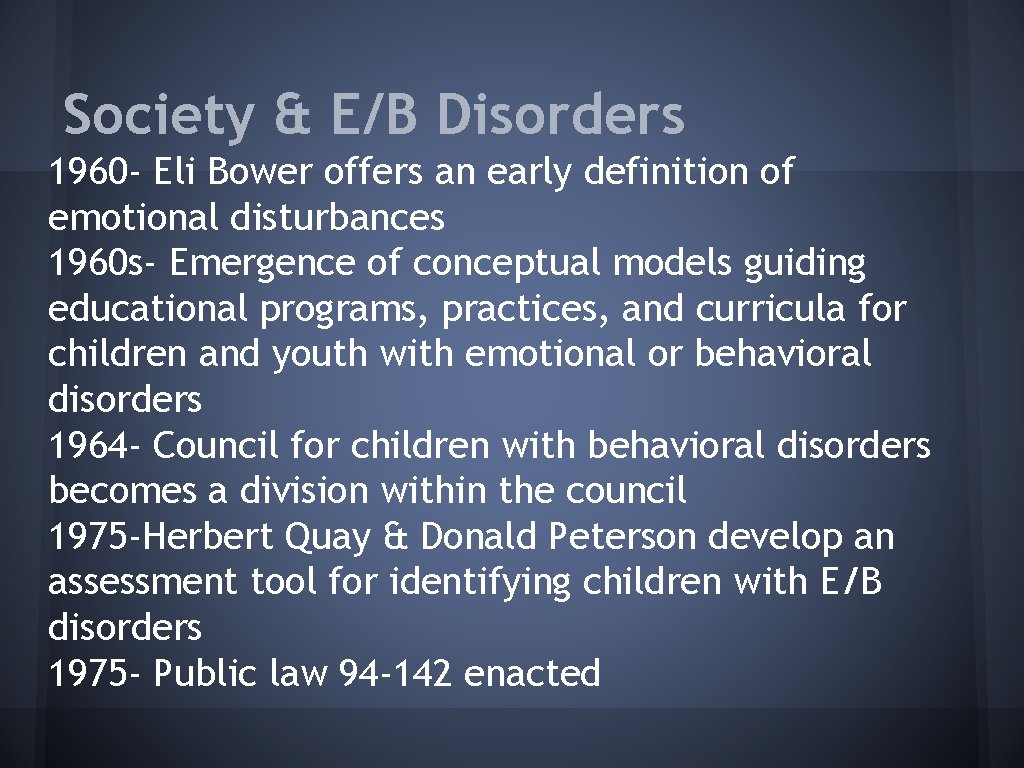
Society & E/B Disorders 1960 - Eli Bower offers an early definition of emotional disturbances 1960 s- Emergence of conceptual models guiding educational programs, practices, and curricula for children and youth with emotional or behavioral disorders 1964 - Council for children with behavioral disorders becomes a division within the council 1975 -Herbert Quay & Donald Peterson develop an assessment tool for identifying children with E/B disorders 1975 - Public law 94 -142 enacted
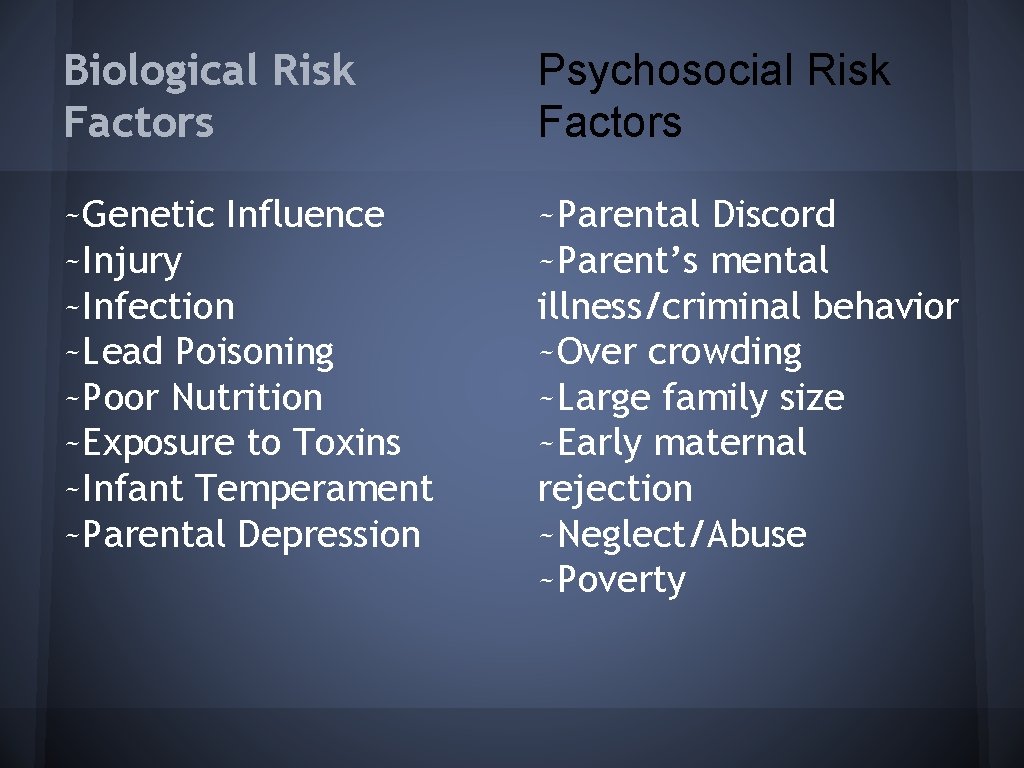
Biological Risk Factors Psychosocial Risk Factors ~Genetic Influence ~Injury ~Infection ~Lead Poisoning ~Poor Nutrition ~Exposure to Toxins ~Infant Temperament ~Parental Depression ~Parental Discord ~Parent’s mental illness/criminal behavior ~Over crowding ~Large family size ~Early maternal rejection ~Neglect/Abuse ~Poverty
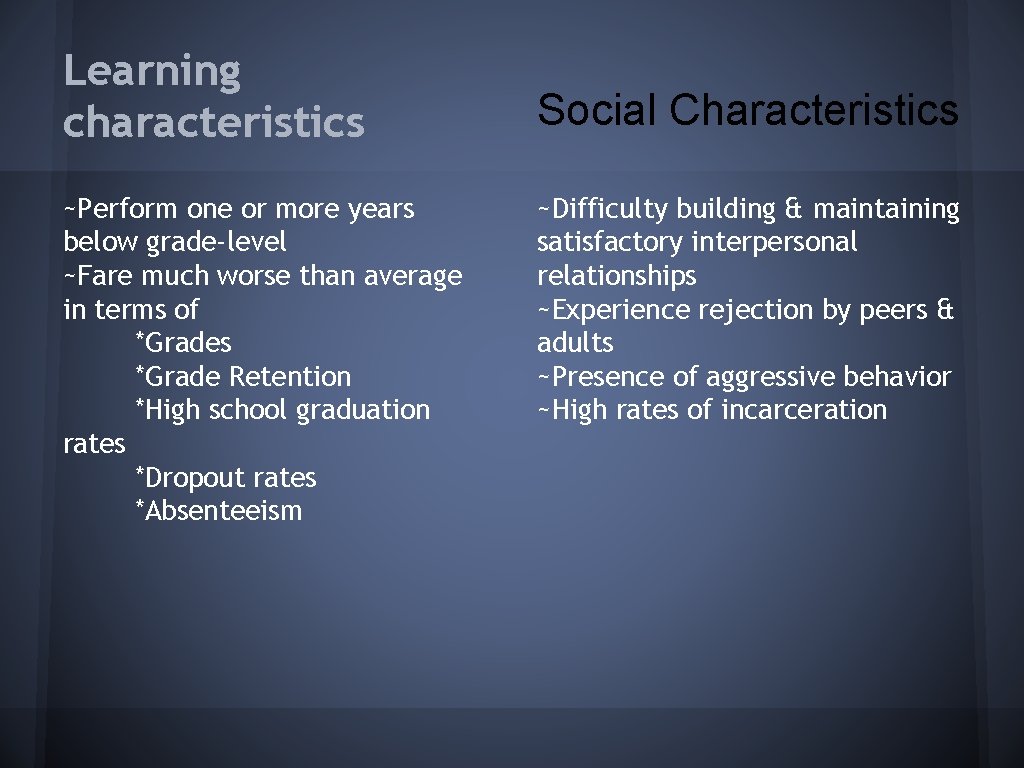
Learning characteristics ~Perform one or more years below grade-level ~Fare much worse than average in terms of *Grades *Grade Retention *High school graduation rates *Dropout rates *Absenteeism Social Characteristics ~Difficulty building & maintaining satisfactory interpersonal relationships ~Experience rejection by peers & adults ~Presence of aggressive behavior ~High rates of incarceration
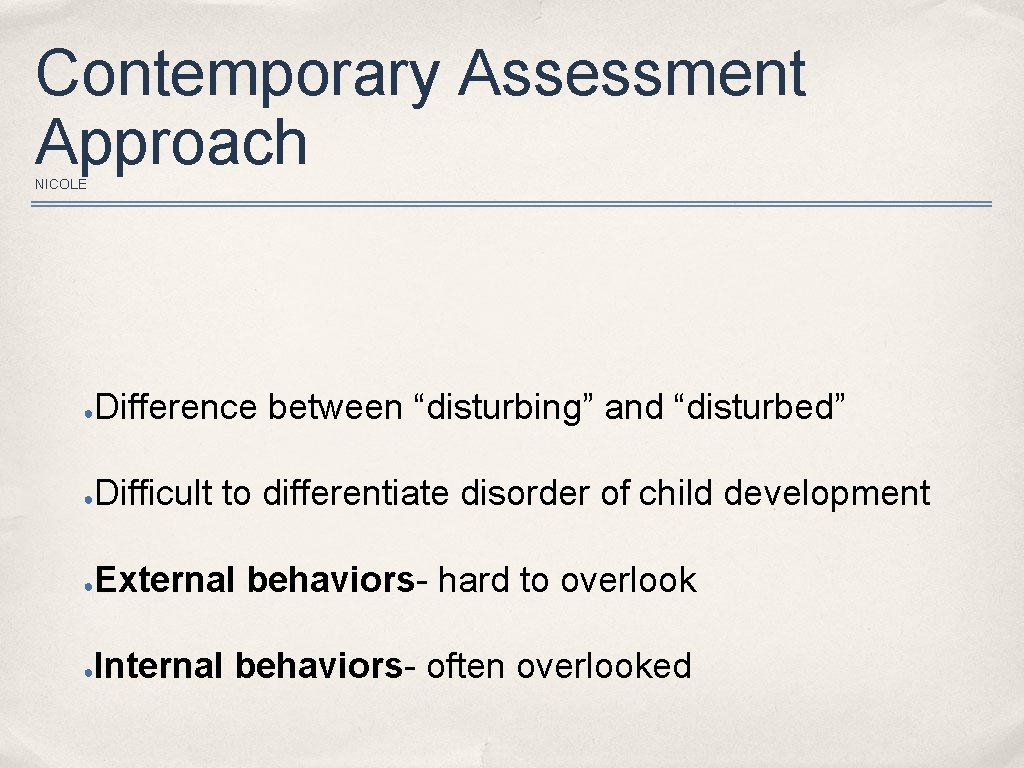
Contemporary Assessment Approach NICOLE ● Difference between “disturbing” and “disturbed” ● Difficult to differentiate disorder of child development ● External behaviors- hard to overlook ● Internal behaviors- often overlooked
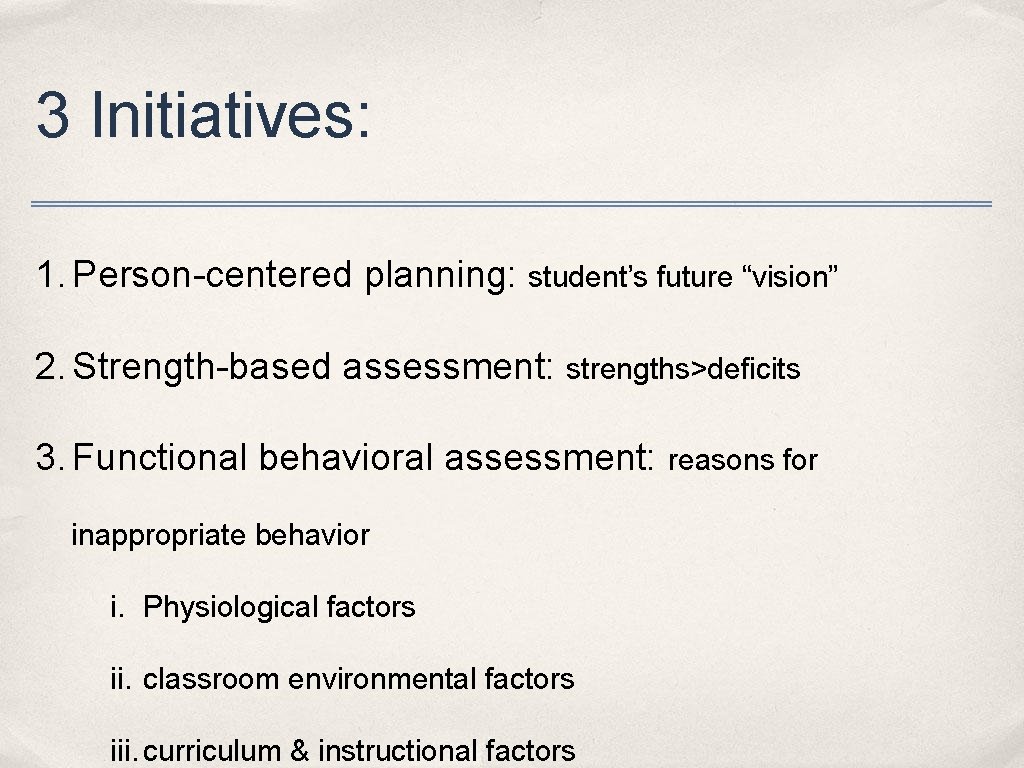
3 Initiatives: 1. Person-centered planning: student’s future “vision” 2. Strength-based assessment: strengths>deficits 3. Functional behavioral assessment: reasons for inappropriate behavior i. Physiological factors ii. classroom environmental factors iii. curriculum & instructional factors
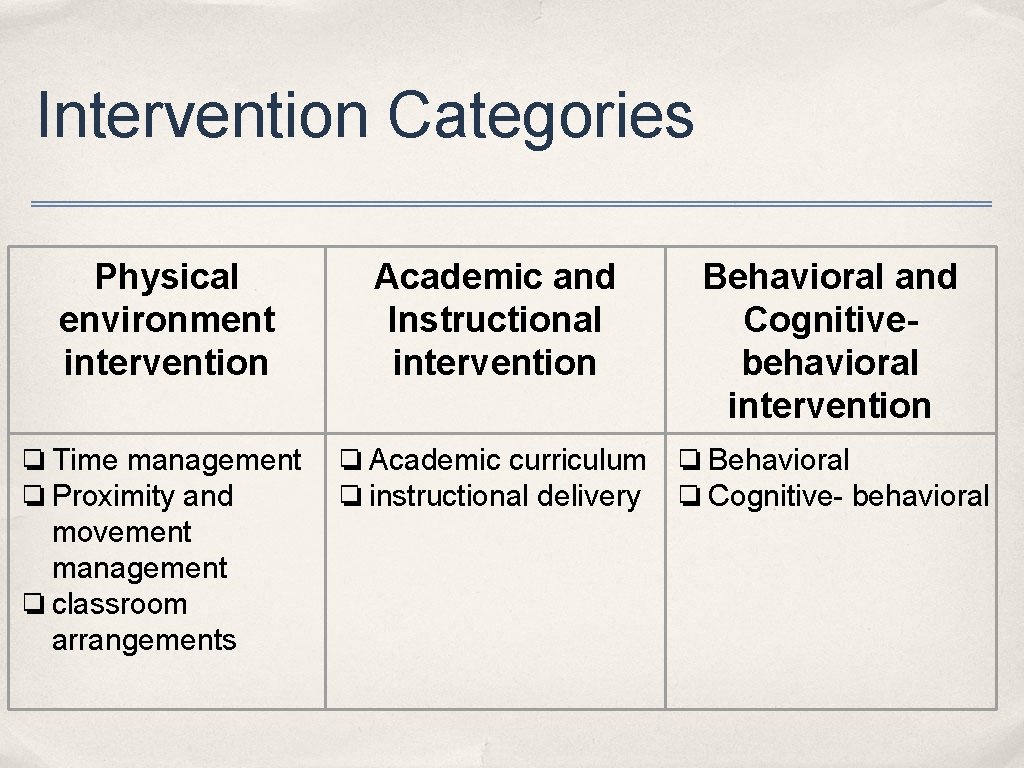
Intervention Categories Physical environment intervention ❏ Time management ❏ Proximity and movement management ❏ classroom arrangements Academic and Instructional intervention Behavioral and Cognitivebehavioral intervention ❏ Academic curriculum ❏ Behavioral ❏ instructional delivery ❏ Cognitive- behavioral
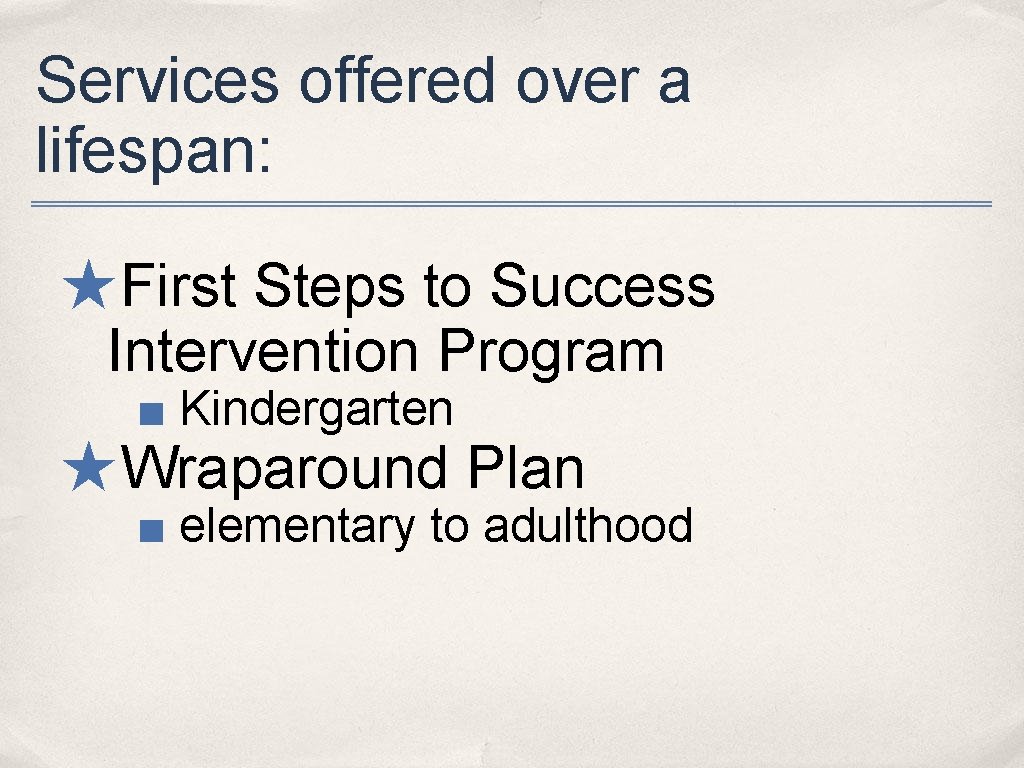
Services offered over a lifespan: ★First Steps to Success Intervention Program ■ Kindergarten ★Wraparound Plan ■ elementary to adulthood
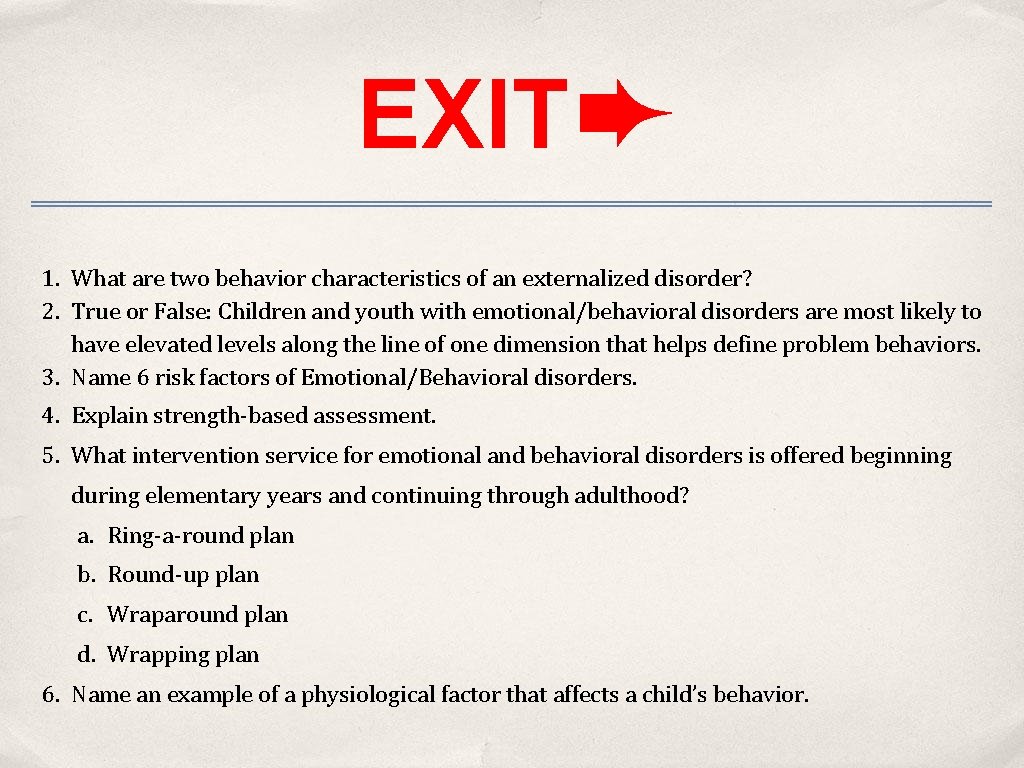
EXIT➨ 1. What are two behavior characteristics of an externalized disorder? 2. True or False: Children and youth with emotional/behavioral disorders are most likely to have elevated levels along the line of one dimension that helps define problem behaviors. 3. Name 6 risk factors of Emotional/Behavioral disorders. 4. Explain strength-based assessment. 5. What intervention service for emotional and behavioral disorders is offered beginning during elementary years and continuing through adulthood? a. Ring-a-round plan b. Round-up plan c. Wraparound plan d. Wrapping plan 6. Name an example of a physiological factor that affects a child’s behavior.
Work Cited Early Childhood Technical Assistance Center. (2013). Family-Centered Principles and Practices. Retrieved from: http: //ectacenter. org/topics/families/famctrprin. asp Gargiulo, R. M. (2015). Special Education in Contemporary Society 5 e. Los Angeles, CA: Sage Publications, Inc. Institute of Education Sciences. (2012). First Step to Success. Retrieved from: http: //ies. ed. gov/ncee/wwc/interventionreport. aspx? sid=179 National Parent Center on Transition and Employment. (2015). Person-Centered Planning. Retrieved from: http: //www. pacer. org/transition/learningcenter/independent-community-living/person-centered. asp Powell, S. D. (2015). Your Introduction to Education. Boston: Pearson Education, Inc.
- Slides: 30