
Emotional and Social Development in Middle Childhood Chapter
- Slides: 17
Emotional and Social Development in Middle Childhood Chapter 13: pgs. 481 -525 (Infants & Children)
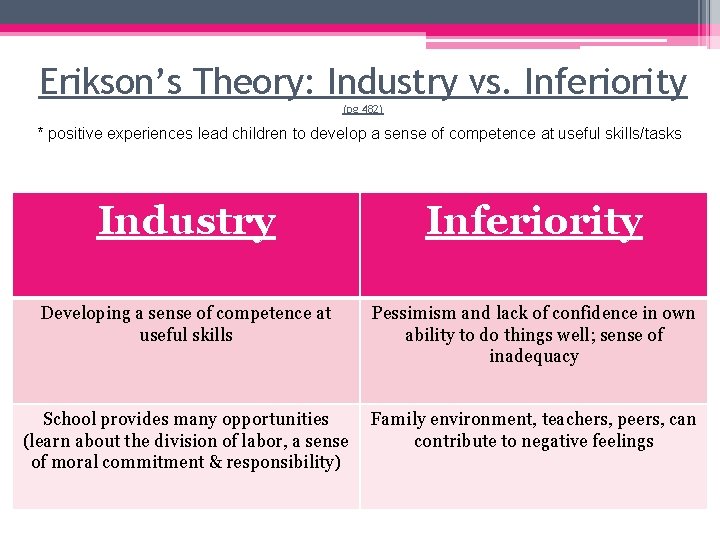
Erikson’s Theory: Industry vs. Inferiority (pg 482) * positive experiences lead children to develop a sense of competence at useful skills/tasks Industry Inferiority Developing a sense of competence at useful skills Pessimism and lack of confidence in own ability to do things well; sense of inadequacy School provides many opportunities (learn about the division of labor, a sense of moral commitment & responsibility) Family environment, teachers, peers, can contribute to negative feelings
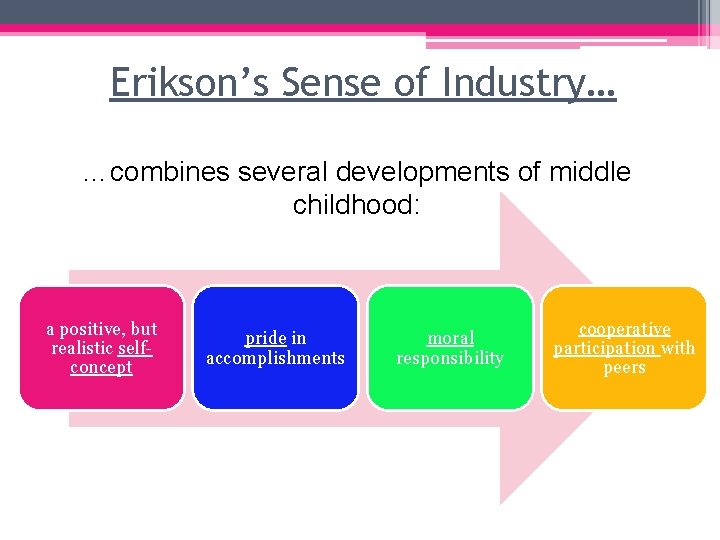
Erikson’s Sense of Industry… …combines several developments of middle childhood: a positive, but realistic selfconcept pride in accomplishments moral responsibility cooperative participation with peers
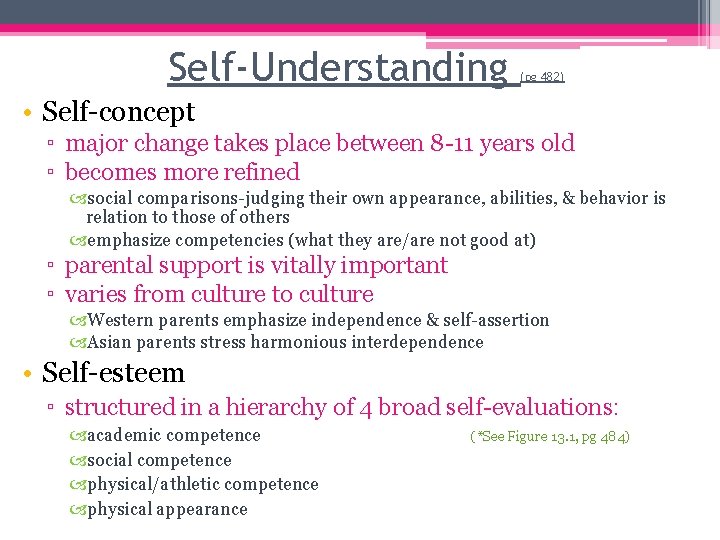
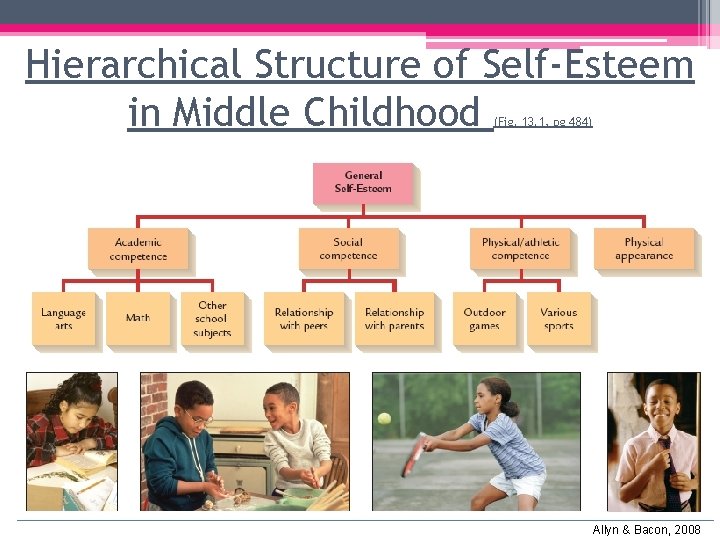
Self-Understanding (pg 482) • Self-concept ▫ major change takes place between 8 -11 years old ▫ becomes more refined social comparisons-judging their own appearance, abilities, & behavior is relation to those of others emphasize competencies (what they are/are not good at) ▫ parental support is vitally important ▫ varies from culture to culture Western parents emphasize independence & self-assertion Asian parents stress harmonious interdependence • Self-esteem ▫ structured in a hierarchy of 4 broad self-evaluations: academic competence social competence physical/athletic competence physical appearance (*See Figure 13. 1, pg 484)
Hierarchical Structure of Self-Esteem in Middle Childhood (Fig. 13. 1, pg 484) Allyn & Bacon, 2008
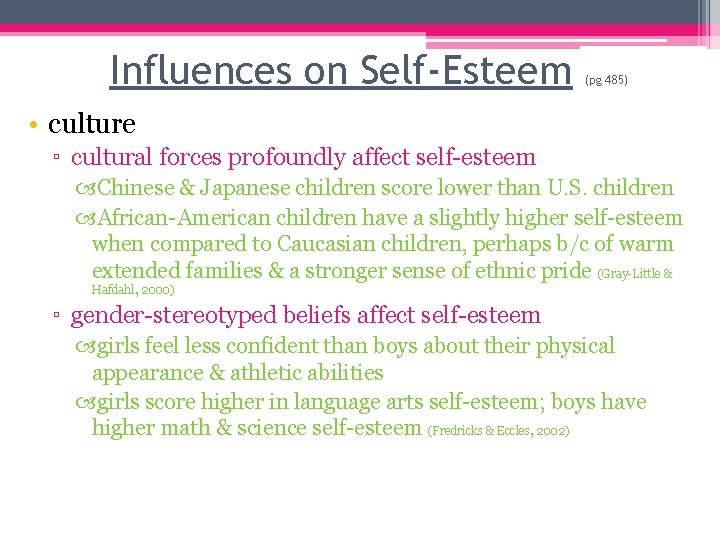
Influences on Self-Esteem (pg 485) • culture ▫ cultural forces profoundly affect self-esteem Chinese & Japanese children score lower than U. S. children African-American children have a slightly higher self-esteem when compared to Caucasian children, perhaps b/c of warm extended families & a stronger sense of ethnic pride (Gray-Little & Hafdahl, 2000) ▫ gender-stereotyped beliefs affect self-esteem girls feel less confident than boys about their physical appearance & athletic abilities girls score higher in language arts self-esteem; boys have higher math & science self-esteem (Fredricks & Eccles, 2002)
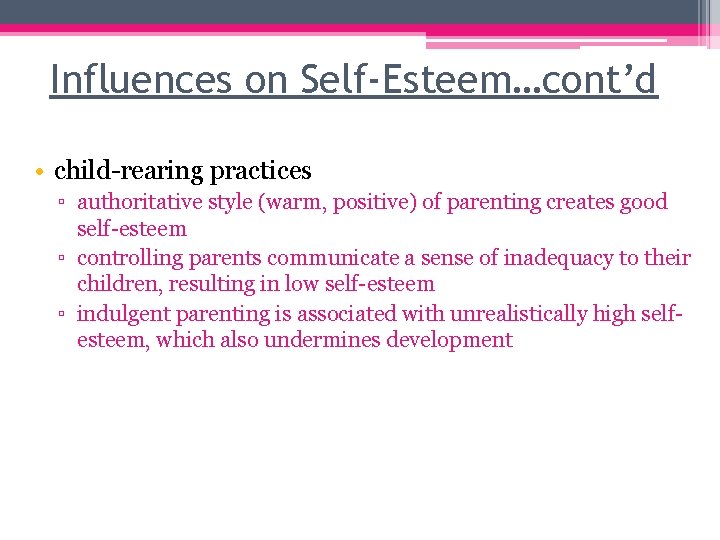
Influences on Self-Esteem…cont’d • child-rearing practices ▫ authoritative style (warm, positive) of parenting creates good self-esteem ▫ controlling parents communicate a sense of inadequacy to their children, resulting in low self-esteem ▫ indulgent parenting is associated with unrealistically high selfesteem, which also undermines development
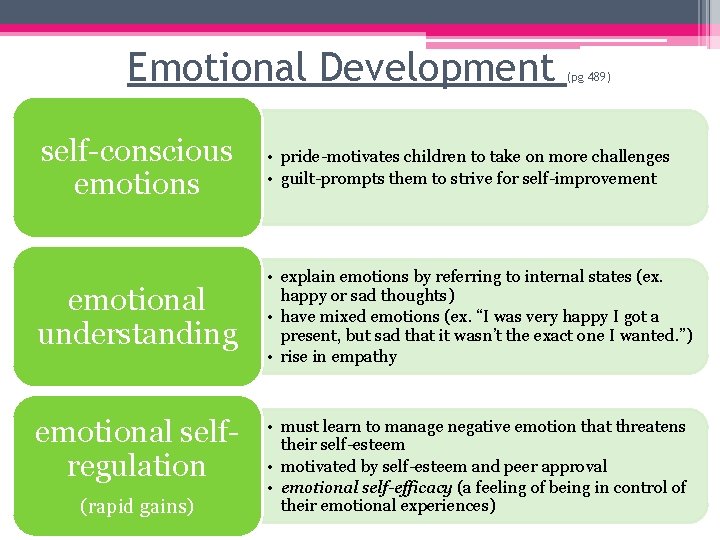
Emotional Development (pg 489) self-conscious emotions • pride-motivates children to take on more challenges • guilt-prompts them to strive for self-improvement emotional understanding • explain emotions by referring to internal states (ex. happy or sad thoughts) • have mixed emotions (ex. “I was very happy I got a present, but sad that it wasn’t the exact one I wanted. ”) • rise in empathy emotional selfregulation (rapid gains) • must learn to manage negative emotion that threatens their self-esteem • motivated by self-esteem and peer approval • emotional self-efficacy (a feeling of being in control of their emotional experiences)
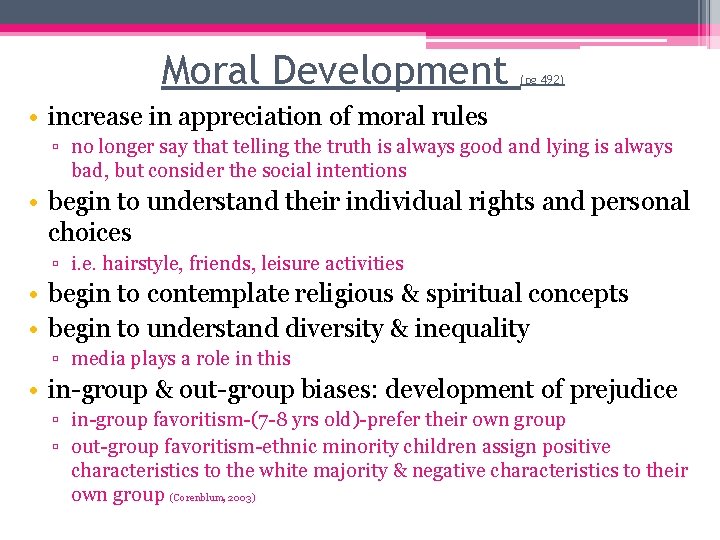
Moral Development (pg 492) • increase in appreciation of moral rules ▫ no longer say that telling the truth is always good and lying is always bad, but consider the social intentions • begin to understand their individual rights and personal choices ▫ i. e. hairstyle, friends, leisure activities • begin to contemplate religious & spiritual concepts • begin to understand diversity & inequality ▫ media plays a role in this • in-group & out-group biases: development of prejudice ▫ in-group favoritism-(7 -8 yrs old)-prefer their own group ▫ out-group favoritism-ethnic minority children assign positive characteristics to the white majority & negative characteristics to their own group (Corenblum, 2003)
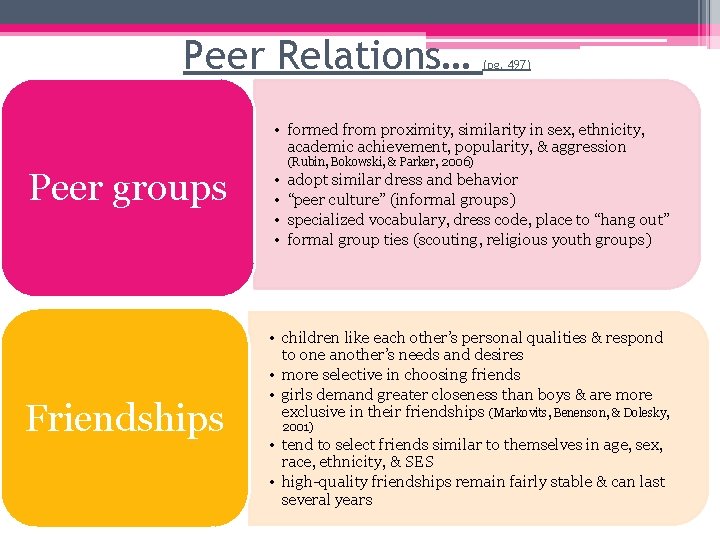
Peer Relations… (pg. 497) • formed from proximity, similarity in sex, ethnicity, academic achievement, popularity, & aggression Peer groups Friendships (Rubin, Bokowski, & Parker, 2006) • • adopt similar dress and behavior “peer culture” (informal groups) specialized vocabulary, dress code, place to “hang out” formal group ties (scouting, religious youth groups) • children like each other’s personal qualities & respond to one another’s needs and desires • more selective in choosing friends • girls demand greater closeness than boys & are more exclusive in their friendships (Markovits, Benenson, & Dolesky, 2001) • tend to select friends similar to themselves in age, sex, race, ethnicity, & SES • high-quality friendships remain fairly stable & can last several years
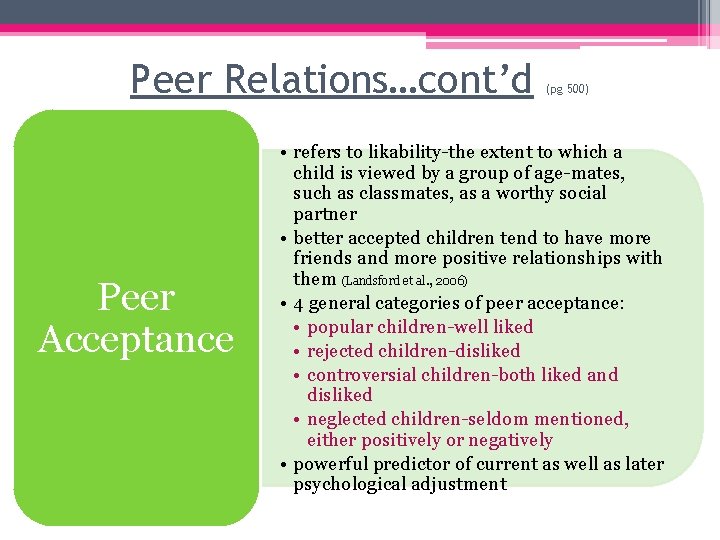
Peer Relations…cont’d Peer Acceptance (pg 500) • refers to likability-the extent to which a child is viewed by a group of age-mates, such as classmates, as a worthy social partner • better accepted children tend to have more friends and more positive relationships with them (Landsford et al. , 2006) • 4 general categories of peer acceptance: • popular children-well liked • rejected children-disliked • controversial children-both liked and disliked • neglected children-seldom mentioned, either positively or negatively • powerful predictor of current as well as later psychological adjustment
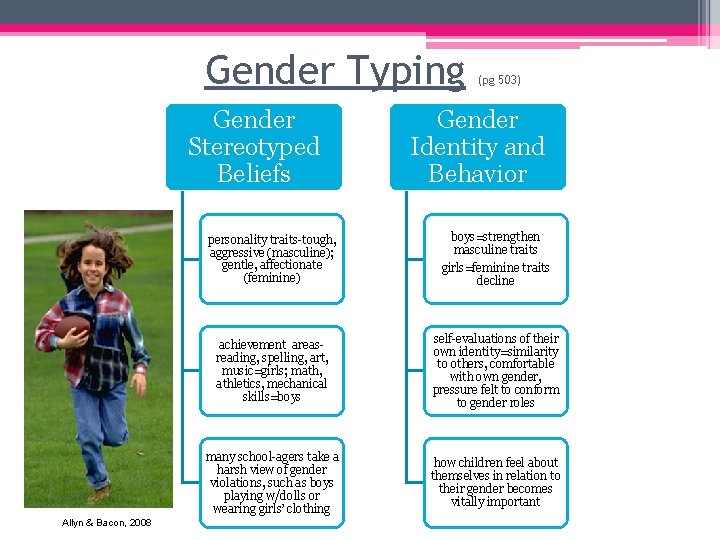
Gender Typing Gender Stereotyped Beliefs Allyn & Bacon, 2008 (pg 503) Gender Identity and Behavior personality traits-tough, aggressive (masculine); gentle, affectionate (feminine) boys=strengthen masculine traits girls=feminine traits decline achievement areasreading, spelling, art, music=girls; math, athletics, mechanical skills=boys self-evaluations of their own identity=similarity to others, comfortable with own gender, pressure felt to conform to gender roles many school-agers take a harsh view of gender violations, such as boys playing w/dolls or wearing girls’ clothing how children feel about themselves in relation to their gender becomes vitally important
Family Influences on Social Development (pg 506) • Family Relationships ▫ parent-child relationship gradual control shifts from adult to child; parents must learn to guide & monitor from a distance and effectively communicate expectations parenting becomes easier for those parents who established an authoritative style in the early years the amount of time children spend w/their parents declines dramatically 5 th & 6 th graders report their parents are the most influential people in their lives a strong sense of attachment security to both parents is positively related to school-age children’s academic & social self-esteem ▫ siblings relationship sibling rivalry increases parents often compare siblings’ traits & accomplishments rely on each other for companionship, assistance, & emotional support (Seibert & Kerns, 2009) older siblings help younger siblings
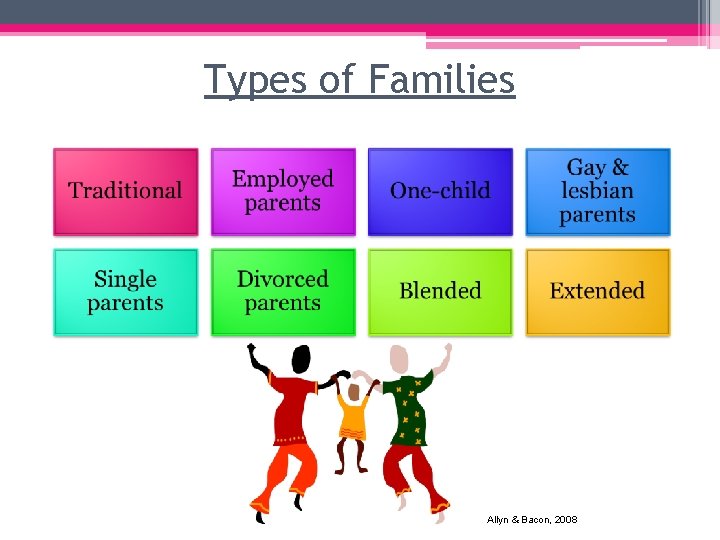
Types of Families Allyn & Bacon, 2008
Family Influences…cont’d (pg 508) • Gay/lesbian families ▫ research shows children in gay/lesbian families do not differ from the children of heterosexuals in mental health, peer relations, and gender identity (Farr, Forssell, & Patterson, 2010) • Never-married single-parent families ▫ largest group is African-American young women (64%) ▫ generally increases financial hardships; nearly 50% have a 2 nd child • Divorced families ▫ family conflict, sharp drop in income, stress, depression, anxiety, disorganized family situation, differing discipline techniques ▫ children show improved adjustment by 2 yrs after divorce, yet continue to score slightly lower than children of continuously married parents in academic achievement, self-esteem, social competence, and emotional & behavioral adjustment (Lansford, 2009)
Family Influences…cont’d (pg 512) • Blended families ▫ adaptation is related to the quality of family functioning, which parent forms the new relationship, child’s age/sex, & the complexity of blended family relationships ▫ older children & girls seem to have the most difficulty • Maternal employment/dual earner families ▫ leads fathers to take on greater child-rearing responsibilities ▫ when mothers enjoy their work & remain committed to parenting, children show favorable adjustment-higher selfesteem, more positive family & peer relations, less genderstereotyped beliefs, & better grades in school ▫ high quality child care is vital
Some Common Problems of Development (pg 517) • fears & anxiety ▫ dark, thunder & lightening, supernatural beings ▫ personal harm (being robbed, stabbed, shot) ▫ media events (war & disasters)-most common source of fears in Western nations ▫ academic failure, separation from parents, parents’ health, physical injuries, dying, peer rejection ▫ phobias-unmanageable fears • child sexual abuse ▫ a serious & widespread problem-60, 000 cases reported in 2009; greatly underestimates the true amount b/c of non-reports ▫ Internet & mobile phones are becoming avenues in which adults commit child abuse