
EMOTION REGULATION BIASES IN MEMORY Expressive Suppression Produces
EMOTION REGULATION & BIASES IN MEMORY Expressive Suppression Produces Negatively Biased Memories of Prior Interactions IARR 2016 Valerie Chang and Nickola Overall University of Auckland, New Zealand
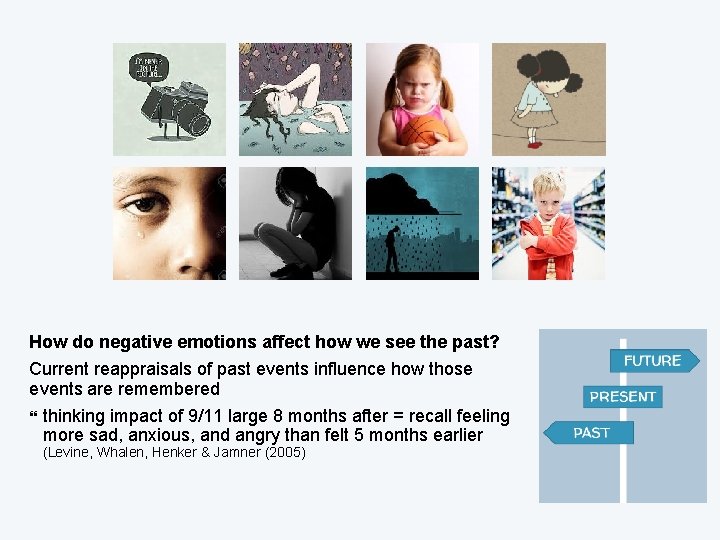
How do negative emotions affect how we see the past? Current reappraisals of past events influence how those events are remembered } thinking impact of 9/11 large 8 months after = recall feeling more sad, anxious, and angry than felt 5 months earlier (Levine, Whalen, Henker & Jamner (2005)
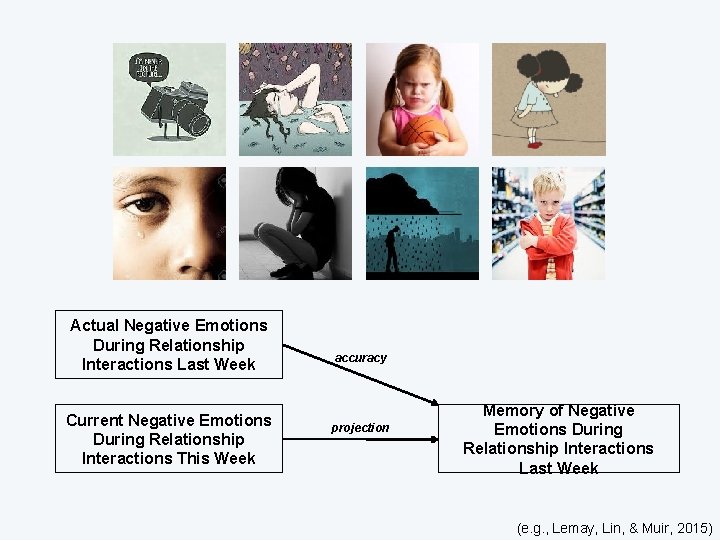
Actual Negative Emotions During Relationship Interactions Last Week Current Negative Emotions During Relationship Interactions This Week accuracy projection Memory of Negative Emotions During Relationship Interactions Last Week (e. g. , Lemay, Lin, & Muir, 2015)
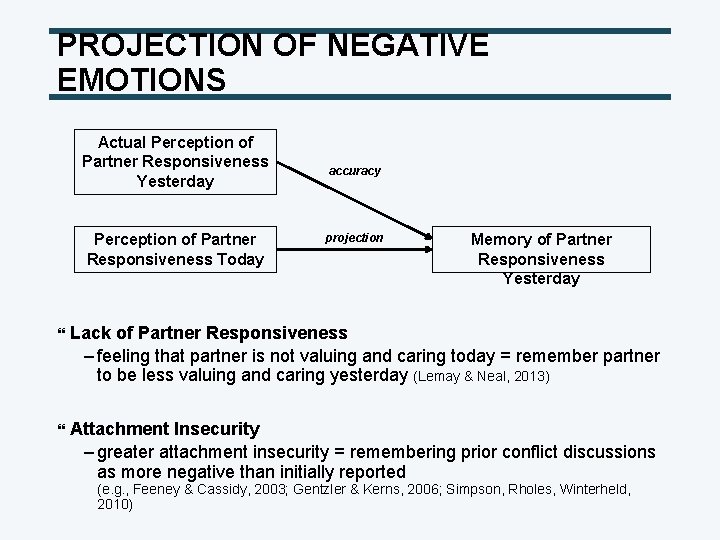
PROJECTION OF NEGATIVE EMOTIONS Actual Perception of Partner Responsiveness Yesterday Perception of Partner Responsiveness Today accuracy projection Memory of Partner Responsiveness Yesterday } Lack of Partner Responsiveness – feeling that partner is not valuing and caring today = remember partner to be less valuing and caring yesterday (Lemay & Neal, 2013) } Attachment Insecurity – greater attachment insecurity = remembering prior conflict discussions as more negative than initially reported (e. g. , Feeney & Cassidy, 2003; Gentzler & Kerns, 2006; Simpson, Rholes, Winterheld, 2010)
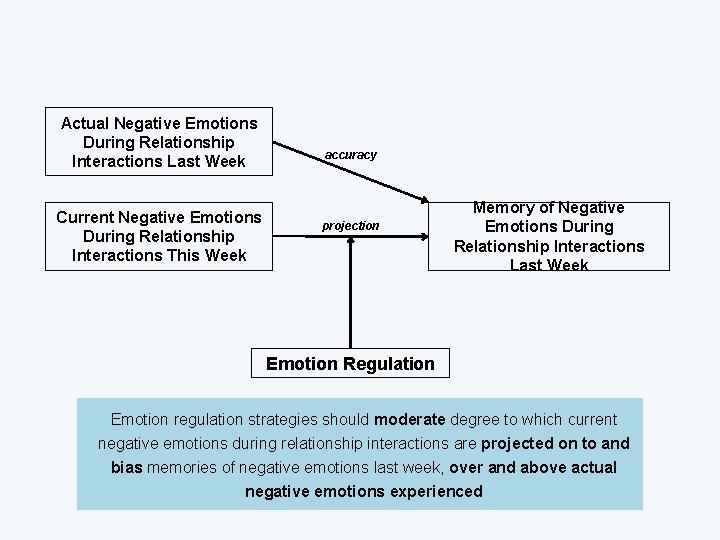
Actual Negative Emotions During Relationship Interactions Last Week Current Negative Emotions During Relationship Interactions This Week accuracy projection Memory of Negative Emotions During Relationship Interactions Last Week Emotion Regulation Emotion regulation strategies should moderate degree to which current negative emotions during relationship interactions are projected on to and bias memories of negative emotions last week, over and above actual negative emotions experienced
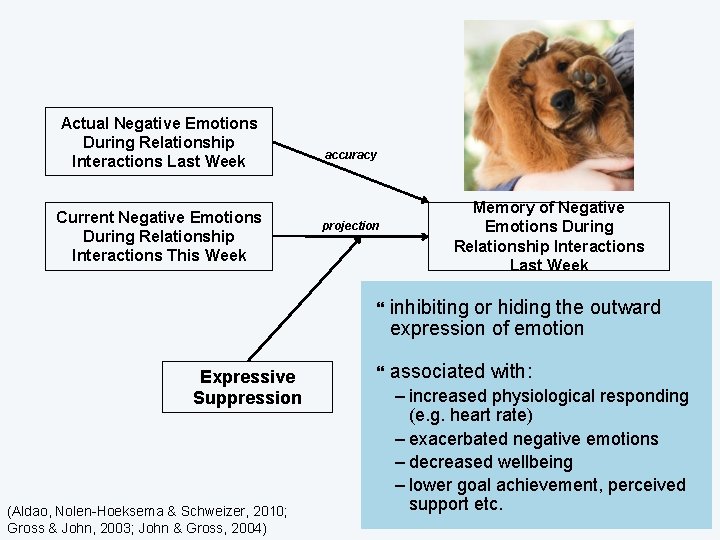
Actual Negative Emotions During Relationship Interactions Last Week Current Negative Emotions During Relationship Interactions This Week Expressive Suppression (Aldao, Nolen-Hoeksema & Schweizer, 2010; Gross & John, 2003; John & Gross, 2004) accuracy projection Memory of Negative Emotions During Relationship Interactions Last Week } inhibiting or hiding the outward expression of emotion } associated with: – increased physiological responding (e. g. heart rate) – exacerbated negative emotions – decreased wellbeing – lower goal achievement, perceived support etc.
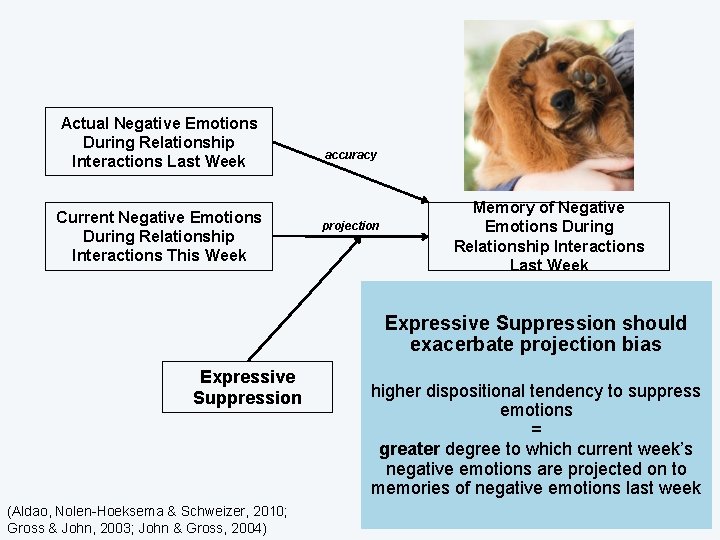
Actual Negative Emotions During Relationship Interactions Last Week Current Negative Emotions During Relationship Interactions This Week accuracy projection Memory of Negative Emotions During Relationship Interactions Last Week Expressive Suppression should exacerbate projection bias Expressive Suppression (Aldao, Nolen-Hoeksema & Schweizer, 2010; Gross & John, 2003; John & Gross, 2004) higher dispositional tendency to suppress emotions = greater degree to which current week’s negative emotions are projected on to memories of negative emotions last week
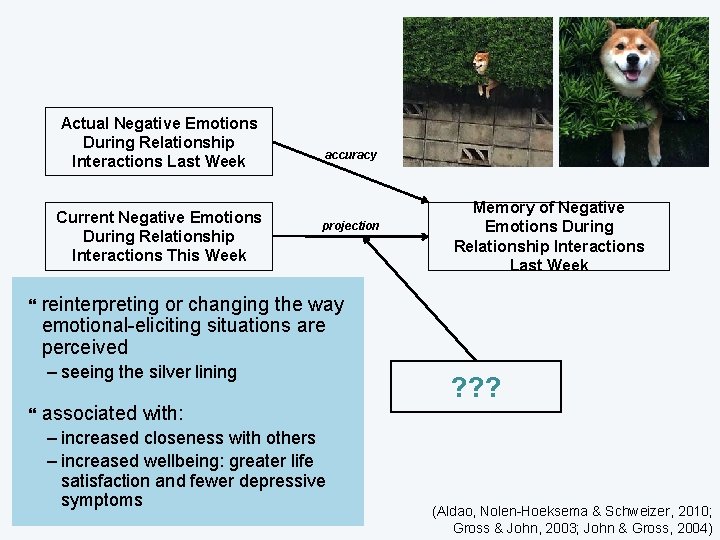
Actual Negative Emotions During Relationship Interactions Last Week Current Negative Emotions During Relationship Interactions This Week } accuracy projection reinterpreting or changing the way emotional-eliciting situations are perceived – seeing the silver lining } Memory of Negative Emotions During Relationship Interactions Last Week associated with: – increased closeness with others – increased wellbeing: greater life satisfaction and fewer depressive symptoms Cognitive ? ? ? Reappraisal (Aldao, Nolen-Hoeksema & Schweizer, 2010; Gross & John, 2003; John & Gross, 2004)
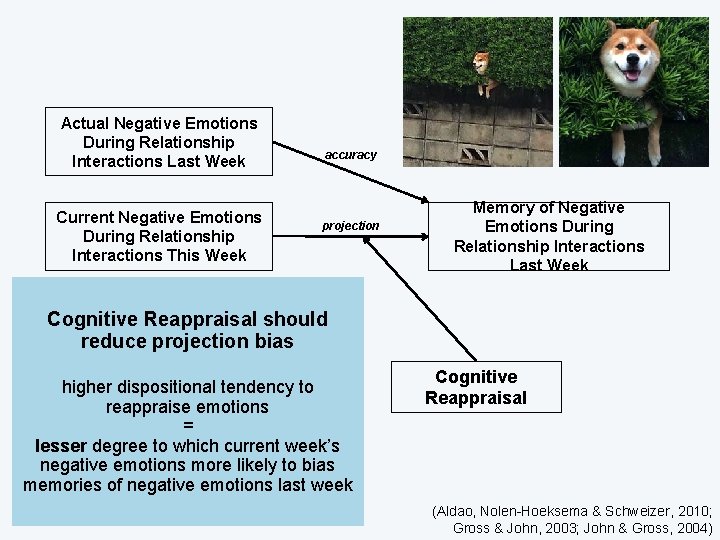
Actual Negative Emotions During Relationship Interactions Last Week Current Negative Emotions During Relationship Interactions This Week accuracy projection Memory of Negative Emotions During Relationship Interactions Last Week Cognitive Reappraisal should reduce projection bias higher dispositional tendency to reappraise emotions = lesser degree to which current week’s negative emotions more likely to bias memories of negative emotions last week Cognitive Reappraisal (Aldao, Nolen-Hoeksema & Schweizer, 2010; Gross & John, 2003; John & Gross, 2004)
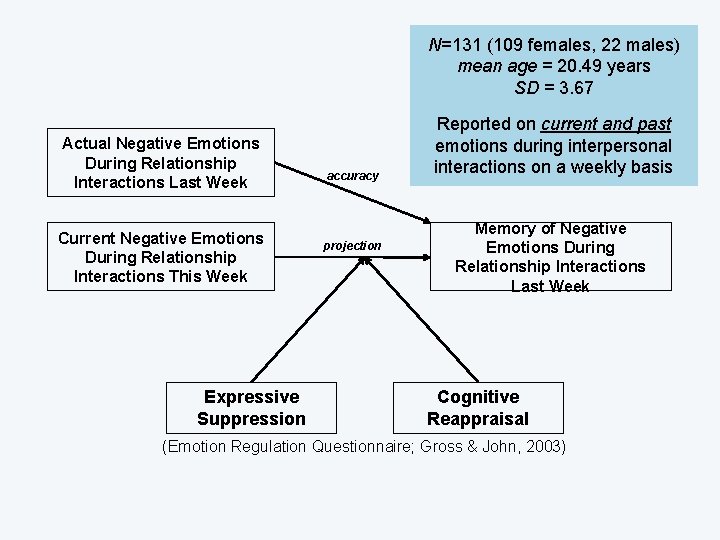
N=131 (109 females, 22 males) mean age = 20. 49 years SD = 3. 67 Actual Negative Emotions During Relationship Interactions Last Week Current Negative Emotions During Relationship Interactions This Week Expressive Suppression accuracy projection Reported on current and past emotions during interpersonal interactions on a weekly basis Memory of Negative Emotions During Relationship Interactions Last Week Cognitive Reappraisal (Emotion Regulation Questionnaire; Gross & John, 2003)
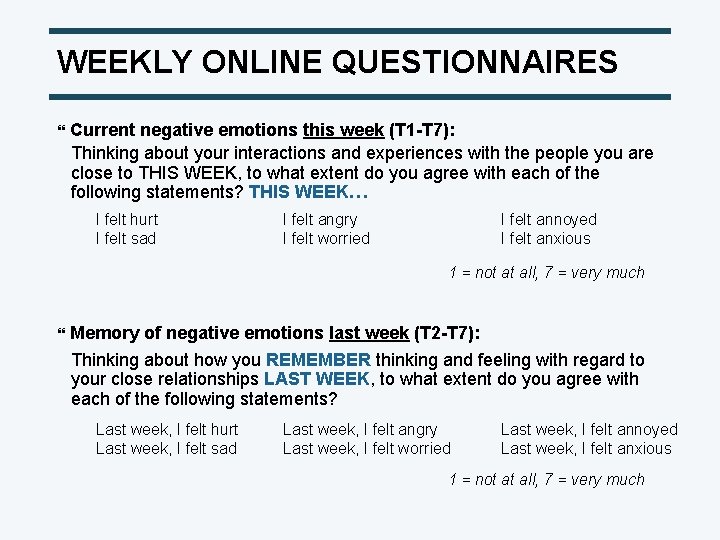
WEEKLY ONLINE QUESTIONNAIRES } Current negative emotions this week (T 1 -T 7): Thinking about your interactions and experiences with the people you are close to THIS WEEK, to what extent do you agree with each of the following statements? THIS WEEK… I felt hurt I felt sad I felt angry I felt worried I felt annoyed I felt anxious 1 = not at all, 7 = very much } Memory of negative emotions last week (T 2 -T 7): Thinking about how you REMEMBER thinking and feeling with regard to your close relationships LAST WEEK, to what extent do you agree with each of the following statements? Last week, I felt hurt Last week, I felt sad Last week, I felt angry Last week, I felt worried Last week, I felt annoyed Last week, I felt anxious 1 = not at all, 7 = very much
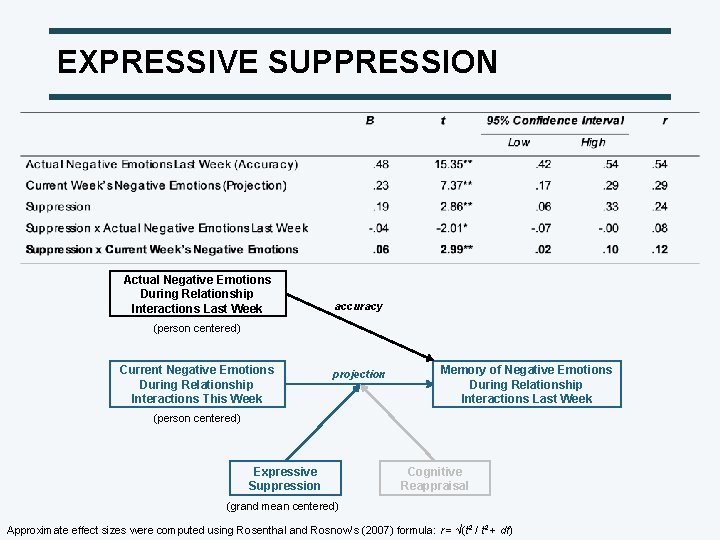
EXPRESSIVE SUPPRESSION Actual Negative Emotions During Relationship Interactions Last Week accuracy (person centered) Current Negative Emotions During Relationship Interactions This Week projection Memory of Negative Emotions During Relationship Interactions Last Week (person centered) Expressive Suppression Cognitive Reappraisal (grand mean centered) Approximate effect sizes were computed using Rosenthal and Rosnow’s (2007) formula: r = √(t 2 / t 2 + df)
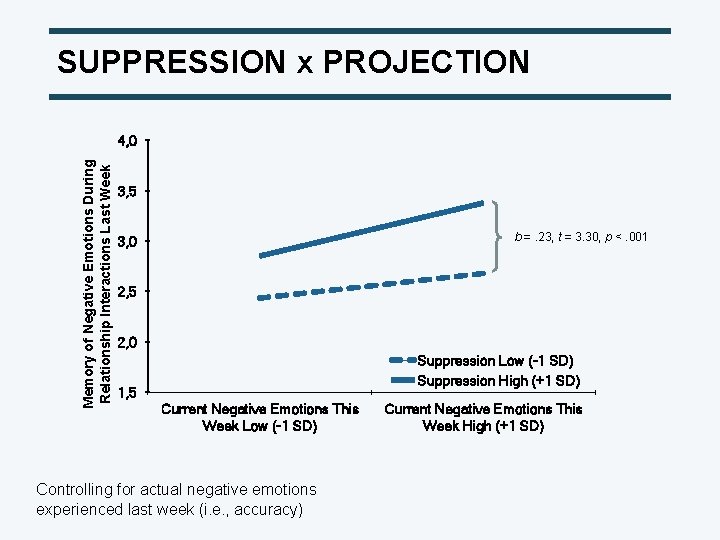
SUPPRESSION x PROJECTION Memory of Negative Emotions During Relationship Interactions Last Week 4, 0 3, 5 b =. 23, t = 3. 30, p <. 001 3, 0 2, 5 2, 0 Suppression Low (-1 SD) Suppression High (+1 SD) 1, 5 Current Negative Emotions This Week Low (-1 SD) Controlling for actual negative emotions experienced last week (i. e. , accuracy) Current Negative Emotions This Week High (+1 SD)
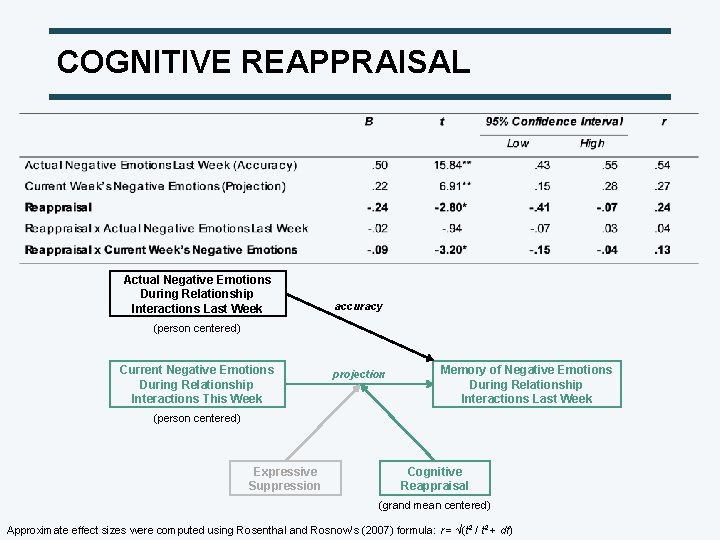
COGNITIVE REAPPRAISAL Actual Negative Emotions During Relationship Interactions Last Week accuracy (person centered) Current Negative Emotions During Relationship Interactions This Week projection Memory of Negative Emotions During Relationship Interactions Last Week (person centered) Expressive Suppression Cognitive Reappraisal (grand mean centered) Approximate effect sizes were computed using Rosenthal and Rosnow’s (2007) formula: r = √(t 2 / t 2 + df)
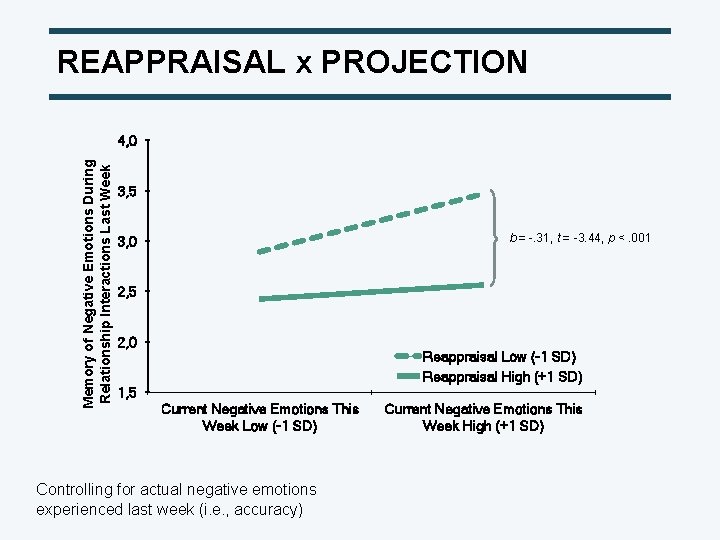
REAPPRAISAL x PROJECTION Memory of Negative Emotions During Relationship Interactions Last Week 4, 0 3, 5 b = -. 31, t = -3. 44, p <. 001 3, 0 2, 5 2, 0 Reappraisal Low (-1 SD) Reappraisal High (+1 SD) 1, 5 Current Negative Emotions This Week Low (-1 SD) Controlling for actual negative emotions experienced last week (i. e. , accuracy) Current Negative Emotions This Week High (+1 SD)
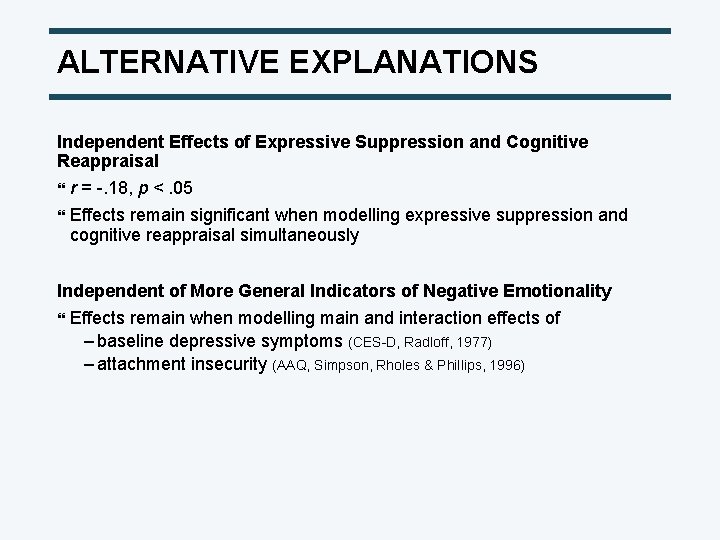
ALTERNATIVE EXPLANATIONS Independent Effects of Expressive Suppression and Cognitive Reappraisal } r = -. 18, p <. 05 } Effects remain significant when modelling expressive suppression and cognitive reappraisal simultaneously Independent of More General Indicators of Negative Emotionality } Effects remain when modelling main and interaction effects of – baseline depressive symptoms (CES-D, Radloff, 1977) – attachment insecurity (AAQ, Simpson, Rholes & Phillips, 1996)
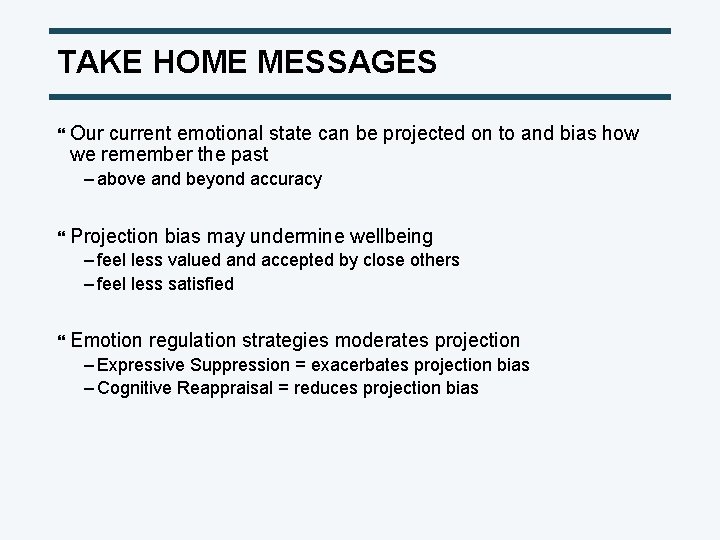
TAKE HOME MESSAGES } Our current emotional state can be projected on to and bias how we remember the past – above and beyond accuracy } Projection bias may undermine wellbeing – feel less valued and accepted by close others – feel less satisfied } Emotion regulation strategies moderates projection – Expressive Suppression = exacerbates projection bias – Cognitive Reappraisal = reduces projection bias

Thank you! valerie. chang@auckland. ac. nz http: //relationships. auckland. ac. nz/
- Slides: 19