
Emotion Motivation Emotions Positive or Negative Feeling States












- Slides: 43
Emotion & Motivation
Emotions: Positive or Negative Feeling States • Emotion: a positive or negative feeling state typically including some combination of physiological arousal, cognitive appraisal, and behavioral expression
What is an emotion? • Emotions are responses, including physiological responses • Sense or experience of feeling • Leads to expression, behavior; can be a motive • Related to thoughts and beliefs as well as immediate experience
Emotions • Basic emotions are universal • They include happiness, fear, anger, surprise, sadness, disgust, interest, etc. • Facial expressions (also universal) are the most reliable cues
Facial Expressions • Vary slightly by culture • Provide facial feedback • Are used by others to determine our emotions
Functionalist View of Emotion • What is their purpose? • Emotions are means of communicating and play a role in relationships. • They are also linked to an individual’s goals and motivation toward progress and overcoming obstacles. • Subjective evaluation of good and bad; comparable to pain in the physical realm
What is emotional intelligence (EQ)? • Gardners “interpersonal intelligence” • Salovey & Mayer (1990): ability to perceive and express emotion accurately • MSCEIT (2002) Mayer-Salovey-Caruso Emotional Intelligence Test • Daniel Goleman (1995) Published a book, “Emotional Intelligence”
What is emotional intelligence (EQ)? Salovey & Mayer (1990): ability to perceive and express emotion accurately, including: taking perspective understanding the roles of emotion in relationships using feelings to facilitate thought managing emotions such as anger
Emotions Gone Awry • . . . Are the basis for some mental disorders. • Clinical depression • Bipolar disorder • Anxiety disorders • Intermittent explosive disorder • Antisocial personality disorder
Emotions: Unifying Characteristics • Involve reactions of many bodily systems, • Expressions are based on genetically transmitted mechanisms but are altered by learning and interpretation of events, • Communicate information between people, and are important to relationships. • Help individuals respond to changes in their environment.
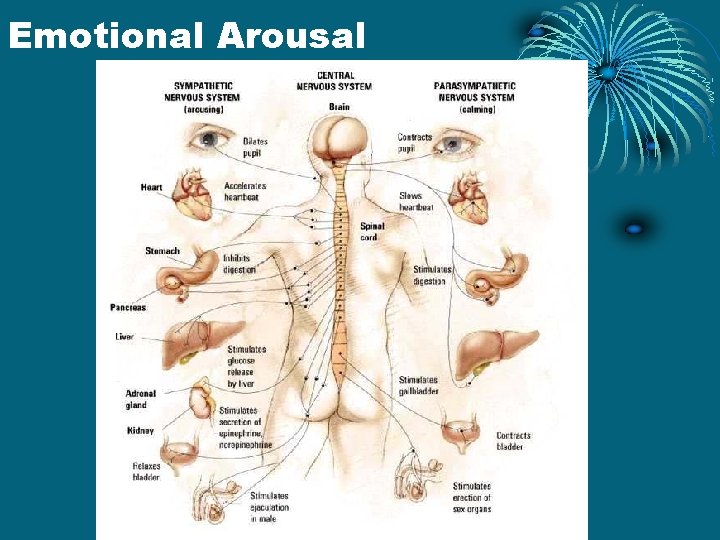
Emotions Result in Bodily Responses • The autonomic nervous system produces bodily responses of emotion. • It has two separate branches: • Sympathetic: geared toward energy expenditure • Parasympathetic: geared toward energy conservation and “refueling”
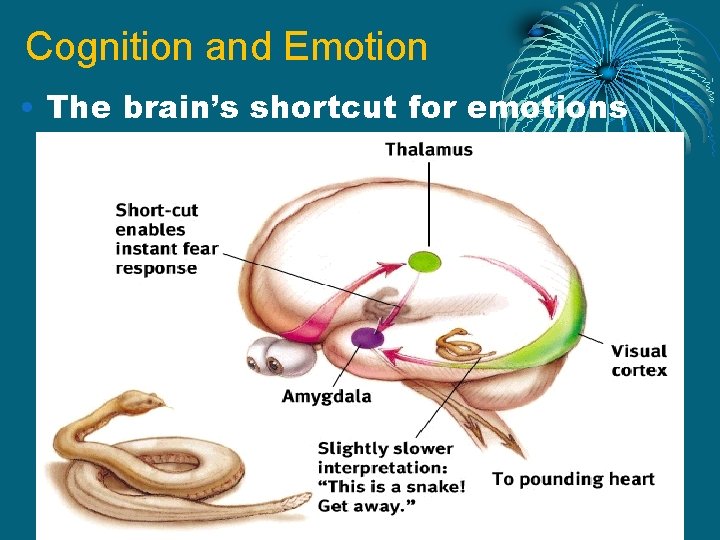
Three Brain Regions Coordinate Emotional Responses • The hypothalamus • vital link between higher-order cognition (forebrain) and the lower brain (homeostatic control of the body) • The limbic system (amygdala) • Two distinct neural circuits produce emotional responses, particularly fear • The cerebral cortex • Important for the subjective experience of emotions
Cognition and Emotion • The brain’s shortcut for emotions
Emotional Arousal
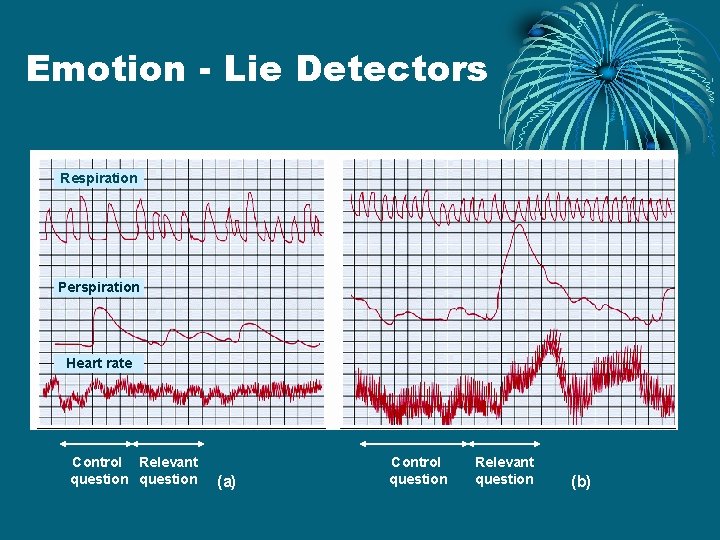
Lie Detectors • Polygraph • machine commonly used in attempts to detect lies • measures several arousal responses that accompany emotion • perspiration • heart rate • blood pressure • breathing changes
Emotion - Lie Detectors Respiration Perspiration Heart rate Control Relevant question (a) Control question Relevant question (b)
Emotion - Lie Detectors • 50 Innocents • 50 Thieves Percentage 80 70 60 50 40 30 20 10 0 Innocent people Guilty people Judged innocent by polygraph Judged guilty by polygraph • 1/3 of innocent declared guilty • 1/4 of guilty declared innocent (from Kleinmuntz & Szucko, 1984)
Subjective Well-Being • self-perceived happiness or satisfaction with life/contentment • used along with measures of objective well-being • physical and economic indicators to evaluate people’s quality of life
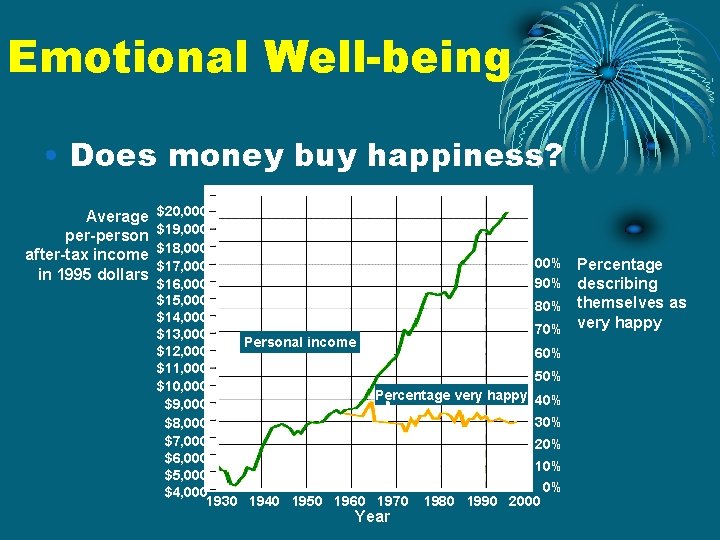
Emotional Well-being • Does money buy happiness? Average per-person after-tax income in 1995 dollars $20, 000 $19, 000 $18, 000 100% $17, 000 90% $16, 000 $15, 000 80% $14, 000 70% $13, 000 Personal income $12, 000 60% $11, 000 50% $10, 000 Percentage very happy 40% $9, 000 30% $8, 000 $7, 000 20% $6, 000 10% $5, 000 0% $4, 000 1930 1940 1950 1960 1970 1980 1990 2000 Year Percentage describing themselves as very happy
Emotional Well-being • Values and life satisfaction 0. 6 Importance scores 0. 4 Money Love 0. 2 0. 0 -0. 2 -0. 4 1. 00 2. 00 3. 00 4. 00 5. 00 Life satisfaction 6. 00 7. 00
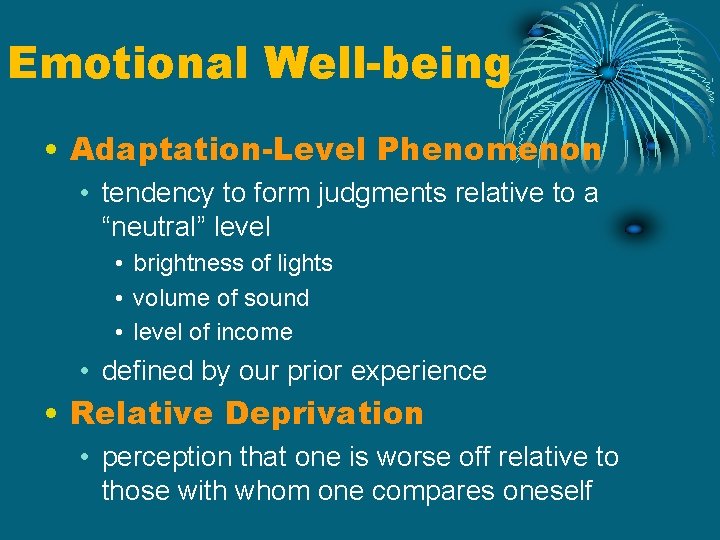
Emotional Well-being • Adaptation-Level Phenomenon • tendency to form judgments relative to a “neutral” level • brightness of lights • volume of sound • level of income • defined by our prior experience • Relative Deprivation • perception that one is worse off relative to those with whom one compares oneself
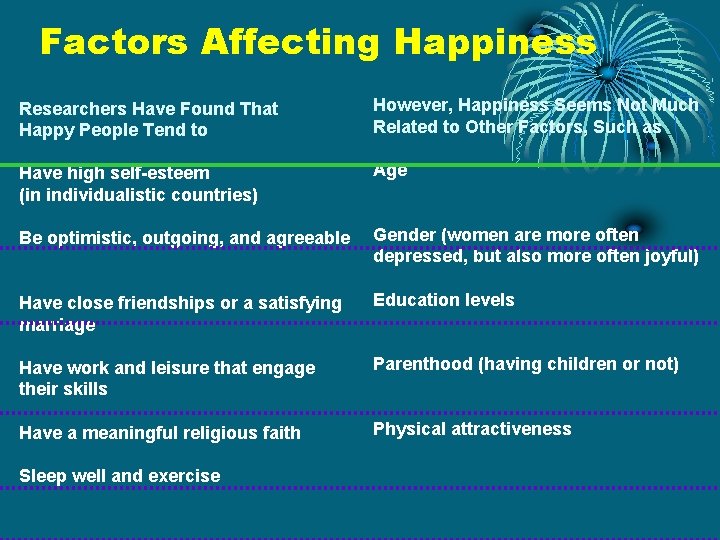
Factors Affecting Happiness Researchers Have Found That Happy People Tend to However, Happiness Seems Not Much Related to Other Factors, Such as Have high self-esteem (in individualistic countries) Age Be optimistic, outgoing, and agreeable Gender (women are more often depressed, but also more often joyful) Have close friendships or a satisfying marriage Education levels Have work and leisure that engage their skills Parenthood (having children or not) Have a meaningful religious faith Physical attractiveness Sleep well and exercise
Emotions are Motivating • Feel bad-Do Bad: the negative emotions of anger and fear usually result in maladaptive responses
Emotions are Motivating • Feel-good, do-good phenomenon • people’s tendency to be helpful when already in a good mood
Motivation Is a Dynamic Process • The study of motivation is essentially the study of what moves a person or animal to act in a particular way. • Motivation: an inner state that energizes behavior toward the fulfillment of a goal
Theories of Motivation Internal: something about the organism pushes it toward (or away from) some object External: attributes of the goal or the environment pull the organism in a certain direction
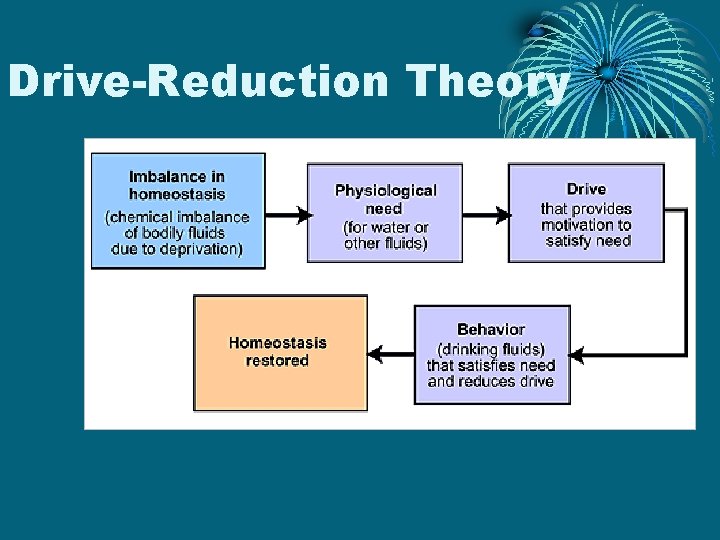
Biological Motivation: Drive Reduction Theories: • Homeostasis: tendency to keep physiological systems internally balanced and adjusting in response to change • an imbalance in homeostasis creates a physiological need, which produces a drive that motivates the organism to satisfy the need
Drive-Reduction Theory
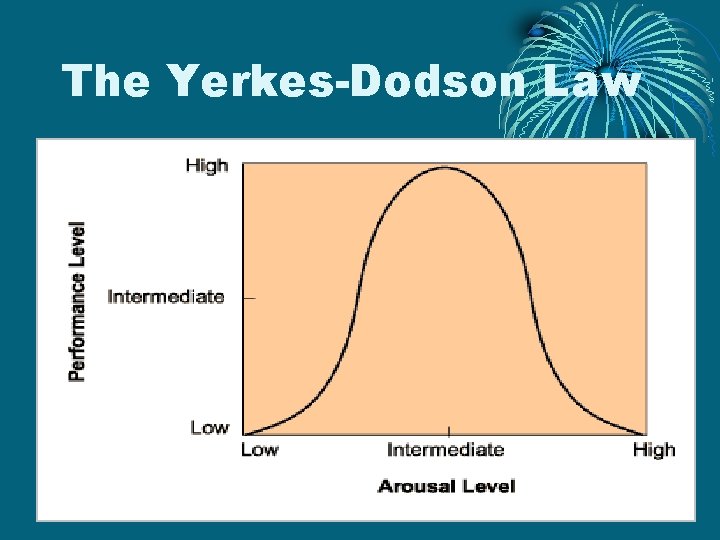
Arousal Motivation Maintaining an Optimal Level • Research indicates too low levels of arousal are as uncomfortable as those that are too high. • Yerkes-Dodson law. • Best performance occurs when we are at an intermediate level of arousal.
The Yerkes-Dodson Law
Incentive Motivation: External Factors Motivate Behavior • Behavior is directed toward attaining desirable stimuli (positive incentives) & avoiding undesirable stimuli ( negative incentives). (Remember operant conditioning: an incentive is the promise of reinforcement. ) • Any stimulus that we learn to associate with positive or negative outcomes can serve as an incentive for behavior.
Incentive Theory: External Factors Motivate Behavior • Researchers distinguish two types of motivation: • Intrinsic motivation: a behavior or an activity that a person perceives as a valued goal in its own right • Extrinsic motivation: type of motivation that leads a person to engage in a behavior or an activity for external reasons
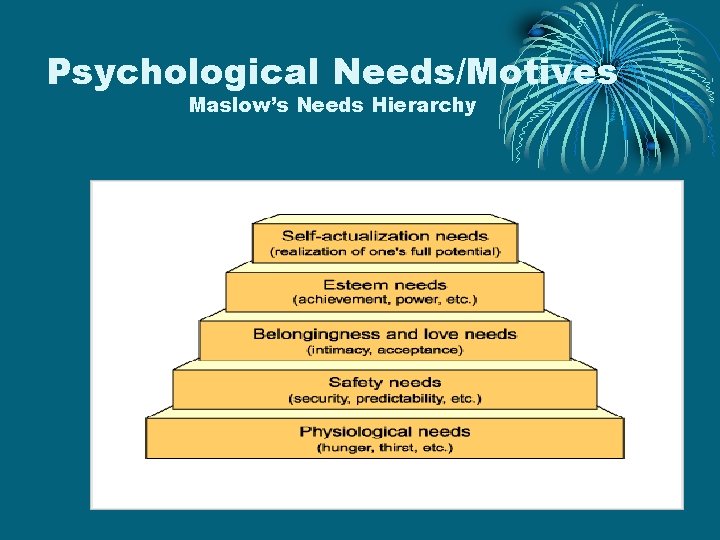
Maslow Proposed Some Needs Must Be Met before Others • We are born with a hierarchy of needs. • First, basic safety and survival needs must be sufficiently satisfied. • Next, the person is motivated by more social needs such as the desire for intimacy, love, and acceptance from others. • These are followed by esteem needs such as the desire for achievement, power, recognition, and respect from others. • All the needs in the four levels of the hierarchy are deficiency needs.
Psychological Needs/Motives Maslow’s Needs Hierarchy
Do We Prioritize our Needs? Maslow Proposed Some Needs Must Be Met before Others He also said that self-actualization, the need to fulfill one’s potential, is the ultimate goal of human growth. This is an appealing theory of motivation in business, education, etc. , and it provides an organized framework for discussing human motives. However, the simplicity of theory proved to be its primary problem. (It tells us little that we did not already know and explains nothing.
Obesity & Eating Disorders: Internal & External Forces • Definition of obesity: the excessive accumulation of body fat • Diagnosis: calculate body mass index (BMI), which is weight in kilograms divided by height in meters squared (30 kg/m 2) • Person with body mass index over 30 is considered obese.
Do Genes Shape Our Motivation? Are eating patterns hereditary? • Instinct: an unlearned, relatively fixed pattern of behavior that is essential to a species’ survival • In the early 1900 s William Mc. Dougall and other instinct theorists contended that much of human behavior is controlled by instincts. • The problem with these instinct theories is that many so-called instinctual behaviors are learned and shaped by experience.
Then what determines eating patterns? • Internals – listen to hunger cues from the body • Externals – are pulled by the incentives of tasty food and social cues • People differ individually, so there may be genetic influence.
Biological influences on Eating Patterns • Hormones such as gastrin, leptin, and cholecystokinin (CCK) produced by a full stomach/digestive track • Blood glucose and insulin levels • Monitoring by the hypothalamus
The Psychology of Eating Learned Eating Patterns • Classical conditioning • Comfort food • Social events • Social acceptability • Acquired tastes
Obesity & Eating Disorders: Social/Cultural Forces From 1991 to 1998, 50% increase in number of obese American adults (12% to 18%) • Number of overweight children has doubled in past 20 years. • Obesity closely related to chronic health conditions: high blood pressure, heart disease, diabetes, arthritis, & sleep disorders
Obesity & Eating Disorders: Social Forces • Weight discrimination more pervasive and widely condoned than race and gender discrimination • Results in social climate that pressures people to reach certain body ideals • Female ideal stresses difficult-to-attain thinness standards that endanger women’s health • Women of all ages more likely to view their bodies as objects of others’ attention and evaluate their bodies more negatively than men • Women more likely to habitually experience social physique anxiety , which is anxiety about others observing or evaluating their bodies
Obesity & Eating Disorders • Anorexia nervosa: eating disorder in which person weighs less than 85% of normal weight & expresses an intense fear of gaining weight. • Bulimia: eating disorder in which person engages in recurrent episodes of binge eating followed by drastic measures to purge body of consumed calories • In addition to sociocultural factors, a growing body of evidence suggests possible genetic and motivational influences on these eating disorders.