
Emotion in Clinical Psychology Chapter 15 Outline Taxonomy









- Slides: 23
Emotion in Clinical Psychology Chapter 15
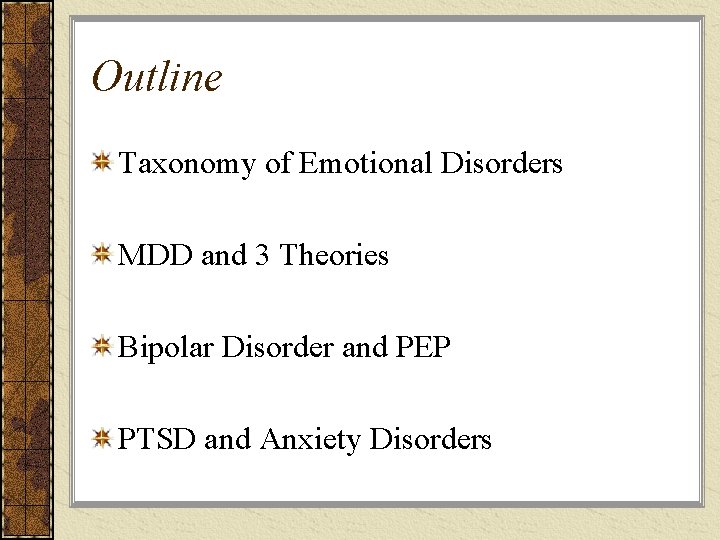
Outline Taxonomy of Emotional Disorders MDD and 3 Theories Bipolar Disorder and PEP PTSD and Anxiety Disorders
Emotion Disturbances Emotional Valence Disturbances Emotional Intensity / Regulation Disturbances Disconnections (Berenbaum et al. , 2003)
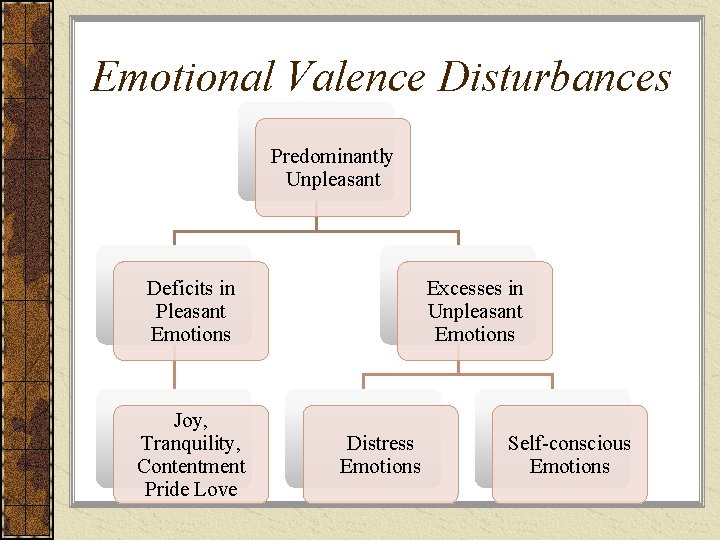
Emotional Valence Disturbances Predominantly Unpleasant P P U U P U Normal Level
Emotional Valence Disturbances Predominantly Unpleasant Deficits in Pleasant Emotions Joy, Tranquility, Contentment Pride Love Excesses in Unpleasant Emotions Distress Emotions Self-conscious Emotions
Emotional Valence Disturbances Predominantly Pleasant U U P P P U Normal Level
Emotional Valence Disturbances Predominantly Pleasant Deficits in Unpleasant Emotions Excesses in Pleasant Emotions Fear Guilt Shame Joy Pride Love Interest/Curiosity
Emotional Valence Disturbances Predominantly Pleasant Deficits in Pleasant Emotions Joy, Tranquility, Contentment Pride Love Predominantly Unpleasant Excesses in Unpleasant Emotions Distress Emotions Self-conscious Emotions Deficits in Unpleasant Emotions Excesses in Pleasant Emotions Fear Guilt Shame Joy Pride Love Interest/Curiosity
Emotional Intensity / Regulation Disturbances Hyperreactivity Hyporeactivity U P
Emotion Disconnections Affect Awareness
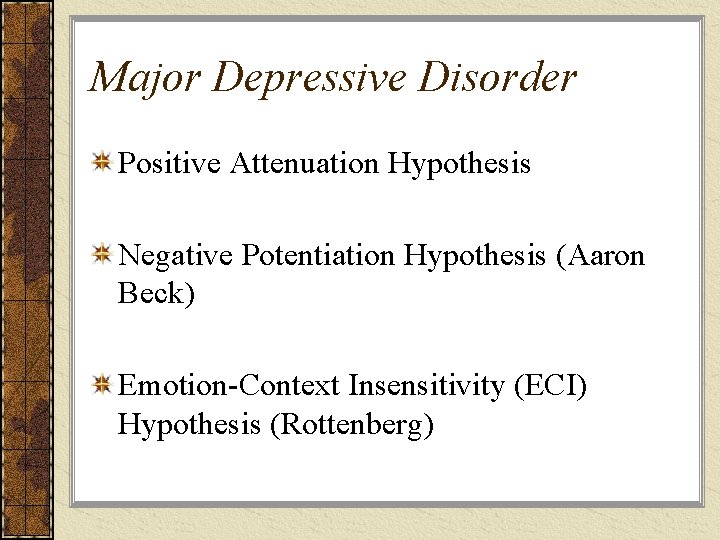
Major Depressive Disorder Positive Attenuation Hypothesis Negative Potentiation Hypothesis (Aaron Beck) Emotion-Context Insensitivity (ECI) Hypothesis (Rottenberg)
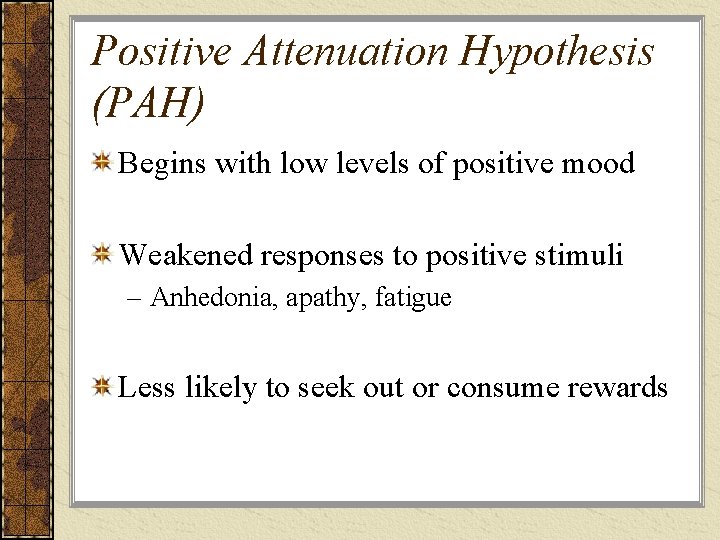
Positive Attenuation Hypothesis (PAH) Begins with low levels of positive mood Weakened responses to positive stimuli – Anhedonia, apathy, fatigue Less likely to seek out or consume rewards
Negative Potentiation Hypothesis (NPH) Begins with high levels of negative mood Greater reactivity to negative emotional stimuli Negative worldview leads people to experience more negative emotions in response to unpleasant stimuli
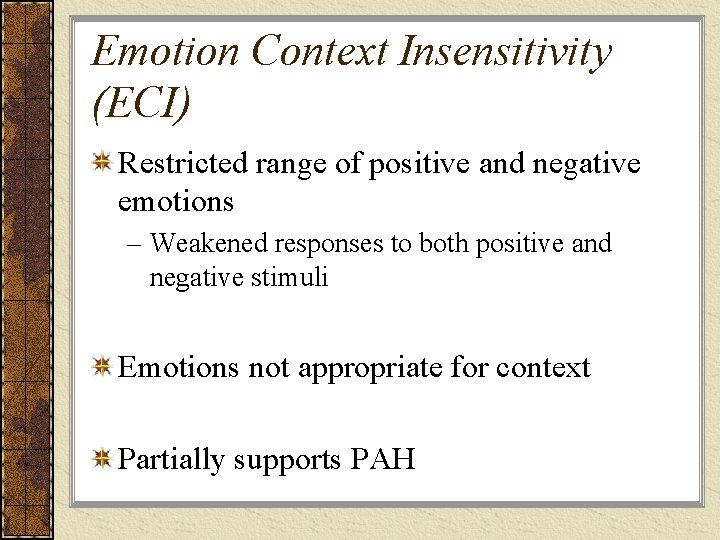
Emotion Context Insensitivity (ECI) Restricted range of positive and negative emotions – Weakened responses to both positive and negative stimuli Emotions not appropriate for context Partially supports PAH
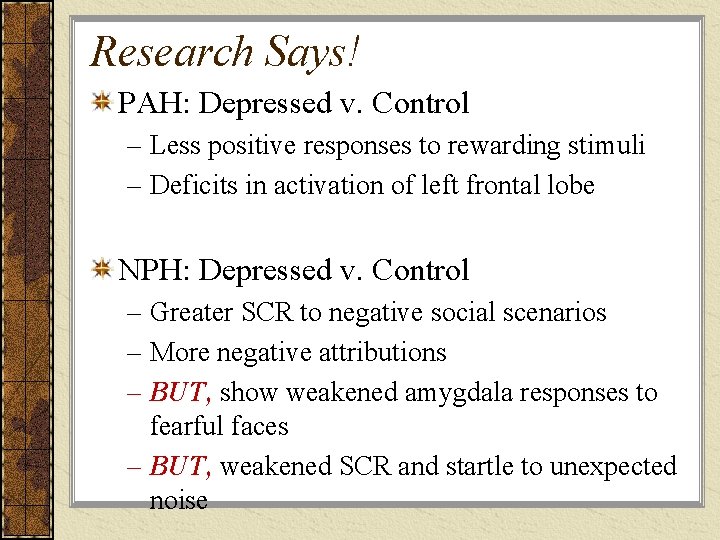
Research Says! PAH: Depressed v. Control – Less positive responses to rewarding stimuli – Deficits in activation of left frontal lobe NPH: Depressed v. Control – Greater SCR to negative social scenarios – More negative attributions – BUT, show weakened amygdala responses to fearful faces – BUT, weakened SCR and startle to unexpected noise
For ECI, Research Says! Across sad, amusing and neutral contexts, people with most similar facial expressions and physiological reactions: – Highest depression severity – Depressed for longest period of time – Least likely to recover 6 months later (Rottenberg, Kasch, et al. , 2002)
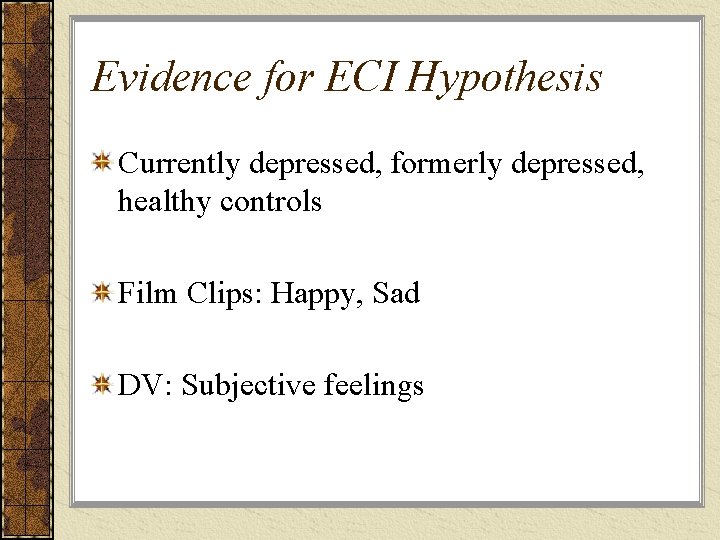
Evidence for ECI Hypothesis Currently depressed, formerly depressed, healthy controls Film Clips: Happy, Sad DV: Subjective feelings
Evidence for ECI Hypothesis Happy Neutral Sad Self-reported Happiness 9 7 5 3 1 Depressed Recovered Control
Evidence for ECI Hypothesis Happy Neutral Sad Self-reported Sadness 9 7 5 3 1 Depressed Recovered Control
Evidence for ECI Hypothesis Supports ECI and Positive Attenuation: – Across all clips, lower positive emotions than recovered and controls – Similar sadness across 3 film clips Against ECI – More negative emotions than recovered and controls – No differences for facial expressions or physiology
Positive Emotion Persistence (PEP) Greater degree of positive emotions Increases in reward and achievement-oriented emotions Increased positive emotions across all contexts Deficiencies in Emotion Regulation – Up-regulate positive emotions – Difficulty down-regulating positive emotions (Gruber and colleagues)
Bipolar Risk Control (Gruber, 2011)