
Emotion Daniel Messinger Ph D Infant emotions Core
- Slides: 51
Emotion Daniel Messinger, Ph. D.
Infant emotions � Core elements of infant behavior � Quickly motivate behavior Hunger-Distress-Cry Interest-Attentive face Engaging playful other – joy - smile � Organize action, physiology, cognition, & perception � To meet environmental and internal demands � Patterns constitute core aspects of temperament/personality functioning dmessinger@miami. edu 2
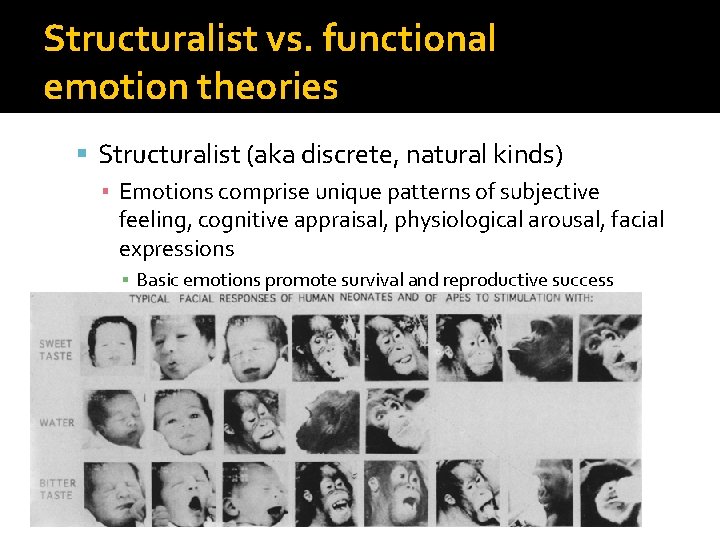
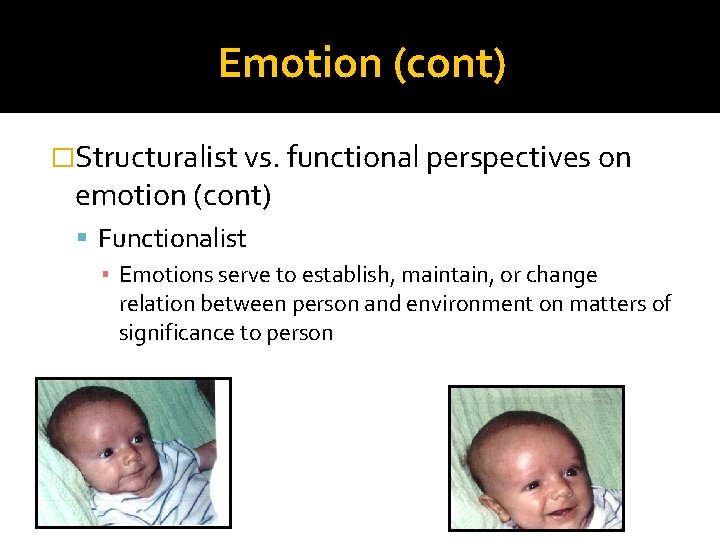
Structuralist vs. functional emotion theories Structuralist (aka discrete, natural kinds) ▪ Emotions comprise unique patterns of subjective feeling, cognitive appraisal, physiological arousal, facial expressions ▪ Basic emotions promote survival and reproductive success
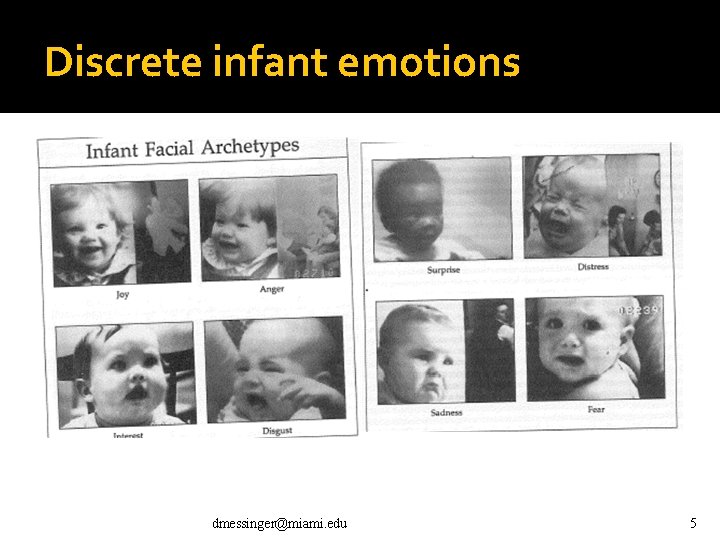
Discrete infant emotions dmessinger@miami. edu 5
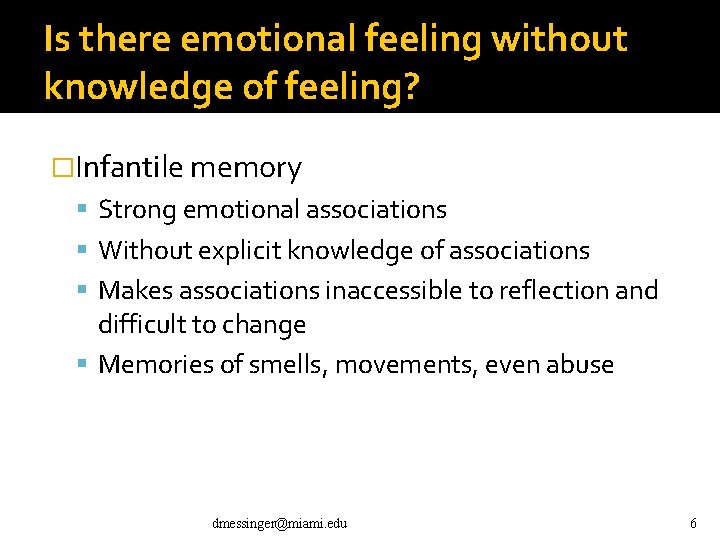
Is there emotional feeling without knowledge of feeling? �Infantile memory Strong emotional associations Without explicit knowledge of associations Makes associations inaccessible to reflection and difficult to change Memories of smells, movements, even abuse dmessinger@miami. edu 6
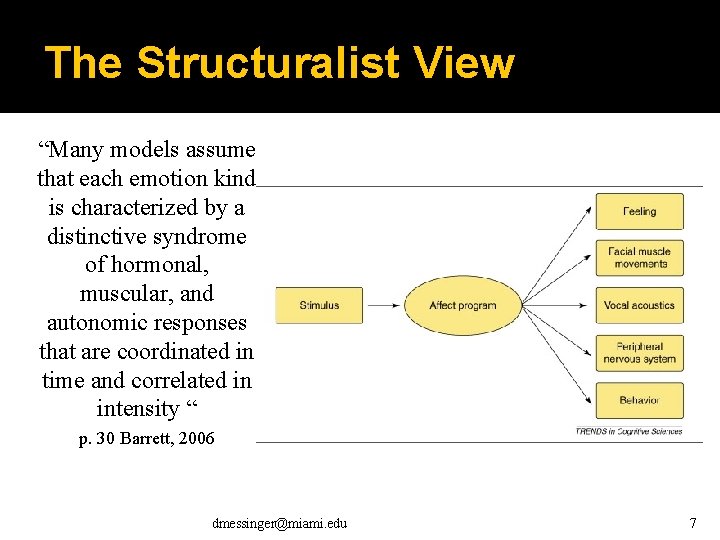
The Structuralist View “Many models assume that each emotion kind is characterized by a distinctive syndrome of hormonal, muscular, and autonomic responses that are coordinated in time and correlated in intensity “ p. 30 Barrett, 2006 dmessinger@miami. edu 7
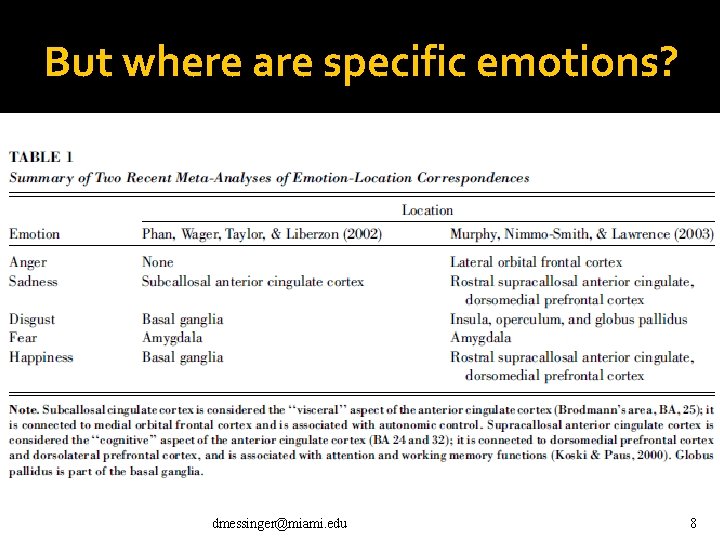
But where are specific emotions? dmessinger@miami. edu 8
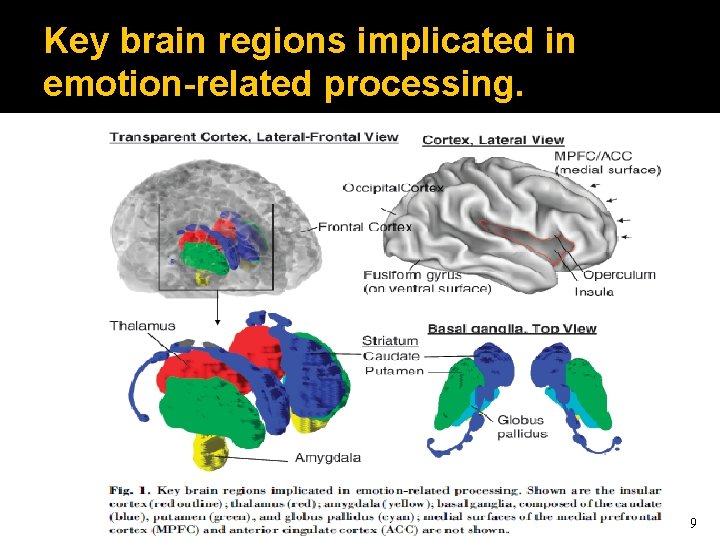
Key brain regions implicated in emotion-related processing. dmessinger@miami. edu 9
Facial affect programs? �Current evidence: Relevant linked brain systems But not distinct affect programs Fear may be exception Panskepp and current animal work dmessinger@miami. edu 10
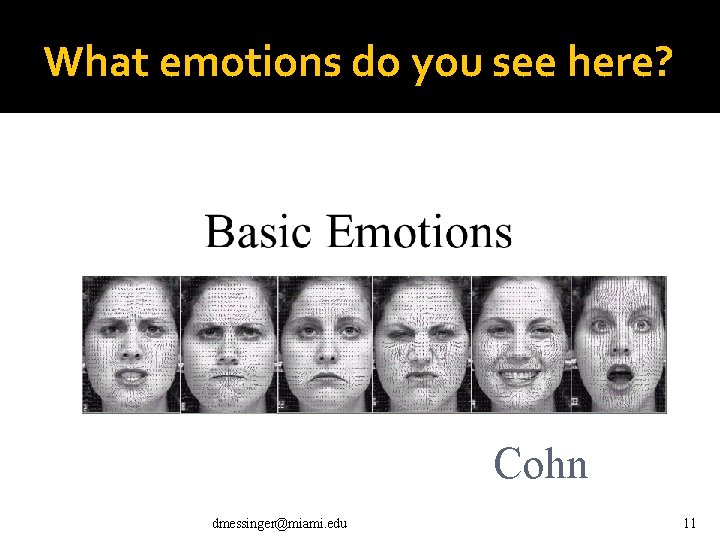
What emotions do you see here? Cohn dmessinger@miami. edu 11
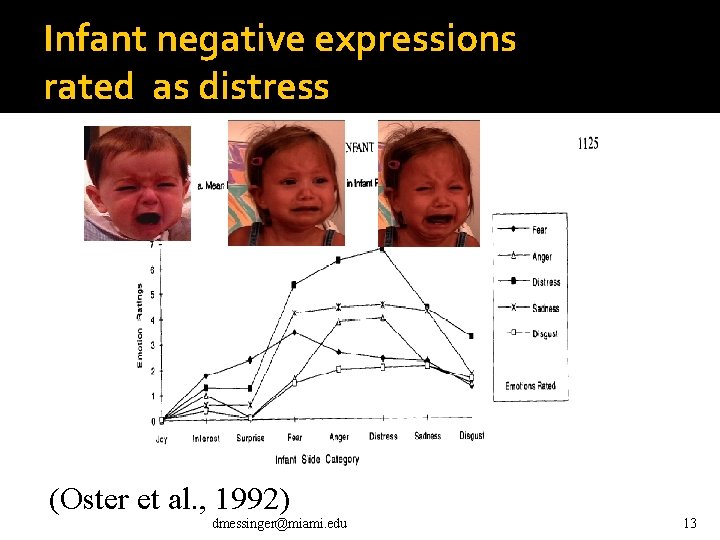
Negative emotional expressions are not situationally specific �Through 2 months, Justine shows distress to bathing, being moved, & pacifier removal (inoculation and hunger) �After 2 months, anger and, to a much lesser degree, sadness are most common reaction to all negative elicitors infants cry, not a specific reaction �Camras, 1992 dmessinger@miami. edu 12
Infant negative expressions rated as distress (Oster et al. , 1992) dmessinger@miami. edu 13
Examples � Sad distress smile: http: //www. youtube. com/watch? v=ak. PVt. Ob. BUOk&feature=related �Distress: � � Sad disress: https: //www. youtube. com/watch? v=l 7 o. D 9 WX-1 CU Smiloe Fear/orient distress: http: //www. youtube. com/watch? NR=1&feature=fvwp&v=Qi. Br. Pk. Goq. FM Fear distress: http: //www. youtube. com/watch? v=f. ASp 42 Zvj. IM&feature=fvwrel, http: //www. youtube. com/watch? feature=fvwp&NR=1&v=H-1 me_wsuyk (alligator bite) �Sad: http: //www. youtube. com/watch? v=sz. Lj. Xta 0 Szw, dad singing http: //www. youtube. com/watch? v=d. Az. Lsn. Yvd. Yo&feature=related (lower lip in response to rasberries) � Examples (Slides 3 -10 are pictures) : http: //www. slideserve. com/marilu/emotions dmessinger@miami. edu 15
Maze game—Scary—children � http: //www. youtube. com/watch? v=ZGd 5 Nq. P 6 qd 4 � Slow-motion: http: //www. youtube. com/watch? v=LC 5 q. Pv. TQUdo � Compendium: http: //www. youtube. com/watch? v=cype. Lu. CIr. U 0 � Long: http: //www. youtube. com/watch? v=q 9 k. NCBGEyfk 0: 55 -1: 07, 1: 45 -2: 30 dmessinger@miami. edu 16
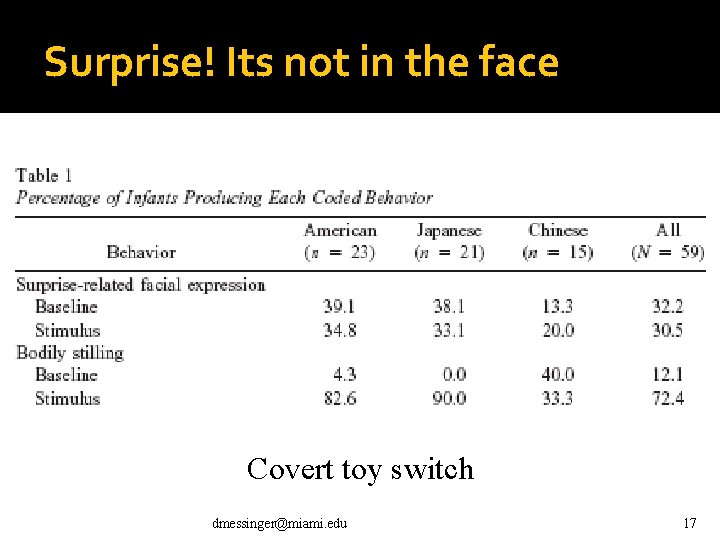
Surprise! Its not in the face Covert toy switch dmessinger@miami. edu 17
Surprise examples �Expression on demand: http: //www. youtube. com/watch? v=8 Da. Kc. Kq. Vhe. E&NR=1 �Coordinative structure? http: //www. youtube. com/watch? v=c. Ovt. NPljtv 0&feature=related � � Posed adult: http: //www. youtube. com/watch? v=f 4 Ayfr. M 8 Q 2 o Girl and Dad 1: 05— 1: 40. http: //www. youtube. com/watch? v=q 5 HXl_z. J 5 po dmessinger@miami. edu 18
Emotion (cont) �Structuralist vs. functional perspectives on emotion (cont) Functionalist ▪ Emotions serve to establish, maintain, or change relation between person and environment on matters of significance to person
Developmental patterns �Socialization Emotion displays become more restricted Full-face to partial face - miniaturization �Cognitive input shame, guilt, contempt emerge ▪ involve rudimentary appraisal of self vis-à-vis other ▪ dynamic systems dmessinger@miami. edu 20
Developmental Changes in Emotion � Psychobiological foundations Subcortical mediation of basic emotions Developing subcortical-frontal connections permit more effective emotion regulation � Emotion Perception Discrimination/categorization of expression by 5 months of age Rely on others’ reactions to interpret unfamiliar situations = social referencing (12+ months) Understanding of subjective state of emotion (24+ months), allows for prosocial displays of comforting etc.
Developmental Changes in Emotion (cont) �Emotion and Self-Development Increases in self-awareness (2/3 yrs) leads to expression of new, more complex emotions ▪ Self-Conscious Emotions ▪ ▪ Pride Guilt Shame Embarrassment
Developmental Changes in Emotion (cont) �Understanding effects of emotions on others: The use of display rules Increased ability to understand apply social rules for display of emotion in social situations ▪ Emotion masking ▪ Primitive forms in preschool; more flexible, reasoned use in middle childhood
Developmental Changes in Emotion (cont) �Emotion Regulation Adaptive management of emotional experiences Developmental transition from other-regulation to self-regulation ▪ Internalization of socialization experiences
Dynamic systems � Development, interaction, and (emotional) behavior are complex � involving multiple interfacing/interacting constituents � which produce patterns we see as pre-designed regularities � A bottom-up approach Discrete emotions as preferred states formed from the interface of multiple constituents dmessinger@miami. edu 25
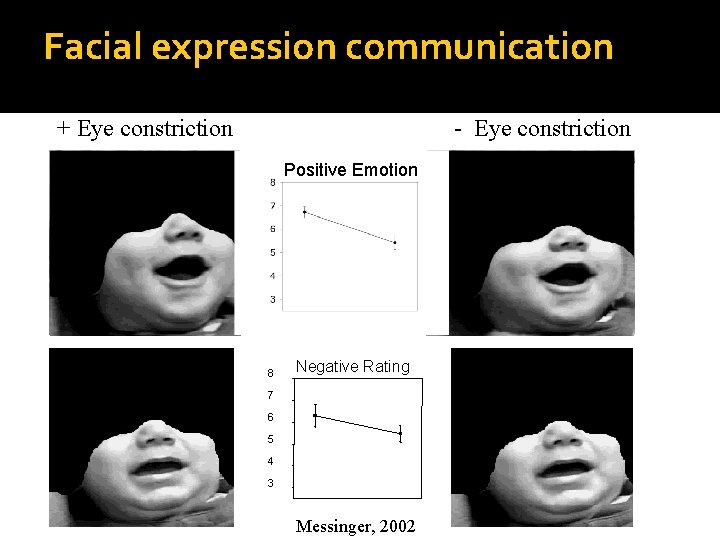
Facial expression communication + Eye constriction - Eye constriction Positive. Emotion Rating 8 Negative Rating 7 6 5 4 3 Messinger, 2002
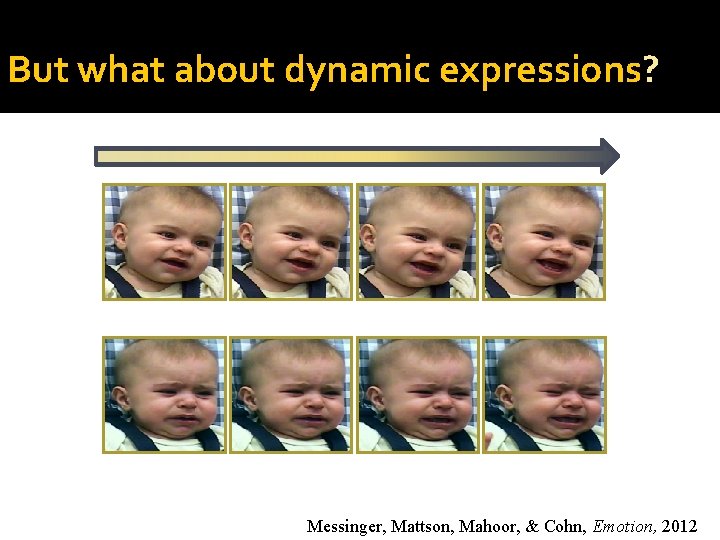
But what about dynamic expressions? Messinger, Mattson, Mahoor, & Cohn, Emotion, 2012
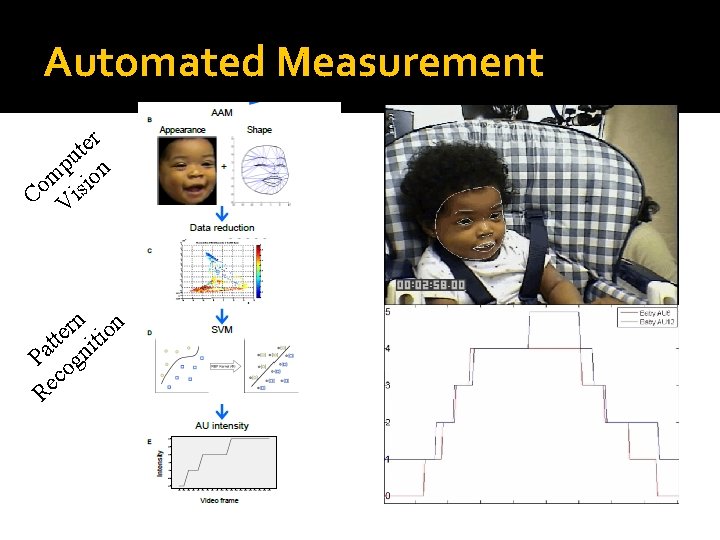
Automated Measurement er t pu n m sio o C Vi n on r e i t t t i Pa ogn c e R
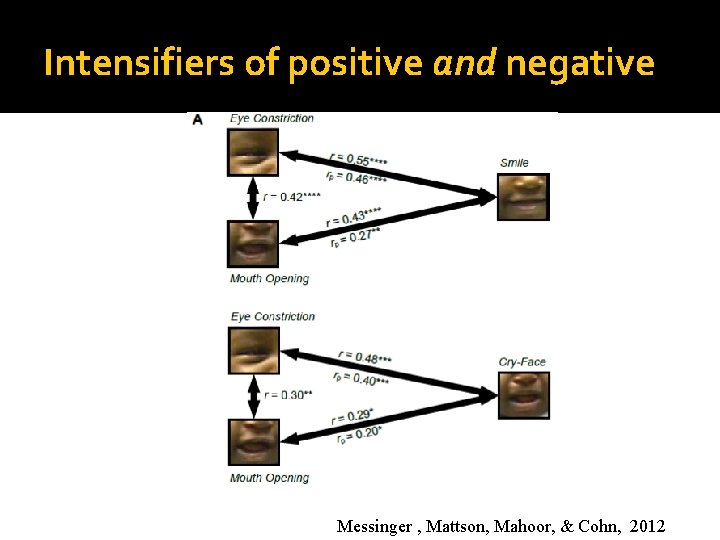
Intensifiers of positive and negative Messinger , Mattson, Mahoor, & Cohn, 2012
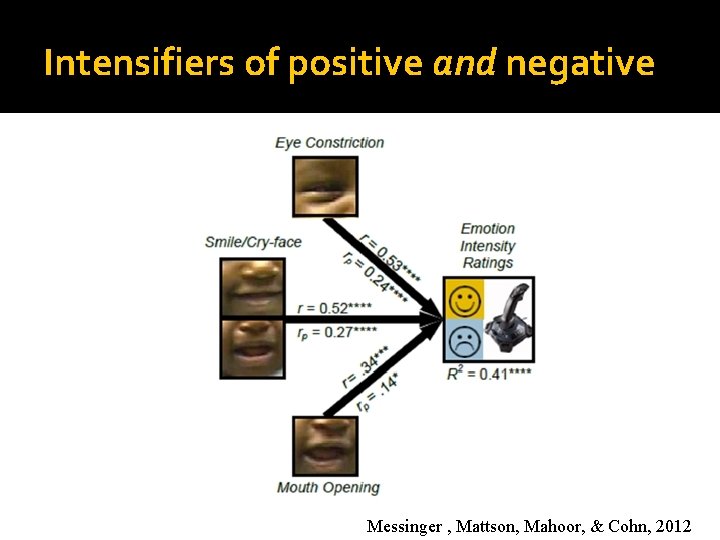
Intensifiers of positive and negative Messinger , Mattson, Mahoor, & Cohn, 2012
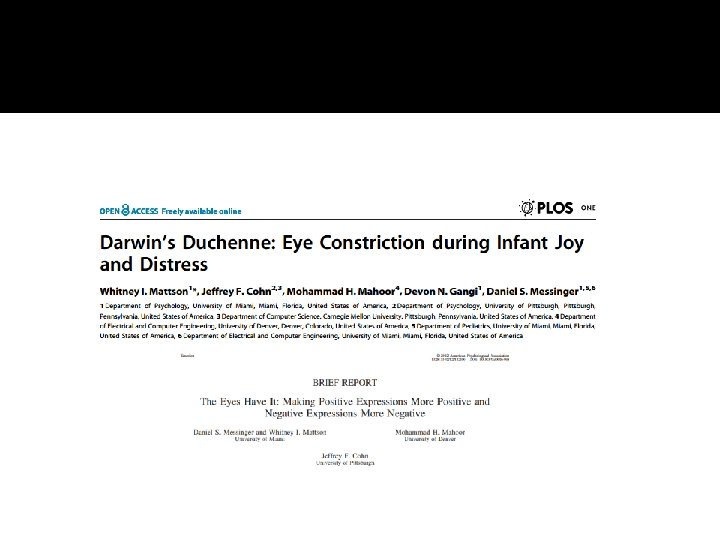
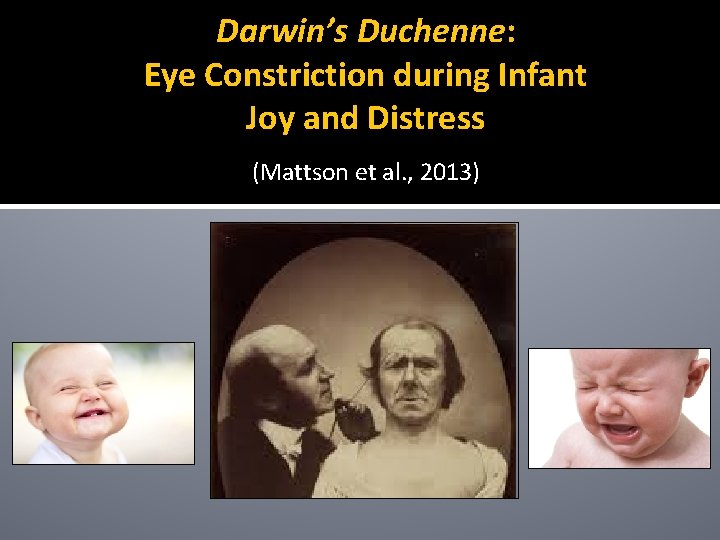
Darwin’s Duchenne: Eye Constriction during Infant Joy and Distress (Mattson et al. , 2013)
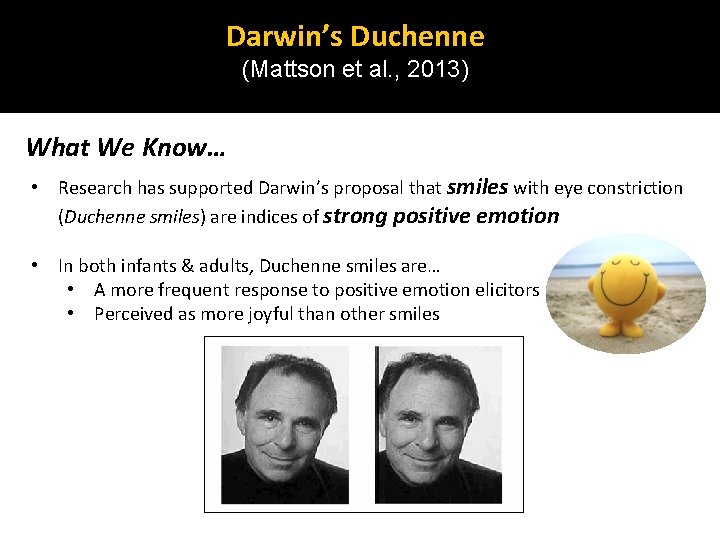
Darwin’s Duchenne (Mattson et al. , 2013) What We Know… • Research has supported Darwin’s proposal that smiles with eye constriction (Duchenne smiles) are indices of strong positive emotion • In both infants & adults, Duchenne smiles are… • A more frequent response to positive emotion elicitors • Perceived as more joyful than other smiles
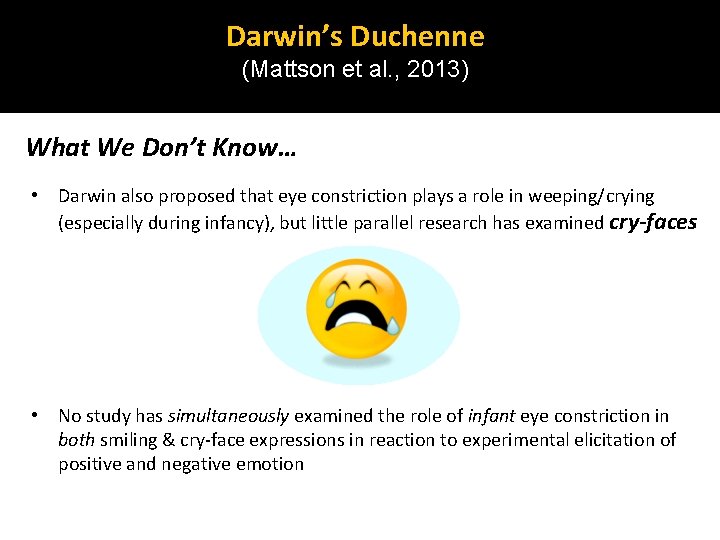
Darwin’s Duchenne (Mattson et al. , 2013) What We Don’t Know… • Darwin also proposed that eye constriction plays a role in weeping/crying (especially during infancy), but little parallel research has examined cry-faces • No study has simultaneously examined the role of infant eye constriction in both smiling & cry-face expressions in reaction to experimental elicitation of positive and negative emotion
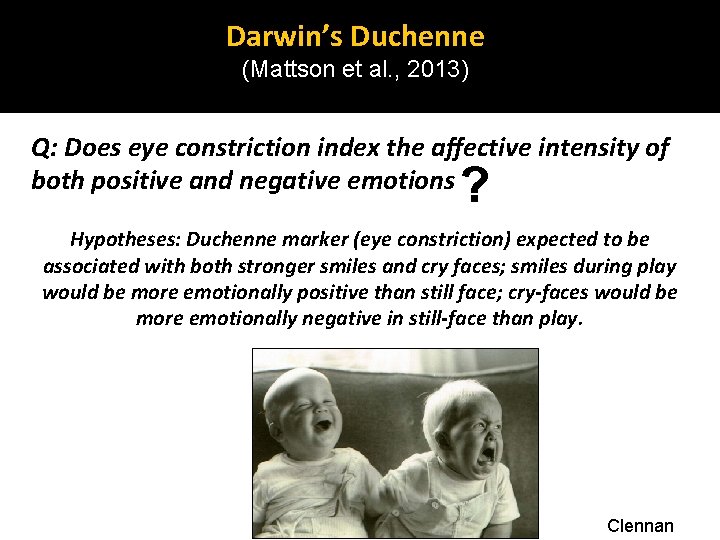
Darwin’s Duchenne (Mattson et al. , 2013) Q: Does eye constriction index the affective intensity of both positive and negative emotions ? Hypotheses: Duchenne marker (eye constriction) expected to be associated with both stronger smiles and cry faces; smiles during play would be more emotionally positive than still face; cry-faces would be more emotionally negative in still-face than play. Clennan
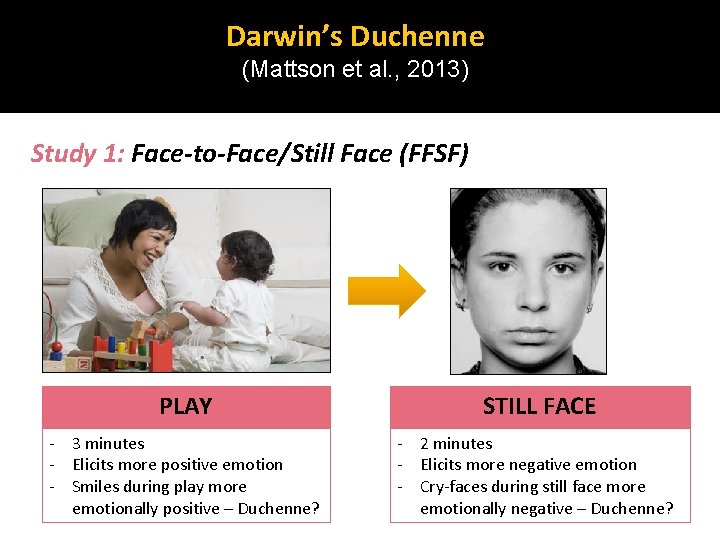
Darwin’s Duchenne (Mattson et al. , 2013) Study 1: Face-to-Face/Still Face (FFSF) PLAY STILL FACE - 3 minutes - Elicits more positive emotion - Smiles during play more emotionally positive – Duchenne? - 2 minutes - Elicits more negative emotion - Cry-faces during still face more emotionally negative – Duchenne?
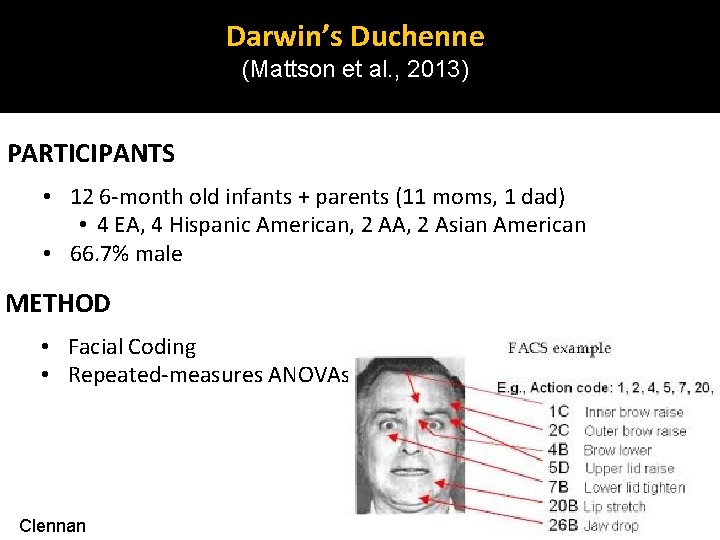
Darwin’s Duchenne (Mattson et al. , 2013) PARTICIPANTS • 12 6 -month old infants + parents (11 moms, 1 dad) • 4 EA, 4 Hispanic American, 2 AA, 2 Asian American • 66. 7% male METHOD • Facial Coding • Repeated-measures ANOVAs Clennan
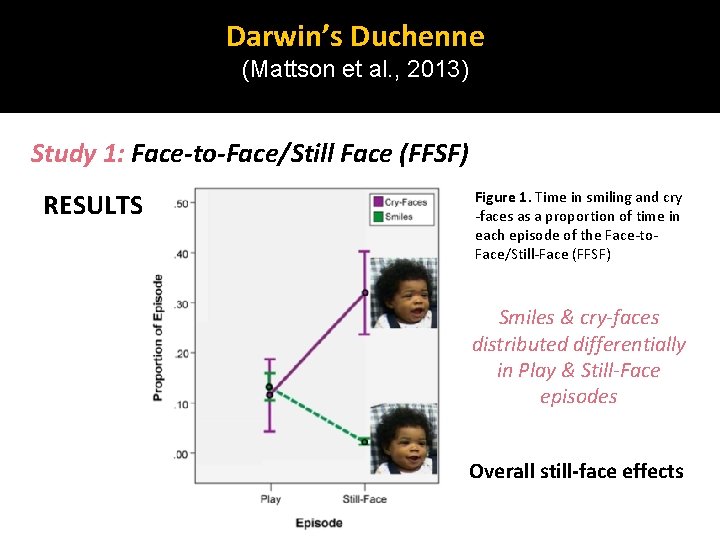
Darwin’s Duchenne (Mattson et al. , 2013) Study 1: Face-to-Face/Still Face (FFSF) RESULTS Figure 1. Time in smiling and cry -faces as a proportion of time in each episode of the Face-to. Face/Still-Face (FFSF) Smiles & cry-faces distributed differentially in Play & Still-Face episodes Overall still-face effects
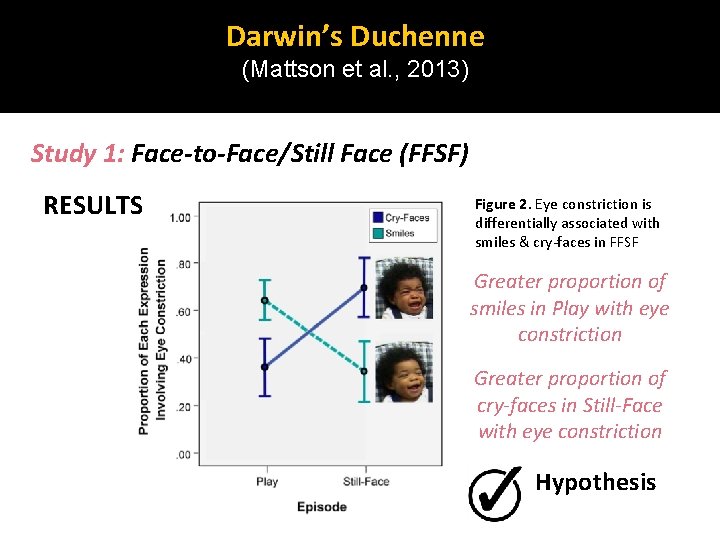
Darwin’s Duchenne (Mattson et al. , 2013) Study 1: Face-to-Face/Still Face (FFSF) RESULTS Figure 2. Eye constriction is differentially associated with smiles & cry-faces in FFSF Greater proportion of smiles in Play with eye constriction Greater proportion of cry-faces in Still-Face with eye constriction Hypothesis
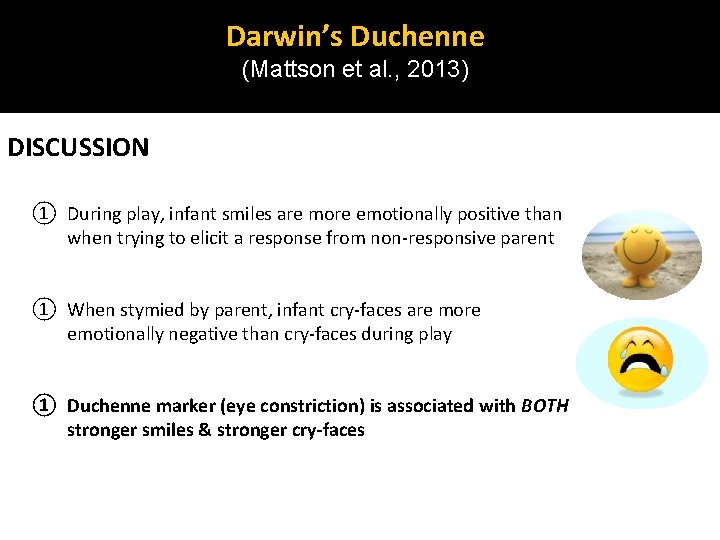
Darwin’s Duchenne (Mattson et al. , 2013) DISCUSSION ① During play, infant smiles are more emotionally positive than when trying to elicit a response from non-responsive parent ① When stymied by parent, infant cry-faces are more emotionally negative than cry-faces during play ① Duchenne marker (eye constriction) is associated with BOTH stronger smiles & stronger cry-faces
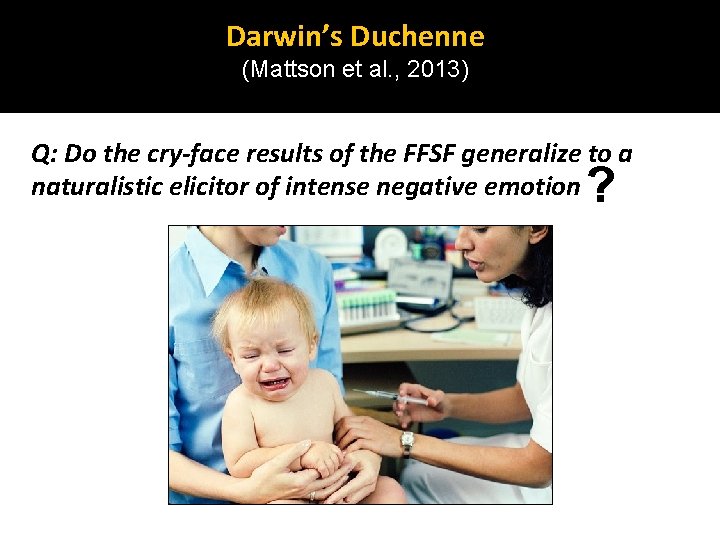
Darwin’s Duchenne (Mattson et al. , 2013) Q: Do the cry-face results of the FFSF generalize to a naturalistic elicitor of intense negative emotion ?
Darwin’s Duchenne (Mattson et al. , 2013) Study 2: Vaccinations PARTICIPANTS • Identified through You. Tube videos of infant vaccinations • 12 6 -month old & 12 -month old infants METHOD • Facial Coding of 10 seconds following first injection • Repeated-measures ANOVAs
Darwin’s Duchenne (Mattson et al. , 2013) Study 2: Vaccinations RESULTS • Most cry-faces involved Duchenne marker • 6 -month olds = 12 -month olds in… ² Proportion of time involving crying faces ² Proportion of cry-faces with eye constriction DISCUSSION • Extends results to naturalistic elicitor of negative emotion • “Duchenne distress expression” is predominant response to both parents ceasing play & noxious stimulus
Darwin’s Duchenne (Mattson et al. , 2013) Conclusions 1. Results support hypotheses • • Eye constriction indexes the affective intensity of both positive & negative facial configurations “Duchenne distress expression” parallels “Duchenne smile” ² Facial action has consistent function in various facial expressions ² Parsimonious way to communicate emotional intensity 2. Eye constriction • • • Possible functions: (1) Regulates exposure to intense emotional stimuli, (2) Increase attention to internal emotional state Signals: Intense positive engagement & Intense need for comfort In adults: Pain, Orgasm
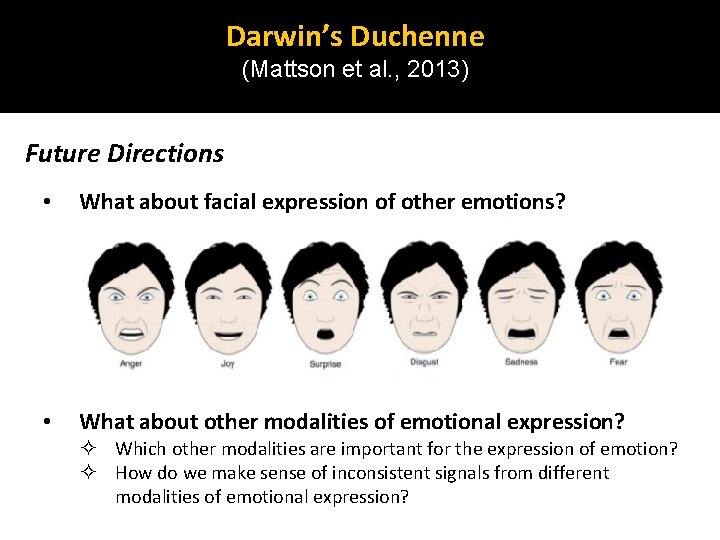
Darwin’s Duchenne (Mattson et al. , 2013) Future Directions • What about facial expression of other emotions? • What about other modalities of emotional expression? ² Which other modalities are important for the expression of emotion? ² How do we make sense of inconsistent signals from different modalities of emotional expression?
Darwin’s Duchenne (Mattson et al. , 2013) DISCUSSION QUESTIONS: 1. How can these findings be extended (i. e. clinical implications)? Do you think these findings can be replicated in an adult population? 1. If the findings are similar in an older sample, what does this imply? 2. How might these Duchenne expressions (eye constriction) impact our behavior? 1. From and evolutionary perspective, how are Duchenne expressions beneficial? Clennan
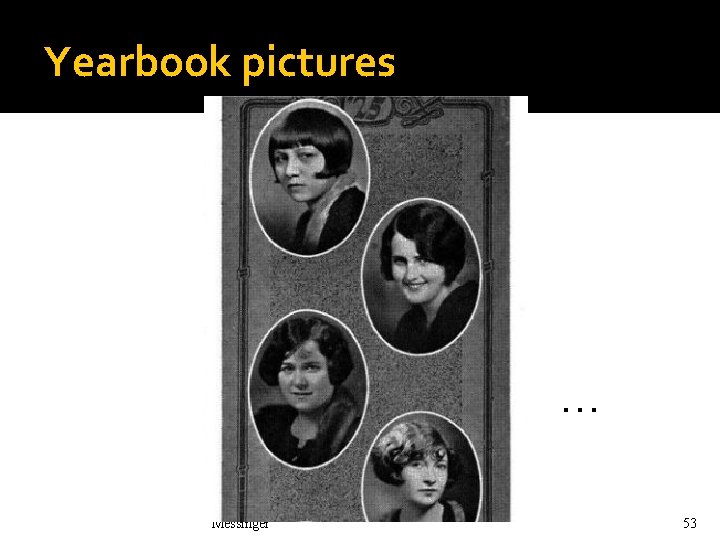
Yearbook pictures …and life Messinger 53
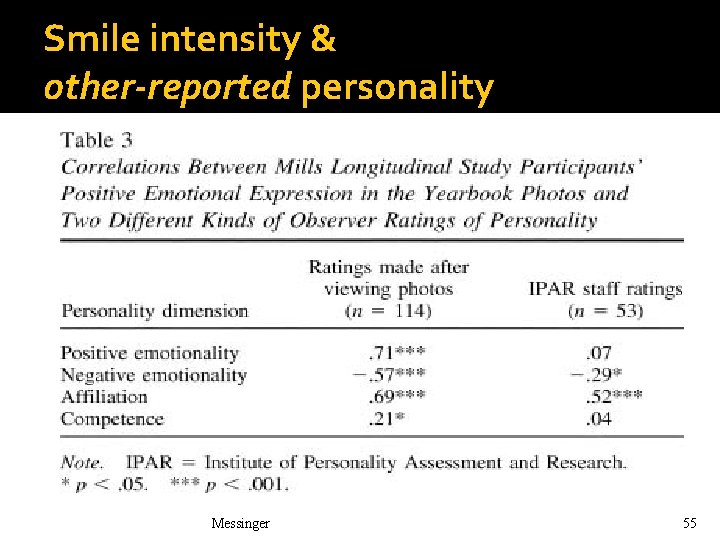
Smile intensity & other-reported personality Messinger 55
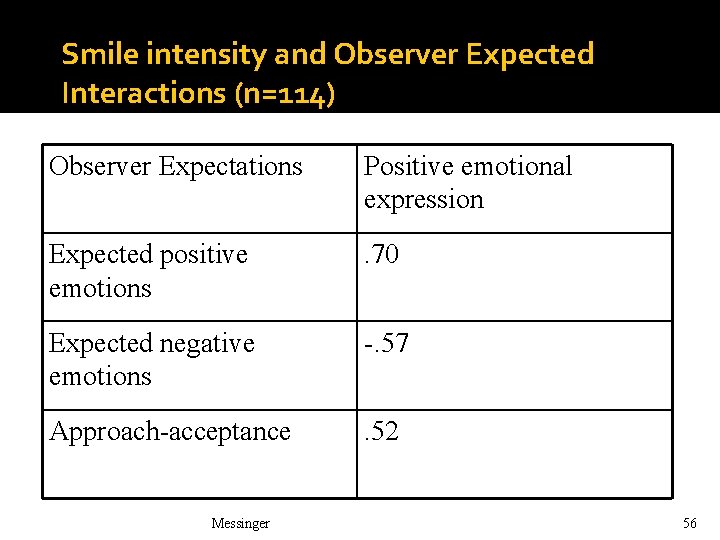
Smile intensity and Observer Expected Interactions (n=114) Observer Expectations Positive emotional expression Expected positive emotions . 70 Expected negative emotions -. 57 Approach-acceptance . 52 Messinger 56
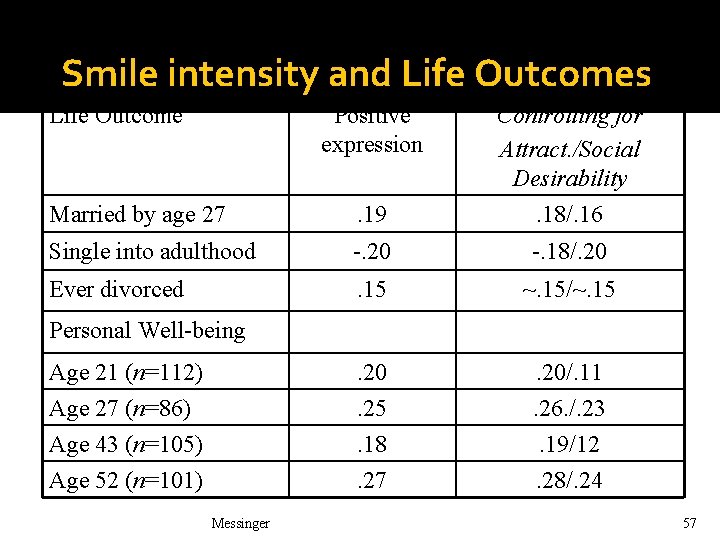
Smile intensity and Life Outcomes Life Outcome Positive expression Controlling for Attract. /Social Desirability Married by age 27 . 19 . 18/. 16 Single into adulthood -. 20 -. 18/. 20 Ever divorced . 15 ~. 15/~. 15 Age 21 (n=112) . 20/. 11 Age 27 (n=86) . 25 . 26. /. 23 Age 43 (n=105) . 18 . 19/12 Age 52 (n=101) . 27 . 28/. 24 Personal Well-being Messinger 57
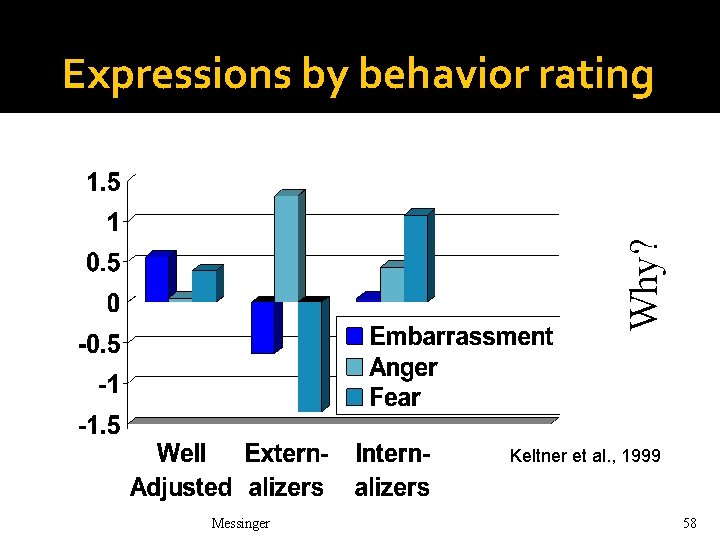
Why? Expressions by behavior rating Keltner et al. , 1999 Messinger 58
Functionalist theory � Emotion is the person’s attempt or readiness to establish, maintain, or change the relation between the person and the environment on matters of significance to that person (Saarni et al. , 1998). Emotion is associated with goal-attainment, social relationships, situational appraisals, action tendencies, self -understanding, self regulation, etc. Messinger 59
Halloween Candy �http: //www. youtube. com/watch? v=WOlpdd 7 y 8 MI Messinger 60