
Emotion Chapter 11 Copyright 2007 Pearson Education Canada
- Slides: 29
Emotion Chapter 11 Copyright © 2007 Pearson Education Canada 1
Chapter Outline • • • Defining Emotion Elements of Emotion 1: The Body Elements of Emotion 2: The Mind Elements of Emotion 3: The Culture Putting the Elements together: Emotion and Gender Copyright © 2007 Pearson Education Canada 2
Emotion • A state of arousal involving facial and body changes, brain activation, cognitive appraisals, subjective feelings, and tendencies toward action, all shaped by cultural rules Copyright © 2007 Pearson Education Canada 3
Elements of Emotion 1: The Body • • • Primary and secondary emotions The face of emotion The brain and emotion Hormones and emotion Detecting emotions: Does the body lie? Copyright © 2007 Pearson Education Canada 4
Elements of Emotion 1: The Body • Primary emotions – Emotions considered to be universal and biologically based. They generally include fear, anger, sadness, joy, surprise, disgust, and contempt • Secondary emotion – Emotions that develop with cognitive maturity and vary across individuals and cultures • Three biological areas of emotion are – – – facial expressions brain regions and circuits autonomic nervous system Copyright © 2007 Pearson Education Canada 5
Universal Expressions of Emotion • Facial expressions for primary emotions are universal • Even members of remote cultures can recognize facial expressions in people who are foreign to them • Facial feedback – Process by which the facial muscles send messages to the brain about the basic emotion being expressed • Infants are able to read parental expressions • Facial expression can generate same expressions in others, creating mood contagion Copyright © 2007 Pearson Education Canada 6
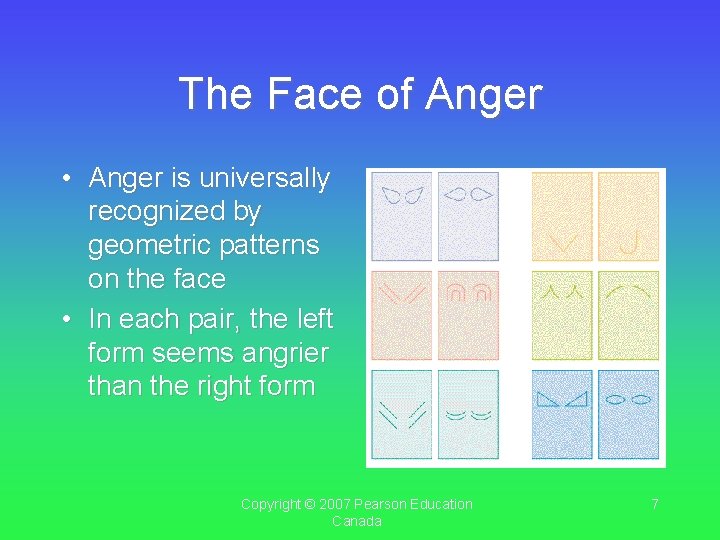
The Face of Anger • Anger is universally recognized by geometric patterns on the face • In each pair, the left form seems angrier than the right form Copyright © 2007 Pearson Education Canada 7
Facial Expressions in Social Context • Across and within cultures, agreement often varies on which emotion a particular facial expression is revealing • People don’t usually express their emotion in facial expressions unless others are around • Facial expressions convey different meanings depending on their circumstances • People often use facial expressions to lie about their feelings as well as to express them Copyright © 2007 Pearson Education Canada 8
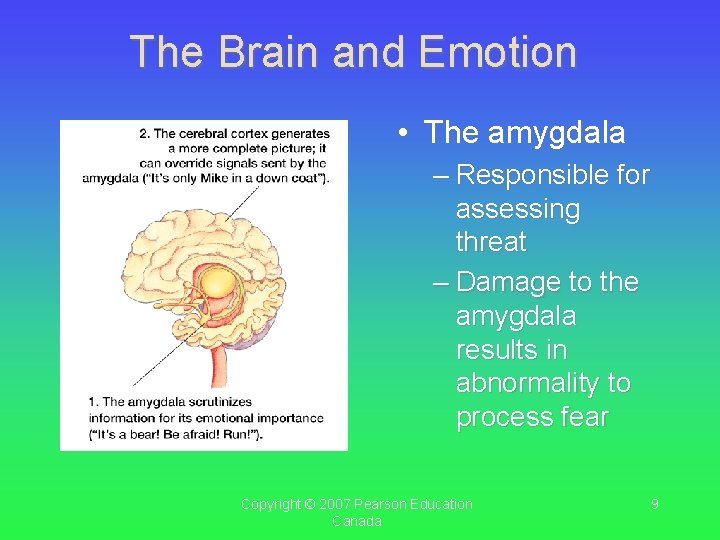
The Brain and Emotion • The amygdala – Responsible for assessing threat – Damage to the amygdala results in abnormality to process fear Copyright © 2007 Pearson Education Canada 9
The Brain and Emotion • Left prefrontal cortex – Involved in motivation to approach others – Damage to this area results in loss of joy • Right prefrontal cortex – Involved in withdrawal and escape – Damage to the area results in excessive mania and euphoria Copyright © 2007 Pearson Education Canada 10
Hormones and Emotion • When experiencing an intense emotion, two hormones are released – Epinephrine – Norepinephrine • Results in increased alertness and arousal • At high levels, it can create the sensation of being out of control emotionally Copyright © 2007 Pearson Education Canada 11
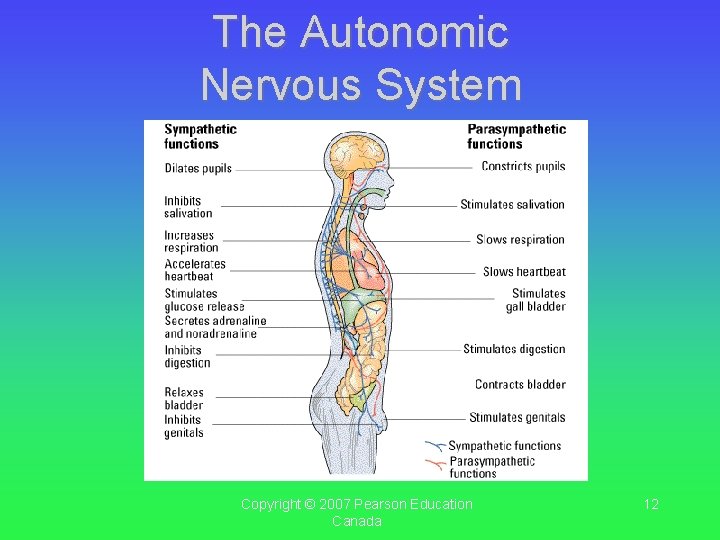
The Autonomic Nervous System Copyright © 2007 Pearson Education Canada 12
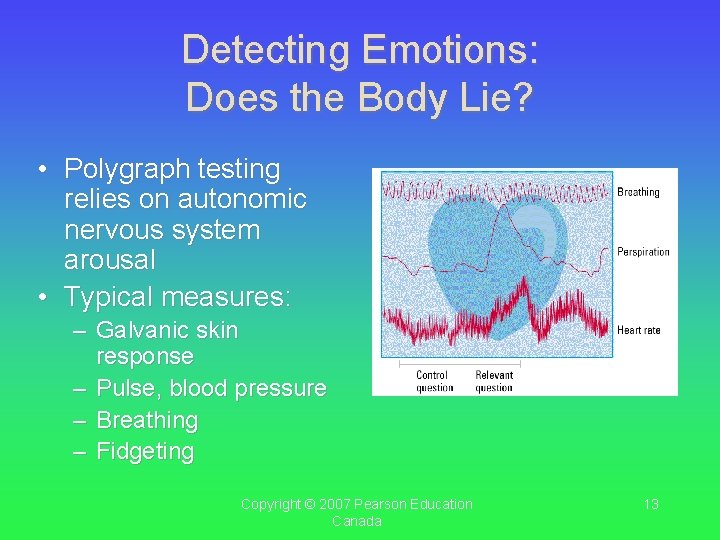
Detecting Emotions: Does the Body Lie? • Polygraph testing relies on autonomic nervous system arousal • Typical measures: – Galvanic skin response – Pulse, blood pressure – Breathing – Fidgeting Copyright © 2007 Pearson Education Canada 13
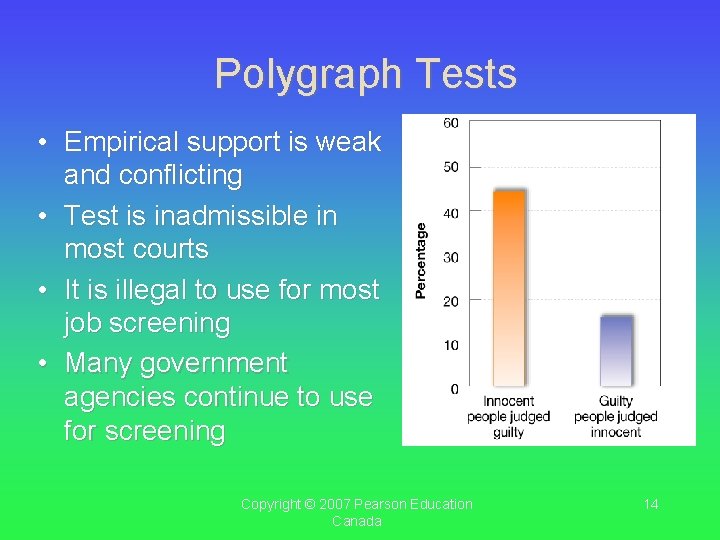
Polygraph Tests • Empirical support is weak and conflicting • Test is inadmissible in most courts • It is illegal to use for most job screening • Many government agencies continue to use for screening Copyright © 2007 Pearson Education Canada 14
Elements of Emotion 2: The Mind • How thoughts create emotions – The two-factor theory of emotion – Attributions and emotions • Cognitions & Emotional Complexity Copyright © 2007 Pearson Education Canada 15
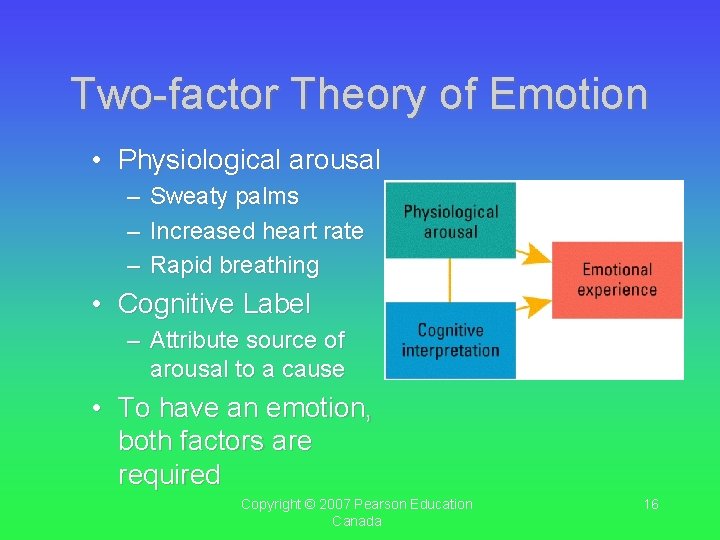
Two-factor Theory of Emotion • Physiological arousal – Sweaty palms – Increased heart rate – Rapid breathing • Cognitive Label – Attribute source of arousal to a cause • To have an emotion, both factors are required Copyright © 2007 Pearson Education Canada 16
Attributions and Emotions • Perceptions and attributions are involved in emotions • How one reacts to an event depends on how he or she explains it – For example, how one reacts to being ignored or winning the silver instead of the gold medal • Philosophy of life is also influential Copyright © 2007 Pearson Education Canada 17
Cognitions and Emotional Complexity • • • Cognitions affect emotions Emotions affect cognitions Cognitive and emotional developments occur together, become more complex with age • Cognitive therapy attempts to change emotions by changing cognitions Copyright © 2007 Pearson Education Canada 18
Elements of Emotion 3: The Culture • Culture and emotional variation • The rules of emotional regulation – Display rules – Body language – Emotion work Copyright © 2007 Pearson Education Canada 19
Culture and Emotional Variation • Culture determines what people feel angry, sad, lonely, happy, ashamed or disgusted about • Some cultures have words for specific emotions unknown to other cultures – Ex. Schadenfreude • Some cultures don’t have words for emotions that seem universal to others – Tahitian and sadness • Differences in secondary emotions appear to be reflected in differences in languages Copyright © 2007 Pearson Education Canada 20
Culture & Emotional Expression • Display Rules – When, where, and how emotions are to be expressed or when they should be squelched • Body Language – The nonverbal signals of body movement, posture and gaze that people constantly express • Emotion Work – Acting out an emotion we do not feel or trying to create the right emotion for the occasion Copyright © 2007 Pearson Education Canada 21
Putting it all together: Emotion and Gender • • Emotional Reactivity Sensitivity to other people’s emotions Cognitions Expressiveness – Factors which affect expressiveness • Emotion work Copyright © 2007 Pearson Education Canada 22
Putting the Elements Together: Emotion and Gender • Emotional Reactivity – Women recall emotional events more intensely and vividly than do men – Men experience emotional events more intensely than do women – Conflict is physiologically more upsetting for men than women Copyright © 2007 Pearson Education Canada 23
Gender differences in physiology and intensity • Males’ autonomic nervous system is more reactive than females’ • Men are more likely to rehearse angry thoughts, which maintains anger • Women are more likely to ruminate, which maintains depression Copyright © 2007 Pearson Education Canada 24
Sensitivity to Other People’s Emotions • Factors that influence one’s ability to “read” emotional signals: – The sex of the sender and receiver – How well the sender and receiver know each other – How expressive the sender is – Who has the power – Stereotypes and expectations Copyright © 2007 Pearson Education Canada 25
Cognitions • Men and women appear to differ in the types of everyday events that provoke their anger • Women become angry over issues related to their partner’s disregard • Men become angry over damage to property or problems with strangers Copyright © 2007 Pearson Education Canada 26
Expressiveness • In North America, women: – – – Smile more than men Gaze at listeners more Have more emotionally expressive faces Use more expressive body movements Touch others more Acknowledge weakness and emotions more • Compared to women, men only express anger to strangers more Copyright © 2007 Pearson Education Canada 27
Factors Influencing Emotional Expressiveness • • • Gender roles Cultural norms The specific situation Copyright © 2007 Pearson Education Canada 28
Emotion Work and Gender • Women work hard at appearing warm, happy and making sure others are happy • Men work hard at persuading others they are stern, aggressive and unemotional • Why? – Gender roles and status Copyright © 2007 Pearson Education Canada 29